Nuclear Waste Administration Act of 2013 a step towards USA action
 Finally, there is a glimmer of hope that – more than 30 years after the Nuclear Waste Policy Act passed, and 15 years after the feds guaranteed they’d start accepting the waste – paralysis and dithering might give way to action
The new bill would:
essentially yank all responsibility from the Department of Energy (which spent about $10 billion on moribund Yucca Mountain) and would create a new organization solely devoted to solving the nuclear waste storage and disposal problem (as was recommended by the president’s Blue Ribbon
Commission, and is widely hailed as a solid idea by Republicans and Democrats alike).
develop the aforementioned “consensual process” for figuring out where to actually put nuclear waste by engaging with willing, rather than unwilling, communities, thus hoping to avoid the gridlock that resulted from 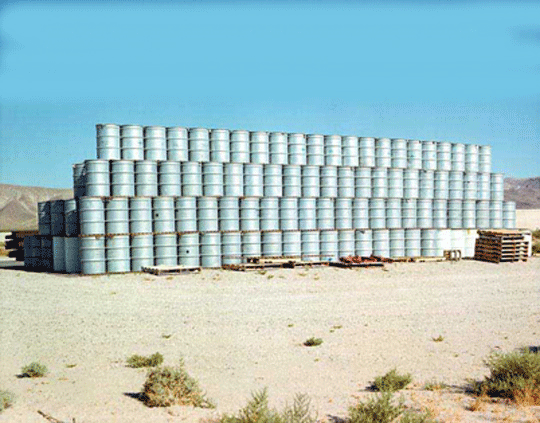 Nevada’s rabid opposition to deep, permanent geologic storage at Yucca Mountain.
emphasize getting the ball rolling for short-term storage first, and for permanent disposal second. This means pushing the new agency to start accepting waste as soon as possible at an “interim storage” site or sites, while it wrestles with the more thorny issue of where to put a permanent, deep geologic repository (or repositories).
End of paralysis on nuclear waste disposal? Orange County Register, August 9th, 2013, by By TERI SFORZA At this very moment, the vast majority of America’s highly radioactive nuclear waste – and San Onofre’s as well — is cooling in steel-lined concrete pools filled with water, which “are essentially loaded guns aimed at neighboring communities,” a scientist testified at a Congressional hearing last week.
“Unlike the reactor cores, the spent fuel pools are not protected by redundant emergency makeup and cooling systems and/or housed within robust containment structures having reinforced . “Thus, large amounts of radioactive material – which under the (Nuclear Waste Policy Act of 1982) should be stored within a federal repository designed to safely and securely isolate it from the environment for at least 10,000 years – instead remains at the reactor sites.”
These “spent fuel pools” were initially designed to hold about one reactor
core’s worth of fuel, Lochbaum said. But since the feds have failed
miserably to fulfill their promise to permanently dispose of this dangerous
waste, some pools are holding up to nearly nine times that amount.
DO SOMETHING
Finally, there is a glimmer of hope that – more than 30 years after the Nuclear Waste Policy Act passed, and 15 years after the feds guaranteed they’d start accepting the waste – paralysis and dithering might give way to action.
In June, Sen. Dianne Feinstein, D-Calif., and three other senators
introduced the Nuclear Waste Administration Act of 2013, “a bipartisan,
comprehensive plan for safeguarding and permanently disposing of tens of
thousands of tons of dangerous radioactive nuclear waste currently
accumulating at sites dispersed across the country,” including areas at risk
of earthquakes, floods and other natural disasters, they said in a prepared
statement.
“This bipartisan bill – years in the making – will finally begin to address
the dangerous, expensive absence of a comprehensive nuclear waste policy,”
Feinstein said in the statement. “In addition to creating an independent
Nuclear Waste Administration to manage nuclear waste, the bill authorizes
the construction of interim storage facilities and permanent waste
repositories, sited through a consent-based process and funded by fees
currently collected from nuclear power ratepayers. The inability of the
federal government to collect waste stored across the country at functioning
power plants, decommissioned reactors and federal facilities is costing
taxpayers hundreds of millions of dollars a year. It’s time to finally put a
policy in place to address this problem.”
Across-the-aisle partner Sen. Lamar Alexander, R-Tenn., said, “After 25
years of stalemate, this legislation puts us back on the road to finding
safe places to dispose of used nuclear fuel. It does this in the obvious
way: by making local, state and federal governments equal partners in the
process of finding temporary and permanent storage for nuclear waste.”
It is, of course, far from perfect. Experts, like Lochbaum, lamented its
shortfalls at a hearing July 30 before the U.S. Senate Committee on Energy
and Natural Resources. But there is still more hope than there has been in a
very long time.
“I think the current time is more likely to end the status quo on interim
spent fuel storage than any time in the past twenty years,” Lochbaum said by
email. “Various parties all share reasons to end the status quo. Their
reasons differ, but they share the common thread of the status quo being
untenable.”
The federal government? It wants to stop paying through the nose. About 80
lawsuits have been filed by utility companies over its broken promise to
start accepting spent fuel in 1998. The Department of Energyhad paid out
$2.6 billion in damages to utility companies by the end of 2012 , and it
faces another $19.7 billion in liabilities through 2020, according to the
General Accounting Office.
Plant owners and their neighbors? They want the stuff safely stored far
away. Safety advocates? They want overcrowded spent fuel pools thinned down
to reduce the hazard.
“So, while motives vary widely, there’s nearly universal agreement that the
status quo is the worst outcome,” Lochbaum said.
WHAT IT WOULD DO
The new bill would:
essentially yank all responsibility from the Department of Energy (which spent about $10 billion on moribund Yucca Mountain) and would create a new organization solely devoted to solving the nuclear waste storage and disposal problem (as was recommended by the president’s Blue Ribbon
Commission, and is widely hailed as a solid idea by Republicans and Democrats alike).
develop the aforementioned “consensual process” for figuring out where to actually put nuclear waste by engaging with willing, rather than unwilling, communities, thus hoping to avoid the gridlock that resulted from Nevada’s rabid opposition to deep, permanent geologic storage at Yucca Mountain.
emphasize getting the ball rolling for short-term storage first, and for permanent disposal second. This means pushing the new agency to start accepting waste as soon as possible at an “interim storage” site or sites, while it wrestles with the more thorny issue of where to put a permanent, deep geologic repository (or repositories).
Environmentalists to scientists to utility commissioners to nuclear industry types support taking the responsibility away from the DOE. But many worry about the emphasis on short-term storage vs. long-term disposal……..http://www.ocregister.com/taxdollars/waste-520410-nuclear-storage.html
1 Comment »
Leave a comment
1 This Month


Tell the Ukrainian Government to Drop Prosecution of Peace Activist Yurii Sheliazhenko

Petition to revoke the licensing of the Near Surface Nuclear Disposal Facility (NSDF) at Chalk River. https://www.ourcommons.ca/petitions/en/Petition/Details?Petition=e-7247


of the week – STOP SMALL MODULAR REACTORS IN CANADA
To see nuclear-related stories in greater depth and intensity – go to https://nuclearinformation.wordpress.com
-
Archives
- March 2026 (204)
- February 2026 (268)
- January 2026 (308)
- December 2025 (358)
- November 2025 (359)
- October 2025 (376)
- September 2025 (258)
- August 2025 (319)
- July 2025 (230)
- June 2025 (348)
- May 2025 (261)
- April 2025 (305)
-
Categories
- 1
- 1 NUCLEAR ISSUES
- business and costs
- climate change
- culture and arts
- ENERGY
- environment
- health
- history
- indigenous issues
- Legal
- marketing of nuclear
- media
- opposition to nuclear
- PERSONAL STORIES
- politics
- politics international
- Religion and ethics
- safety
- secrets,lies and civil liberties
- spinbuster
- technology
- Uranium
- wastes
- weapons and war
- Women
- 2 WORLD
- ACTION
- AFRICA
- Atrocities
- AUSTRALIA
- Christina's notes
- Christina's themes
- culture and arts
- Events
- Fuk 2022
- Fuk 2023
- Fukushima 2017
- Fukushima 2018
- fukushima 2019
- Fukushima 2020
- Fukushima 2021
- general
- global warming
- Humour (God we need it)
- Nuclear
- RARE EARTHS
- Reference
- resources – print
- Resources -audiovicual
- Weekly Newsletter
- World
- World Nuclear
- YouTube
-
RSS
Entries RSS
Comments RSS
 nuclear-news
Dear friends
1. “Theoretically and under very special applied conditions a Nuclear fission reactor may explode as Nuclear Bomb” by Joseph-Christos Kondylakis , published in the Proceedings of 19th Scientific Symposium of the Hellenic Nuclear Physics Scosiety (HNPS) which held at the Aristotle University of Thessaloniki , Greece on 28-39 May 2010 and its Proceedings exist in the following internet site:
Click to access ANP2010.pdf
2. One microgram Plutonium if it is INHALLED can de DEADLY! anf if a typical nuclear fission power reactor may explode as Nuclear Bomb! then about two TONES! of Plutonium will go to the atmospheric circulation in INHALLED particle sizes(s)…
3. I try to create a relevant to above scientific research on the theme “Nuclear Safety via Criminal Law including PREVENTIVE actions”. If you know Excellent scientists interested to be involoved in our mentioned scientific research then please ask them to send me one of the Best scientific article that they have created solely by themself(published or unpublished) and their C.V to Think about…
4. We also have formed an initial scientific research group of Me+Two Profesors from European Universities and we search for resources for our scientific research and perhaph you may assist us.
From: Joseph-Christos Kondylakis,Nuclear Physicist/Specialized in Nuclear FISSION(Applied+Theoretically) , Mikras Asias 13, Agios Nikolaos , Anavissou , 19013 Greece, Tel+Fax:+30-22910-55275 (in my house) or +30-22910-76358 (in H.C.M.R.) , my mobile telephone number is :
+30-6982617369 on day Thursday-11-April-2013