Fukushima cancer risk to workers, thyroid cancer to older people
 ‘Fukushima cancer risk surges’ — Ongoing saga at nuclear plant ‘dangerously murkier’ — Over 10 times more workers suffered cancer-inducing radiation doses than Tepco admitted http://enenews.com/fukushima-cancer-risk-surges-ongoing-saga-at-nuclear-plant-dangerously-murkier-over-10-times-more-workers-suffered-cancer-inducing-radiation-doses-than-tepco-admitted
Title: Fukushima cancer risk surges
Source: The Times of India
Author: Subodh Varma
Date: Jul 21, 2013
Fukushima cancer risk surges
The ongoing saga of Fukushima nuclear plant in Japan that suffered a triple meltdown in March 2011 just got dangerously murkier.
The number of workers who suffered cancer-inducing radiation doses is not 178, but 1,978, Asahi Shimbun reported on Friday. That’s eleven times more than admitted by Tepco, the owner of the plant last December.
[…] Very shaky records of radiation testing and results have been maintained.
The Fukushima plant continues to leak radiation in the sea and the groundwater and Tepco […] appears to have no clue as to what is happening. […]
Asahi Shimbun:: Children are believed to be the highest at risk to thyroid gland doses. But a recent study showed the risk of cancer from thyroid gland doses rises even in people over 40, countering the previous belief that older people were far less susceptible to the cancer-inducing effects of radiation.
See also: 25 times as many people in Fukushima area developed thyroid cancer after disaster — Japan Expert: My heart breaks greatly that those U.S. servicemembers suffered radiation exposure
UK government out of step with public, on nuclear power
 Government has announced £10 billion of Treasury guarantees to EDF to build Hinkley C nuclear power station. Ed Davey has said (see two blog posts earlier) that nuclear power will receive premium rate payments for 35 years while his Government has just announced that the premium price contracts for renewables will be cut from 20 years under the Renewables Obligation to just 15 years under the proposals for ‘Electricity Market Reform’ . One could list other things, but it is already clear that the Government strategy is completely out of step with the priorities of the electorate.
So how is it that nuclear commands such support from within the establishment? One clue can be found from survey evidence itself which tends to show that the most pro-nuclear parts of the population are older people and males, and the least supportive of nuclear power (and most supportive of real green energy solutions) are young people and females. But guess which general type of person makes up the scientific and engineering establishment? Well, older males of course.

 Public prefers reductions in room temperature to nuclear power as an energy solution says key survey http://realfeed-intariffs.blogspot.co.uk/ Dr David Toke 20 July 2013 A comprehensive survey published by the UK Energy Research Centre (UKERC) of attitudes of the British public has found low support for nuclear power as a solution to the UK’s problems compared to energy efficiency and renewable energy. Indeed, when ranked as a solution to the problems of energy security, climate change and affordability, nuclear power was perceived as being less preferable than reducing the heating temperature inside the home.
Paladin Energy “screwing” Malawians in uranium mining deal
all a fat lie. Paladin and many other foreign multinational mining countries are least interested to contributing to the Malawi economic growth. They are here to milk the country – exploiting all that it has rich in minerals and dump us when the time is right even poorer.
Killing Malawians through the rotten extractives deals: The case of Paladin’s uranium mining Nyasa Times, by Patrica Masinga, 24 April 13, Malawi has in the few weeks been engaged by a plethora of stakeholders discussing strategies to revive, or more on the ground, reclaim the benefits that Malawians are been milked of by the so-called extractive industry multi-national corporations.
They call themselves investors, and government believes that the Malawi Development Goals (MDGs – who cares if it’s the second phase) will be boosted, particularly that mining alone through Kayerekera of Paladin Energy Limited group of companies (trading as Paladin (Africa) Ltd in Malawi?) could provide a large economic base.
But that is all a fat lie. Paladin and many other foreign multinational mining countries are least interested to contributing to the Malawi economic growth. They are here to milk the country – exploiting all that it has rich in minerals and dump us when the time is right even poorer.
Imagine, to screw Malawians of their rightful economic gains, the company, incorporated in Australia first listed on the Australian Stock Exchange (ASX) on March 29, 1994 under code ‘PDN’, and quickly changed its name from Paladin Resources NL to Paladin Resources Ltd in 2000 and listed under the Toronto Stock Exchnage (TSX) in Canada April 29, 2005, and again changed its name to Paladin Energy Ltd in November 2007 and listed on the Namibian Stock Exchnage on February 2008.
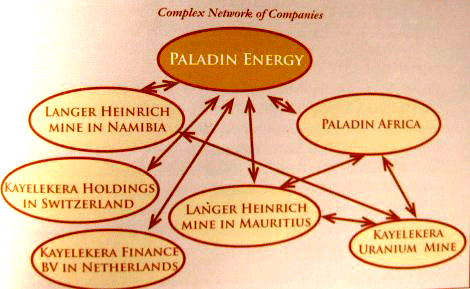
By such trends, one is compelled to question the motive, considering also that in Namibia itself the company owns the Langer Heinrich Uranium Mine where it started production in 2008 and has Kayerekera Uranium Mine as its second largest mining venture in this part of Africa acting also as a good supllment to the Langer Heinrich Uranium Mine.They call themselves investors, and government believes that the Malawi Development Goals (MDGs – who cares if it’s the second phase) will be boosted, particularly that mining alone through Kayerekera of Paladin Energy Limited group of companies (trading as Paladin (Africa) Ltd in Malawi?) could provide a large economic base.
But that is all a fat lie. Paladin and many other foreign multinational mining countries are least interested to contributing to the Malawi economic growth. They are here to milk the country – exploiting all that it has rich in minerals and dump us when the time is right even poorer. Continue reading
USA a bigger nuclear attack threat than North Korea is
The threat of nuclear war? North Korea or the United States http://rt.com/op-edge/north-korea-nuclear-us-467/ RT 23 July 13 Michel Chossudovsky is an award-winning author, professor of economics, founder and director of the Centre for Research on Globalization, Montreal and editor of the globalresearch.ca website.
Operation Redwing saga: the radioactive pollution of the Marshall Islands
The Fallout from Nuclear Secrecy , Consortium News, July 23, 2013 “……….As the Redwing tests continued, radiation badges were handed out, which Harris described as “small rectangular plastic discs three inches by an inch and a half.” Even with these, Harris wondered about the future impact of the radiation: “Had our genetic code been compromised? Would we get leukemia or some other form of cancer?”
His answer came decades later. Those present at Operations Redwing or Hardtack or for six months afterward who succumb to one of 19 primary cancers are eligible for $75,000 compensation made available by Congress.
At the time of Operation Redwing in 1956, the U.S. government under President Dwight Eisenhower released very little information. This secrecy was politically significant because it kept voters in the dark during the presidential election campaign in which Democratic candidate Adlai Stevenson advocated stopping the H-bomb tests being conducted by the Eisenhower administration.
During the election year, U.S. officials announced only two of the 17 blasts in the Redwing series. This virtual blackout hid from U.S. voters over 77 summertime days during the presidential election campaign Redwing’s 20,820 kilotons of explosive force — or the equivalent of 1,388 Hiroshima-size bombs. That tonnage is the equivalent of 18 Hiroshima-size bombs per day over 77 days.
Seven Redwing tests received no public notice and the remaining eight blasts were disclosed by Japanese scientists in news articles datelined Tokyo. Thus the fastest and most accurate information about U.S. Redwing testing was disclosed from Tokyo by Japanese, an immense irony given that only a decade earlier, U.S. atomic bombs had contributed to Japan’s surrender by destroying two of its cities. Eisenhower handily won re-election.
The more powerful 32 detonations in Operation Hardtack were launched in 1958 as the U.S. and the Soviets raced toward declaring a moratorium on such experiments and the U.S. accelerated testing missile warheads. Washington disclosed only nine of the 32 blasts that produced a total yield of 28,026 kilotons, or the equivalent of 1,868 Hiroshima-size bombs – an average of 35 per week in 1958 or five per day. That was the lowest disclosure rate of any U.S. Pacific testing operation.
Even more ironic than the Japanese disclosures in 1956 were the Soviet ones about the 1958 Hardtack detonations. The Soviets charged that the U.S. had concealed most of the tests being conducted, which even U.S. officials deemed accurate.
In doing so, the Soviets made huge propaganda gains as they announced their initiative of stopping their nuclear testing that year. Surprisingly, New York Times columnist James Reston wrote that “the United States, which pamphleteered its way to independence and elevated advertising and other arts of persuasion into a national cult, should be unable to hold its own in the battle for the headlines of the world.”
Samples made during several Hardtack tests showed that fractions of the radioactive elements of strontium and cesium were dispersed over distances of more than 4,000 miles, according to a report titled “Operation Hardtack: Fallout Measurements by Aircraft and Rocket Sampling” dated 1961 and declassified in 1985. The U.S. gave a newly declassified version of this report to RMI officials.
That 4,000-miles range means the radioactive elements could have descended on San Francisco and other West Coast areas. Both radioactive elements pose serious health problems.
The decades-long delay in receiving a full accounting of these fallout results helps to substantiate the contention of the RMI that its negotiators were denied vital information when they agreed in 1986 with President Ronald Reagan to form an independent nation, thus ending the American administration of the U.N.-sanctioned trust territory established in 1947.
Kept in the dark about the fallout results, the Marshallese agreed to terms so insufficient that a U.S.-financed $150 million nuclear-claims trust fund is now penniless, unable to compensate fully Marshallese for health and property damages presumed to have resulted from the tests. RMI’s appeals to Congress, the U.S. courts and the Bush administration have been turned back and the Obama administration has yet to help them.
Last September, Special Rapporteur Calin Georgescu of the United Nations reported to its Human Rights Council that the U.S. government should:
–Remedy and compensate Marshall Islanders for its nuclear weapons testing that has caused “immediate and lasting effects” on their human rights,
–Open up still-secret information and records regarding the environmental and human health effects of past and current U.S. military use of the islands,
–Grant Marshallese full access to their medical and other records, and
–Consider issuing a presidential acknowledgment and apology to victims adversely affected by the 66 weapons tests it conducted when it administered the Marshall Islands as a U.N. strategic trust territory.
Over the decades, the Marshallese have not been alone in wanting more information about the nuclear tests. In 1954, the Association of State Health Officials voted to ask the federal government to give health officials with security clearances access to classified atomic energy information so as to prevent health hazards.
From 1945 to 1992, the United States carried out 1,054 nuclear tests worldwide. Beverly Deepe Keever is the author of News Zero: The New York Times and The Bomb and the newly released Death Zones and Darling Spies: Seven Years of Vietnam War Reporting. http://consortiumnews.com/2013/07/23/the-fallout-from-nuclear-secrecy/
UK’s Ministry of Defence under pressure to clean up radiation sites
More pressure on MoD after new report on Dalgety Bay radiation risk The Courier UK By LEEZA CLARK, 23 July 2013 Gordon Brown has called for a swift Ministry of Defence agreement to fund the Dalgety Bay radiation clean-up after the UK Government’s radiation watchdog highlighted imminent health risks.
The Committee on Medical Aspects of Radiation in the Environment has backed the Scottish Environment Protection Agency’s recent report into the long-running saga and has called for remedial action to be taken as soon as possible.
This, he claimed, could set up a head-on clash between the MoD and Sepa, after the ministry refused to back the agency’s report into radiation in the area……. The committee is also so worried about the number of sites where there is radiation contamination that it wants to create a UK-wide list of sites which are known to have been, or thought to be potentially contaminated with radium.
It is the latest twist in the battle to clean up the area contaminated with particles of radioactive radium-226. http://www.thecourier.co.uk/news/local/fife/more-pressure-on-mod-after-new-report-on-dalgety-bay-radiation-risk-1.114331
Columbia River threatened by Hanford radioactive waste cleanup plan
Hanford Cleanup Plan Would Let Massive Amounts of Uranium Flow into the Columbia River http://columbiariverkeeper.org/featured/hanford-agencies-want-to-let-massive-amounts-of-uranium-flow-into-the-columbia-river/
On July 15th, the Tri-Party agencies, the U.S. Department of Energy, the U.S. Environmental Protection Agency (EPA), and the Washington State Department of Ecology, released their Proposed Plan for cleanup for forty square miles, ten along the Columbia River, on the southern corner of the Hanford Nuclear Reservation, also known as the 300 Area. The public has only thirty-two days, until, August 16th, to submit comments on the 300 Area Proposed Plan.
Unfortunately, the Tri-Party agencies’ want to rely on experimental technology and natural attenuation to treat the pollutants in the soil and groundwater of southeast Hanford. This strategy demonstrably fails to protect the Columbia River from long lived pollutants such as uranium that seep into the groundwater and the river where they enter the food chain. Continue reading
10 million data points: Safecast volunteers map Fukushima radiation
 Volunteers See Fukushima Radiation on the Move http://www.technologyreview.com/view/517416/volunteers-see-fukushima-radiation-on-the-move/ Aviva Hope Rutkin, 23 July 13
Crowd-sourced data provides a high-res view of radiation levels in Japan.The radiation-mapping project launched shortly after the Fukushima Daiichi nuclear disaster recently surpassed more than ten million data points, all gathered by a network of local volunteers. The maps show, among other things, that radiation levels are dropping more quickly than should be expected via half-life decay alone. Project director Sean Bonner says this may be a sign that radioactive contamination is on the move. “This could mean that organic material (such as leaves on tree, brush) might have been contaminated and fallen off and washed away over the last two years, lowering the overall background of an area,” he said in an email.
The project, Safecast, was founded one week after the disaster to share information about radiation levels around Japan. Although the Japanese government provides its own statistics on this issue, its data is sometimes unreliable and can be restricted from public access. Safecast sends volunteers cheap Geiger counters, called geigies, to measure local levels of radioactivity. Volunteers can either purchase a unit for anywhere from $200 to $1000 or build their own using a $450 kit. This data is then mapped and made publicly available through the Safecast website.
Over more than two years of data collection, Safecast has produced the highest resolution picture to date of Japan’s radiation levels. The project’s maps confirm that the majority of the country’s radiation levels remain near background, with no appreciable change in radioactive activity. In areas that do have significant radiation, the maps show how levels can fluctuate simply when one crosses the street in a given neighborhood—uncovering small, previously unrecognized hotspots, though the organization maintains that these hotspots are not cause for concern.
Safecast plans to continue collecting data to use in a larger analysis of how these levels change in different cities over the coming years. They hope to uncover more about where the radiation is spreading, and how a given area’s climate, topography, and soil affect the way surface radioactivity decays.
Criminal charges against India’s Kudankulam anti nuclear protestors
 Kudankulam: Criminal cases against nuclear plant protestors to stay A Subramani, TNN | Jul 23, 2013 CHENNAI: The situation in Kudankulam is neither conducive nor ripe for withdrawal of criminal cases registered against the anti-nuclear power plant activists, the Tamil Nadu government informed the Madras high court on Tuesday.
When three PILs seeking fulfillment of 15 conditions laid down by the Supreme Court prior to the operationalisation of the nuclear power plant and also for withdrawal of cases against the agitating activists came up for hearing before the first bench, advocate general of Tamil Nadu A L Somayaji said: “The stage is not ripe for withdrawal of criminal cases already filed.”
Somayaji told the bench comprising acting Chief Justice R K Agrawal and Justice M Sathyanarayanan that the agitators faced cases for snatching a pistol, holding ‘marana porattam’ (stir unto death) and fishing boycott. He said their agitations continued even after the apex court ruling and they were targeting the unit-II of the plant as well.
Pointing out that the tenor of the apex court’s condition no. 14 that endeavours should be made to withdraw cases against the agitators was different from other conditions such as AERB and NPCIL clearances for operationalisation of the plant, Somayaji said there was no positive sign for the state government to drop the cases. ……http://timesofindia.indiatimes.com/city/chennai/Kudankulam-Criminal-cases-against-nuclear-plant-protestors-to-stay/articleshow/21280617.cms?
Hinkley nuclear site’s history of weapons deals with USA
 Hinkley’s hidden history Morning Star UK 21 July 2013 by David Lowry With the coalition government’s decision to back a third nuclear reactor at Hinkley Point on Somerset’s coast and the ongoing debate over Trident replacement, it’s interesting to take a look back at the origins of Britain’s nuclear programme.
 When the British nuclear power and weapons programmes were born, a different foreign power, the United States, was intimately involved in the planning.
The first public hint came with an MoD announcement in June 1958 on “the production of plutonium suitable for weapons in the new [nuclear] power stations programme as an insurance against future defence needs” at Britain’s first-generation Magnox reactor (named after the fuel type, magnesium oxide).
A week later in Parliament, Labour’s Roy Mason asked why the government had “decided to modify atomic power stations, primarily planned for peaceful purposes, to produce high-grade plutonium for war weapons.”
He was informed by paymaster general Reginald Maudling: “At the request of the government, the Central Electricity Generating Board has agreed to a small modification in the design of Hinkley Point and of the next two stations in its programme so as to enable plutonium suitable for military purposes to be extracted should the need arise.
“The modifications will not in any way impair the efficiency of the stations. As the initial capital cost and any additional operating costs that may be incurred will be borne by the government, the price of electricity will not be affected……….
the following month, the US and British governments signed a mutual defense – spelt with an “s” even in the official British version, so you can guess where it was authored – co-operation agreement on atomic energy matters.
The agreement was intended to circumvent the draconian restrictions of the 1954 Atomic Energy Act, which sought to retain all nuclear secrets within the US, even though many foreign nationals had worked collaboratively with US counterparts for six or more years on nuclear R&D.
The deal was reached after several months of congressional hearings in Washington DC, but no oversight whatsoever in the British Parliament.
As this formed the basis, within a mere five years, for Britain obtaining the Polaris nuclear WMD system from the US, and some 20-odd years later for Britain to buy US Trident nuclear WMD, the failure of Parliament to at least appraise the security merits of this key bilateral atomic arrangement was unconscionable…….
And so it may be seen that the Britain’s first civil nuclear programme was used as a source of nuclear explosive plutonium for the US military, with Hinkley Point A the prime provider.
The reason there was a swap between Britain and the US of weapons-suitable highly enriched uranium and plutonium was the US had huge surpluses of uranium, but wanted more plutonium than its nuclear production complex at Hanford could deliver, while the British first-generation “commercial” Magnoxes, which were scaled-up plutonium production factories, were perfect for producing military-suitable plutonium as they had online refuelling systems to optimise plutonium over electricity production.
They produced perfect plutonium in surplus, but Britain lacked sufficient highly enriched uranium, so an exchange deal was mutually beneficial.
Two decades later in 1984 Wales national daily the Western Mail reported that the largest Magnox reactor in Britain, at Wylfa on Anglesey, had also been used to provide plutonium for the military.
Plutonium from both reactors went into the British military stockpile of nuclear explosives, and could well still be part of the British Trident warhead stockpile today.
Subsequent research by the Scientists Against Nuclear Arms, published in the prestigious science weekly journal Nature and presented to the Sizewell B and Hinkley C public inquiries in the ’80s, has demonstrated that around 6,700kg of plutonium was shipped to the US under the military exchange agreement, which stipulates explicitly that the material must be used for military purposes by the recipient country.
To put this quantity into context, a nuclear warhead contains around 5kg of plutonium.
Is it any wonder the Atoms for Peace movement began to demand “safeguards” to deter diversion of civilian nuclear plants to military misuse?
After all, the US and Britain knew that such deadly diversion was possible – they had demonstrated it themselves.
The trouble is that safeguards are misleading. They are neither safe, nor do they guard. And what would Iran or North Korea make of this deliberate intermixing of civil and military nuclear programmes by one of the nuclear weapons superpowers – one which leads the criticisms of them for allegedly doing this very thing today. http://www.morningstaronline.co.uk/news/content/view/full/135635
Nuclear Abolition Week activities in 25 countries
Nuclear Abolition Week: A great success http://www.icanw.org/campaign-news/nuclear-abolition-week-a-great-success/#.Ue2mrtJwo6I In Africa, Asia, Europe, Latin America, the Middle East, North America and in the Pacific, for Nuclear Abolition Week 2013, ICAN campaigners organised bike trips, Target X actions, flag hoisting, parties, cabin trips, church services, beach days, press conferences, exhibitions, public meetings, round tables, meetings with government officials, social media outreach, film screenings, pub quizzes, and many other activities. In addition to this, more than five hundred people shared their shadows in solidarity with the victims of nuclear detonations, and several thousands signed ICAN’s online petition calling for a treaty banning nuclear weapons. This report outlines the main achievements of Nuclear Abolition Week 2013.
25 countries…
1 This Month

of the week – Shut Down Drone Warfare!


Tell the Ukrainian Government to Drop Prosecution of Peace Activist Yurii Sheliazhenko

Petition to revoke the licensing of the Near Surface Nuclear Disposal Facility (NSDF) at Chalk River. https://www.ourcommons.ca/petitions/en/Petition/Details?Petition=e-7247
To see nuclear-related stories in greater depth and intensity – go to https://nuclearinformation.wordpress.com
-
Archives
- April 2026 (57)
- March 2026 (251)
- February 2026 (268)
- January 2026 (308)
- December 2025 (358)
- November 2025 (359)
- October 2025 (376)
- September 2025 (257)
- August 2025 (319)
- July 2025 (230)
- June 2025 (348)
- May 2025 (261)
-
Categories
- 1
- 1 NUCLEAR ISSUES
- business and costs
- climate change
- culture and arts
- ENERGY
- environment
- health
- history
- indigenous issues
- Legal
- marketing of nuclear
- media
- opposition to nuclear
- PERSONAL STORIES
- politics
- politics international
- Religion and ethics
- safety
- secrets,lies and civil liberties
- spinbuster
- technology
- Uranium
- wastes
- weapons and war
- Women
- 2 WORLD
- ACTION
- AFRICA
- Atrocities
- AUSTRALIA
- Christina's notes
- Christina's themes
- culture and arts
- Events
- Fuk 2022
- Fuk 2023
- Fukushima 2017
- Fukushima 2018
- fukushima 2019
- Fukushima 2020
- Fukushima 2021
- general
- global warming
- Humour (God we need it)
- Nuclear
- RARE EARTHS
- Reference
- resources – print
- Resources -audiovicual
- Weekly Newsletter
- World
- World Nuclear
- YouTube
-
RSS
Entries RSS
Comments RSS
 nuclear-news