The Amazing foolishness of nuclear weapons and nuclear power building
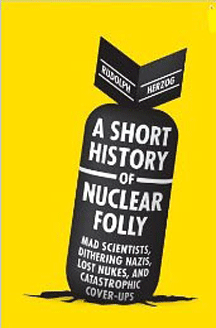 Book Review: A Short History Of Nuclear Folly http://www2.macleans.ca/2013/07/19/a-short-history-of-nuclear-folly/ by Bookmarked and Andrew Stobo Sniderman on Friday, July 19, 2013 A Short History Of Nuclear Folly By Rudolph Herzog
Reading about human courtship of nuclear destruction is like watching the wobbles of an amateur tightrope walker: one gawks in terror and amazement. Herzog, son of the eminent filmmaker, offers a snapshot tour of the “frivolity, naïveté, and unscrupulousness” with which nuclear devices have been used since physicists figured out how to get a big bang out of a wee atom. This is not a scholarly or particularly well-structured book, and it reads more like a collection of cool stuff the author found while reading around the subject of nuclear madness. Yet Herzog will make your jaw drop with regularity.
For examples: Cold-Warring Soviets forced 40,000 soldiers to march into the site of a nuclear test explosion immediately after the ascension of its mushroom cloud, just to see what happened to the poor fellows; an influential American physicist sought to blast an alternative international shipping route to the Panama and Suez canals using nuclear bombs as convenient excavation devices; and, my favourite, plutonium-powered pacemakers enraptured doctors with their long-lasting convenience, except that no one bothered to keep track of them once the patients eventually died. Woe to the cremators.
Beyond the shocking “indifference to the fate of individuals” of the superpowers as they tinkered with their nuclear toys, Herzog identifies one central problem with the nuclear fixation: persistent failures of imagination. “No one was able to picture the worst-case scenario.” So it was typical that the Soviet Union gleefully built nuclear-powered satellites, but didn’t prepare for the possibility of them crashing back to Earth. As it happened, in 1977 a malfunctioning Soviet satellite with 45 kilograms of radioactive uranium on board crashed in the Yukon. American radiation detectors didn’t work in the Canadian winter cold, but thankfully some random mushers stumbled upon the wreckage. It could have been worse. Indeed, though there was plenty of folly, often fatal, we somehow avoided Armageddon.
No comments yet.
1 This Month

of the week – Shut Down Drone Warfare!


Tell the Ukrainian Government to Drop Prosecution of Peace Activist Yurii Sheliazhenko

Petition to revoke the licensing of the Near Surface Nuclear Disposal Facility (NSDF) at Chalk River. https://www.ourcommons.ca/petitions/en/Petition/Details?Petition=e-7247
To see nuclear-related stories in greater depth and intensity – go to https://nuclearinformation.wordpress.com
-
Archives
- April 2026 (103)
- March 2026 (251)
- February 2026 (268)
- January 2026 (308)
- December 2025 (358)
- November 2025 (359)
- October 2025 (376)
- September 2025 (257)
- August 2025 (319)
- July 2025 (230)
- June 2025 (348)
- May 2025 (261)
-
Categories
- 1
- 1 NUCLEAR ISSUES
- business and costs
- climate change
- culture and arts
- ENERGY
- environment
- health
- history
- indigenous issues
- Legal
- marketing of nuclear
- media
- opposition to nuclear
- PERSONAL STORIES
- politics
- politics international
- Religion and ethics
- safety
- secrets,lies and civil liberties
- spinbuster
- technology
- Uranium
- wastes
- weapons and war
- Women
- 2 WORLD
- ACTION
- AFRICA
- Atrocities
- AUSTRALIA
- Christina's notes
- Christina's themes
- culture and arts
- Events
- Fuk 2022
- Fuk 2023
- Fukushima 2017
- Fukushima 2018
- fukushima 2019
- Fukushima 2020
- Fukushima 2021
- general
- global warming
- Humour (God we need it)
- Nuclear
- RARE EARTHS
- Reference
- resources – print
- Resources -audiovicual
- Weekly Newsletter
- World
- World Nuclear
- YouTube
-
RSS
Entries RSS
Comments RSS
 nuclear-news
Leave a comment