Japanese public do not trust Prime Minister Abe on restart of nuclear plants
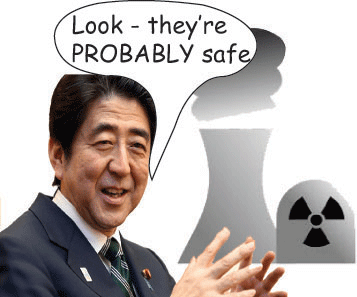 The problem is that few Japanese now trust the government’s promises that it can make nuclear power safe.
The public will not accept a sudden, complete restart anytime soon. Even in the long term, chances are
slim.
 Abe’s Nuclear Promises and the Trust Deficit. WSJ The nuclear impasse will be an early test of whether Mr. Abe can lead the country through much-needed reforms By MINAMI FUNAKOSHI, 19 July 13 Prime Minister Shinzo Abe is expected to win a majority in Sunday’s Upper House elections Sunday, but governing Japan will still be difficult. To implement the Liberal Democratic Party’s economic revival platform he needs not just citizens’ votes but their trust—and that is in short supply nowadays.
Public confidence in the government was shattered in 2011 by the
meltdown at the Fukushima Daiichi Nuclear Plant. The Tohoku earthquake
and tsunami caused a series of explosions, cooling system failures and
radiation leaks at the plant run byTokyo Electric Power Co., 9501.TO
-0.54% or Tepco.
Many saw this as a manmade disaster; investigators concluded the
meltdown was “the result of collusion between the government, the
regulators and Tepco.” Even after the accident, the government let
special interests interfere with crisis management, suppressed
information, downplayed radiation dangers and put innocent lives at
risk.
Moreover, this incident has to be viewed in the context of a series of
government blunders over the last decade…….
one must at least give Mr. Abe credit for his political courage since
he has made nuclear power a centerpiece of his plans to revive the
economy. Not only does he want to restart the country’s 50 nuclear
reactors, which have been on standby since Fukushima. He also says “we
are likely to build new nuclear power plants on winning the public’s
understanding.”
The problem is that few Japanese now trust the government’s promises
that it can make nuclear power safe. After Tokyo proclaimed Fukushima
safe earlier this year, a dead mouse caused a power outage and failure
of the cooling system failure. Leaks of radioactive water continue.
In 2012, a Pew Research Center poll found that 70% of respondents
supported a reduced role of nuclear power. Even Mr. Abe’s wife
admitted she is “anti-nuclear” and disapproves of her husband’s
policy.
In the face of such doubts, Mr. Abe faces a dilemma. He needs cheap
power to stimulate the economy, but pushing too hard for nuclear power
may alienate the public…… The public will not accept a sudden,
complete restart anytime soon. Even in the long term, chances are
slim. http://online.wsj.com/article/SB10001424127887323993804578613442099449434.html
No comments yet.
1 This Month

of the week – Shut Down Drone Warfare!


Tell the Ukrainian Government to Drop Prosecution of Peace Activist Yurii Sheliazhenko

Petition to revoke the licensing of the Near Surface Nuclear Disposal Facility (NSDF) at Chalk River. https://www.ourcommons.ca/petitions/en/Petition/Details?Petition=e-7247
To see nuclear-related stories in greater depth and intensity – go to https://nuclearinformation.wordpress.com
-
Archives
- April 2026 (103)
- March 2026 (251)
- February 2026 (268)
- January 2026 (308)
- December 2025 (358)
- November 2025 (359)
- October 2025 (376)
- September 2025 (257)
- August 2025 (319)
- July 2025 (230)
- June 2025 (348)
- May 2025 (261)
-
Categories
- 1
- 1 NUCLEAR ISSUES
- business and costs
- climate change
- culture and arts
- ENERGY
- environment
- health
- history
- indigenous issues
- Legal
- marketing of nuclear
- media
- opposition to nuclear
- PERSONAL STORIES
- politics
- politics international
- Religion and ethics
- safety
- secrets,lies and civil liberties
- spinbuster
- technology
- Uranium
- wastes
- weapons and war
- Women
- 2 WORLD
- ACTION
- AFRICA
- Atrocities
- AUSTRALIA
- Christina's notes
- Christina's themes
- culture and arts
- Events
- Fuk 2022
- Fuk 2023
- Fukushima 2017
- Fukushima 2018
- fukushima 2019
- Fukushima 2020
- Fukushima 2021
- general
- global warming
- Humour (God we need it)
- Nuclear
- RARE EARTHS
- Reference
- resources – print
- Resources -audiovicual
- Weekly Newsletter
- World
- World Nuclear
- YouTube
-
RSS
Entries RSS
Comments RSS
 nuclear-news
Leave a comment