Nuclear waste casks filling up one aweek, and rate is increasing

it is crazy to keep making this radioactive trash
New dry casks are popping up around the country at the rate of about one a week these days. As spent fuel pools fill up, that rate will increase to a steady-state (for 100 reactors) of about 4 to 6 dry casks per week around the nation.
Each one, if its contents get out, could wipe out a small state
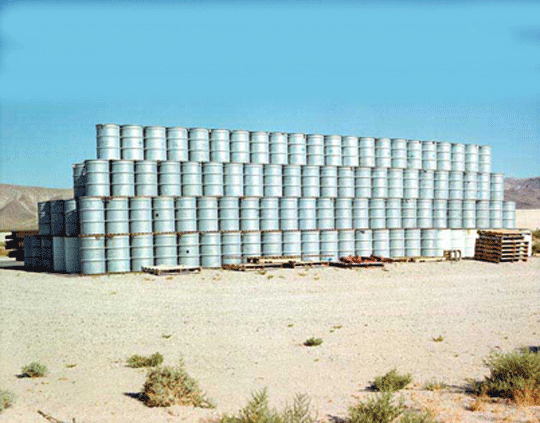
A spent fuel accident at San Onofre Nuclear Waste Dump could cost a trillion dollars. Deal with it. Salem News Ace Hoffman July 13th, 2013 “……..Nevertheless, some people, even some among those who helped shut down San Onofre because of the danger, now refuse to talk about moving the waste, primarily for one of two reasons:
First, they are concerned about transportation accidents — a reasonable fear. But consider this: Transport risks last for only a few days each trip, and there are a finite number of trips, because, thankfully, the reactors at San Onofre are permanently closed. So that’s a relatively limited risk. On the other hand, leaving the waste to sit dangerously in an earthquake/tsunami/growing population zone is a danger that lasts for decades or centuries, and possibly forever.
The other reason some people oppose transporting the waste away from San Onofre is that there’s nowhere to put it.
That is also a reasonable concern. Citizens, once alerted to the dangers spent fuel represents, invariably wise up and oppose both the transport of waste through their communities, and especially, becoming the “final destination” which will, inevitably, be called a temporary location.
But for all intents and purposes it will be permanent, because we are all waiting for the impossible: A better solution to the nuclear waste problem than either of our actual available two choices: Storing it, or releasing it into the environment. There are no other choices. About 97% of the spent fuel waste has no value whatsoever, but is radioactive, so it has lots of “negative value.” The rest — plutonium and uranium of the “right” isotopes — only has value for making more nuclear power plants and nuclear bombs. In other words, it, too, has no real value. (Nuclear medicine has never used more than a relatively minuscule amount of a few short-lived isotopes for diagnostic purposes.)
Nuclear waste is a tremendous liability to society. It always has been, and it always will be.
All plans for long-term or “interim” storage have been stopped thus far — not by “NIMBYism” so much as by common sense. No sane community wants the waste. 50 years ago the waste issue was recognized by many top scientists — brilliant nuclear physicists — as “intractable.” The definition of “intractable” has not changed in the interim. Solutions have not been found.
Shutting down all the reactors is the critical first step, since a closed reactor is no longer making MORE waste. However, at San Onofre, where that first step has recently been taken, some people refuse to even discuss removing the waste and instead, support the utility’s plan for permanent on-site dry casks, pausing only to demand that those plans be implemented as quickly as possible, without considering any other alternatives.
Frankly, SoCalEdison couldn’t care less what we do with our waste.
SCE is already authorized to walk away from the problem, maintaining just a few guards at ratepayer expense for eternity. SCE is also insured, and to top it off, their insurance is capped by federal policy at fractions of a penny on the dollar if anything goes wrong. So they have no reason to care.
But dry casks — especially the dry casks planned and currently used at San Onofre — are inadequate. Fuel assemblies and even the fuel itself deteriorate over time from the heat and especially from the radiation. “High burn up” fuel, which San Onofre used for the last ten years, degrades its cladding especially quickly, making it much more fragile. This will significantly increase the risk if anyone tries to transport it later. As it deteriorates, high burn up fuel will also cause increased releases into the environment of radioactive noble gases and other radioactive isotopes including cesium, strontium and plutonium.
Greater protection is theoretically possible — but it’s more expensive, and it requires moving the waste to a safer location that hasn’t been found yet. However, that doesn’t mean it shouldn’t be done or can’t be done. It just means it hasn’t been done. New dry casks are popping up around the country at the rate of about one a week these days. As spent fuel pools fill up, that rate will increase to a steady-state (for 100 reactors) of about 4 to 6 dry casks per week around the nation.
Each one, if its contents get out, could wipe out a small state………http://www.salem-news.com/articles/july142013/san-onofre-bdb-ah.php
No comments yet.
1 This Month

of the week – Shut Down Drone Warfare!


Tell the Ukrainian Government to Drop Prosecution of Peace Activist Yurii Sheliazhenko

Petition to revoke the licensing of the Near Surface Nuclear Disposal Facility (NSDF) at Chalk River. https://www.ourcommons.ca/petitions/en/Petition/Details?Petition=e-7247
To see nuclear-related stories in greater depth and intensity – go to https://nuclearinformation.wordpress.com
-
Archives
- April 2026 (57)
- March 2026 (251)
- February 2026 (268)
- January 2026 (308)
- December 2025 (358)
- November 2025 (359)
- October 2025 (376)
- September 2025 (257)
- August 2025 (319)
- July 2025 (230)
- June 2025 (348)
- May 2025 (261)
-
Categories
- 1
- 1 NUCLEAR ISSUES
- business and costs
- climate change
- culture and arts
- ENERGY
- environment
- health
- history
- indigenous issues
- Legal
- marketing of nuclear
- media
- opposition to nuclear
- PERSONAL STORIES
- politics
- politics international
- Religion and ethics
- safety
- secrets,lies and civil liberties
- spinbuster
- technology
- Uranium
- wastes
- weapons and war
- Women
- 2 WORLD
- ACTION
- AFRICA
- Atrocities
- AUSTRALIA
- Christina's notes
- Christina's themes
- culture and arts
- Events
- Fuk 2022
- Fuk 2023
- Fukushima 2017
- Fukushima 2018
- fukushima 2019
- Fukushima 2020
- Fukushima 2021
- general
- global warming
- Humour (God we need it)
- Nuclear
- RARE EARTHS
- Reference
- resources – print
- Resources -audiovicual
- Weekly Newsletter
- World
- World Nuclear
- YouTube
-
RSS
Entries RSS
Comments RSS
 nuclear-news
Leave a comment