Why UK wants nuclear submarines in Scotland, and Scotland doesn’t
The UK’s military were highly ambivalent about acquiring nuclear weapons, not least because they could not be launched without US permission. Nuclear bases on British soil have always been de facto US bases and we pay US firms for provision and maintenance. But politicians wanted them. Being a nuclear power is almost as good as still having an empire.
 Trident, the UK’s current nuclear weapon system, is in Scotland because London isn’t. That’s one of the reasons why Trident is hugely unpopular with Scots. Faslane is a deep-water port that keeps mildly unstable weapons far from the politicians disastrously wedded to the idea that if enough civilians of the right type die, almost anything is achievable.
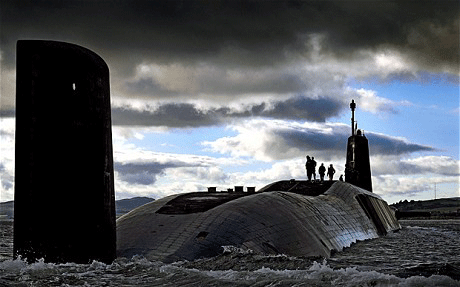 Faslane: this was a nuclear weapon for the SNP, Guardian UK, 12 July 13, The rumoured plans for the naval base were a reminder of how deeply unpopular Trident is among Scots The MoD’s, or Whitehall’s, or whoever’s plans to designate Trident’s Faslane base “sovereign UK territory” earlier this week seemed, at best, petty – an attempt at humiliation timed to balance Andy Murray’s cheering victory. It was a gift to the SNP, now denied and passed from hand to hand like a vomiting baby. That the idea was ever floated offers us another reminder of the colonial attitudes so catastrophically embedded in nuclear policy; a fundamental, fatal dismissal of “ordinary” people.
Once, it was relatively easy to acquire a colony if you had access to industrialised military production when the people you were invading didn’t. But by the end of the 19th century there was nowhere desirable left to steal, and industrialised armies finally faced each other. The results were intolerable: massive national debt and casualties that could mount by tens of thousands a day.
But then, in the 1920s, Britain’s airforce successfully bombed undefended Iraqi villages into quiescence. Italy followed suit in Ethiopia, and Germany in Spain. The age of “intimidation by bomb” was born, and with it the dream that killing a high enough percentage of a civilian population from the air would destroy a country and win a war with low military casualties………
The UK’s military were highly ambivalent about acquiring nuclear weapons, not least because they could not be launched without US permission. Nuclear bases on British soil have always been de facto US bases and we pay US firms for provision and maintenance. But politicians wanted them. Being a nuclear power is almost as good as still having an empire.
Trident, the UK’s current nuclear weapon system, is in Scotland because London isn’t. That’s one of the reasons why Trident is hugely unpopular with Scots. Faslane is a deep-water port that keeps mildly unstable weapons far from the politicians disastrously wedded to the idea that if enough civilians of the right type die, almost anything is achievable.
Other reasons for Scots’ unease include the costs – never mind relocation, the cost of replacing Trident will be at least £115bn over the next 30 years – its uselessness in the “war on terror”, and its deployment as part of the Nato missile defence system, which involves firing missiles at missiles. Tests have shown this would only be remotely possible if our opponent’s missiles were in open silos, or just leaving them, so we fire have to first. This all means SNP plans to make Scotland nuclear-free are popular, even if full independence may not be.
So Whitehall manoeuvres once again help to make independence seem more inviting. Scotland can feel that being threatened as if it’s a colony is par for the course. England can feel the post-colonial UK project is unable to shake off a legacy of violence and the imposition of massive burdens on those who can afford them least. The SNP are smiling this weekend.http://www.guardian.co.uk/commentisfree/2013/jul/12/faslane-trident-westminster-snp
No comments yet.
1 This Month

of the week – Shut Down Drone Warfare!


Tell the Ukrainian Government to Drop Prosecution of Peace Activist Yurii Sheliazhenko

Petition to revoke the licensing of the Near Surface Nuclear Disposal Facility (NSDF) at Chalk River. https://www.ourcommons.ca/petitions/en/Petition/Details?Petition=e-7247
To see nuclear-related stories in greater depth and intensity – go to https://nuclearinformation.wordpress.com
-
Archives
- April 2026 (57)
- March 2026 (251)
- February 2026 (268)
- January 2026 (308)
- December 2025 (358)
- November 2025 (359)
- October 2025 (376)
- September 2025 (257)
- August 2025 (319)
- July 2025 (230)
- June 2025 (348)
- May 2025 (261)
-
Categories
- 1
- 1 NUCLEAR ISSUES
- business and costs
- climate change
- culture and arts
- ENERGY
- environment
- health
- history
- indigenous issues
- Legal
- marketing of nuclear
- media
- opposition to nuclear
- PERSONAL STORIES
- politics
- politics international
- Religion and ethics
- safety
- secrets,lies and civil liberties
- spinbuster
- technology
- Uranium
- wastes
- weapons and war
- Women
- 2 WORLD
- ACTION
- AFRICA
- Atrocities
- AUSTRALIA
- Christina's notes
- Christina's themes
- culture and arts
- Events
- Fuk 2022
- Fuk 2023
- Fukushima 2017
- Fukushima 2018
- fukushima 2019
- Fukushima 2020
- Fukushima 2021
- general
- global warming
- Humour (God we need it)
- Nuclear
- RARE EARTHS
- Reference
- resources – print
- Resources -audiovicual
- Weekly Newsletter
- World
- World Nuclear
- YouTube
-
RSS
Entries RSS
Comments RSS
 nuclear-news
Leave a comment