Busting the nuclear industry’s propaganda fairy tale
As always in the face of failure, the industry puts forth new designs as a basis for new promises, now touting small modular reactors with the same fervour with which it touted large, partially modular reactors a decade ago. Congress finds a few hundred million to preserve these dreams even as its cutbacks shatter so many others.
A new movie, Pandora’s Promise (no film-maker familiar with nuclear history would include “promise” in a title intended to be pronuclear), recently screened at Sundance.Featuring the same old converts and straw men, it opened in cinemas a few weeks ago to tiny audiences and generally unenthusiastic reviews, especially from reviewers knowledgeable about nuclear power.
 In the astonishing persistence of the global appetite for false nuclear promises lies the critical importance of the World Nuclear Industry Status Report, published on Thursday.
Nuclear renaissance was just a fairy tale http://www.guardian.co.uk/environment/2013/jul/11/nuclear-renaissance-power-myth-us The promise of cheap, low-carbon power – with 31 new reactors in the US – was based on rhetoric and obedience. Anyone who doubts that should read the new status report on the industry Peter Bradford guardian.co.uk, 12 July 2013 Nuclear power requires obedience, not transparency. The gap between nuclear rhetoric and nuclear reality has been a fundamental impediment to wise energy policy decisions for half a century now.
For various reasons, in many nations the nuclear industry cannot tell the truth about its progress, its promise or its perils. Its backers in government and in academia do no better.
Rhetorical excess from opponents of nuclear power contributes to the fog, but proponents have by far the heavier artillery. In the US, during the rise and fall of the bubble formerly known as “the nuclear renaissance”, many of the proponents’ tools have been on full display. Continue reading
Get the Facts: World Nuclear Industry Status Report 2013
 The World Nuclear Industry Status Report 2013 http://www.worldnuclearreport.org/-2013-.html Two years after the Fukushima disaster started unfolding on 11 March 2011, its impact on the global nuclear industry has become increasingly visible. Global electricity generation from nuclear plants dropped by a historic 7 percent in 2012, adding to the record drop of 4 percent in 2011. This World Nuclear Industry Status Report 2013 (WNISR)provides a global overview of the history, the current status and the trends of nuclear power programs worldwide.
Fukushima’s leaking water 90,000 times more radioactive than the “safe level”
 Fukushima Radiation Leaks Rise Sharply By William Boardman, Reader Supported News 11 July 13 Bad as the situation is at Fukushima, it’s gotten worse.
  erhaps you’ve heard that radiation levels of the water leaving the Fukushima Daiichi nuclear power plant in Japan and flowing into the Pacific Ocean have risen by roughly 9,000 per cent. Turns out, that’s probably putting a good face on it.
By official measurement, the water coming out of Fukushima is currently 90,000 times more radioactive than officially “safe” drinking water.
These are the highest radiation levels measured at Fukusmima since March 2011, when an earthquake-triggered tsunami destroyed the plant’s four nuclear reactors, three of which melted down.
As with all nuclear reporting, precise and reliable details are hard to come by, but the current picture as of July 10 seems to be something like this:
On July 5, radiation levels at Fukushima were what passes for “normal,” which means elevated and dangerous, but stable, according to measurements by the owner, the Tokyo Electric Power Company (TEPCO).
- On July 8, radiation levels had jumped about 90 times higher, as typically reported. TEPCO had no explanation for the increase.
- On July 9, radiation levels were up again from the previous day, but at a slower rate, about 22 per cent. TEPCO still had no explanation.
- On July 10, Japan’s Nuclear Regulation Authority (NRA) issued a statement saying that the NRA strongly suspects the radioactive water is coming from Fukushima’s Reactor #1 and is going into the Pacific.
Climate change increases Chernobyl’s risk of radioactive wildfires
Women in their 20s living just outside the zone face the highest risk from exposure to radioactive smoke, the 2011 study found: 170 in 100,000 would have an increased chance of dying of cancer. Among men farther away in Kiev, 18 in 100,000 20 year olds would be at increased risk of dying of cancer.
the greatest danger from forest fire for most people would be consuming foods exposed to smoke. Milk, meat and other products would exceed safe levels, the 2011 study predicts. The Ukrainian government would almost certainly have to ban consumption of foodstuffs produced as far as 150 kilometres from the fire
 Watching for a radioactive forest fire JANE BRAXTON LITTLE, ABC Environment 8 JUL 2013 Tinder dry and radioactive: the forests around Chernobyl are an accident waiting to happen. For 27 years, forests around Chernobyl have been absorbing radioactive elements. A fire would send them skyward again – a growing concern as summers grow longer, hotter and drier. “…….Nikolay Ossienko patrols the forests surrounding the Chernobyl nuclear power plant,,,,,,, “Our number one job is to save the forest from fire,”…… It’s a job with international consequences.
For almost three decades the forests around the shuttered nuclear power plant have been absorbing contamination left from the 1986 reactor explosion. Now climate change and lack of management present a troubling predicament: If these forests burn, strontium 90, cesium 137, plutonium 238 and other radioactive elements would be released, according to an analysis of the human health impacts of wildfire in Chernobyl’s exclusion zone conducted by scientists in Germany, Scotland, Ukraine and the United States. Continue reading
New guidelines allow far greater radiation exposure to the public
 For Future Reactor Meltdowns, EPA Means “Extra Pollution Allowed” by JOHN LaFORGE Cutting Corners, Cutting Costs, Creating Cancer
As the nuclear power industry struggles against collapse from skyrocketing costs, bankrupting repair bills and investor flight (four operating reactors were permanently closed this year, more than in any previous 12 month period), the government seems to have capitulated to political pressure to weaken radiation exposure standards and save nuclear utilities billions.
On April 15, the EPA issued new Protective Action Guides (PAGs) for dealing with large scale radiation releases — like the catastrophic triple reactor meltdowns at Fukushima, Japan that spread cesium and radio-iodine worldwide. The new PAGs are like a government bailout, saving reactor owners the gargantuan costs of comprehensive cleanup. And eerily, the new PAGs seem to presume the inevitability of radiation disasters that the industry — with its fleet of 100 rickety 40-year-old units — can’t currently afford to withstand.
According to Daniel Hirsch, President of Committee to Bridge the Gap, the latest PAGs took effect in April but can be amended — and EPA is taking comments. Hirsch says that the National Council on Radiation Protection’s plans for implementing the new PAGs “would allow the public to be exposed to extraordinarily higher levels of radiation than previously permitted” during reactor accident emergencies.
The new PAGs also allow extremely high contamination of food, he says. “In essence,” Hirsch reports, the PAGs say “nuclear power accidents could be so widespread and produce such immense radiation levels that the government would abandon cleanup obligations” forcing people to absorb and live with far more cancers.
To cut costs, industry has long pushed for weakening radiation exposure rules. In 2002, Roger Clarke president of the International Commission on Radiological Protection (ICRP) warned in the Bulletin of the Atomic Scientists, “Some people think that too much money is being spent to achieve low levels of residual contamination.” The ICRP recommends exposure standards to governments for nuclear industry workers and the public…….http://www.counterpunch.org/2013/07/09/for-future-reactor-meltdowns-epa-means-extra-pollution-allowed/
Rising radioactivity in Fukushima’s leaking water
- 11,000 becquerels per liter – TEPCO’s measurement of Cesium-134 on July 9.
- 18,000 becquerels per liter — TEPCO’s measurement of Cesium-137 on July 8.
- 22,000 becquerels per liter – TEPCO’s measurement of Cesium-137 on July 9.
Fukushima Radiation Leaks Rise Sharply By William Boardman, Reader Supported News 11 July 13 “………Here’s another perspective on the same situation:
- 10 becquerels per liter – The officially “safe” level for radioactivity in drinking water, as set by the NRA.
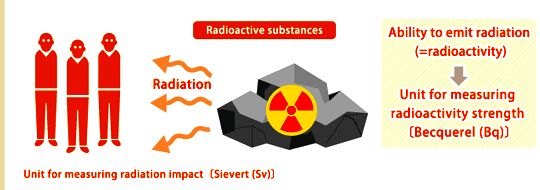
A becquerel is a standard scientific measure of radioactivity, similar in some ways to a rad or a rem or a roentgen or a sievert or a curie, but not equivalent to any of them. But you don’t have to understand the nuances of nuclear physics to get a reasonable idea of what’s going on in Fukushima. Just keep the measure of that safe drinking water in mind, that liter of water, less than a quart, with 10 becquerels of radioactivity.
- 60 becquerels per liter – For nuclear power plants, the safety limit for drinking water is 60 becquerels, as set by the NRA, with less concern for nuclear plant workers than ordinary civilians.
- 60-90 becquerels per liter – For waste water at nuclear power plants, the NRA sets a maximum standard of 90 becquerels per liter for Cesium-137 and 60 becquerels per liter of Cesium-134.
At some of Fukushima’s monitoring wells, radiation levels were in fractions of a becquerel on July 8 and 9. At the well (or wells) that are proving problematical, TEPCO has provided no baseline readings. Continue reading
Fukushima’s radioactive water storage space nearly full, and leaking
 No thanks to Tepco’s ongoing failures, the Fukushima disaster is nowhere near over
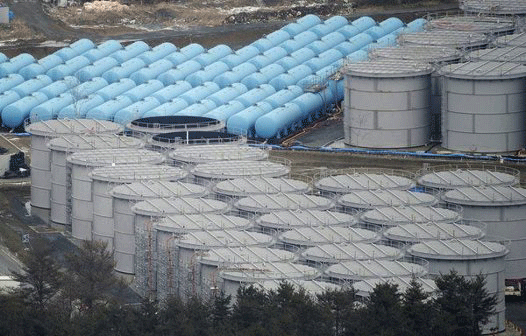
The most pressing problem aside from stopping the leaks is that storage space for the irradiated water is running out—the Wall Street Journal reports(paywall) that 310,000 of the 350,000 tons of storage space at the site are now occupied, and at least one tank has been leaking. Neither Tepco nor the Japanese government have a long-term solution to the problem.
Two years after the tsunami, Fukushima is still leaking radiation and Tepco is still clueless http://qz.com/102992/two-years-after-the-tsunami-fukushima-is-still-leaking-radiation-and-tepco-is-still-clueless/ By Jake Maxwell Watts @jmwatts_ July 11, 2013 Radioactive water has been steadily leaking into the sea around the damaged Fukushima Daiichi nuclear power plant ever since it was hit by an earthquake and tsunami in March 2011, Japan’s nuclear watchdog announced on Wednesday. Plant operator Tokyo Electric Power Co, widely reviled for its inept response to the disaster, had long insisted that no leakage was taking place; in recent days it has backtracked to saying that it is “not sure” if there’s a leak.
The levels of cesium detected by the nuclear regulator are high enough to cause significantly increased rates of cancer, but are not an immediate threat to public health because they are in a remote location.
Tepco has been pumping water into three reactors for the past two years in an attempt to cool them, creating enough radioactive water to fill an Olympic-sized swimming pool every week. Now it seems that at least some of that contaminated water has also been flowing into the sea. Continue reading
Tepco’s huge underground dike
Fukushima Radiation Leaks Rise Sharply By William Boardman, Reader Supported News 11 July 13 “……..Nobody Knows if It Will Get Worse, Get Better, or Just Stay Bad The water flow through the Fukushima accident site is substantial and constant, both from groundwater and from water pumped into the reactors and fuel pools to prevent further meltdowns.
In an effort to prevent the water from reaching the ocean, TEPCO is building what amounts to a huge, underground dike, “a deeply sunken coastal containment wall.” The NRA is calling on TEPCO to finish the project before its scheduled 2015 completion date.
Meanwhile, radiation levels remain high and no one knows for sure how to bring them down, or even if they can be brought down by any means other than waiting for however long it takes. http://readersupportednews.org/opinion2/271-38/18354-focus-fukushima-radiation-leaks-rise-sharply
Global maritime environment threatened by Russia’s floating nuclear plants
 Tow cables snap, Arctic conditions can be unpredictable, ships sink. As the ocean is the common heritage of humanity, perhaps the international community might evince a tad more interest in this project.
Chernobyl At Sea? Russia Building Floating Nuclear Power Plants http://www.zerohedge.com/node/476304 submitted by Tyler Durden 07/11/2013 by John Daly via OilPrice.com,So much for the lessons of Fukushima. Never mind oil spills, the Russian Federation is preparing an energy initiative that, if it has problems, will inject nuclear material into the maritime environment.
Speaking to reporters at the 6th International Naval Show in St. Petersburg, Baltiskii Zavod shipyard general director Aleksandr Voznesenskii said that the Russian Federation’s first floating nuclear power plant “should be operational by 2016.” Continue reading
UK might make nuclear base in Scotland a ‘sovereign United Kingdom territory”

 Trident nuclear base on banks of the Clyde ‘could be designated as UK territory’ if Scotland votes for independence
- Idea floated as a contingency if Scotland breaks away from the UK
- But Number 10 says it is not ‘credible or sensible’
- SNP accused Westminster of trying to bully Scotland
By MATT CHORLEY, MAILONLINE POLITICAL EDITOR, 11 July 2013 The nuclear deterrent base in Scotland would be designated as sovereign United Kingdom territory under plans drawn up by the Ministry of Defence.
The move comes amid warnings of the ‘enormous’ costs of trying to relocate the Trident missile system away from Faslane if Scotland breaks away from the rest of the UK.
But David Cameron today moved to quash the idea, warning it was not a ‘credible or sensible’. The future of Britain’s nuclear deterrent has become a key area of dispute in the run up to the referendum on Scottish independence next year.
The submarines and missiles are housed at a naval base on the Clyde but the SNP wants rid of the system.
Officials in Whitehall have been looking at alternatives to ensure Britain can maintain its at sea deterrent.
Under the plan to reclassify Faslane, the base would be given the same status as the British sovereign military bases in Cyprus, the Guardian reported. Continue reading
Permissible radiation doses established by polluters
 For Future Reactor Meltdowns, EPA Means “Extra Pollution Allowed”, Counter Punch, Cutting Corners, Cutting Costs, Creating Cancer, by JOHN LaFORGE, 11 July 13,
“……….There is no exposure to ionizing radiation that’s safe. Even the smallest exposures have cellular-level effects that can lead to immune dysfunction, birth defects, cancer and other diseases. The National Academy of Sciences’ 7th book-length on the biological effects of ionizing radiation, BEIR-VII, declared that any exposure, regardless of how small, may cause the induction of cancer. BEIR-VII also explicitly refuted and  repudiated the pop culture “hormesus” theory, promoted by industry boosters, that a little radiation is good for us and acts like a vaccination.
Today, the nuclear industry — military, industrial and medical — is required to keep radiation exposures only “as low as reasonably achievable.” This tragicomic standard is neither a medical nor scientific concept. It’s not based on health physics or biology. It’s merely the formal admission that radiation producers cannot keep worker or public exposures to a level that is safe — that is zero.
Exposure limits have been established at the convenience of the military and industrial producers of radioactive pollution, not by medical doctors of health physicists. The late Dr. Rosalie Bertell made clear 36 years ago in Robert Del Tredici’s book At Work In the Fields of the Bomb, “The people with the highest vested interest are the ones that are making the nuclear bombs. And it turns out they have complete control over setting the permissible [radiation exposure] levels.” Since then, little has changed in the regulatory world (although scientists have found that far more damage is caused by low dose radiation than was earlier thought possible): the ICRP’s 1990 recommendations to reduce worker and public exposures by three-fifths has yet to be adopted by the United States.
We can thank industrial and political roadblocks for that, yet in spite of them the government’s permissible dose (lazy reporters often write “safe” dose) of radiation has dramatically decreased over the years — as we’ve come to better understand the toxic, carcinogenic and mutagenic properties of low-level exposures. In the 1920s the permissible dose was 75 rem (radiation equivalent man) per year for nuclear industry workers. In 1936, the limit was reduced to 50 rem per year; then 20-25 in 1948; 15 in 1954; and down to 5 rem per year in 1958. The general public is officially allowed to be exposed to one-tenth the workers’ dose, or 0.5 rem per year. The ICRP’s 1990 suggestion was to cut this to 2 and 0.2 respectively.
With cancer rates at pandemic proportions, adding higher radiation exposures to the effects of 80,000 chemicals that contaminate our air, water and food only makes our chance of avoiding the dread disease slimmer. Rather than permitting increased doses of dangerous and sometimes deadly radiation, especially following reactor disasters, the government should be acting to prevent them — like Germany, Italy and Japan — by preparing the phase-out of the country’s accident-prone nukes.
John LaForge is a co-director of Nukewatch, a nuclear watchdog and environmental justice group in Wisconsin.
1 This Month

of the week – Shut Down Drone Warfare!


Tell the Ukrainian Government to Drop Prosecution of Peace Activist Yurii Sheliazhenko

Petition to revoke the licensing of the Near Surface Nuclear Disposal Facility (NSDF) at Chalk River. https://www.ourcommons.ca/petitions/en/Petition/Details?Petition=e-7247
To see nuclear-related stories in greater depth and intensity – go to https://nuclearinformation.wordpress.com
-
Archives
- April 2026 (114)
- March 2026 (251)
- February 2026 (268)
- January 2026 (308)
- December 2025 (358)
- November 2025 (359)
- October 2025 (376)
- September 2025 (257)
- August 2025 (319)
- July 2025 (230)
- June 2025 (348)
- May 2025 (261)
-
Categories
- 1
- 1 NUCLEAR ISSUES
- business and costs
- climate change
- culture and arts
- ENERGY
- environment
- health
- history
- indigenous issues
- Legal
- marketing of nuclear
- media
- opposition to nuclear
- PERSONAL STORIES
- politics
- politics international
- Religion and ethics
- safety
- secrets,lies and civil liberties
- spinbuster
- technology
- Uranium
- wastes
- weapons and war
- Women
- 2 WORLD
- ACTION
- AFRICA
- Atrocities
- AUSTRALIA
- Christina's notes
- Christina's themes
- culture and arts
- Events
- Fuk 2022
- Fuk 2023
- Fukushima 2017
- Fukushima 2018
- fukushima 2019
- Fukushima 2020
- Fukushima 2021
- general
- global warming
- Humour (God we need it)
- Nuclear
- RARE EARTHS
- Reference
- resources – print
- Resources -audiovicual
- Weekly Newsletter
- World
- World Nuclear
- YouTube
-
RSS
Entries RSS
Comments RSS
 nuclear-news