Tepco rushes effort to restart two nuclear reactors, ignores local councils
TEPCO gets harsh response from Niigata gov. over restarting reactors Global Post 5 July 13 Tokyo Electric Power Co. faced a harsh response on Friday from Niigata Gov. Hirohiko Izumida in its attempt to swiftly apply for a state safety assessment of two reactors there as a step toward resuming their operations.
After meeting with Izumida and the mayors of two municipalities that the Kashiwazaki-Kariwa plant straddles, TEPCO President Naomi Hirose admitted it is “difficult” to join other utilities’ moves to apply for safety assessment of reactors next Monday, when a set of new regulations for atomic power plants take effect.
Izumida said TEPCO did not offer any explanation to local people before announcing the company’s plan to file for the assessment of the plant’s Nos. 6 and 7 reactors.
“Why did you rush (to make a decision to file for application)?” the governor said in the meeting, while also refusing to accept a paper in which TEPCO sought approval on a plan to install a safety system which is essential to restart the two units under the new safety standards…… http://www.globalpost.com/dispatch/news/kyodo-news-international/130705/tepco-gets-harsh-response-niigata-gov-over-restarting-
Fukushima Prefecture voters stress the reality of the nuclear crisis
Fukushima voters urge politicians to face reality of nuclear crisis Global Post 5 July 13 Voters in Fukushima Prefecture, where about 150,000 people are still living as evacuees from their homes due to the nuclear disaster triggered by the 2011 earthquake and tsunami, urged politicians to face the reality of the crisis as official campaigning for the July 21 House of Councillors election got under way Thursday…….
Yasuo Yoshida, a 46-year-old fisherman in Iwaki, a coastal city in the prefecture, said politicians should visit the areas affected by the nuclear disaster more often and listen to the local people.
“Now we face a moment of truth in trying to rebuild Fukushima’s fishing industry and I want politicians to ensure that the central government will take responsibility” for the revival of fishing, he said. Continue reading
Toxicity of ionising radiation from uranium mining
 Health hazards posed by uranium mining IPP MEDIA 5th July 2013 All Uranium mined end up as either nuclear weapons or highly radioactive waste from nuclear reactors. Uranium is a naturally occurring radioactive toxic element, found in the ground worldwide, including Tanzania, soon to be mined! Countries with active uranium mining are Australia, Canada, Central Africa Republic, France Namibia, Niger, South Africa and the US. The normal decay of uranium in the soil results in the production of decay radioactive products.In the process of mining uranium we liberate from the ground these natural radioactive substances like radium and radon, which are among the most harmful materials known in science.
Uranium emits ionising nuclear radiation like x-rays. Ionising radiation is energetic enough to break chemical bonds, thereby possessing the ability to damage or destroy living cells. Hence the need to keep away from nuclear radiation x-rays, uranium and its radioactive waste. Ultrasound, radio, sound and light are non-ionising nuclear radiations and are harmless
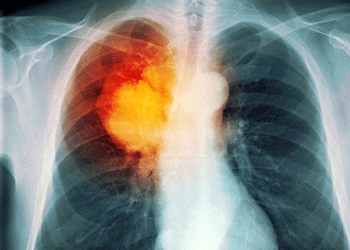 As long as the mineral remains outside the body, uranium poses little health hazards. However, if uranium is inhaled or ingested, its radioactivity and toxicity pose increased risks of lung cancer as well as cancer of bones, stomach, soft tissue and blood. It may also cause damage to internal organs notably kidneys alongside affecting the reproductive system, leading to birth defects in future generations.
Imaging swallowing or inhaling small radiation exposing x-ray machines with jammed exposure switches could result in serious health effects in the form of cancer. Similar incidence of diseases is observed in Atomic bomb survivors, refer bombing of Hiroshima and Nagasaki in Japan 1942 at end of World War II.
All the decay radioactive products of uranium remain in the crushed rock when uranium is separated from the ore. The rock left over’s waste contains 85 per cent radioactivity of the ore as well as heavy metals and toxic dissolving chemicals, which have dangerous health hazards.
Uranium mining is responsible for introducing into the human environment a tremendous large range of radioactive materials which are all very harmful to biological organisms – human beings included.
1 This Month

Petition to revoke the licensing of the Near Surface Nuclear Disposal Facility (NSDF) at Chalk River. https://www.ourcommons.ca/petitions/en/Petition/Details?Petition=e-7247

18 March Webinar @ 1 PM EST: An Assessment of SMR Projects: The Case of Canada
register for the zoom:
https://us02web.zoom.us/webinar/register/WN_o8BIIOUvQ2ONJR1nta65DQ#/registration


of the week – STOP SMALL MODULAR REACTORS IN CANADA
To see nuclear-related stories in greater depth and intensity – go to https://nuclearinformation.wordpress.com
-
Archives
- March 2026 (146)
- February 2026 (268)
- January 2026 (308)
- December 2025 (358)
- November 2025 (359)
- October 2025 (376)
- September 2025 (258)
- August 2025 (319)
- July 2025 (230)
- June 2025 (348)
- May 2025 (261)
- April 2025 (305)
-
Categories
- 1
- 1 NUCLEAR ISSUES
- business and costs
- climate change
- culture and arts
- ENERGY
- environment
- health
- history
- indigenous issues
- Legal
- marketing of nuclear
- media
- opposition to nuclear
- PERSONAL STORIES
- politics
- politics international
- Religion and ethics
- safety
- secrets,lies and civil liberties
- spinbuster
- technology
- Uranium
- wastes
- weapons and war
- Women
- 2 WORLD
- ACTION
- AFRICA
- Atrocities
- AUSTRALIA
- Christina's notes
- Christina's themes
- culture and arts
- Events
- Fuk 2022
- Fuk 2023
- Fukushima 2017
- Fukushima 2018
- fukushima 2019
- Fukushima 2020
- Fukushima 2021
- general
- global warming
- Humour (God we need it)
- Nuclear
- RARE EARTHS
- Reference
- resources – print
- Resources -audiovicual
- Weekly Newsletter
- World
- World Nuclear
- YouTube
-
RSS
Entries RSS
Comments RSS
 nuclear-news