UK’s nuclear waste mess at Sellafield, like USA’s at Hanford?
 Nuclear waste: Clean-up Quandary.FT, By Sylvia Pfeifer, 1 July 13, More reactors are to be built but a permanent solution for high-level waste remains elusiveMore reactors are to be built but a permanent solution for high-level waste remains elusive
A hulking building faced with dirty yellow concrete, B30 sits at the heart of Sellafield, a sprawling nuclear site on the windswept coast of Cumbria in northwest England. Surrounded by a fence topped with razor wire, this is no ordinary building. But it’s only when the small device hooked to the pocket of my guide’s overalls begins to click as we draw closer to the building that my heart skips a beat.
The exterior tells you nothing but inside B30 lies some of the most radioactive waste in the world. It is one of four pond and silo facilities built in the 1950s and 1960s to store irradiated fuel from Britain’s first atomic reactors.
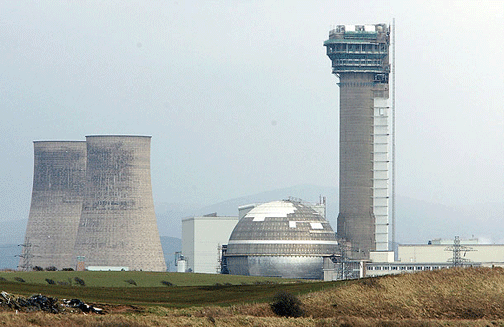
Over the years, it has accumulated large amounts of waste, sludge from corroded fuel casings and other debris that has blown in. B30 is as nasty as they come – hence the clicks from my guide’s pocket gadget, which measures the amount of radiation to which we are exposed. On the outside, we are safe but just a glimpse of B30 is an unsettling reminder of Britain’s nuclear legacy.
The site of a former munitions factory, Sellafield has seen it all. By the early 1950s, the site’s two Windscale reactors, as Sellafield was then known, were making plutonium for nuclear weapons. By the middle of the decade, Calder Hall, the world’s first commercial nuclear power station, was opened. More reactors followed, as did reprocessing activities. Today, the site’s main focus is on managing waste safely and cleaning up the legacy of the past. The estimated cost is £67.5bn and rising.
“Our aim is to put ourselves out of business, to tidy the toys away,” says John Clarke, chief executive of the Nuclear Decommissioning Authority, the government body set up in 2005 to oversee the job….. . http://www.ft.com/cms/s/0/77c177ba-dcba-11e2-b52b-00144feab7de.html#axzz2XvB1ouop
No comments yet.
1 This Month

of the week – Shut Down Drone Warfare!


Tell the Ukrainian Government to Drop Prosecution of Peace Activist Yurii Sheliazhenko

Petition to revoke the licensing of the Near Surface Nuclear Disposal Facility (NSDF) at Chalk River. https://www.ourcommons.ca/petitions/en/Petition/Details?Petition=e-7247
To see nuclear-related stories in greater depth and intensity – go to https://nuclearinformation.wordpress.com
-
Archives
- April 2026 (68)
- March 2026 (251)
- February 2026 (268)
- January 2026 (308)
- December 2025 (358)
- November 2025 (359)
- October 2025 (376)
- September 2025 (257)
- August 2025 (319)
- July 2025 (230)
- June 2025 (348)
- May 2025 (261)
-
Categories
- 1
- 1 NUCLEAR ISSUES
- business and costs
- climate change
- culture and arts
- ENERGY
- environment
- health
- history
- indigenous issues
- Legal
- marketing of nuclear
- media
- opposition to nuclear
- PERSONAL STORIES
- politics
- politics international
- Religion and ethics
- safety
- secrets,lies and civil liberties
- spinbuster
- technology
- Uranium
- wastes
- weapons and war
- Women
- 2 WORLD
- ACTION
- AFRICA
- Atrocities
- AUSTRALIA
- Christina's notes
- Christina's themes
- culture and arts
- Events
- Fuk 2022
- Fuk 2023
- Fukushima 2017
- Fukushima 2018
- fukushima 2019
- Fukushima 2020
- Fukushima 2021
- general
- global warming
- Humour (God we need it)
- Nuclear
- RARE EARTHS
- Reference
- resources – print
- Resources -audiovicual
- Weekly Newsletter
- World
- World Nuclear
- YouTube
-
RSS
Entries RSS
Comments RSS
 nuclear-news
Leave a comment