Global nuclear radioactive trash problem – no solution in sight
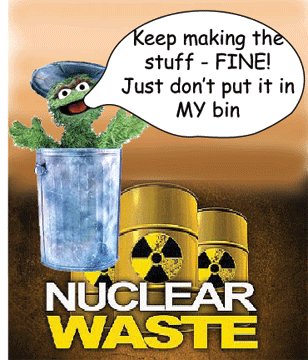

it’s just plain stupid to keep on making the stuff
Nuclear waste: Clean-up Quandary.FT, By Sylvia Pfeifer, 1 July 13 “….Today, apart from Finland and Sweden, most countries have not agreed on a site for their high-level waste. In the US, the issue has stalled after President Barack Obama withdrew support for a facility in the Yucca Mountains in Nevada. Britain, too, has gone back to the drawing board after Cumbria voted against storing the waste this year.
France, meanwhile, which derives 75 per cent of its electricity from nuclear energy, is seeking to store its waste underground near Bure, a remote area in the east of the country. Public debates have had to be postponed because of local opposition.
For now, spent fuel from the UK’s reactors is transported to Sellafield in specifically designed flasks, removed and stored in big ponds to cool. It is dissolved in nitric acid and separated into uranium (96 per cent), plutonium (1 per cent) and waste products (3 per cent). The high-level waste is fused into borosilicate glass using a process called vitrification. The resulting mixture is poured into stainless steel canisters and stored pending availability of an underground repository.
Cleaning up the legacy of the past is a particular problem for western nations such as the US and the UK and, to a lesser extent, France, whose involvement in the arms race has left them with military as well as civil waste. In the US, the former plutonium production facility at Hanford in Washington is the subject of a big clean-up operation and political wrangling about rising costs and delays, as well as concerns about contamination of groundwater.
In Europe, the true scale of the challenge is laid bare at Sellafield, the continent’s most complex facility which employs about 10,000 people. Decades of mismanagement and a lack of urgency have dogged the site, which was passed from one government agency to another. During the miners’ strike of 1972, when the imperative was to keep the lights on, the site’s Magnox power reactors were run flat-out, resulting in a faster build-up of spent fuel than they could handle. Much was dumped in the silos and ponds…….http://www.ft.com/cms/s/0/77c177ba-dcba-11e2-b52b-00144feab7de.html#axzz2XvB1ouop
No comments yet.
1 This Month

of the week – Shut Down Drone Warfare!


Tell the Ukrainian Government to Drop Prosecution of Peace Activist Yurii Sheliazhenko

Petition to revoke the licensing of the Near Surface Nuclear Disposal Facility (NSDF) at Chalk River. https://www.ourcommons.ca/petitions/en/Petition/Details?Petition=e-7247
To see nuclear-related stories in greater depth and intensity – go to https://nuclearinformation.wordpress.com
-
Archives
- April 2026 (68)
- March 2026 (251)
- February 2026 (268)
- January 2026 (308)
- December 2025 (358)
- November 2025 (359)
- October 2025 (376)
- September 2025 (257)
- August 2025 (319)
- July 2025 (230)
- June 2025 (348)
- May 2025 (261)
-
Categories
- 1
- 1 NUCLEAR ISSUES
- business and costs
- climate change
- culture and arts
- ENERGY
- environment
- health
- history
- indigenous issues
- Legal
- marketing of nuclear
- media
- opposition to nuclear
- PERSONAL STORIES
- politics
- politics international
- Religion and ethics
- safety
- secrets,lies and civil liberties
- spinbuster
- technology
- Uranium
- wastes
- weapons and war
- Women
- 2 WORLD
- ACTION
- AFRICA
- Atrocities
- AUSTRALIA
- Christina's notes
- Christina's themes
- culture and arts
- Events
- Fuk 2022
- Fuk 2023
- Fukushima 2017
- Fukushima 2018
- fukushima 2019
- Fukushima 2020
- Fukushima 2021
- general
- global warming
- Humour (God we need it)
- Nuclear
- RARE EARTHS
- Reference
- resources – print
- Resources -audiovicual
- Weekly Newsletter
- World
- World Nuclear
- YouTube
-
RSS
Entries RSS
Comments RSS
 nuclear-news
Leave a comment