Tokyo anti nuclear rally – 60,000 protest
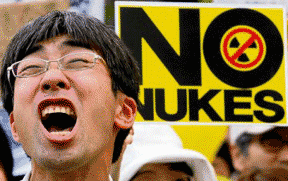 60,000 in Tokyo Protest Government Plans to Restart Nuclear Power Earth First Newswire by Adam Westlake / Japan Daily Press, 3 June 13
Approximately 60,000 people rallied in Japan’s capital of Tokyo on Sunday, June 2nd in order to protest recent government plans to restart the country’s idled nuclear reactors. People gathered in Shiba Park and later marched towards the parliament building. Among the organizers was Kenzaburo Oe, a Nobel literature laureate, who called on the Japanese government to leave the nuclear power plants in suspension out of fears for safety.
The Japanese government has previously stated that it will most likely allow those reactors to return to power which have been approved by the Nuclear Regulation Authority (NRA), whose new safety guidelines are scheduled to be adopted in July. One of Japan’s largest-ever protests saw 170,000 people gather in a similar fashion in July 2012, around the same time that then-Prime Minister Yoshihiko Noda decided on the first two reactor restarts since the March 2011 Fukushima disaster. As of now, the anti-nuclear protestors say they have collected over 8 million signatures of those opposed to reactor restarts…… http://earthfirstnews.wordpress.com/2013/06/03/60000-in-tokyo-protest-government-plans-to-restart-nuclear-power/
Biggest pile of plutonium in the world: Britain’s nightmare
 Britain has accumulated the biggest stockpile of civil
plutonium in the world, a target for terrorists and future bomb-makers. What was once thought to be a valued asset is now a costly liability. The Government faces a dilemma. Should it try to
turn the stuff into nuclear fuel at huge cost or write off the plutonium altogether? Previous attempts to deal with the problem went disastrously wrong, costing the taxpayer more than a billion pounds. Tonight File on 4 investigates what’s been called one of the most embarrassing failures in British industrial history. And now MP’s are worried taxpayers could be asked to pay up again. Continue reading

Uranium is France’s major strategic economic interest in the Sahel,
How long before the bombings hit Paris?
Niger’s Uranium Facilities Under Assault Oil Price, By John Daly, 03 June 2013 One of the scariest scenarios for Western intelligence analysts is the possible nexus between terrorism and nuclear materials Recent events in Africa have heightened these scenarios. Continue reading
South Korea and USA planning nuclear pyroprocessing
 Meanwhile, South Korea and the U.S. are set to sign a pact that will allow the two nations to step up their joint research on pyroprocessing technology, said a senior official at Seoul’s foreign ministry.
 If adopted, the pact would enable the International Atomic Energy Agency to guarantee the safety of pyroprocessing technology.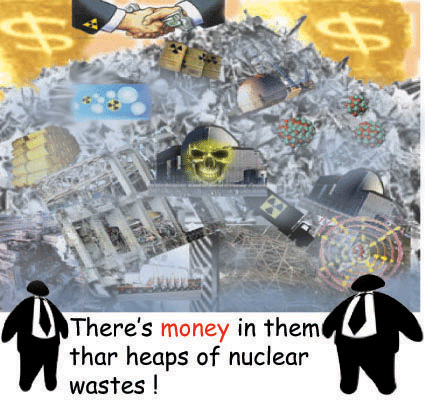
Radiation Exposure from Eating Pacific Bluefin Tuna Affected by Fukushima Nuke Accident Miniscule, US Researchers Say
Monday, June 3, 2013
http://ex-skf.blogspot.co.uk/2013/06/radiation-exposure-from-eating-pacific.html
The comments on the EXSKF link are interesting..[Arclight2011]
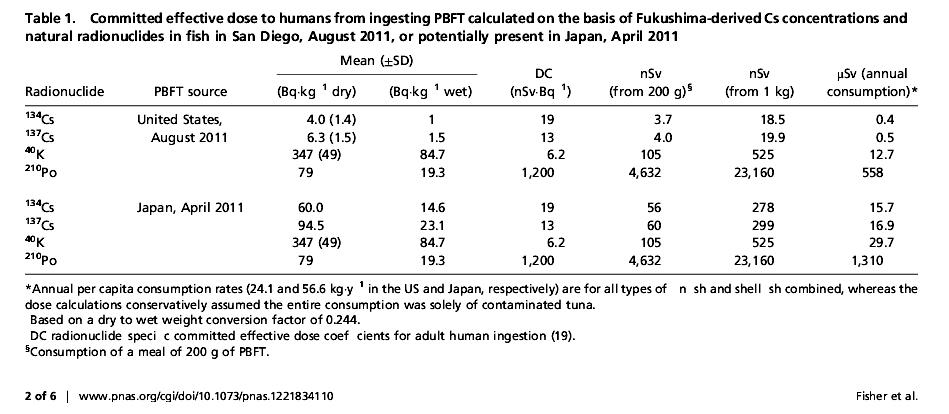
32 microsieverts per year or 0.032 millisievert per year, for the Japanese people in Japan, 0.9 microsievert per year or 0.0009 millisievert per year for people in the US.
Exposure from radioactive polonium in fish is much greater than radioactive cesium of Fukushima origin, says Professor Nicholas Fisher at Stony Brook University in New York. (See Table 1 at the bottom of the post.)
He also says the the amount of radioactive cesium in bluefin tuna caught off the coast of San Diego in 2012 dropped in half, compared to the bluefin tuna caught in 2011.
Unlike most of the Japanese media these days, the US media, including CNN below, still talks about radiation in terms of dental X-ray or transcontinental flight. Just give us the number, please.
From CNN (6/3/2013):
Fukushima tuna study finds miniscule health risks
Go ahead, order the sushi.
Levels of radioactivity found in Pacific bluefin tuna that spawned off Japan around the time of the Fukushima Daiichi nuclear accident are far below anything that would pose a health risk and have dropped in fish caught the following year, U.S. researchers reported Monday.
The latest findings follow up on a 2012 study that found radioactive cesium, a nuclear reactor byproduct, in tuna caught off California in the months after the triple meltdown at Fukushima Daiichi. The attention that study received led scientists to take another look at the data, said Nicholas Fisher, a marine science professor at New York’s Stony Brook University.
“People did not know how to translate that into a dose, or into what risk do I have from eating that tuna,” Fisher said. “The paper that’s coming out today addresses that.”
They found that anyone who eats the bluefin — highly prized for sushi and sashimi — would get about 5% of the radiation they’d get from eating one typical banana, a fruit high in naturally radioactive potassium. The results were released Monday by the journal Proceedings of the National Academy of Sciences.
Even subsistence fishermen, who eat far more fish than the typical American, would receive a dose of radiation from the cesium isotopes released in the meltdown equivalent to a single dental X-ray, Fisher and his colleagues reported. That translates to a “worst-case scenario” of two additional cancer deaths for every 10 million people in that category, he said.
The doses were calculated from fish caught off San Diego in August 2011. A follow-up study with fish caught in 2012 found the amount of cesium-134 and -137 dropped by about half in those tuna, Fisher said.
(Full article at the link)
Japan’s Kyodo News says exposure from radioactive polonium in fish is much greater than radioactive cesium of Fukushima origin.
It also says the radiation exposure would be 0.032 millisievert in one year.
Pacific bluefin tuna transport Fukushima-derived radionuclides from Japan to California
Daniel J. Madigan, Zofia Baumann, and Nicholas S. Fisher
Abstract
The Fukushima Dai-ichi release of radionuclides into ocean waters caused significant local and global concern regarding the spread of radioactive material. We report unequivocal evidence that Pacific bluefin tuna, Thunnus orientalis, transported Fukushima-derived radionuclides across the entire North Pacific Ocean. We measured γ-emitting radionuclides in California-caught tunas and found 134Cs (4.0 ± 1.4 Bq kg−1) and elevated 137Cs (6.3 ± 1.5 Bq kg−1) in 15 Pacific bluefin tuna sampled in August 2011. We found no 134Cs and background concentrations (∼1 Bq kg−1) of 137Cs in pre-Fukushima bluefin and post-Fukushima yellowfin tunas, ruling out elevated radiocesium uptake before 2011 or in California waters post-Fukushima. These findings indicate that Pacific bluefin tuna can rapidly transport radionuclides from a point source in Japan to distant ecoregions and demonstrate the importance of migratory animals as transport vectors of radionuclides. Other large, highly migratory marine animals make extensive use of waters around Japan, and these animals may also be transport vectors of Fukushima-derived radionuclides to distant regions of the North and South Pacific Oceans. These results reveal tools to trace migration origin (using the presence of 134Cs) and potentially migration timing (using 134Cs:137Cs ratios) in highly migratory marine species in the Pacific Ocean.
Full paper PDF: http://www.pnas.org/content/early/2013/05/30/1221834110.full.pdf
Part about radiation exposure for Japan and for the US:
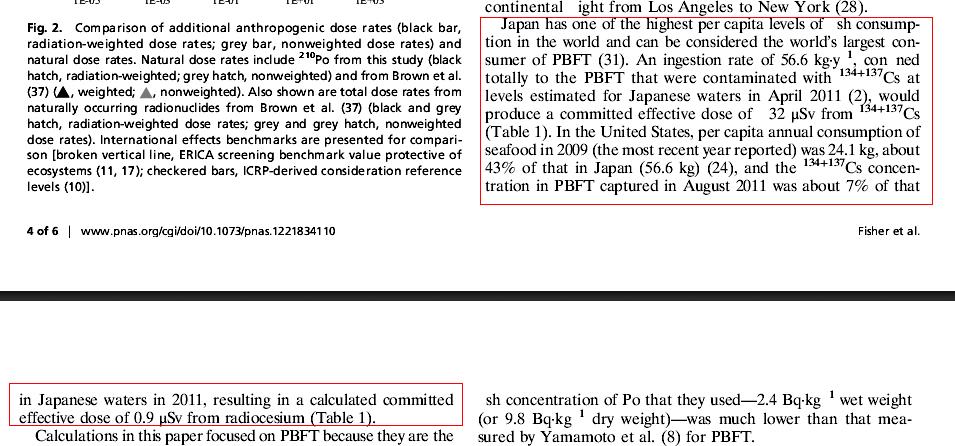
Table 1 showing the radiation dose:
Published on Apr 19, 2013
“Cycle of bias” described at 10 minutes suppressed by sponsor and issues on manipulation of the Peer review process as in the above “report” and check out the comment at 1hr 04 mins [Arclight2011]
Chernobyl fallout in the Baltic Sea sediments investigated
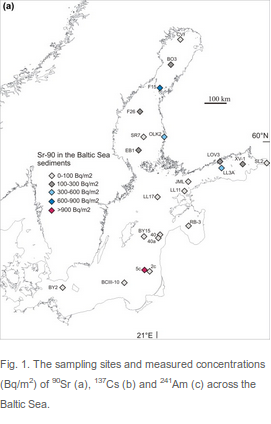
Volume 70, Issues 1–2, 15 May 2013, Pages 210–218
…..These results are an important amendment to the radioactivity baseline of the Baltic Sea…..
Artificial radionuclides 90Sr and 241Am in the sediments of the Baltic Sea: Total and spatial inventories and some temporal trends
- a Radiation and Nuclear Safety Authority, P.O. Box 14, FIN-00881 Helsinki, Finland
- b Water Protection Association of The River Kokemäenjoki, P.O. Box 265, FIN-33101 Tampere, Finland
Kaisa-Leena Hutri, Jukka Mattila, Tarja Tuulikki Ikäheimonen, Vesa-Pekka Vartti. Artificial radionuclides 90Sr and 241Am in the sediments of the Baltic Sea: Total and spatial inventories and some temporal trends. Marine Pollution Bulletin 70 (2013) 210-218. DOI: http://dx.doi.org/10.1016/j.marpolbul.2013.03.007
Abstract
The Baltic Sea was contaminated by radioactivity following global nuclear fallout and later by the Chernobyl accident. Despite the decrease of radioactivity caused by radioactive decay, radionuclides have a prolonged residence time in the water of the Baltic Sea due to slow water exchange and relatively rapid sedimentation. Very little is known about the amounts or spatial differences of 90Sr and 241Am in the Baltic Sea sediments.
In this study, 20 sediment cores taken around the Baltic Sea were investigated to estimate inventories of these radionuclides.
The rough results show that the Chernobyl fallout added the amount of 90Sr in the same areas where the increase of 137Cs can be detected, whereas this is not the case for 241Am which is more evenly distributed in the sea bottom. In addition, local differences occur in the concentrations. These results are an important amendment to the radioactivity baseline of the Baltic Sea…. subscription only
http://www.sciencedirect.com/science/article/pii/S0025326X13001471
Good news: ionising radiation type scanners removed from airports across USA
 Full-body scanners at airports replaced with less-revealing, low radiation machines http://abclocal.go.com/wls/story?section=news/local&id=9125985 June 03, 2013 — Airports across the U.S. have removed the full-body scanners that used x-rays to create what looks like nude images of passengers.
The remaining 250 machines were removed about two weeks before the June 1st deadline set by Congress.Some critics said they were too revealing, while others expressed health concerns over radiation exposure.
Passengers still have to undergo full-body scans. However, the scanners now use radio waves that produce a less-detailed image.
Tepco Detects Radioactive Cesium In Groundwater and other contamination issues in Japan
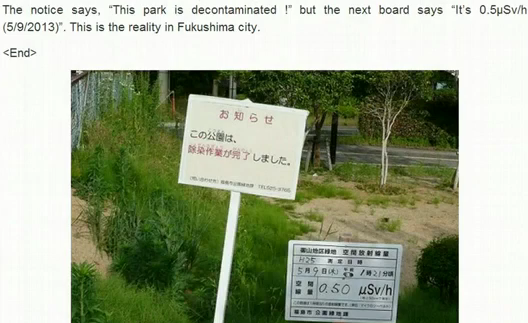
Published on Jun 3, 2013
TEPCO detects radioactive cesium in groundwater
TEPCO officials have detected radioactive cesium in groundwater at Fukushima Daiichi nuclear power plant. But they said levels were much lower than legal limits.
Monju’s data transmitting system fails
A technical glitch prevented data from the Monju fast-breeder nuclear reactor in Fukui, central Japan, from being sent to the government’s monitoring system for more than 4 hours on Monday.
Rallies held to oppose restart of nuclear plants
Tens of thousands of people have taken to the streets of Tokyo to oppose moves to bring the country’s nuclear power stations back online.
Residents win radiation uncertainty compensation
A group of nuclear accident evacuees in Fukushima has won a compensation settlement decision from a state-backed legal arbitration body for radiation exposure and future health uncertainties.
Tohoku summer festivals opens in Fukushima City
Thousands of people are in Fukushima City in northeastern Japan for a 2-day event combining 6 local summer festivals.
The event was first held 2 years ago to promote tourism in areas hard hit by the March 2011 disaster.
Cancer rates spiking in North America, after the Fukushima disaster
Kevin Blanch 6/3/13
https://www.youtube.com/watch?v=v4epv…
http://enenews.com/un-fukushima-nucle…
http://enenews.com/rates-of-thyroid-p…
http://enenews.com/reuters-rising-rad…
2013.4.6 Namie street dust 86.09μSv/h at 1cm above ground
Published on Jun 2, 2013 by birdhairjp
http://www.youtube.com/watch?v=vU5DB4…
[Spare contaminated water] 20,000m3 of highly contaminated water still retained in seawater trenches,”4.2 tera Bq/m3″
http://fukushima-diary.com/2013/06/sp…
[Express] “Highschool students picnic in 0.93 μSv/h in Kohriyama city”
Posted by Mochizuki on May 31st, 2013 ·
http://fukushima-diary.com/2013/05/ex…
[Express] “150 bags of decontamination waste in my garden of Da-te city”
Posted by Mochizuki on May 31st, 2013
http://fukushima-diary.com/2013/05/ex…
The Asia-Pacific Journal, Vol 11, Issue 22, No. 1, June 2, 2013.
Life and Death Choices: Radiation, children, and Japan’s future
Two years after the start of Japan’s nuclear disaster, parents fear for their children’s future.
http://japanfocus.org/-David-McNeill/…
published Sunday, June 2nd, 2013
TVA eyes building 2 smaller reactors on the Clinch River in Oak Ridge
The next new nuclear reactor for TVA may be built in a factory and shipped to the Tennessee Valley in a truck or railcar.
http://timesfreepress.com/news/2013/j…
Nuclear site scrap metal could be headed to recyclers
June 2, 2013 12:16 am
By Len Boselovic / Pittsburgh Post-Gazette
A U.S. Department of Energy proposal to recycle scrap metal from its nuclear facilities has set off the radiation detectors of environmental groups, some in the metals industry and one member of Congress.
http://www.post-gazette.com/stories/b…
New Mexico plant may lack space for remote-handled Hanford waste
A national repository may run out of space for the hottest radioactive waste it was designed to store if changes are not made, according to an audit by the Department of Energy Office of Inspector General.
http://www.tri-cityherald.com/2013/06…
Skullduggery alleged over mayors’ ‘secret’ nuclear-waste storage meetings
By Colin Perkel, The Canadian Press June 2, 2013
TORONTO – Municipal leaders in the Ontario region that is home to one of the world’s largest nuclear power plants are facing allegations they discussed proposed storage facilities for radioactive waste in secret because they feared damaging their electoral fortunes.
http://www.leaderpost.com/technology/…
Harm from radiation, among families of nuclear workers
 Some Atomic Energy Workers Passed Effects of Radiation and Chemical Exposure to their Spouses and Children Huntington News, June 3, 2013 – BY TONY E. RUTHERFORD, NEWS EDITOR “……“Big Jim” took a job working around radioactive elements in 1954 at the Portsmouth Gaseous Diffusion Plant (PGDP) in Piketon, Ohio. Workers told his daughter how they kept their lunches warm by laying them on uranium yellow cakes and poked fun of individuals who put around their clothing before painting. They wore radiation exposure badges, but by “doing his job” Jim later developed four cancers.
“My dad talked about the A plant, but he never told us what it was,” Joan Fearing (Big Jim’s daughter) said. “Mom washed his work clothes.” She passed away from a rare form of cancer too. “When my mother was dying, she still did not tell us what it was.”
The Cold War ended the arms race. Nuclear weapons were replaced with atoms for peace at electrical power plants. However, the atomic legacy appears passed to the 21st Century. Continue reading
Climate change on top of Marshall Islands’ nuclear disasters
 Pacific islands’ deadly threat from climate change http://www.washingtonpost.com/opinions/pacific-islands-face-a-deadly-threat-from-climate-change/2013/05/30/86ff1956-c7a9-11e2-9245-773c0123c027_story.html By Phillip Muller, May 30 2013 Phillip Muller is foreign minister of the Marshall Islands.
For almost 70 years, my country, the Marshall Islands, has been fighting for its survival. Unfortunately, the threats we face are the result of forces we cannot control.

From 1946 to 1958, we endured the horror of 67 atmospheric nuclear tests. The most powerful was the “Bravo shot,” equivalent in power to 1,000 Hiroshima bombs. Now our residents are confronted by a different kind of atmospheric danger: the existential threat posed by climate change.
After a prolonged and unseasonable droughtthat began late last year, the severe lack of drinking water in our northern atolls led my government to declare a disaster area on May 7. This humanitarian crisis is climate-induced. Continue reading
Rapidly increasing popularity of solar panels, in Japan

 Japan’s post-Fukushima solar boom SMH, June 2, 2013 Domestic shipments of solar cells and modules in Japan leapt by their most in at least 30 years last fiscal year as government efforts to spur clean energy after the 2011 Fukushima disaster began to pay off.
Local shipments rose to 3,809 megawatts in the 12 months ended March 31 from 1,404 megawatts the previous year, the Japan Photovoltaic Energy Association said today on its website. The increase was the largest since 1981 when the figures were compiled for the first time.
The data underscore the popularity of solar in Japan as pressures mount to boost energy supplies after the Fukushima Dai-Ichi accident led to the shutdown of almost all the nation’s nuclear reactors. Japan started offering above-market rates in July for renewable sources such as solar and wind. Continue reading
Britain’s quite horrible problem of stockpiled plutonium
UK’s plutonium stockpile dilemma http://www.bbc.co.uk/news/uk-21505271 By Rob Broom byFile on 4 June 2013, Britain has accumulated the biggest stockpile of civil plutonium in the world. What was once a valued asset is now viewed as a costly liability and a target for terrorists.
Previous attempts to deal with the stockpile have gone wrong and the government now faces a dilemma. Should it try to turn the stuff into nuclear fuel or write off the plutonium altogether?
Amid tight security at the Sellafield nuclear plant in Cumbria, is a store holding most of Britain’s stockpile of plutonium. Continue reading
It’s already happening: the effects of global warming
 The Effects of Global Warming by Marc Lallanilla , LiveScience Staff Writer 31 May 2013 “……. global warming is having a measurable effect on the planet right now.
Increase in average temperatures
One of the most immediate and obvious impacts of global warming is the increase in temperatures around the world. The average global temperature has increased by about 1.4 degrees Fahrenheit (0.8 degrees Celsius) over the past 100 years, according to the National Oceanic and Atmospheric Administration (NOAA).
Since recordkeeping began in 1895, the hottest year on record for the 48 contiguous U.S. states was 2012. Worldwide, 2012 was also the 10th-warmest year on record, according to NOAA. And nine of the warmest years on record have occurred since 2000. Continue reading
Travesty of justice – Bradley Manning on trial
 The United States should be in the dock, not Bradley Manning, The Independent, Owen Jones, 2 June 2013 The whistleblower has allowed us to scrutinise the hidden realities of US power “…..Today, American hero stands in the dock, damned for a relatively tiny ray of light he shone on the darker recesses of this elite. Over three years ago, US soldier Bradley Manning – even now just 25 years old – leaked 250,000 US diplomatic cables and half a million army reports. There has never been a bigger leak of classified material in the history of the United States.
His punishment has already been severe. According to Juan Méndez, the UN special rapporteur on torture, he has faced cruel, inhuman and degrading treatment. For months, he was deprived of human contact. He was stripped of his clothes, left without privacy, and forced to sleep without any darkness. In 2011, P J Crowley was forced to resign as the US state department’s official spokesman after slamming Manning’s treatment as “ridiculous and counterproductive and stupid”. Continue reading
Compensation for Fukushima evacuees’ radiation anxiety
 Fukushima Evacuees To Get Radiation Uncertainty Compensation http://www.rttnews.com/2128844/fukushima-evacuees-to-get-radiation-uncertainty-compensation.aspx?type=gn&utm_source=google&utm_campaign=sitemap 6/3/2013 A government-backed arbitration body in Japan directed the operator of the tsunami-wrecked Fukushima nuclear power plant to pay compensation to former residents of a district for radiation exposure and future healthuncertainties.
As per a directive issued by the Nuclear Damage Claim Dispute Resolution Center, the Tokyo Electric Power Company (TEPCO) has to pay about $10,000 each to pregnant women and those aged below 18 years. The other residents of Nagadoro district would get $5,000 each, Japanese media reported on Sunday.
Nagadoro is near the Fukushima plant where radiation levels remain high and it is the only district that the government declared uninhabitable for a long period.
An evacuation order for the area was issued more than a month after the nuclear accident on March 11, 2011. The arbitrators accepted the residents’ claim of fear and anxiety as they had lived without any protection against high radiation doses because of their delayed evacuation. The residents had already received compensation for having to evacuate, but the amount did not cover health anxieties. Lawyers representing the residents said it was for the first time that compensation for health anxietywas granted.
The massive tsunami severely damaged four reactors at the Fukushima plant north of Tokyo, knocking out its cooling systems and triggering meltdowns and radiation leaks. Tens of thousands of people fled their homes in the worst atomic disaster since the 1986 Chernobyl nuclear accident.
1 This Month

22 June – Virtual Event –Climate Change: New Data, New Debate

Monday, June 22, 2026 2:30 p.m. – 3:15 p.m. CT
YouTube. Register here

Protect Sazan Island from the Trump family! https://secure.avaaz.org/campaign/en/protect_sazan_island_from_the_trump_family_loc/?bqFCVab&v=174511&cl=22707147157&_checksum=5e9dde668860e8231c33699735e16a1fbf22ab2cb01da50c999fe8732b9775ef&utm_source=email&utm_medium=blast_email&utm_campaign=174511
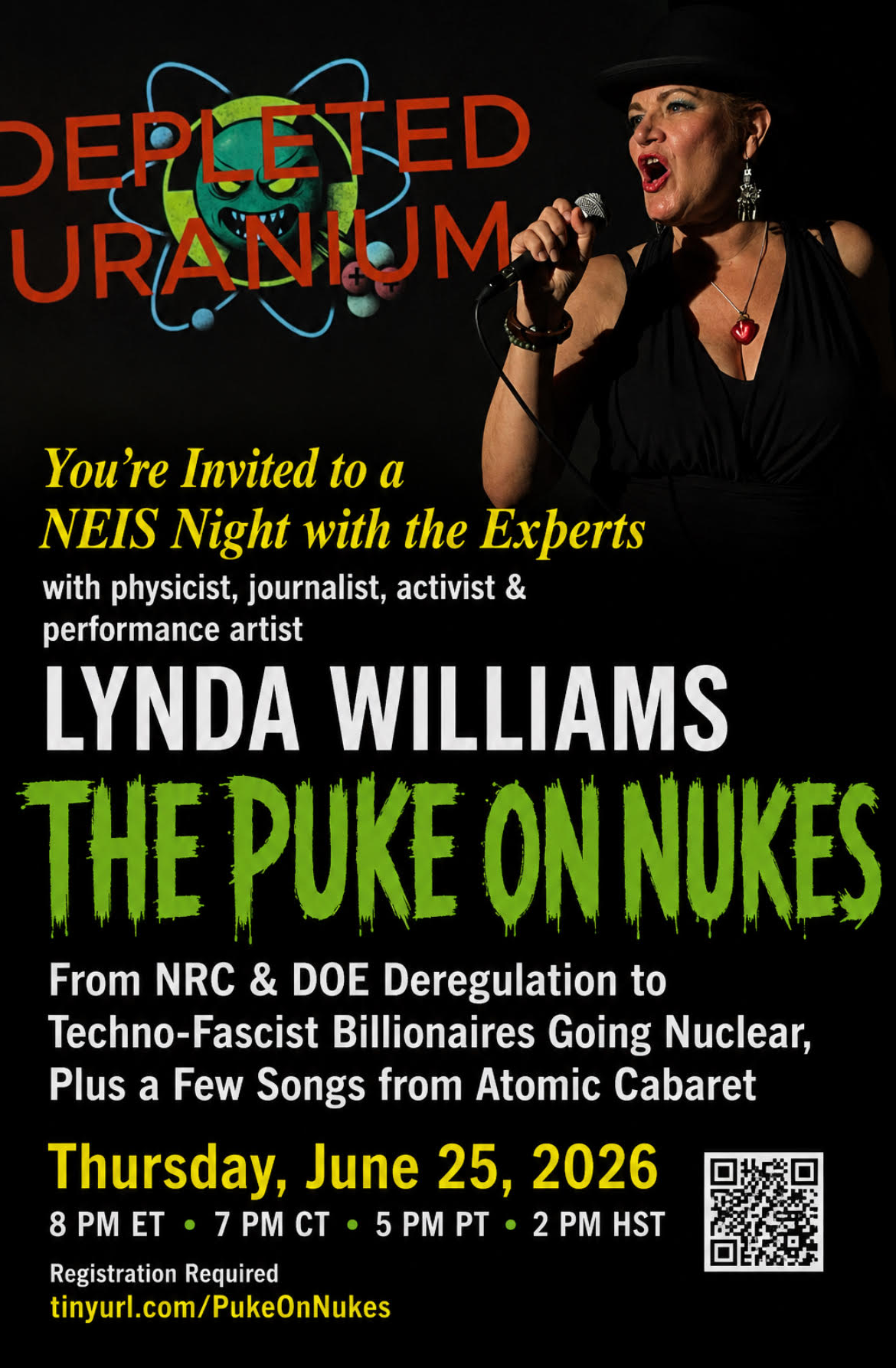
25 June- THE PUKE ON NUKES
Thursday, June 25, 2026
7pm Central Time (8pm ET, 6pm MT, 5pm PT) UTC – 5
From NRC & DOE Deregulation to Techno-Fascist Billionaires Going Nuclear, Plus a Few Songs from Atomic Cabaret REGISTER
26 June – Radiation Trainwreck at the NRC / Join the Protect Better Campaign – https://us02web.zoom.us/meeting/register/4ZlZ5_qLSHGiLSCg8FF6Bg#/registration


Cuba Is Not a Failed State – It Is a Besieged State
PETITION: “Global Appeal to Endorse Palestinian Right of Return of Refugees”
To see nuclear-related stories in greater depth and intensity – go to https://nuclearinformation.wordpress.com
-
Archives
- June 2026 (211)
- May 2026 (306)
- April 2026 (356)
- March 2026 (251)
- February 2026 (268)
- January 2026 (308)
- December 2025 (358)
- November 2025 (359)
- October 2025 (376)
- September 2025 (257)
- August 2025 (319)
- July 2025 (230)
-
Categories
- 1
- 1 NUCLEAR ISSUES
- business and costs
- climate change
- culture and arts
- ENERGY
- environment
- health
- history
- indigenous issues
- Legal
- marketing of nuclear
- media
- opposition to nuclear
- PERSONAL STORIES
- politics
- politics international
- Religion and ethics
- safety
- secrets,lies and civil liberties
- spinbuster
- technology
- Uranium
- wastes
- weapons and war
- Women
- 2 WORLD
- ACTION
- AFRICA
- Atrocities
- AUSTRALIA
- Christina's notes
- Christina's themes
- culture and arts
- Events
- Fuk 2022
- Fuk 2023
- Fukushima 2017
- Fukushima 2018
- fukushima 2019
- Fukushima 2020
- Fukushima 2021
- general
- global warming
- Humour (God we need it)
- Nuclear
- RARE EARTHS
- Reference
- resources – print
- Resources -audiovicual
- Weekly Newsletter
- World
- World Nuclear
- YouTube
-
RSS
Entries RSS
Comments RSS
 nuclear-news