Us nuclear corporations regulate the regulators: Indian point has no license
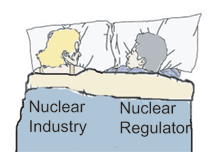 “The regulators are basically being regulated by the corporations that they’re supposedly overseeing,”
GERIATRIC NUCLEAR REACTORS COULD KILL US ALL, VICE NEWS, By Peter Rugh 26 June 13 In America, you need a license to drive an automobile, to operate heavy machinery, to hunt and fish, but apparently not to run a nuclear reactor. Entergy Corp. is slated to become the first company in history to operate a reactor without a license this fall. The Louisiana-based energy corporation’s rogue reactor is located at its Indian Point Energy Center in 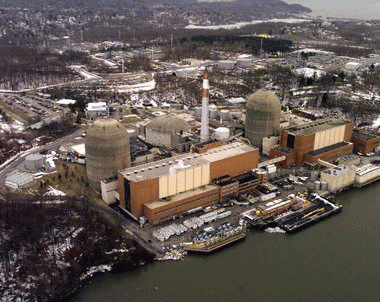 Buchanan, NY—just 24 miles from Manhattan. Entergy Corp’s license to run its Indian Point 2 reactor expires on September 28. The regulations of the Nuclear Regulatory Commission (NRC), which is charged with overseeing the civilian use of nuclear power, says it is prepared to grant the license but its hands are tied by legal challenges mounted by New York State and a federal court ruling last year. The ruling dismissed the agency’s radioactive waste management plans as inadequate.
Most of America’s nuclear plants were built in the 60s and 70s. They were given shelf lives of 40 years. It was assumed by the industry at the time of their construction that when the millennium rolled around there would be new plants up, running, and ready to replace the old fleet. But between then and now interest in nuclear power has waned due to cost and the public’s reaction to Three Mile Island, Chernobyl, and other nuclear calamities. Instead, the energy industry has sought to renew the licenses on the reactors they already operate, while keeping the cost of infrastructure improvements to a bare minimum. They’ve encountered little resistance from the NRC, which has approved 73 separate license renewals and only denied one single application in its history.
Meanwhile, the waste has piled up. The Nuclear Energy Institute, an industry policy group, estimates that US’s 104 commercial reactors have generated 69,720 metric tons of radioactive waste (spent-fuel) over the past four decades, with each plant chipping in approximately 2,000 to 2,300 metric tons each year. Nobody knows what to do with it all. Plant operators are, in a sense, shitting where they eat at the moment by storing nuclear waste onsite at the plants where it is generated. …..
Last June, a federal appeals court ruled that—as the Energy Department hunts for a new Yucca Mt. and a community willing to live beside nearly 70,000 metric tons of radioactive waste—the NRC must come up with a longterm plan that addresses waste storage. Until then, the agency can’t renew reactor licenses. Diane Screnci, a spokeswoman for the NRC said it won’t be until 2015 that the NRC draws up a plan and it is approved by courts.
In the meantime, the NRC plans to allow Entergy to continue to operate Indian Point 2 reactor under the “timely renewal” doctrine, since the company applied for a new license more than five years prior to the expiration of the one it currently possess. The maneuver, effectively skirting the appeals court ruling, could also be applied to the other operational reactor at the plant, reactor 3, when its license expires in 2015.
“Under timely renewal, your current license remains in place,” said Screnci. “In this case, Entergy will abide by any commitments it would make under a new license.” Screnci said the NRC also regulates nuclear materials used for medical purposes and academic research. In those arenas, the timely renewal doctrine has been applied in the past. However, she conceded that this is the first time it has been applied to a reactor.
Critics of Entergy tell a different story. They have long pushed for Indian Point’s closure, countering the company’s slogan “Safe. Secure. Vital.” with their own “Old. Dangerous. Unnecessary.” They contend it is reckless to operate a nuclear plant in close proximity to America’s largest metropolitan area and say chances are scant of evacuating the 20 million people who live within a 50 mile radius of the facility should a meltdown occur. (Fifty miles was the NRC’s recommended evacuation zone during the meltdowns at Fukushima in Japan.)
“Nuclear power generation is an inherently unstable process,” said Pace University physics professor Chris Williams. “What you are trying to do is control instability because the moment things get out of control, as we saw recently at Fukushima, all hell breaks loose. So you set up a system that has to be kept cool at all times once the nuclear reactions have started, otherwise you can’t contain the heat and there are explosions, radiation leaks, and meltdowns.”
New York Attorney General Eric Schneiderman together with the state’s Department of Environmental Conservation have petitioned the NRC to scrutinize the environmental hazards associated with Indian Point, including the seepage of strontium-90, tritium, and other cancerous radioactive substances into groundwater reservoirs and the Hudson River. The NRC must demonstrate it has addressed the state’s contentions or further legal challenges will ensue before it can grant Indian Point a renewed license.
Critics also charge that the NRC is far too lax when it comes to safety at the plant, pointing out the agency has granted Entergy numerous fire safety exemptions over the years.
In 2007, for example, fire insolation around cables controlling Indian Point’s two reactors were found to be deficient, only capable of withstanding flames for 26 minutes. Instead of requiring that Entergy meet their regulations requiring cables be capable of withstanding a blaze for up to an hour, which would allow fire crews time to arrive, nullify flames, and prevent a potential meltdown, the NRC granted an exemption. They lowered the required flame retardant time at Indian Point to 24 minutes so that Entergy was in compliance.
“The regulators are basically being regulated by the corporations that they’re supposedly overseeing,” said Williams.http://www.vice.com/read/geriatric-nuclear-reactors-could-kill-us-all
No comments yet.
1 This Month

of the week – Shut Down Drone Warfare!


Tell the Ukrainian Government to Drop Prosecution of Peace Activist Yurii Sheliazhenko

Petition to revoke the licensing of the Near Surface Nuclear Disposal Facility (NSDF) at Chalk River. https://www.ourcommons.ca/petitions/en/Petition/Details?Petition=e-7247
To see nuclear-related stories in greater depth and intensity – go to https://nuclearinformation.wordpress.com
-
Archives
- April 2026 (79)
- March 2026 (251)
- February 2026 (268)
- January 2026 (308)
- December 2025 (358)
- November 2025 (359)
- October 2025 (376)
- September 2025 (257)
- August 2025 (319)
- July 2025 (230)
- June 2025 (348)
- May 2025 (261)
-
Categories
- 1
- 1 NUCLEAR ISSUES
- business and costs
- climate change
- culture and arts
- ENERGY
- environment
- health
- history
- indigenous issues
- Legal
- marketing of nuclear
- media
- opposition to nuclear
- PERSONAL STORIES
- politics
- politics international
- Religion and ethics
- safety
- secrets,lies and civil liberties
- spinbuster
- technology
- Uranium
- wastes
- weapons and war
- Women
- 2 WORLD
- ACTION
- AFRICA
- Atrocities
- AUSTRALIA
- Christina's notes
- Christina's themes
- culture and arts
- Events
- Fuk 2022
- Fuk 2023
- Fukushima 2017
- Fukushima 2018
- fukushima 2019
- Fukushima 2020
- Fukushima 2021
- general
- global warming
- Humour (God we need it)
- Nuclear
- RARE EARTHS
- Reference
- resources – print
- Resources -audiovicual
- Weekly Newsletter
- World
- World Nuclear
- YouTube
-
RSS
Entries RSS
Comments RSS
 nuclear-news
Leave a comment