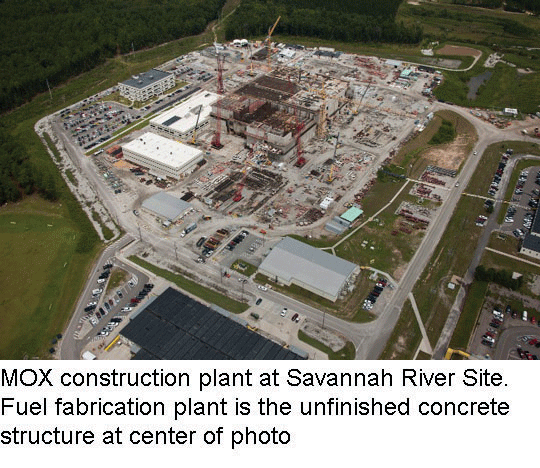
Savannah River Mixed Oxide Nuclear Fuel (MOX) a costly failure
Von Hippel last May joined three other scientists in advocating the burial alternative in a scientific journal article about Britain’s plutonium stocks. One co-author was Rodney Ewing, who Obama has since appointed to head a federal nuclear waste panel, and another was Allison MacFarlane, now chair of the Nuclear Regulatory Commission. The MOX plant, if it is completed, needs an NRC license……
Administration officials say the main purpose of their “strategic reassessment” is to reexamine the burial alternative. A DOE report in 2002 concluded it would cost hundreds of millions of dollars less than building the MOX plant.
Energy Department Nuclear Nonproliferation Program Plagued By Problems, HUFFINGTON POST , 24 June 13 A multibillion-dollar U.S.-led effort to stem the threat of a terrorist nuclear blast is slowly unraveling because of huge cost overruns at a federal installation in South Carolina and stubborn resistance in Moscow to fulfilling the program’s chief goal, according to U.S. officials and independent experts.
The 13-year old Energy Department program, authorized in agreements with Moscow spanning three presidents, is meant to transform excess plutonium taken from retired U.S. and Russian nuclear weapons into fuel for nuclear plants, so that it can’t be stolen and misused.
But that ambitious goal has been blocked by a tangle of technical, diplomatic and financial problems. The Obama administration is now considering cancelling the project, an idea that has provoked furious opposition from some Republican lawmakers who say it is vital to U.S. national security.
Its potential demise has provoked cheers from some leading arms control and nonproliferation experts, however. They say that as a result of little-noticed revisions to the underlying pact with Moscow on the plutonium’s disposal, the deal might actually wind up promoting Russia’s production of as much or more plutonium as it was supposed to eliminate. To keep its end of the bargain, the U.S. has spent more than a decade and $3.7 billion building a problem-plagued factory for making the plutonium-laced reactor fuel, located at the government’s Savannah River complex south of Aiken. Its construction and related costs have recently hit more than $680 million a year, but Congress is now considering a White House plan to shrink that spending substantially.
Russia has begun construction of a similar fuel factory in a tunnel complex deep in a mountain near Zheleznogorsk in Russia at an estimated cost of more than $2 billion, but current and former U.S. officials say Moscow is still counting on at least $400 million dollars promised by Washington to help defray its costs.
The U.S. plant, now in the sixth year of construction, is beset by technical problems and its total estimated cost is more than $6 billion above its original $1 billion budget. Its design is still incomplete, and there are no customers in the United States as yet for the so-called Mixed Oxide (MOX) fuel it will make from a mixture of plutonium powder and standard reactor fuel.
Government audits have cited blown deadlines, poor oversight, and multiple construction snafus at the plant, making it a new, embarrassing symbol of mismanagement by the department’s National Nuclear Security Administration, which oversees all U.S. nuclear weapons-related work. The agency’s large projects have repeatedly appeared on the government’s “high risk” list of those vulnerable to fraud, waste, and abuse…….
Von Hippel last May joined three other scientists in advocating the burial alternative in a scientific journal article about Britain’s plutonium stocks. One co-author was Rodney Ewing, who Obama has since appointed to head a federal nuclear waste panel, and another was Allison MacFarlane, now chair of the Nuclear Regulatory Commission. The MOX plant, if it is completed, needs an NRC license……
Administration officials say the main purpose of their “strategic reassessment” is to reexamine the burial alternative. A DOE report in 2002 concluded it would cost hundreds of millions of dollars less than building the MOX plant. But it cited two factors that trumped the cost savings then and may do so again: Russia’s hostility to the idea and the absence of “employment that would have been created in South Carolina.”….http://www.huffingtonpost.com/2013/06/25/energy-department-nuclear-nonproliferation_n_3498626.html
No comments yet.
1 This Month

of the week – Shut Down Drone Warfare!


Tell the Ukrainian Government to Drop Prosecution of Peace Activist Yurii Sheliazhenko

Petition to revoke the licensing of the Near Surface Nuclear Disposal Facility (NSDF) at Chalk River. https://www.ourcommons.ca/petitions/en/Petition/Details?Petition=e-7247
To see nuclear-related stories in greater depth and intensity – go to https://nuclearinformation.wordpress.com
-
Archives
- April 2026 (68)
- March 2026 (251)
- February 2026 (268)
- January 2026 (308)
- December 2025 (358)
- November 2025 (359)
- October 2025 (376)
- September 2025 (257)
- August 2025 (319)
- July 2025 (230)
- June 2025 (348)
- May 2025 (261)
-
Categories
- 1
- 1 NUCLEAR ISSUES
- business and costs
- climate change
- culture and arts
- ENERGY
- environment
- health
- history
- indigenous issues
- Legal
- marketing of nuclear
- media
- opposition to nuclear
- PERSONAL STORIES
- politics
- politics international
- Religion and ethics
- safety
- secrets,lies and civil liberties
- spinbuster
- technology
- Uranium
- wastes
- weapons and war
- Women
- 2 WORLD
- ACTION
- AFRICA
- Atrocities
- AUSTRALIA
- Christina's notes
- Christina's themes
- culture and arts
- Events
- Fuk 2022
- Fuk 2023
- Fukushima 2017
- Fukushima 2018
- fukushima 2019
- Fukushima 2020
- Fukushima 2021
- general
- global warming
- Humour (God we need it)
- Nuclear
- RARE EARTHS
- Reference
- resources – print
- Resources -audiovicual
- Weekly Newsletter
- World
- World Nuclear
- YouTube
-
RSS
Entries RSS
Comments RSS
 nuclear-news
Leave a comment