India’s uncertain nuclear power future
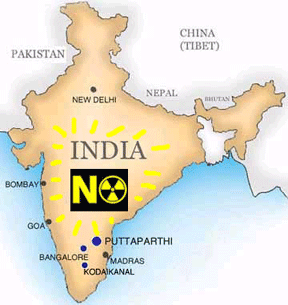 for all of its ambition, and its government’s strident rhetoric, India’s nuclear industry is one beset by problems, both in its current operation and in its plans for expansion.
Emboldened by a global nuclear wariness post-Fukushima, those living nearby to proposed plants are resisting by all means available.
At Kundakalum in Tamil Nadu, rolling protests have slowed construction by years. Violent demonstrations against a proposed mega-plant in Jaitapur (it would be the third largest in the world) have seen hundreds arrested, dozens hurt and one man shot dead by police.
(unfortunate & incorrect title) India depends on a nuclear future The Age, June 22, 2013 Ben Doherty “……India has bold plans for its nuclear industry – 470GW by 2050, Dr Singh says, more than the entire world can produce now – but today, with the lights still flickering out, the country is finding its nuclear ambitions frustrated on every front.
Plans for new power plants are being resisted by violent protest, existing ones are stricken by radiation leaks, and uranium mines are plagued by reports of thievery and smuggling.
And high on a hill in a tiny corner of the country, one woman is holding out against the might of her government’s will. 81-year-old Spility Langrin Lyngdoh has lived in the village of Domiasiat in the Khasi Hills of Meghalaya, longer than modern India has existed.
Her father bought this land decades ago – his grave is a few hundred metres from the home where she now sits – and Spility has spent almost her entire life here. She wants it to remain as a home for her children and grandchildren and great-grandchildren.
But beneath the hills her father bought lies uranium, more than 9,500 tonnes the Indian government estimates, between eight and 47 metres underground: the “largest, richest, near-surface and low-cost sandstone-type uranium deposit discovered in India so far”.
The state-run Uranium Corporation of India Limited is anxious to begin commercial mining as soon as possible. It plans two open-cut mines over 10 square kilometres……
for all of its ambition, and its government’s strident rhetoric, India’s nuclear industry is one beset by problems, both in its current operation and in its plans for expansion.
Security is weak.
Stolen uranium is regularly trafficked in this part of India.
In January, police in Assam recovered a homemade bomb and more than 1.5 kilograms of uranium from members of the separatist militant United Liberation Front of Assam.
In October 2012, six men described by police as “members of an international smuggling gang” were arrested with a pouch of uranium in Sasaram.
The Nuclear Threat Initiative has documented eight cases of theft and attempted trafficking of uranium ore, yellowcake, or low-enriched uranium in India between 2008 and 2011.
“Most instances of uranium theft seem to have occurred at local facilities in the north-eastern states of Assam and Meghalaya,” it says.
The thefts are usually carried out by members of local militias. Most often they know uranium is valuable, and believe they can sell it, but have little knowledge about the material they are smuggling, or the capacity to use it themselves.
In Domiasiat, the exploratory mine is closed, covered by four concrete slabs.
They sit, unmarked and unguarded, in the forest near to Spility’s home.
The bunker that Fairfax visited had been broken into, a small hole had been gouged in one corner, and the concrete pulled away.
India’s operating nuclear plants have a patchy safety record.
In two separate incidents within five weeks last year, 40 workers at the Rajasthan Atomic Power Station in Rawatbhata were exposed to radiation leakages.
The year before, four labourers were irradiated at the Kakrapur Atomic Power Station in Gujarat, and in 2009, plant workers in Karnataka fell ill after radioactive water contaminated their drinking supply.
An auditor-general’s report said India’s Atomic Energy Regulatory Board, is ineffective, mired in bureaucracy, and negligent in monitoring safety.
More than 60 per cent of inspections of operating or under-construction nuclear power plants are either late _ by up to five months _ or never undertaken at all, the report found.
In addition, plans for new reactors and mines are regularly frustrated by bureaucratic delays and fierce public protests.
Emboldened by a global nuclear wariness post-Fukushima, those living nearby to proposed plants are resisting by all means available.
At Kundakalum in Tamil Nadu, rolling protests have slowed construction by years. Violent demonstrations against a proposed mega-plant in Jaitapur (it would be the third largest in the world) have seen hundreds arrested, dozens hurt and one man shot dead by police. ……. http://www.theage.com.au/world/india-depends-on-a-nuclear-future-20130622-2ooyx.html#ixzz2WzwJa7yE
No comments yet.
1 This Month

of the week – Shut Down Drone Warfare!


Tell the Ukrainian Government to Drop Prosecution of Peace Activist Yurii Sheliazhenko

Petition to revoke the licensing of the Near Surface Nuclear Disposal Facility (NSDF) at Chalk River. https://www.ourcommons.ca/petitions/en/Petition/Details?Petition=e-7247
To see nuclear-related stories in greater depth and intensity – go to https://nuclearinformation.wordpress.com
-
Archives
- April 2026 (91)
- March 2026 (251)
- February 2026 (268)
- January 2026 (308)
- December 2025 (358)
- November 2025 (359)
- October 2025 (376)
- September 2025 (257)
- August 2025 (319)
- July 2025 (230)
- June 2025 (348)
- May 2025 (261)
-
Categories
- 1
- 1 NUCLEAR ISSUES
- business and costs
- climate change
- culture and arts
- ENERGY
- environment
- health
- history
- indigenous issues
- Legal
- marketing of nuclear
- media
- opposition to nuclear
- PERSONAL STORIES
- politics
- politics international
- Religion and ethics
- safety
- secrets,lies and civil liberties
- spinbuster
- technology
- Uranium
- wastes
- weapons and war
- Women
- 2 WORLD
- ACTION
- AFRICA
- Atrocities
- AUSTRALIA
- Christina's notes
- Christina's themes
- culture and arts
- Events
- Fuk 2022
- Fuk 2023
- Fukushima 2017
- Fukushima 2018
- fukushima 2019
- Fukushima 2020
- Fukushima 2021
- general
- global warming
- Humour (God we need it)
- Nuclear
- RARE EARTHS
- Reference
- resources – print
- Resources -audiovicual
- Weekly Newsletter
- World
- World Nuclear
- YouTube
-
RSS
Entries RSS
Comments RSS
 nuclear-news
Leave a comment