Nukenomics: shifting nuclear costs from nuclear suppliers to taxpayers
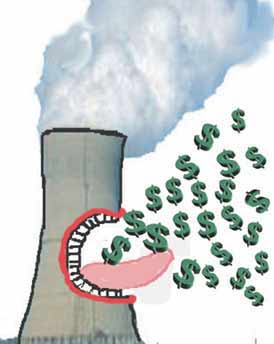 Nuclear Power, Part 2: Nukenomics , By Ned Madden, 14 June 13 TechNewsWorld Can the nuclear industry stand on its own two feet financially? It all depends on whom you ask. “There are plenty of cost estimates out there regarding what a new nuclear power plant will cost — unfortunately, those estimates are speculative. It has been decades since anyone has tried to build a nuclear plant in the United States,” said the Cato Institute’s Jerry Taylor.
There’s no denying that safety and effectiveness are both critical concerns when it comes to nuclear power, and that’s just as true for investors in the technology as it is for those who rely on the energy it generates.
Part 1 of this three-part series describes a new generation of small modular reactor designs whose promise is 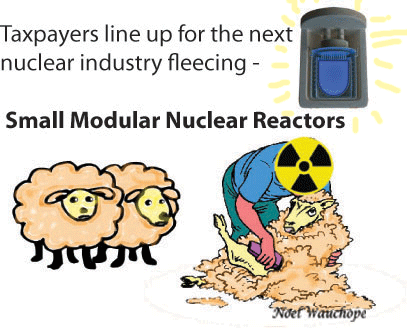 undeniably compelling. What’s less certain, however, is whether they are feasible as a free-market business proposition without current levels of government-backed investment.
That’s the question at the heart of what’s sometimes called “nukenomics,” and it’s a complicated one.
Even giant corporations in the nuclear energy industry are cautious about the fiscal viability of the nuke space. Construction cost estimates for new nuclear power plants are highly uncertain.
Risky Business
However, construction costs are just the beginning. Billions of dollars are spent in operating performance, fuel price, waste disposal and other factors.
Analysis of the economics of nuclear power must take into account who bears the risks of future uncertainties. To date, all operating nuclear power plants worldwide have been subsidized by governments and developed by state-owned or regulated utility monopolies.
Most of the risks associated with nuclear power plants have been borne by taxpayers and ratepayers rather than suppliers, in other words….. “In the U.S. South and Southeast, state legislatures and regulatory commissions provide the assurance of cost recovery necessary for capital-intensive projects,” Kerekes told TechNewsWorld. “They also allow companies to recover financing costs during construction, which eases stress on cash flow and reduces the rate increases necessary when the plant goes into service.”
Only Partial Coverage
Insurance protection is another enormous factor. In accordance with the Price-Anderson Nuclear Industries Indemnity Act of 1957, nuclear power in the U.S. has been granted indemnity from the burden of carrying full third-party insurance liabilities.
The limited insurance that is required does not cover the full multibillion-dollar costs of a major nuclear accident of the sort that occurred at Chernobyl or Fukushima, according to the Union of Concerned Scientists.
In fact, Price-Anderson significantly shifts accident and security risks from industry to taxpayers by limiting the primary insurance a nuclear plant owner is required to carry to $375 million, the UCS charges. In the event of an accident, each nuclear plant owner is assessed a prorated amount for a pool totaling $11.6 billion…… http://www.technewsworld.com/story/78268.html
No comments yet.
1 This Month

of the week – Shut Down Drone Warfare!


Tell the Ukrainian Government to Drop Prosecution of Peace Activist Yurii Sheliazhenko

Petition to revoke the licensing of the Near Surface Nuclear Disposal Facility (NSDF) at Chalk River. https://www.ourcommons.ca/petitions/en/Petition/Details?Petition=e-7247
To see nuclear-related stories in greater depth and intensity – go to https://nuclearinformation.wordpress.com
-
Archives
- April 2026 (68)
- March 2026 (251)
- February 2026 (268)
- January 2026 (308)
- December 2025 (358)
- November 2025 (359)
- October 2025 (376)
- September 2025 (257)
- August 2025 (319)
- July 2025 (230)
- June 2025 (348)
- May 2025 (261)
-
Categories
- 1
- 1 NUCLEAR ISSUES
- business and costs
- climate change
- culture and arts
- ENERGY
- environment
- health
- history
- indigenous issues
- Legal
- marketing of nuclear
- media
- opposition to nuclear
- PERSONAL STORIES
- politics
- politics international
- Religion and ethics
- safety
- secrets,lies and civil liberties
- spinbuster
- technology
- Uranium
- wastes
- weapons and war
- Women
- 2 WORLD
- ACTION
- AFRICA
- Atrocities
- AUSTRALIA
- Christina's notes
- Christina's themes
- culture and arts
- Events
- Fuk 2022
- Fuk 2023
- Fukushima 2017
- Fukushima 2018
- fukushima 2019
- Fukushima 2020
- Fukushima 2021
- general
- global warming
- Humour (God we need it)
- Nuclear
- RARE EARTHS
- Reference
- resources – print
- Resources -audiovicual
- Weekly Newsletter
- World
- World Nuclear
- YouTube
-
RSS
Entries RSS
Comments RSS
 nuclear-news
Leave a comment