Nuclear industry’s call for subsidies for SMRs must be rejected
During times of economic stress, the nuclear industry has a tradition of rushing forth to proclaim a new technology just around the corner will sweep current problems aside. Unfortunately, these visions have an equally long tradition of expensive failure, most often at taxpayers’ expense. The Department of Energy’s efforts to spend taxpayer dollars on Small Modular Reactors will simply continue this legacy of failure and must be rejected.
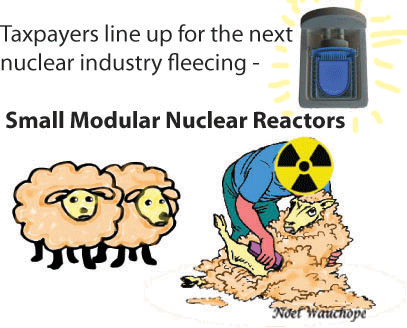 Taxpayer Subsidies for Small Modular Reactors Taxpayers for Common Sense February 27, 2013 Download: Golden Fleece: Taxpayer Subsidies for Small Nuclear Reactors (pdf)
The Department of Energy (DOE) is asking Congress to provide hundreds of millions in subsidies to commercialize small modular reactors (SMR). First proposed in the 2011 budget, the Administration has committed to providing more than $500 million dollars for licensing support and research and development for these downsized nuclear reactors. A fraction of the size of conventional-scale reactors, SMRs would be manufactured by assembly line and transported by truck, ship, or rail to their destinations. With designs ranging in size from one-third the size of a large-scale plant down to the size of a hot tub, SMRs will also produce significantly less power: 300 megawatts electrical (MWe) or less compared to 1,000 MWe for a typical commercial-scale reactor.
SMRs will likely never be a good investment, but in the current fiscal climate taxpayers must be especially concerned with any dollars DOE doles out. High-risk, high-cost, and highly questionable, small modular reactors don’t just look like bad investment they are a ridiculous waste. For a range of reasons, subsidies for SMRs equal nothing more than another handout for the nuclear industry.
SMRs: High-risk, Unknown Costs
To date, there are no reliable cost estimates for SMRs. Nuclear vendors are notorious for underestimating costs, and there is no actual experience manufacturing or building SMRs. Since the 1950s, the nuclear industry worldwide has consistently pushed for larger reactors on the theory the economics would improve if the high fixed costs of building nuclear plants could be spread over more kilowatt hours. SMRs represent a reversal of this reasoning and call into question the extensive federal support now being offered to promote a “nuclear renaissance” based on standardizing and sticking to a few large reactor designs. While commercial scale reactors of 1,000 MWe or greater could cost at least $8 billion, DOE officials have projected the first SMRs will cost approximately $1 billion per 100-150 MWe. When asked about operation and maintenance costs compared to commercial scale reactors, the federally-owned Tennessee Valley Authority (TVA) said it expects it to be higher. The Department of Energy has already provided nearly $100 million for these so-called mini reactors while their commercial viability remains in question. DOE has committed up to $452 million over the next five years in an attempt to fund up to two separate demonstration projects.
Current Applicants Seeking Federal Subsidies……
NRC Not Ready For SMRs…….
Summary: Taxpayer Concerns
In these tight budget times, federal taxpayers cannot afford yet another giveaway to the heavily-subsidized nuclear power industry. Continued taxpayer-backed support for SMR licensing in addition to R&D giveaways amounts to just another subsidy in a suite of federal supports for the nuclear industry. More than 100 reactors operated by 30 companies exist in the United States; the nuclear industry, not federal taxpayers, must lead the way if SMRs are to reach commercial viability.
Even the nuclear industry has said they can move forward without subsidies. Senior Vice President of Holtec International Pierre Oneid said his company aims to commercialize its SMR design whether or not it receives a federal cost-share subsidy.
– James Hammond. “Holtec, NuHub to Partner on Small Reactor Grant.” GSA Business. April 2012.
In the Department of Energy’s materials on SMRs, the agency argues there is a “need and a market” in the United States for SMRs. In reality, no one is clamoring to buy an SMR because there is no assurance the electricity will be remotely competitive with power from other sources. New nuclear power today is uncompetitive by a very wide margin. To compete with today’s natural gas prices, SMRs would have to produce electricity at half the projected cost of conventional reactors. There is not the slightest indication they can do so.
During times of economic stress, the nuclear industry has a tradition of rushing forth to proclaim a new technology just around the corner will sweep current problems aside. Unfortunately, these visions have an equally long tradition of expensive failure, most often at taxpayers’ expense. The Department of Energy’s efforts to spend taxpayer dollars on Small Modular Reactors will simply continue this legacy of failure and must be rejected. http://www.taxpayer.net/library/article/taxpayer-subsidies-for-small-modular-reactors
No comments yet.
1 This Month

of the week – Shut Down Drone Warfare!


Tell the Ukrainian Government to Drop Prosecution of Peace Activist Yurii Sheliazhenko

Petition to revoke the licensing of the Near Surface Nuclear Disposal Facility (NSDF) at Chalk River. https://www.ourcommons.ca/petitions/en/Petition/Details?Petition=e-7247
To see nuclear-related stories in greater depth and intensity – go to https://nuclearinformation.wordpress.com
-
Archives
- April 2026 (68)
- March 2026 (251)
- February 2026 (268)
- January 2026 (308)
- December 2025 (358)
- November 2025 (359)
- October 2025 (376)
- September 2025 (257)
- August 2025 (319)
- July 2025 (230)
- June 2025 (348)
- May 2025 (261)
-
Categories
- 1
- 1 NUCLEAR ISSUES
- business and costs
- climate change
- culture and arts
- ENERGY
- environment
- health
- history
- indigenous issues
- Legal
- marketing of nuclear
- media
- opposition to nuclear
- PERSONAL STORIES
- politics
- politics international
- Religion and ethics
- safety
- secrets,lies and civil liberties
- spinbuster
- technology
- Uranium
- wastes
- weapons and war
- Women
- 2 WORLD
- ACTION
- AFRICA
- Atrocities
- AUSTRALIA
- Christina's notes
- Christina's themes
- culture and arts
- Events
- Fuk 2022
- Fuk 2023
- Fukushima 2017
- Fukushima 2018
- fukushima 2019
- Fukushima 2020
- Fukushima 2021
- general
- global warming
- Humour (God we need it)
- Nuclear
- RARE EARTHS
- Reference
- resources – print
- Resources -audiovicual
- Weekly Newsletter
- World
- World Nuclear
- YouTube
-
RSS
Entries RSS
Comments RSS
 nuclear-news
Leave a comment