Snapshots of the latest nuclear news

Christina Macpherson’s websites & blogs
Iraq. A 2012 World Health Organization study on congenital birth defects in Iraq has still not been released to the public. Why not?
USA. California’s San Onofre nuclear power plant to stay closed permanently. The closure of this plant, near to 60 million people, is a landmark event for the (lack of?) future of the nuclear industry. It follows fast on 3 other USA nuclear plants shutting down. The reasons for these closures are economic. But in the case of San Onofre, it is largely the result of a sustained, well organised, and well supported citizen campaign. Huge radioactive waste problems remain at San Onofre. Decommissioning will take 50 years.Also a big challenge to supply electricity by other means – especially renewable energy.
Japan’s Prime minister is on a drive to export Japan’s nuclear technology, to Poland, Czech Republic, Turkey. Middle East – anybody really. Meanwhile his wife, Akie, has spoken out against nuclear power, and in favour of Japan exporting clean energy technology.
Fukushima. Grim news coming out about shortage of workers for the Fukushima cleanup. Experienced workers are reaching their radiation dose limit. Radiation cleanup workers prefer work elsewhere. If Japan goes ahead with nuclear power, and exporting nuclear technology, the Fukushima shortage will become even more critical. Cleanup will take 50 years at the very minimum.
India. Nuclear power plans for Kovvada and surrounding villages have stalled, due to huge opposition from local villagers.
UNSCEAR’s skewed message about Fukushima radiation
 Fukushima and the nuclear industry’s fight against fear, Independent Australia, 12 June 13, Now that the Fukushima meltdown has faded from public consciousness, says Noel Wauchope, the nuclear industry is trying to persuade the world there is nothing to fear from fission.“…… how come that the World Nuclear Association and the media can be so confident that the main task now is to overturn that unwarranted fear?
They are relying largely on phone interviews with some members of The United Nations Scientific Committee on the Effects of Atomic Radiation (UNSCEAR) ― notably UNSCEAR chair, Wolfgang Weiss. On 31 May, UNSCEAR released ‒ not an extensive official report ‒ but a brief preliminary report on Fukushima radiation and health ― the full report will be presented at the United Nations in October this year. The world press has been quoting this statement from this unofficial UNSCEAR press release
‘It is unlikely to be able to attribute any health effects in the future among the general public and the vast majority of workers.’ But the World Health Organisation’s comprehensive report (February 2013) concluded that an increased rate of breast cancer is to be expected in future years amongst women who were children when exposed to low level Fukushima radiation. It also predicted increased leukaemia amongst Fukushima clean-up workers.
If you dissect the UNSCEAR statement, you can see how very carefully it is worded so that it does not contradict the World Health Organisation. Continue reading
“I am anti nuclear” says Akie Abe, wife of Japan Prime Minister
 Japan’s first lady says she is ‘anti-nuclear’ Capital News, By AFP | June 11, 2013 TOKYO, – The wife of Japan’s pro-business Prime Minister Shinzo Abe does not like nuclear power and would rather her husband’s government did not try to export it, she said in a speech.
In comments that appear to run against the grain of government thinking, which is increasingly moving towards switching mothballed reactors back on, Akie Abe said Japan should press on instead with renewables. “I feel bad that Japan is trying to sell nuclear power plants overseas because I am anti-nuclear,” she said in a closed-door speech last Thursday at an event organised by a non-profit group that supports farming communities….. despite vocal public opposition, the prime minister has said he wants to restart units when they are proven safe.
And his recently-unveiled bid to treble Japan’s infrastructure exports to 30 trillion yen ($300 billion) a year as part of an effort to boost the economy, will almost certainly have to include nuclear reactors……
After talks in Tokyo on Friday, Abe and French President Francois Hollande said they would cooperate in developing nuclear power technologies and promoting the sector’s exports to emerging economies. http://www.capitalfm.co.ke/news/2013/06/japans-first-lady-says-she-is-anti-nuclear/
Decommissioning Fukushima nuclear reactors will take 50 years at the very least
 Stricken nuke plant struggles on, Yahoo 7 Finance, AAP Jun 10, 2013 “……Experts, including even the most optimistic government officials, say decommissioning Fukushima Dai-ichi will take nearly a half-century.
TEPCO acknowledges that the exact path to decommissioning remains unclear because an assessment of the state of the melted reactor cores has not yet been carried out. Since being brought under control following the disaster, the plant has suffered one setback after another.
A dead rat caused a power blackout, including temporarily shutting down reactor-cooling systems, and leaks required tons of water to be piped into hundreds of tanks and underground storage areas.
The process of permanently shutting down the plant hasn’t gotten started yet and the work up to now has been one makeshift measure after another to keep the reactors from deteriorating.
Thousands of spent nuclear fuel rods that are outside the reactors also have to be removed and safely stored. Taking them out is complex because the explosions at the plant have destroyed parts of the structure used to move the rods under normal conditions. The process of taking out the rods, one by one, hasn’t even begun yet. The spent rods have been used as fuel for the reactors but remain highly radioactive…….”.http://au.finance.yahoo.com/news/stricken-nuke-plant-struggles-000105277.html
Demolishing San Onofre nuclear plant – 50 years and $billions in costs
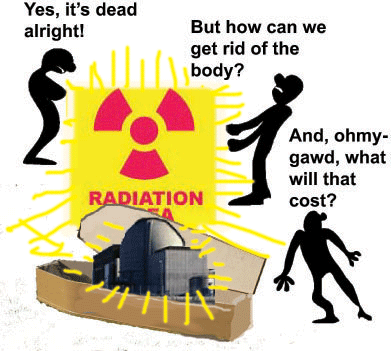 A long cooling-off period for San Onofre nuclear plant http://articles.latimes.com/2013/jun/08/local/la-me-san-onofre-nuclear-20130609 Tearing down San Onofre’s two nuclear reactors will be a technically complex job completed over decades. It’s likely Southern California Edison will first mothball the plant.|By Ralph Vartabedian, Los Angeles Times
Southern California Edison built San Onofre’s two nuclear reactors in about nine years, but tearing them down will be a technically complex, multibillion-dollar job completed over decades. It is likely that Edison first will mothball the plant, which under federal rules could keep its imposing imprint on the Orange-San Diego County coastline for another half-century.
When the plant does come down, it will be a massive job.
Tons of highly radioactive fuel now stored in pools will have to cool before the rods can be moved to concrete pads outdoors. Giant pipes that extend more than a mile into the ocean will have to come out. Pieces of the reactors will have to be cut with special saws and torches that reach 20 feet into the vessels’ cooling water. Continue reading
Nuclear energy sector may be permanently discredited over San Onofre debacle
 Southern California Edison’s Problems Ensnare Entire Nuclear Energy Sector Forbes, Ken Silverstein, 11 June 13 The nuclear energy sector has taken a blow now that Southern CaliforniaEdison has decided to permanently close its troubled nuclear plant. Safety is a key concern. But so is honesty and transparency. “….. nuclear energy experts are telling this reporter that the episode at SONGS does not boost confidence in the industry or its quality assurance processes. That will all come into play as the utilities seek to renew their older operating licenses. As a practical matter, the industry’s leading voice, the Nuclear Energy Institute, has remained mum on the subject, as has its leading utilities: Exelon EXC -0.61% Corp., Duke Energy, Dominion Resources and Entergy Corp….. the utility estimates that the decommissioning cost will run $2.7 billion, of which 90 percent has already been set aside. Basically, the spent fuel rods must first be cooled in pools of water before they will be stored in above-ground concrete-encased steel casks.
Overall, the price tag associated with the shutdown of SONGS is estimated to be $700 million. Chairman Craver explains that four potential pots of money exists from which to pay that cost: ratepayers, shareholders, insurance companies and Mitsubishi Heavy…..
it is not the decommissioning of the facility that is the big news; rather, it is the events leading up to that closure, which have culminated in criminal and civil inquiries as to whether the utility has been forthright and above board.
Ultimately, it could all settle and allow life at Southern California Edison to normalize. But the same may not hold true for the overall nuclear sector, which has been blemished by the lack of candor and communications..
International Atomic Energy Agency’s control over UNSCEAR and WHO
Fukushima and the nuclear industry’s fight against fear, Noel Wauchope, Independent Australia, 12 June 13,“……..We should also bear in mind the relationship between both the World Health Organisation and UNSCEAR to the International Atomic Energy Agency.
The World Health Organisation is bound by an agreement with the IAEA. A clause of this agreement says the WHO effectively grants the right of prior approval over any research it might undertake or report on to the IAEA
 UNSCEAR is also subservient to the IAEA. Every UNSCEAR report must be specifically approved by the IAEA. UNSCEAR’s membership is largely from the nuclear industry. Its chairman, Wolfgang Weiss, is a boss on Euratom which, according to Wikipedia, is
‘… an international organisation founded in 1958 with the purpose of creating a specialist market for nuclear power in Europe, developing nuclear energy and distributing it to its member states while selling the surplus to non-member states.’
The IAEA itself has as its founding brief:
‘The agency shall seek to accelerate and enlarge the contribution of atomic energy to peace, health and prosperity through the world.’……”
Crisis developing as shortage of Fukushima clean-up workers gets worse
“We’re headed toward a real crisis “
Under the worst scenario, experienced workers capable of supervising the work will be gone as they reach their radiation-exposure limits
Stricken nuke plant struggles on, Yahoo 7 Finance, AAP Jun 10, 2013 Keeping the meltdown-stricken Fukushima nuclear plant in north-eastern Japan in stable condition requires a cast of thousands.
Increasingly the plant’s operator is struggling to find enough workers, a trend that many expect to worsen and hamper progress in the decades-long effort to safely decommission it.
Tokyo Electric Power Co (TEPCO), the utility that runs the Fukushima Dai-ichi plant that melted down in March 2011 after being hit by a tsunami, is finding that it can barely meet the headcount of workers required to keep the three broken reactors cool while fighting power outages and leaks of tons of radiated water, said current and former nuclear plant workers and others familiar with the situation at Fukushima…….less risky, better paid decontamination projects in the region irradiated by the Fukushima meltdown are another draw.
Some Fukushima veterans are quitting as their cumulative radiation exposure approaches levels risky to health, said two long-time Fukushima nuclear workers who spoke to The Associated Press.
They requested anonymity because their speaking to the media is a breach of their employers’ policy and they say being publicly identified will get them fired………….. Continue reading
Patterns of Fukushima radiation in Northern hemisphere
 Study: Fukushima fuel burn-up spread over entire northern hemisphere’s middle latitudes — First time measured in southern hemisphere http://enenews.com/study-fukushima-fuel-burn-up-dispersed-over-entire-northern-hemispheres-middle-latitudes-first-time-also-measured-in-southern-hemisphere
Title: An overview of Fukushima radionuclides measured in the northern hemisphere
Source: Science of The Total Environment
Author: P. Thakura, S. Ballard, R. Nelson
Date: August 1, 2013
Abstract
The Great East Japan Earthquake and tsunami on March 11, 2011 resulted in the tragic accident at the Fukushima Nuclear Power Plant (NPP) and subsequently uncontrolled release of radioactive contaminants into the atmosphere. This review article attempts to compile and interpret data collected by various national and international monitoring networks in response to the Fukushima releases across the northern hemisphere. The majority of the releases occurred during the period March 12–22 with a maximum release phase from March 14–17, 2011. The radioactivity released was dominated by volatile fission products including isotopes of the noble gases (xenon and krypton), iodine, cesium, and tellurium. The radioactive gases and particles released in the accident were dispersed over the middle latitudes of the entire northern hemisphere and for the first time also measured in the southern Hemisphere. Isotopes of iodine and cesium were detected in air, water, milk and food samples collected across the entire northern hemisphere. Elevated levels of fission products were detected from March to May 2011 at many locations over the northern hemisphere.
This article focuses on the most prevalent cesium and iodine isotopes, but other secondary isotopes are also discussed. Spatial and temporal patterns and differences are contrasted. The activity ratios of 131I/137Cs and 134Cs/137Cs measured at several locations are evaluated to gain an insight into the fuel burn-up, the inventory of radionuclides in the reactor and the isotopic signature of the accident. It is important to note that all of the radiation levels detected outside of Japan have been very low and are well below any level of public and environmental hazard. Full study available here
Radioactive cesium greatly increased in Fukushima coastal areas
 Study: Huge spike in cesium outside Fukushima long after 3/11 — “Incorporation into sediments was almost irreversible”http://enenews.com/study-huge-spike-in-cesium-outside-fukushima-long-after-311-incorporation-into-sediments-was-almost-irreversible
Title: Sedimentation and remobilization of radiocesium in the coastal area of Ibaraki, 70 km south of the Fukushima Dai-ichi Nuclear Power Plant
Source: Environmental Monitoring and Assessment
Author: Shigeyoshi Otosaka, Takuya Kobayashi
Date: July 2013, Volume 185, Issue 7, pp 5419-5433
Sedimentation and remobilization processes of radiocesium were investigated from time-series observations at nine stations in the coastal area of Ibaraki, 70–110 km south of the Fukushima Dai-ichi Nuclear Power Plant (1FNPP). Sediment samples were collected four times between June 2011 and January 2012, and concentrations of radiocesium as well as sediment properties such as grain size and elemental compositions were analyzed. […] The incorporation of radiocesium into sediments was almost irreversible […] Full study here
Future of American nuclear industry hangs on Vogtle new nuclear plant construction
Nuclear power could become a bypassed technology — like moon landings, Polaroid photos and cassette tapes……..
with construction now roughly one-third complete, it is clear that much is not going as planned, and that the schedule — which is closely linked to cost because of growing interest expense on the incomplete asset — has slipped by at least 14 months and possibly more…

The reason that utilities choose nuclear plants, is that they can collect profits on their investments. In Georgia they can do so even before the plant is finished.
Nuclear Power’s Future May Hinge on Georgia Project NYT, By MATTHEW L. WALD June 11, 2013WAYNESBORO, Ga. — The two nuclear reactors rising out of the red Georgia clay here, twin behemoths of concrete and steel, make up one of the largest construction projects in the United States and represent a giant bet that their cost – in the range of $14 billion – will be cheaper than alternatives like natural gas. But something else is at stake with the reactors called Vogtle 3 and 4: the future of the American nuclear industry itself. Continue reading
Uranium market looking sicker than ever
 Spot uranium drops below US $40.lb 9 News Finance, 11 June 13 – Uranium spot price falls below US$40/lb – Spot market slow – Activity, but no sales in term markets.. By Andrew Nelson Stubborn uranium sellers have been holding off speculative buyers for a while now, unwilling to drop prices to get deals done. Consumers, on the other hand, have little short term requirement and many are out there cherry picking the market. That has been the way of things for quite a while now, that is until last week.
There were only four sales booked in the spot market last week, which saw 500,000 pounds of U308 change hands. More importantly, sellers finally started to buckle in their resolve and in turn, the spot price fell below what has been key psychological support at US$40/lb. This is the first time we’ve seen sub 40 price since March 2006…..with the price dropping to US$39.75/lb, one wonders whether the drop, at least in psychological terms, will turn into something much greater. US$40 has been tested time and time again, and now it’s finally been broken.
TradeTech reports that current spot demand remains thin and the only way to conclude deals at the moment is to drop prices, grin and bear it. …
no new transactions were concluded, leaving TradeTech’s Mid-Term U3O8 Price Indicator at US$44.00/lb, while the Long-Term Price Indicator was flat at US$57.00/lb.
There are still a number of analysts out there spruiking …. http://finance.ninemsn.com.au/newscolumnists/other/8672944/spot-uranium-drops-below-us40-lb
Concern over radiation risks in CT scans for children
 more research is urgently needed to determine when CT in pediatrics can lead to improved health outcomes and whether other imaging methods (or no imaging) could be as effective. For now, it is important for both the referring physician and the radiologist to consider whether the risks of CT exceed the diagnostic value it provides over other tests, based on current evidence,”
Study Examines Cancer Risk from Pediatric Radiation Exposure from CT Scans http://www.sciencedaily.com/releases/2013/06/130610192536.htm June 10, 2013 — According to a study of seven U.S. healthcare systems, the use of computed tomography (CT) scans of the head, abdomen/pelvis, chest or spine, in children younger than age 14 more than doubled from 1996 to 2005, and this associated radiation is projected to potentially increase the risk of radiation-induced cancer in these children in the future, according to a study published Online First byJAMA Pediatrics. The use of CT in pediatrics has increased over the last two decades. The ionizing radiation doses delivered by the tests are higher than convention radiography and are in ranges that have been linked to an increased risk of cancer. Children are more sensitive to radiation-induced carcinogenesis and have many years of life left for cancer to develop, the authors write in the study background.
“The increased use of CT in pediatrics, combined with the wide variability in radiation doses, has resulted in many children receiving a high-dose examination,” the study notes.
Diana L. Miglioretti, Ph.D., of the Group Health Research Institute and University of California, Davis, and colleagues quantified trends in the use of CT in pediatrics plus the associated radiation exposure and estimated potential cancer risk using data from seven U.S. health care systems. Continue reading
Canada’s Harper govt increases nuclear operators’ liability to just $1 billion
Nuclear power plants to be on the hook for $1-billion in event of meltdown GLORIA GALLOWAY OTTAWA — The Globe and Mail, Jun. 10 2013, The Harper government says Canada’s nuclear operators should not have to pay more than a billion dollars in total compensation in the event of a catastrophic incident at one of their reactors.
Natural Resources Minister Joe Oliver said Monday he will introduce legislation in the fall to increase the liability limit from the current $75-million – an amount set four decades ago and one that is widely recognized to be grossly inadequate….. http://www.theglobeandmail.com/news/politics/nuclear-power-plants-to-be-on-the-hook-for-1-billion-in-event-of-meltdown/article12446956/
San Onofre nuclear closure an added blow to nuclear industry’s investment hopes
 “It’s difficult to get Wall Street to loan money against so much uncertainty,” “The four closures this year make Wall Street more apprehensive, not less apprehensive.”
Other facilities are nearing the end of their projected lifespans and may need costly renovations while cheap natural gas has siphoned off market share. Potentially expensive regulations to bolster safety in response to a triple meltdown at Japan’s Fukushima Dai-Ichi plant in 2011 have raised the concerns of investors.
“The decision to shut down San Onofre is another sign that the economics of nuclear are under pressure given the low cost of alternative sources,” Travis Miller, a Chicago-based analyst forMorningstar Inc. (MORN), said in a phone interview. “Just five years ago, nuclear power plants looked like a gold mine.”…..
Dominion Resources Inc. (D) and Duke Energy Corp. (DUK) have announced in recent months that they will retire a unit each. Exelon Corp. (EXC) of Chicago plans to shut its 44-year-old Oyster Creek reactor, the oldest in the U.S. fleet, at the end of 2019.
The economic climate, coupled with an increase in renewable energy sources like solar and wind generation, may not bode well for new units, said David Lochbaum, director of the Nuclear Safety Project for the Union of Concerned Scientists, a Cambridge, Massachusetts-based environmental group.
“It’s difficult to get Wall Street to loan money against so much uncertainty,” he said in a phone interview. “The four closures this year make Wall Street more apprehensive, not less apprehensive.”…….
“The decision to shut down rather than retrofit the San Onofre nuclear plant shows the changing economics of the power market,” Howard Learner, executive director of the Environmental Law and Policy Center, a Chicago-based advocate of cleaner energy, said in a telephone interview. “We suspect other nuclear plant owners may start reaching the same decision.” http://www.bloomberg.com/news/2013-06-10/san-onofre-seen-as-latest-setback-for-u-s-nuclear-power.html
1 This Month

of the week – Shut Down Drone Warfare!


Tell the Ukrainian Government to Drop Prosecution of Peace Activist Yurii Sheliazhenko

Petition to revoke the licensing of the Near Surface Nuclear Disposal Facility (NSDF) at Chalk River. https://www.ourcommons.ca/petitions/en/Petition/Details?Petition=e-7247
To see nuclear-related stories in greater depth and intensity – go to https://nuclearinformation.wordpress.com
-
Archives
- April 2026 (103)
- March 2026 (251)
- February 2026 (268)
- January 2026 (308)
- December 2025 (358)
- November 2025 (359)
- October 2025 (376)
- September 2025 (257)
- August 2025 (319)
- July 2025 (230)
- June 2025 (348)
- May 2025 (261)
-
Categories
- 1
- 1 NUCLEAR ISSUES
- business and costs
- climate change
- culture and arts
- ENERGY
- environment
- health
- history
- indigenous issues
- Legal
- marketing of nuclear
- media
- opposition to nuclear
- PERSONAL STORIES
- politics
- politics international
- Religion and ethics
- safety
- secrets,lies and civil liberties
- spinbuster
- technology
- Uranium
- wastes
- weapons and war
- Women
- 2 WORLD
- ACTION
- AFRICA
- Atrocities
- AUSTRALIA
- Christina's notes
- Christina's themes
- culture and arts
- Events
- Fuk 2022
- Fuk 2023
- Fukushima 2017
- Fukushima 2018
- fukushima 2019
- Fukushima 2020
- Fukushima 2021
- general
- global warming
- Humour (God we need it)
- Nuclear
- RARE EARTHS
- Reference
- resources – print
- Resources -audiovicual
- Weekly Newsletter
- World
- World Nuclear
- YouTube
-
RSS
Entries RSS
Comments RSS
 nuclear-news