USA government push for nuclear energy has ended in failure
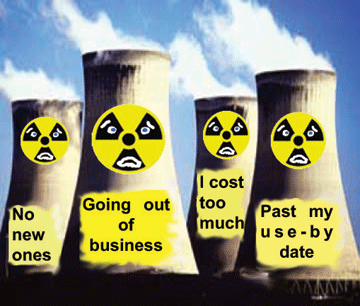 It was not supposed to be this way. In 2005 Congress approved subsidies to bolster the nuclear industry and encourage the construction of new plants. It extended a law limiting owner liability in case of accidents and, for the first few new reactors, offered $18 billion in loan guarantees, $2 billion in indemnification against cost overruns and $1 billion in tax breaks.
The NRC streamlined its licensing procedures, hoping to avoid the years of delays that inflated costs for earlier nuclear plants. (Southern ended up paying $8.7 billion for the existing reactors at Vogtle, a far cry from the $660m originally projected.)
None of this has worked as advertised.
Fracked off Thanks to cheap natural gas, America’s nuclear renaissance is on hold The Economist, Jun 1st 2013 | BURKE COUNTY, GEORGIA IT IS the sort of thing you would expect to see in China, not in the pine forests of rural Georgia. On the banks of the sluggish Savannah river towers one of the world’s biggest cranes. It is helping build two nuclear reactors, to add to the two already up and running at the Vogtle power plant. It testifies to the mammoth efforts that have been made in recent years to revive America’s nuclear industry—and to the disappointing results.
The half-built reactors at Vogtle are the first new ones to be
approved in America since 1979, when a radioactive leak from Three
Mile Island, a nuclear plant in Pennsylvania, ruined the industry’s
already troubled reputation. A consortium of local utilities is paying
for the plant; Westinghouse, a subsidiary of Toshiba, a Japanese
conglomerate, designed the reactors and is helping build them. It is
one of the biggest infrastructure projects in the country, according
to Southern Company, a utility which owns 46% of the new
plant…….All this is impressive, but Vogtle and two more reactors
being built across the river in South Carolina are the last vestiges
of what was heralded, four or five years ago, as America’s “nuclear
renaissance”.
Renaissance postponed
The Nuclear Regulatory Commission (NRC) has received applications for
24 more reactors, to add to the 104 already running (see table). But
none is likely to be built soon. Some are backed by consortia that
have fallen apart; others have been withdrawn. In early May, for
example, Duke Energy, another utility, told the NRC, which must
approve new plants, that it was calling off two of the six reactors it
had planned. Far from building new reactors, utilities are closing
existing ones. Also in May, Dominion power shut a nuclear plant in
Wisconsin that was licensed for another 20 years, “based purely on
economics”.
The culprit is the price of natural gas, which fell from over $13 per
million British thermal units in 2008, when many of the applications
to build new nuclear plants were lodged, to just $2 last year.
Although it has since recovered to over $4, America’s huge reserves of
shale gas should stop it from rising much for years to come. That
makes some old nuclear plants costlier to run than gas-fired ones.
Factoring in the massive expense of building new reactors—the pair at
Vogtle will cost around $15 billion—makes nuclear power even less
competitive. David Crane, the boss of NRG Energy, which scrapped plans
to build two reactors in Texas in 2011 after sinking $331m into the
project, estimates that new gas-fired generation costs $0.04 per
kilowatt-hour, against at least $0.10 for nuclear.
It was not supposed to be this way. In 2005 Congress approved subsidies to bolster the nuclear industry and encourage the
construction of new plants. It extended a law limiting owner liability in case of accidents and, for the first few new reactors, offered $18
billion in loan guarantees, $2 billion in indemnification against cost overruns and $1 billion in tax breaks. The NRC streamlined its
licensing procedures, hoping to avoid the years of delays that inflated costs for earlier nuclear plants. (Southern ended up paying
$8.7 billion for the existing reactors at Vogtle, a far cry from the $660m originally projected.)
None of this has worked as advertised. Because the subsidies are
short-lived, the NRC has been swamped with applications, which it has
processed more slowly than it had hoped. It has quarrelled with the
Vogtle consortium over the design, causing unexpected costs and
delays. The plant is now perhaps 18 months behind schedule and $737m
over budget. That does not include a further $900m that is the subject
of legal dispute, plus the extra financing costs that will come with
these overruns. Meanwhile, the consortium is struggling to agree on
the terms of loan guarantees with the Department of Energy and says it
may not take them up at all…….
Then there is the question of what to do with spent nuclear fuel.
Barack Obama’s energy department scrapped a plan to bury the stuff in
Nevada. (After careful study, it realised that the Senate majority
leader is from that state.) It has not proposed an alternative. The
nuclear accident in Japan in 2011 has made investors more nervous
about nuclear power. Politicians have done little to address such
fears, but continue to insist that America needs an “all-of-the-above”
energy policy.http://www.economist.com/news/united-states/21578690-thanks-cheap-natural-gas-americas-nuclear-renaissance-hold-fracked
No comments yet.
1 This Month

Petition to revoke the licensing of the Near Surface Nuclear Disposal Facility (NSDF) at Chalk River. https://www.ourcommons.ca/petitions/en/Petition/Details?Petition=e-7247


of the week – STOP SMALL MODULAR REACTORS IN CANADA
To see nuclear-related stories in greater depth and intensity – go to https://nuclearinformation.wordpress.com
-
Archives
- March 2026 (153)
- February 2026 (268)
- January 2026 (308)
- December 2025 (358)
- November 2025 (359)
- October 2025 (376)
- September 2025 (258)
- August 2025 (319)
- July 2025 (230)
- June 2025 (348)
- May 2025 (261)
- April 2025 (305)
-
Categories
- 1
- 1 NUCLEAR ISSUES
- business and costs
- climate change
- culture and arts
- ENERGY
- environment
- health
- history
- indigenous issues
- Legal
- marketing of nuclear
- media
- opposition to nuclear
- PERSONAL STORIES
- politics
- politics international
- Religion and ethics
- safety
- secrets,lies and civil liberties
- spinbuster
- technology
- Uranium
- wastes
- weapons and war
- Women
- 2 WORLD
- ACTION
- AFRICA
- Atrocities
- AUSTRALIA
- Christina's notes
- Christina's themes
- culture and arts
- Events
- Fuk 2022
- Fuk 2023
- Fukushima 2017
- Fukushima 2018
- fukushima 2019
- Fukushima 2020
- Fukushima 2021
- general
- global warming
- Humour (God we need it)
- Nuclear
- RARE EARTHS
- Reference
- resources – print
- Resources -audiovicual
- Weekly Newsletter
- World
- World Nuclear
- YouTube
-
RSS
Entries RSS
Comments RSS
 nuclear-news
Leave a comment