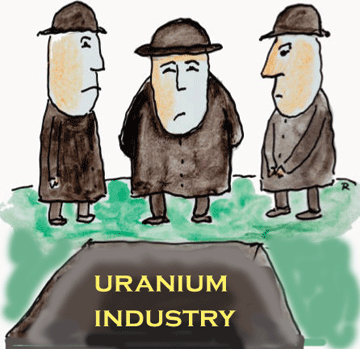
URENCO might die, in failing global uranium industry
 one of the more important factors, surely, is the projected value of the MOX itself, which in turn is a function of long term uranium prices—there would be no point in completing the plant and then making the MOX, as opposed to just dumping the plutonium, if uranium will be dirt-cheap as far ahead as one can see.
the fate of the MOX plant is but one indicator of retrenchment in the global nuclear fuels market, post-Fukushima
the Japanese nuclear shut-down, which, the Times went on to note, has reduced global demand for nuclear fuels by close to 10 percent, plus Germany’s planned nuclear exit, have cast a pall that now stretches to New Mexico,
Kentucky, and South Carolina.
Restructuring and Retrenchment in Nuclear Fuels http://spectrum.ieee.org/energywise/energy/nuclear/restructuring-and-retrenchment-in-nuclear-fuels By Bill Sweet 29 May 2013 In 2000, the United States agreed with Russia to get rid of 34 tons of weapons-grade plutonium. To that end, it embarked on construction of a large plant at Savannah River, S.C.,where the plutonium would be mixed with uranium to make so-called mixed oxide fuel (MOX), suitable for use in nuclear power plants.
Buried in the president’s fiscal 2014 budget request is a line sharply cutting funding for the Savannah River MOX plant, which “may be tantamount to killing it,” a former National Nuclear Security Administration official told Arms Control Today.
The Obama administration is telling Russia that its commitment to
disposing of the excess plutonium is not at issue as such. The United
States may for example opt instead to mix the plutonium with
high-level reactor wastes and ultimately put it in a geological
repository. In any event, real money is at stake: The anticipated
total cost of the MOX facility under construction has ballooned from
$4.8 billion to $7.7 billion, and the expected commissioning of the
plant has slid from 2016 to 2019.
In a project of this scope, many factors obviously are in play, and
the administration has not to our knowledge disclosed in detail why it
is reconsidering the plant. But one of the more important factors, surely, is the projected value of the MOX itself, which in turn is a function of long term uranium prices—there would be no point in completing the plant and then making the MOX, as opposed to just dumping the plutonium, if uranium will be dirt-cheap as far ahead as one can see.
So, from that point of view, the fate of the MOX plant is but one indicator of retrenchment in the global nuclear fuels market, post-Fukushima. Last Friday, the operator of the only American-owned
uranium enrichment plant in the United States announced that its
sprawling Paducah, Kentucky, facility will close for good next month .
The decision is no surprise as such, as the plant employs highly
inefficient and obsolete gaseous diffusion technology, invented during
the Manhattan Project years. But in a booming world market for nuclear
fuels, even a relic like this might have hung on longer.
Three years ago, a state-of-the-art centrifuge enrichment plant in
Eunice, N.M., started operations, though it is is only partially
built. (Eventually it will have enough capacity to supply about half
the reactors in the United States at any one time.) It is being built
and operated by Urenco USA, the North American branch of the European
enrichment consortium. But the consortium, which has been the world
leader in enrichment for many decades, is itself for sale. Its
co-owners—basically the British and Dutch governments, and two top
German utilities—each for its own complicated reasons, wants out.
Urenco is, to be sure, still highly profitable. “Besides fuel,
Urenco’s centrifuges spin off fairly good money: revenue of €1.6
billion (about $2.1 billion last year), yielding earnings of €402
million, for a profit margin of 25 percent,” The New York Times
reported this week. “And its order book stands at €18 billion, which
translates to at least 10 years of steady work. Analysts estimate
Urenco’s market value at about €10 billion.” But the Japanese nuclear shut-down, which, the Times went on to note, has reduced global demand for nuclear fuels by close to 10 percent, plus Germany’s planned nuclear exit, have cast a pall that now stretches to New Mexico,
Kentucky, and South Carolina.
No comments yet.
1 This Month

of the week – Shut Down Drone Warfare!


Tell the Ukrainian Government to Drop Prosecution of Peace Activist Yurii Sheliazhenko

Petition to revoke the licensing of the Near Surface Nuclear Disposal Facility (NSDF) at Chalk River. https://www.ourcommons.ca/petitions/en/Petition/Details?Petition=e-7247
To see nuclear-related stories in greater depth and intensity – go to https://nuclearinformation.wordpress.com
-
Archives
- April 2026 (103)
- March 2026 (251)
- February 2026 (268)
- January 2026 (308)
- December 2025 (358)
- November 2025 (359)
- October 2025 (376)
- September 2025 (257)
- August 2025 (319)
- July 2025 (230)
- June 2025 (348)
- May 2025 (261)
-
Categories
- 1
- 1 NUCLEAR ISSUES
- business and costs
- climate change
- culture and arts
- ENERGY
- environment
- health
- history
- indigenous issues
- Legal
- marketing of nuclear
- media
- opposition to nuclear
- PERSONAL STORIES
- politics
- politics international
- Religion and ethics
- safety
- secrets,lies and civil liberties
- spinbuster
- technology
- Uranium
- wastes
- weapons and war
- Women
- 2 WORLD
- ACTION
- AFRICA
- Atrocities
- AUSTRALIA
- Christina's notes
- Christina's themes
- culture and arts
- Events
- Fuk 2022
- Fuk 2023
- Fukushima 2017
- Fukushima 2018
- fukushima 2019
- Fukushima 2020
- Fukushima 2021
- general
- global warming
- Humour (God we need it)
- Nuclear
- RARE EARTHS
- Reference
- resources – print
- Resources -audiovicual
- Weekly Newsletter
- World
- World Nuclear
- YouTube
-
RSS
Entries RSS
Comments RSS
 nuclear-news
Leave a comment