Upsurge of phytoplankton observed near the Japan deep
Posted by Mochizuki on May 30th, 2013
According to Japan Agency for Marine-Earth Science and Technology, Cs-134 was detected from 7300m deep in the Pacific only 4 months after the Fukushima nuclear accident.
The location is in approximately 115km east from the epicenter, 4.9km east from the trench axis of the Japan Deep.
From their press release of 5/29/2013, 20 Bq/Kg of Cs-134 was measured from the the sea ground sediment (0~1cm depth) in July of 2011. It proves the Fukushima contamination reached 7300m deep in the Pacific detecting Cs-134.
They observed the upsurge of phytoplankton around the Japan deep from late March to early April in 2011. They assume Cs-134 fell down with the mass of marine snow.
Also, at the point of 110km east from the epicenter, they observed the local strong current with a certain direction. Due to this strong current, dead bodies of sea creatures and the sorts of fish that can’t fix themselves at one location were carried to the deeper area. Almost no living benthos was found.
At both of the 110km area and 115km area, they observed mineral particles causing seawater extraordinary unclear. The thickness of the unclear layers were 30m and 50m in each.
http://www.jamstec.go.jp/j/about/press_release/20130529/
Iori Mochizuki
The real problem behind Fukushima accident was “Everyone wanted a LIE.”
Fukushima accident was physically an end. However, it was socially nothing but a check point. As time passes, it’s becoming clear.
By taking advantage of their old brand as “hardworking and honest”, they were depraved to blind themselves from reality.
Media blackout can’t stand without the demand.
By sacrificing the long-term benefit, they will increasingly seek short-term benefit. We don’t have a long way to convergent point.
Not to mention, Fukushima Diary says No to it, anytime, anywhere.
Update and clarification on Japanese deep sea waste dumps
Op-Ed by Arclight2011
7 March 2013
https://nuclear-news.net/2013/04/07/update-and-clarification-on-japanese-deep-sea-waste-dumps/
One of the overlooked subjects concerns the undersea waste dumps located approximately 200 Km off the Japanese coast. These dumps need monitoring for more than just cesium.
Recent evidence shows us the approximate position of these dumps and I have been collecting the data together to find out if these dumps were affected by the great earthquake of March 2011 that caused 3 meltdowns at Fukushima Daichi.
The first evidence to look at is from Ian Fairlies presentation from the Helen Caldicott Symposium in New York. Below is a diagram of the area most impacted by the initial Large earthquake.
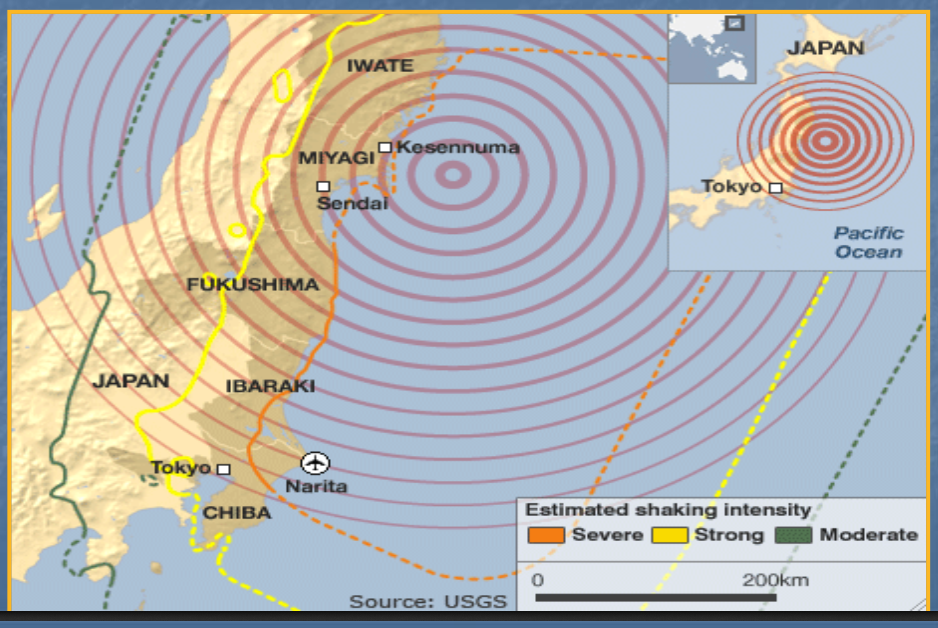
(It might be worth noting that the area of extreme shaking stops at the coast, leaving the nuclear power stations seemingly unaffected. I am only suspicious as Ian Fairlie also used data from Richard Wakeford (a Professor and ex BNFL sellafield) as evidence for the dose measurements. So, the dose measurements found on this PDF are likely an underestimate. There are many reasons to distrust Richard Wakeford to go into here. Please google his name for details in alternate news blogs, LLRC and Green Audit etc. Also, google his name with Chris Busby for interesting information.)
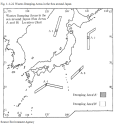
Next is the diagram of the dumps themselves. You will notice that area A3 and A2 seem to be possible targets from the heavy shaking area.

Next is the deposition of Cs 134 and 137 found by the recent released evidence from this report
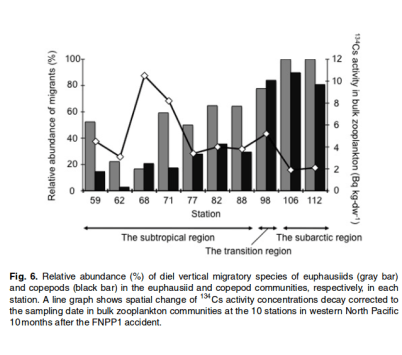
Horizontal distribution of Fukushima-derived radiocesium in
zooplankton in the northwestern Pacific Ocean
Received: 31 December 2012 – Accepted: 27 February 2013 – Published: 2 April 2013

The area near Waste Dump A2 has a proportionally higher levels of cesium 137 Graphic D on Figure 2
The currents took the radioactive effluent North East following the main current shown here;

There was this curious quote from a report.
“…Activity concentrations of radiocesium in zooplankton might be influenced not only environmental radiocesium activity concentration but also other factors that is still unknown….”
and this quote too!
“….……Regardless of how it got there, “there must be some loaded organic material somewhere in the sediment”, Kanda says…….”
And of course there was more than one earthquake and the other dumpsites A3 and A4 may also be effected.
Watch the visualisation video next to the above pictures to match hits on the dumps…..”
2011年の日本の地震 分布図 Japan earthquakes 2011 Visualization map
http://www.youtube.com/watch?v=eKp5cA2sM28
Links to resources
http://www.env.go.jp/en/wpaper/1992/eae210000000000.html#1_1_1_3
http://www.biogeosciences-discuss.net/10/6143/2013/bgd-10-6143-2013.pdf
http://www.totalwebcasting.com/tamdata/Documents/hcf/20130312-1/FairlieFukushimaNYCMarch12.pdf
http://www.nature.com/news/ocean-still-suffering-from-fukushima-fallout-1.11823
“….The oceans may have become ticking time bombs after years of U.S. military dumping have gone almost virtually unregulated, according to government documents. Legislation on the books for this fiscal year requires that the secretary of defense issue a yearly report naming the location and quantity of the dumped military munitions in U.S. waters. The National Defense Authorization Act for Fiscal Year 2007 also mandates sampling and water analysis be done around the disposal sites selected by the secretary. The size of the dump sites as well as the types and quantities of military munitions should also be identified. “The U.S. Army and DoD (Department of Defense) are working deliberately with other federal agencies to verify locations and dates of military sea disposal operations,”……”
“…..”The question always comes up that if there is no release of the munitions, is it worth the risk to pull it up and treat it,” said Siegel. “The answer isn’t clear. We don’t want to risk exposing people to ordnances unless there is a fairly present risk of danger.” The question of whether or not to pull up these sunken canisters continues to baffle and concern environmentalists, politicians, government officials and the general public. “With the initial breach of these canisters, the local impact on the biological communities will be quite high,” said McClain. “Do I think something should be done? Yes. Do I know what should be done about it? No.”…..”
http://abcnews.go.com/blogs/headlines/2007/07/underwater-tick/
And here is a map of undersea dump sites.. The Japanese sites are claimed to be unknown on this interactive map.
http://cns.miis.edu/stories/090806_cw_dumping.htm
……The team will publish all study results, Wilkens says. That’s particularly important because the issue of chemical weapons in the oceans has been kept largely under wraps in many countries, Brewer says. “The topic has pretty much been a black hole.”……. Brewer and Noriko Nakayama of the University of Tokyo wrote in a 2008 article in Environmental Science & Technology. Researchers routinely sample the water column in most of the known dumping areas, “often within a few meters of the seafloor” and “without regard for or knowledge of the disposed materials,” the duo wrote. ……. But no one knows exactly where the weapons are……
….. The records usually don’t contain coordinates. In some cases, historical information only specifies “Atlantic Ocean” or “Pacific Ocean,” according to a 2007 Congressional Research Service report……
http://www.earthmagazine.org/article/danger-deep-chemical-weapons-lie-our-coasts
“….Finally, the Russians were dumping unprocessed nuclear waste into The Sea of Japan. As late as October 1993, the Russians confirmed that one of their ships discharged 900 tons of radioactive water from scrapped nuclear submarines….”
http://www1.american.edu/ted/arctic.htm
No comments yet.
1 This Month

of the week – Shut Down Drone Warfare!


Tell the Ukrainian Government to Drop Prosecution of Peace Activist Yurii Sheliazhenko

Petition to revoke the licensing of the Near Surface Nuclear Disposal Facility (NSDF) at Chalk River. https://www.ourcommons.ca/petitions/en/Petition/Details?Petition=e-7247
To see nuclear-related stories in greater depth and intensity – go to https://nuclearinformation.wordpress.com
-
Archives
- April 2026 (103)
- March 2026 (251)
- February 2026 (268)
- January 2026 (308)
- December 2025 (358)
- November 2025 (359)
- October 2025 (376)
- September 2025 (257)
- August 2025 (319)
- July 2025 (230)
- June 2025 (348)
- May 2025 (261)
-
Categories
- 1
- 1 NUCLEAR ISSUES
- business and costs
- climate change
- culture and arts
- ENERGY
- environment
- health
- history
- indigenous issues
- Legal
- marketing of nuclear
- media
- opposition to nuclear
- PERSONAL STORIES
- politics
- politics international
- Religion and ethics
- safety
- secrets,lies and civil liberties
- spinbuster
- technology
- Uranium
- wastes
- weapons and war
- Women
- 2 WORLD
- ACTION
- AFRICA
- Atrocities
- AUSTRALIA
- Christina's notes
- Christina's themes
- culture and arts
- Events
- Fuk 2022
- Fuk 2023
- Fukushima 2017
- Fukushima 2018
- fukushima 2019
- Fukushima 2020
- Fukushima 2021
- general
- global warming
- Humour (God we need it)
- Nuclear
- RARE EARTHS
- Reference
- resources – print
- Resources -audiovicual
- Weekly Newsletter
- World
- World Nuclear
- YouTube
-
RSS
Entries RSS
Comments RSS
 nuclear-news
Leave a comment