Protesters demand that the IAEA consider the radiation effects seriously – December 15 2012
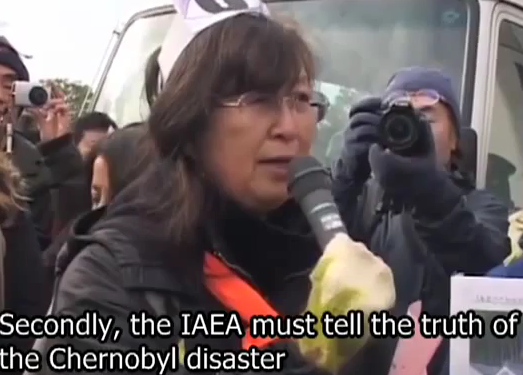
Video published on May 29, 2013
Muto Ruiko and the Movement of Fukushima Residents to Pursue Criminal Charges against Tepco Executives and Government Officials
The Fukushima Complainants for Criminal Prosecution of the Nuclear Accident
Group Statement
June 11, 2012
Today we 1,324 residents of Fukushima Prefecture filed a complaint with the Fukushima Public Prosecutors Office, demanding that it press charges of criminal responsibility for the Fukushima nuclear accident.
We who have been robbed of our daily life, we whose human rights have been trampled upon by the accident—we have pooled our strength and raised our voices in anger.
To take the first step toward seeking prosecution required a great deal of courage on our part.
To ask that criminal charges be brought against other human beings has meant that we had to examine our own way of life.
We believe, however, that this process has profound significance.
•We are challenging a society that fails to value all who live in it, in which sacrifice is always being imposed on some members;
•We are coming together again, even expanding our ties after being divided and torn asunder by the accident;
•We who were hurt and lost in despair are reclaiming our strength and dignity.
We believe that this is the way to fulfill our responsibility towards children and young people.
Standing together with those who cannot raise their voices and with other living things, it is each of us individuals who will change the world.
Refusing to be divided, recognizing the power of our unity, unflinching, we will continue to pursue responsibility for the accident.
Muto Ruiko is a long-time antinuclear activist based in Fukushima. She is also one of 1,324 Fukushima residents who filed a criminal complaint in June 2012 pressing charges against Tepco executives and government officials.
This article introduces Muto’s activism on nuclear energy, her life before and after the Fukushima Dai’ichi disaster, and her recent effort to mobilize citizens for the criminal complaint. An English translation of Muto’s speech at the University of Chicago on May 5, 2012, follows.
More on link..
http://japanfocus.org/-Muto-Ruiko/3784
Press Release 2013/05
IAEA RANET Capacity Building Centre in Fukushima Begins Work
27 May 2013 | Fukushima City, Japan — The designation of the IAEA Response and Assistance Network (RANET) Capacity Building Centre, which will coordinate several training activities related to nuclear and radiological emergency preparedness and response, was marked with a ceremony today.
Huge explosion after freight train crash in Rosedale, Maryland
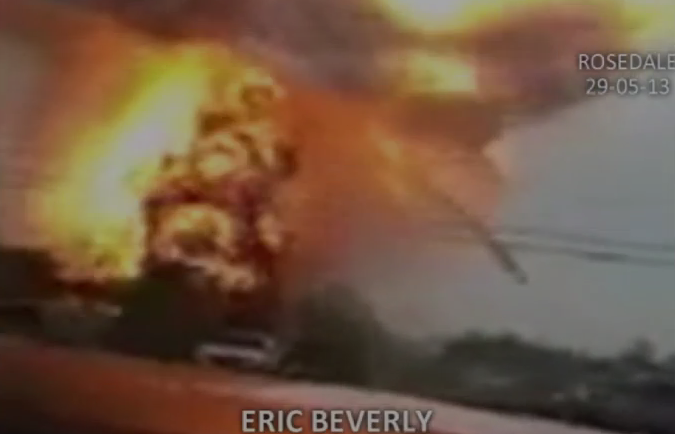
Published on May 29, 2013
A huge explosion has happened after a freight train carrying tetrathphalic acid and sodium chlorate crashed into a rubbish truck and derailed in Rosedale, near Baltimore, in Maryland..
“.. Neither should cause an immediate effect on the public…”
“… Cars were allowed to drive by …”
Wiki Entries
Sodium chlorate comes in dust, spray and granule formulations. There is a risk of fire and explosion in dry mixtures with other substances, especially organic materials, and other herbicides, sulfur, phosphorus, powdered metals, and strong acids. In particular, when mixed with sugar, it has explosive properties. If accidentally mixed with one of these substances it should not be stored in human dwellings.[6]
Marketed formulations contain a fire retardant, but this has little effect if deliberately ignited. Most commercially available chlorate weedkillers contain approximately 53% sodium chlorate with the balance being a fire depressant such as sodium metaborate or ammonium phosphates.
Toxicity in humans
Due to its oxidative nature, sodium chlorate can be very toxic if ingested. The oxidative effect on hemoglobin leads to methaemoglobin formation, which is followed by denaturation of the globin protein and a cross-linking of erythrocyte membrane proteins with resultant damage to the membrane enzymes. This leads to increased permeability of the membrane, and severe hemolysis. The denaturation of hemoglobin overwhelms the capacity of the G6PD metabolic pathway. In addition, this enzyme is directly denatured by chlorate reducing its activity.
Therapy with ascorbic acid and methylene blue are frequently used in the treatment of methemoglobinemia. However, since methylene blue requires the presence of NADPH that requires normal functioning of G6PD system, it is less effective than in other conditions characterized by hemoglobin oxidation.
Acute severe hemolysis results, with multi-organ failure, including DIC and renal failure. In addition there is a direct toxicity to the proximal renal tubule.[4] The treatment will consist of exchange transfusion, peritoneal dialysis or hemodialysis.[5]
Terephthalic acid is used as a filler in some military smoke grenades, most notably the American M83 smoke grenade, producing a thick white smoke when burned.
San Onofre: Southern California Edison intentionally misled nuclear regulators
Senator Boxer calls for probe on California nuclear plant, Christina Science Monitor 28 May 13 Sen. Barbara Boxer (D) of California charges that Southern California Edison intentionally misled regulators in order to avoid an extensive safety review of upgrades to its San Onofre nuclear plant. Senator Boxer has called on the Justice Department to investigate. By David J. Unger, Correspondent / May 28, 2013 The operator of a California nuclear plant is under fire from a US senator for allegedly misrepresenting the nature of an equipment upgrade that resulted in a small radioactive leak at the plant last year. It’s another blow to Southern California Edison (SCE), which has worked to reopen the closed San Onofre Nuclear Generating Station for over a year. The fallout has cost the company more than $553 million and drawn attacks from environmentalists who say the plant is inherently unsafe.
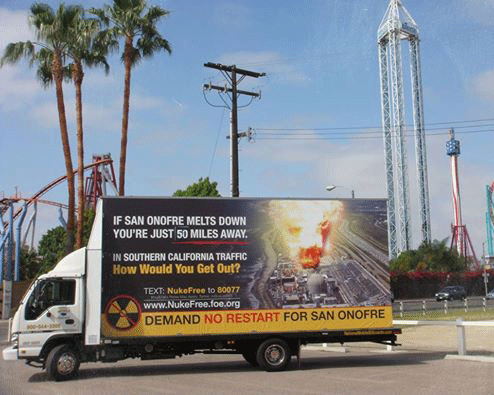
On Tuesday, Sen. Barbara Boxer (D) of California released a private company letter she says is evidence of the company intentionally misleading regulators in order to avoid an extensive safety review of upgrades to San Onofre. She has called on the Justice Department to investigate. Continue reading
Europe gives cold shoulder to Russia’s nuclear marketing
One of the main reasons that the Baltic NPP project has run aground is that neither investors nor energy importers that Rosatom has approached in Europe have agreed to come on board…..
………The story of the Baltic NPP is an illustrative account of Rosatom’s incapability of landing anything other than rebuffs in Europe, earning trust in the safety of its reactor technology, and winning over foreign investors.
Europe has given a cold shoulder to Rosatom’s brilliant plan to quell its energy security concerns with power streaming from nuclear reactors built in its backyard

 GAZETA.RU: Nuclear failure Gazeta.ru, May 24, 2013 – Moscow’s resigned willingness to consider reduced capacity for the future Baltic Nuclear Power Plant is testimony to the Russian nuclear industry’s failure to overcome criticism it has been facing in the European market, convince potential customers of the reliability of its technologies, or attract foreign investors so it could get a foot in Europe’s door. By Vladimir Slivyak Continue reading

 South Korea Shuts 2 Reactors Over Faked Certificates http://www.nytimes.com/2013/05/29/world/asia/south-korea-turns-off-nuclear-reactors.html?_r=0 By CHOE SANG-HUN May 28, 2013 SEOUL, South Korea — South Korea said on Tuesday that it was turning off two nuclear power reactors and delaying the scheduled start of operations at another two after its inspectors discovered that the reactors used components whose safety certificates had been fabricated.
South Korea’s nuclear power industry has been plagued by a series of forced shutdowns, corruption scandals and mechanical failures in recent years, undermining public confidence in atomic energy even as the country’s dependence on it for electricity is expected to grow. Continue reading
In 1983, nuclear war was only just avoided

While historians have previously noted the high risk of an accidental nuclear war during this period, the new documents make even clearer how the world’s rival superpowers found themselves blindly edging toward the brink of nuclear war through suspicion, belligerent posturing and blind miscalculation.
The USSR and US Came Closer to Nuclear War Than We Thought A series of war games held in 1983 triggered “the moment of maximum danger of the late Cold War.” The Atlantic, DOUGLAS BIRCHMAY 28 2013 An ailing, 69-year-old Yuri Andropov was running the Soviet Union from his Moscow hospital bed in 1983 as the United States and its NATO allies conducted a massive series of war games that seemed to confirm some of his darkest fears.
Two years earlier Andropov had ordered KGB officers around the globe to gather evidence for what he was nearly certain was coming: A surprise nuclear strike by the U.S. that would decapitate the Soviet leadership. …
The Western maneuvers that autumn,called Autumn Forge, , were depicted by the Pentagon as simply a large military exercise. But its scope was hardly routine, as Americans learned in detail this week, for the first time, from declassified documents published by the National Security Archive, a Washington-based nonprofit research organization. Continue reading
Navajo will block uranium transport
Navajo plans to block access for uranium transport, Yahoo 7 Finance, 28 May 13 Navajo Nation plans to deny uranium mining company permission to transport ore on tribal land By Felicia Fonseca, Associated Press |FLAGSTAFF, Ariz. (AP) – A uranium mining company seeking a mineral lease on state land in northwestern Arizona could have a hard time transporting the ore off-site because of the Navajo Nation’s objections to an industry that left a legacy of death and disease among tribal members.
The section of land in Coconino County is surrounded by the Navajo Nation’s Big Boquillas Ranch. The tribe has said it will not grant Wate Mining Company LLC permission to drive commercial trucks filled with chunks of uranium ore across its land to be processed at a milling site in Blanding, Utah.
The Navajo Nation was the site of extensive uranium mining for weapons during the Cold War. Although most of the physical hazards, including open mine shafts, have been fixed at hundreds of sites, concerns of radiation hazards remain.
The tribe banned uranium mining on its lands in 2005, and last year passed a law governing the transport of radioactive substances over its land. The ranch itself is not part of the reservation, although the Navajo Nation owns it.
“Given the (Navajo) Nation’s history with uranium mining, it is the nation’s intent to deny access to the land for the purpose of prospecting for or mining of uranium,” officials from the Navajo Department of Justice wrote in response to the mineral lease application.
The parcel of state land is in a checkerboard area of Arizona, east of the Hualapai reservation and south of the Havasupai reservation and Grand Canyon National Park. Tribal officials and the park superintendent have said any mining would threaten nearby water sources,……
Documents filed with the Arizona State Land Department indicate Wate Mining had requested approval from the Navajo Nation for the proposed access route, but the tribe said it has nothing on record showing that, nor does the state have access to the property.
“We have no intention of allowing them to cross Navajo lands unless they have appropriate access rights,” Navajo Deputy Attorney General Dana Bobroff said in an email…… http://au.finance.yahoo.com/news/navajo-plans-block-access-uranium-154503649.html
Good evidence for a high renewable energy future
power industry structure includes hefty and durable fossil fuel subsidies, which amount to $1.9 trillion per year or more, according to a report from the International Monetary Fund earlier this year. Those fossil fuel subsidies far outweighed the smaller and more transient subsidies offered to renewables, according to the International Energy Agency’s World Energy Outlook 2012.
Is a high renewables future really possible? REneweconomy, By Peter Bronski 27 May 2013“……..Renewables’ track record shows that they continue to outpace skeptics’ expectations. “People thought that maybe renewables would get to two percent. When they did that, people said maybe five percent. Then 10 percent,” says Hutch Hutchinson, managing director at RMI. “Renewables have been fighting and scratching the entire way. Now, there’s good analytical evidence that with some creativity and customary levels of reinvestment in our energy system, we can get to a high renewables future.” Continue reading
Russia’s unsafe new nuclear reactors, the Baltic NPP and others

 GAZETA.RU: Nuclear failure Gazeta.ru, May 24, 2013 “……..In fact, Kaliningrad Region’s neighbor Lithuania has been vigorously protesting the construction, voicing not just political complaints but also concerns regarding the future station’s safety. For instance, the Lithuanian government has charged that the VVER-1200 reactors that Rosatom planned to build at the site have never been subjected to safety tests in accordance with the criteria adopted in the European Union. And safety concerns are far from frivolous or irrelevant here. Let’s take a moment to look at the technology improvements that we are told have been implemented in the design.
The VVER-1200 reactor, on which the project of the Baltic NPP was based, includes a novelty called a “core catcher.” This contraption is meant to mitigate the consequences of an accident that evolves according to a Chernobyl or Fukushima scenario – namely, leads to a core meltdown. For one thing, the very presence of a core catcher would imply that such an accident is possible in principle. For another, all a core catcher can do is simply “catch” the highly radioactive mass of a molten reactor core as it burns through the bottom of the reactor vessel. What it cannot do is help contain the accompanying massive release of radioactivity of the kind that poisoned the environment far and wide during the catastrophe at Chernobyl. So what would be the meaning of this expensive new enhancement? Put a tick next to a budget item called “That new fancy gizmo we have – our reactors are the best!”?
It would be funny if it weren’t so sad: VVER-1200s are being built at the second Leningrad nuclear station, near St. Petersburg, and at the new Novovoronezh site, in Central European Russia, and are being planned for a number of other sites across the country – not to mention the export reactor projects in Belarus, Vietnam, Turkey, and other foreign states.
There are other problems with the Baltic NPP. Its price tag was estimated at around EUR 6 billion, and that’s not counting the very costly transmission networks that the plant would badly need. The very electricity export idea was not duly thought through: Kaliningrad Region lacks the modern and reliable transmission and distribution networks that would be required to carry the station’s electricity to consumers either inside the region or abroad. New power lines could – according to a 2009 estimate by the Russian electricity generation and foreign and domestic power trading company Inter RAO – set Rosatom back by an additional nearly EUR 3 billion, driving the station’s cost up by another 50 percent………http://anti-atom.ru/en/node/5185
Petition to demand zero nuclear weapons
 Action of the Week: Make History and Demand Zero Nuclear Weapons http://www.takepart.com/article/2013/05/20/action-week-make-history-and-demand-zero-nuclear-weapons Callie Spaide, May 24, 2013
A world free from the threat of nuclear war? It starts today! There are nine countries around the world with more than 17,000 nuclear weapons combined, and many more are on the cusp of developing their own stockpiles. The fragile systems used to control these weapons for the past 50 years are crumbling—in the last two decades, there have been at least 25 cases of nuclear materials being lost or stolen.
The global costs of nuclear weapons are clear: bloated military budgets, more countries becoming weaponized, and the growing possibility that terrorist organizations will get their hands on a missile. This escalating insanity will end only when our leaders decide to make a nuclear-free world a priority. That begins with all of us taking a stand.
Four years ago, President Obama stated that he was committed to a nuclear-free world. It’s time to hold him to his word. In June, he will be meeting with Russian President Vladimir Putin, the perfect opportunity to negotiate the reduction of nuclear weapon stockpiles.
Since 2008, Global Zero has tirelessly advocated for the elimination of all nuclear weapons, winning broad support from both Republican and Democratic leaders. They’re calling on President Obama to keep his word and begin a step-by-step plan to eliminate all nuclear weapons. Add your name to their petition and tell President Obama that you believe in a nuclear-free world!
VIDEO: Finland’s nuclear waste tunnels
 VIDEO Finland to bury nuclear waste underground http://www.aljazeera.com/news/europe/2013/05/201352154030372976.html Country plans to solve problem of disposing radioactive waste permanently by using tunnels. 21 May 2013 Finland has struggled with disposal of radioactive waste for decades, with temporary storage sites requiring constant monitoring.
The country now plans to bury its nuclear waste in tunnels underground.
But in the United States and elsewhere such tunnels have been prevented because of safety fears.
Al Jazeera’s Tim Friend reports from a facility in Olkiluoto island.
USA did nuclear tests to find out effects on animals
Veteran recalls 1940s radiation contamination study http://www.texarkanagazette.com/news/2013/05/27/veteran-recalls-1940s-radiation-contamin-470111.php By: Greg Bischof – Texarkana Gazette John Cary served in the Navy during World War II and participated in Operation Crossroads at Bikini Atoll. The operation consisted of two nuclear weapon tests to determine radiation’s effects on animals.
However, unlike the biblical Noah’s ark, the animals’ placement wasn’t to p…subscribers only
Uranium enrichment company URENCO for sale – uneconomic
Powerhouse of the Uranium Enrichment Industry Seeks an Exit NYT, BY STANLEY REED , 26 May 13“..….Urenco was formed by treaty in 1971 when Britain, West Germany and the Netherlands decided for
strategic and business reasons to combine their uranium enrichment programs. The company is still owned by the British and Dutch governments, with one-third each, and with the German third held jointly by two big utility companies, E.On and RWE.
Urenco now has four enrichment plants — in Britain, the Netherlands
and Germany — selling fuel for civilian energy purposes around the
world, capturing nearly a third of the global market………the
company is at a crossroads. Growth may flatten in the next couple of
years, executives say, mainly because Japan — a major user of nuclear
power until the 2011 Fukushima Daiichi disaster — has shut down its
reactors, taking about 10 percent of the world’s nuclear energy
generating capacity offline. And the Japanese have stockpiled
substantial amounts of fuel for the day, if ever, that those reactors
go back into operation……
“Nuclear strategies have changed,” said Michael Kruse, a consultant on
nuclear issues for the management consultant Arthur D. Little in
Frankfurt. “Governments no longer think they need to be in this
business,” he said, “and utilities in several countries want out after
Fukushima.”
People in the industry say the most likely buyers would be companies
already in the industry that might want to offer clients fuel along
with nuclear power stations. Areva, a French giant, might fit that
bill. So might Toshiba of Japan, which is studying building nuclear
plants in Britain. Still, “there are in my view not many companies
that can buy Urenco,” Mr. Kruse said.
Michigan concerns over plans for nuclear waste dump near Lake Huron
Nuclear waste site on Lake Huron concerns Michigan, Sarnia Ontario Power Generation plans to build underground repository in Kindcardine, 1.6 km from Lake Huron CBC News May 27, 2013 The mayor of Sarnia, Ont., is rallying opposition to Ontario Power Generation’s plan to store nuclear waste underground on the shores of Lake Huron…..
Michigan worriedIn Michigan, lawmakers worry that the facility might affect the Great Lakes, and they want Congress to help ensure Michigan’s concerns are fully resolved.
A state Senate resolution that was introduced by Democratic Sen. Hoon-Yung Hopgood of Taylor passed last week.
According to Ontario Power Generation, the deep geologic repository would be located 680 metres below ground, in stable rock formations over 450 million years old. (Ontario Power Generation)“Lake Huron and the Great Lakes are some of Michigan’s most vital natural resources, containing 95 per cent of North America’s surface fresh water and providing drinking water to tens of millions of people,” Hopgood said in a statement. “This type of nuclear waste repository, planned within water-soluble limestone, is unprecedented and could present a danger to our lakes and our environment.”
According to Hopgood, Michigan law already strictly prohibits the disposal of radioactive waste of any site within 16 kilometres (10 miles) of the Great Lakes and certain other major bodies of water connected to them.
Resolution 58, introduced by Hopgood and passed last week, urges Canada to consider similar criteria……
The group Stop the Great Lakes Nuclear Dump has been opposing the project for six months. It bought billboard space on the Gardiner Expressway in Toronto to make its point.
“Burying radioactive nuclear waste beside the Great Lakes — 21 per cent of the world’s surface fresh water, and the supply of fresh drinking water for 40 million people in two countries — defies common sense,” said Beverly Fernandez.http://www.cbc.ca/news/canada/windsor/story/2013/05/27/wdr-nuclear-waste-lake-huron-ontario-power-generation.html
Exposed: Japanese Officials Upped Radiation Yardsticks to Dodge Compensation Costs
by Andrea Germanos / Common Dreams / May 26, 2013 /
Japanese officials raised the level of acceptable radiation doses for evacuees of the Fukushima nuclear disaster to avoid increasing costs for compensation, Japan’s Asahi Shimbun reported on Saturday.
A 5-millisieverts per year dose, the same level of exposure used as a yardstick to relocate residents after the Chernobyl nuclear disaster, was proposed at an unofficial meeting of ministers in October of 2011, seven months after the disaster began, they report.
But just weeks later, the yardstick was upped to 20 millisieverts per year.
… at a meeting on Oct. 28, joined by Chief Cabinet Secretary Osamu Fujimura and Tatsuo Kawabata, internal affairs minister, participants appeared reluctant to approve a yardstick other than 20 millisieverts. […]
“The prefectural government could not function with population drain under the 5-millisievert scenario,” said a state minister who attended the meeting. “In addition, there were concerns that more compensation money will be needed, with an increase in the number of evacuees.” […]
The Abe administration in March decided to release by the end of this year a set of protection measures for evacuees returning to areas with doses of up to 20 millisieverts.
The move is apparently aimed at setting the stage for return of evacuees even if decontamination operation fails to achieve the target of 1 millisievert. […]
1 This Month

of the week – Shut Down Drone Warfare!


Tell the Ukrainian Government to Drop Prosecution of Peace Activist Yurii Sheliazhenko

Petition to revoke the licensing of the Near Surface Nuclear Disposal Facility (NSDF) at Chalk River. https://www.ourcommons.ca/petitions/en/Petition/Details?Petition=e-7247
To see nuclear-related stories in greater depth and intensity – go to https://nuclearinformation.wordpress.com
-
Archives
- March 2026 (251)
- February 2026 (268)
- January 2026 (308)
- December 2025 (358)
- November 2025 (359)
- October 2025 (376)
- September 2025 (257)
- August 2025 (319)
- July 2025 (230)
- June 2025 (348)
- May 2025 (261)
- April 2025 (305)
-
Categories
- 1
- 1 NUCLEAR ISSUES
- business and costs
- climate change
- culture and arts
- ENERGY
- environment
- health
- history
- indigenous issues
- Legal
- marketing of nuclear
- media
- opposition to nuclear
- PERSONAL STORIES
- politics
- politics international
- Religion and ethics
- safety
- secrets,lies and civil liberties
- spinbuster
- technology
- Uranium
- wastes
- weapons and war
- Women
- 2 WORLD
- ACTION
- AFRICA
- Atrocities
- AUSTRALIA
- Christina's notes
- Christina's themes
- culture and arts
- Events
- Fuk 2022
- Fuk 2023
- Fukushima 2017
- Fukushima 2018
- fukushima 2019
- Fukushima 2020
- Fukushima 2021
- general
- global warming
- Humour (God we need it)
- Nuclear
- RARE EARTHS
- Reference
- resources – print
- Resources -audiovicual
- Weekly Newsletter
- World
- World Nuclear
- YouTube
-
RSS
Entries RSS
Comments RSS
 nuclear-news