The long haul for cleaning up Germany’s radioactive trash
Klaus-Günter Warnecke, the mayor of Remlingen, has been monitoring progress at the Asse nuclear waste site for nearly 20 years. Recent local media reports say he may have to wait another 20 years before the clearance of the site begins.
 Living above Germany’s old nuclear waste, DW, 20 May 13, A German law has recently come into effect ordering the cleanup of 126,000 barrels of radioactive waste at the Asse nuclear dump site. But it seems the process could take a lot longer than locals initially hoped for….. Heike Wiegel is not just a resident here, she’s also a member of the citizen group ‘aufpASSEn’ – meaning ‘watch out’ in German – which helps raise awareness about issues from the Asse nuclear waste site.
There are a number of other anti-Asse groups in the region. Now, with the law ordering the removal of waste from the site, they want to make sure that the mistakes of the past are not repeated.
“What happened back then at the Asse site should never have happened,” Wiegel says after a long pause. “That such an old, unstable salt mine would be used for nuclear waste, which, in the end, was just thrown in barrel by barrel.”
Stored deep below the ground
Less than two kilometers (1.2 miles) away, workers emerge from a lift wearing mining helmets, grubby overalls and carrying oxygen tanks.
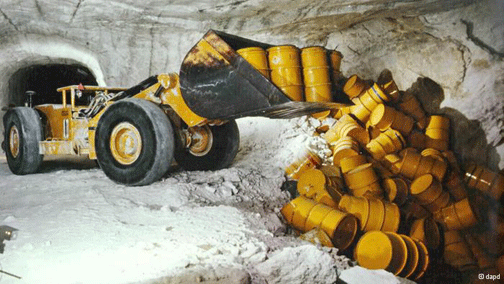
The Asse site used to be one Germany’s most productive salt mines until it was closed down in 1964. Shortly thereafter it was bought by the German government and used as a storage site for the country’s low to medium-level radioactive waste for more than a decade. The barrels, most of which came directly as nuclear waste from power plants, were stored in empty chambers already dug out by the salt miners.
Now, engineers and safety experts work here, shoring up the aging mine and protecting Germany’s decades-old nuclear waste which is buried deep underground.
Florian Emrich, of the German Federal Office for Radiation Protection (BfS), which now runs the facility, explains why the site no longer takes deliveries of nuclear waste.
“Back then they stopped storing the nuclear waste here because the mine didn’t adhere to the new legal requirements of storing nuclear waste in Germany. That’s why they had to shut it down.” Unknown contents, unstable mine
But, while there is no nuclear waste now being brought in, there are still thousands of drums down in the salt chambers. Emrich says the condition of many of the barrels is unknown and that’s why exploratory drilling is now taking place. In the 50 years since they were dropped in, many barrels are believed to have rusted and may be leaking.
And, he says that the mine itself is also unstable. Water has been seeping into the mine from groundwater runoff for years. That’s why new, more stable, access shafts are now being designed for the planned waste removal.
“Since 1988 water has been coming into the mine,” Emrich explains. “People have realized that this site isn’t safe. After all, if more and more water comes in, there is always the chance that the mine floods completely.”
The fear is that, through the pressure created by a flooded mine, nuclear waste could be pushed back up to the surface, contaminating local water supplies……
The long wait
Klaus-Günter Warnecke, the mayor of Remlingen, has been monitoring progress at the Asse nuclear waste site for nearly 20 years. Recent local media reports say he may have to wait another 20 years before the clearance of the site begins.
“That sort of length of time really makes people here worry,” Warnecke says. “It’s such a long period. The people here say the cleanup should start earlier, and more should be done concurrently.
“Actually, we get the feeling that relatively little is happening.”
Emrich of the BfS says legislators have discussed the year 2033 as a possible cleanup date – but this isn’t fixed.
“The clearance and shutting down of this site is a really big challenge. There is no doubt about that. Here, we have to sort out the problems that others have left for us in the past,” he told DW. “But, 2033 is not a final date.”
Looking to the future
However, once the waste removal work begins, one big question remains: where will the radioactive material be stored once it’s brought up? Locals are worried that authorities will decide on an aboveground storage facility, right next to the mine site….. http://www.dw.de/living-above-germanys-old-nuclear-waste/a-16820648
No comments yet.
1 This Month

of the week – Shut Down Drone Warfare!


Tell the Ukrainian Government to Drop Prosecution of Peace Activist Yurii Sheliazhenko

Petition to revoke the licensing of the Near Surface Nuclear Disposal Facility (NSDF) at Chalk River. https://www.ourcommons.ca/petitions/en/Petition/Details?Petition=e-7247
To see nuclear-related stories in greater depth and intensity – go to https://nuclearinformation.wordpress.com
-
Archives
- April 2026 (44)
- March 2026 (251)
- February 2026 (268)
- January 2026 (308)
- December 2025 (358)
- November 2025 (359)
- October 2025 (376)
- September 2025 (257)
- August 2025 (319)
- July 2025 (230)
- June 2025 (348)
- May 2025 (261)
-
Categories
- 1
- 1 NUCLEAR ISSUES
- business and costs
- climate change
- culture and arts
- ENERGY
- environment
- health
- history
- indigenous issues
- Legal
- marketing of nuclear
- media
- opposition to nuclear
- PERSONAL STORIES
- politics
- politics international
- Religion and ethics
- safety
- secrets,lies and civil liberties
- spinbuster
- technology
- Uranium
- wastes
- weapons and war
- Women
- 2 WORLD
- ACTION
- AFRICA
- Atrocities
- AUSTRALIA
- Christina's notes
- Christina's themes
- culture and arts
- Events
- Fuk 2022
- Fuk 2023
- Fukushima 2017
- Fukushima 2018
- fukushima 2019
- Fukushima 2020
- Fukushima 2021
- general
- global warming
- Humour (God we need it)
- Nuclear
- RARE EARTHS
- Reference
- resources – print
- Resources -audiovicual
- Weekly Newsletter
- World
- World Nuclear
- YouTube
-
RSS
Entries RSS
Comments RSS
 nuclear-news
Leave a comment