IAEA inspector backs pumping Fukushima groundwater into sea
By Marco Sostero
VIENNA, May 19, Kyodo
A possible solution to the increasing amount of contaminated water inside the crisis-hit Fukushima Daiichi nuclear power plant could be to pump groundwater into the sea before it gets into the reactor buildings, as planned by the plant operator, the head of international inspectors has said.
“It will be very nice if they really get to bypass the main building through these systems — through this direct pumping of the water to the sea or whatever it is. Because it is clean water,” Juan Carlos Lentijo, head of a 13-member team of the International Atomic Energy Agency that inspected the plant last month, told Kyodo News in a recent interview.
Tokyo Electric Power Co. has created a system to direct part of the groundwater into the sea before it flows and seeps into the reactor buildings and mixes with highly radioactive water accumulating inside, increasing the amount by 400 tons a day, but has yet to win approval from local fishermen to discharge the water.
Subscription only
Remember Fukushima meeting in March – 2013 House of Commons
Published on Mar 28, 2013
We are JAN UK (januk.org), Japanese residents that live and work in the UK, campaigning on anti-nuclear platform to stop all nuclear power plants in Japan, the UK and everywhere in the world.

Three events were held in London in March 2013, to mark the two-year anniversary of the triple disasters in Japan (the earthquake, tsunami, and ongoing nuclear accident), and especially to speak out against nuclear power:
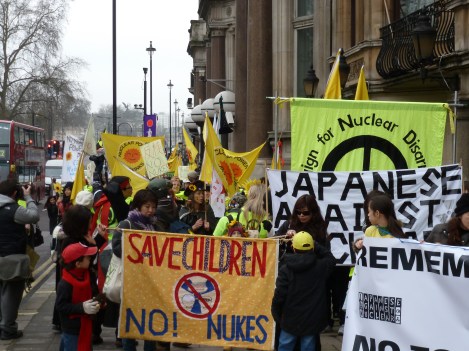
Fukushima Solidarity march was held in central London on Saturday, March 9th, co-organised by JAN UK, Kick Nuclear, and CND (Campaign for Nuclear Disarmament). Candle-lit vigil was held in front of the Japanese Embassy in London in the evening of March 11th, the very day the disaster happened two years ago. Then, straight after that, a public meeting was held in Committee Room 8, at the House of Commons. Main theme of the public meeting was: “The situation in Japan two years on from Fukushima, and the lessons we can learn for a nuclear-free world”.
The speech in this video was made by one of the JAN members.
Three events were held in London in March 2013, to mark the two-year anniversary of the triple disasters in Japan (the earthquake, tsunami, and ongoing nuclear accident), and especially to speak out against nuclear power:
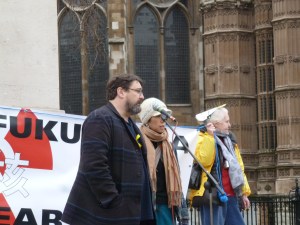
Fukushima Solidarity march was held in central London on Saturday, March 9th, co-organised by JAN UK, Kick Nuclear, and CND (Campaign for Nuclear Disarmament). Candle-lit vigil was held in front of the Japanese Embassy in London in the evening of March 11th, the very day the disaster happened two years ago. Then, straight after that, a public meeting was held in Committee Room 8, at the House of Commons. Main theme of the public meeting was: “The situation in Japan two years on from Fukushima, and the lessons we can learn for a nuclear-free world”.
The speech in this video was made by one of the JAN members.
Videos – Voices of nuclear protest and support for Fukushima victims – London UK 9 March 2013
Here are snippets of the speeches given on the day!
High cesium levels only just discovered in Tokyo river eels!
“Basically, only fish that enter the distribution network is subject to studies. The eel fishing season also does not start until summer.” The Chiba prefectural government was more downright blunt, saying, “No one in the prefecture catches eels for a living.” But eventually, the Japanese central government compelled both local units to sanction studies because eels were being consumed as food, which is a logical connection to make – not that it was logical enough for the two local government units.
High cesium levels discovered in Tokyo river eels, local governments make belated study
Posted on May 17, 2013 by John Hofilena
A worrying phenomenon has been discovered in Tokyo river eels that have been caught by local residents living near the Edogawa River – the eels that they have been catching, and may have eaten at one time or another, have very high cesium levels, in most cases higher than the safe levels required by the Japanese government.

Cesium-137 – normally called just “cesium” – is usually a byproduct of radioactive and nuclear processes, and is one of those isotopes that are easily spread in nature. The ingestion of high levels of cesium in the body would cause many negative effects to the health of humans. This is why the Japanese central government sets the safe limit in animals and the environment at 100 becquerels per kilogram.
The phenomenon at hand was officially noted starting with a 47-year-old self-employed woman who caught an eel from the Edogawa River in Tokyo’s Katsushika Ward n March 9. There have been reports of high cesium levels in fish from the river, so the woman sent the eel to Hideo Yamazaki, a professor of environmental analysis at Kinki University in Osaka Prefecture. Yamazaki then found that the eel had 147.5 becquerels of radioactive cesium per kilogram, higher than the central government standard of 100 becquerels. Professor Yamazaki passed on his findings to the Fisheries Agency in late March because he felt there was a need for an official investigation to back up his findings, and maybe look into other species as well. But the local governments of Tokyo and Chiba Prefecture refused to sanction official studies.
1 This Month

of the week – Shut Down Drone Warfare!


Tell the Ukrainian Government to Drop Prosecution of Peace Activist Yurii Sheliazhenko

Petition to revoke the licensing of the Near Surface Nuclear Disposal Facility (NSDF) at Chalk River. https://www.ourcommons.ca/petitions/en/Petition/Details?Petition=e-7247
To see nuclear-related stories in greater depth and intensity – go to https://nuclearinformation.wordpress.com
-
Archives
- April 2026 (103)
- March 2026 (251)
- February 2026 (268)
- January 2026 (308)
- December 2025 (358)
- November 2025 (359)
- October 2025 (376)
- September 2025 (257)
- August 2025 (319)
- July 2025 (230)
- June 2025 (348)
- May 2025 (261)
-
Categories
- 1
- 1 NUCLEAR ISSUES
- business and costs
- climate change
- culture and arts
- ENERGY
- environment
- health
- history
- indigenous issues
- Legal
- marketing of nuclear
- media
- opposition to nuclear
- PERSONAL STORIES
- politics
- politics international
- Religion and ethics
- safety
- secrets,lies and civil liberties
- spinbuster
- technology
- Uranium
- wastes
- weapons and war
- Women
- 2 WORLD
- ACTION
- AFRICA
- Atrocities
- AUSTRALIA
- Christina's notes
- Christina's themes
- culture and arts
- Events
- Fuk 2022
- Fuk 2023
- Fukushima 2017
- Fukushima 2018
- fukushima 2019
- Fukushima 2020
- Fukushima 2021
- general
- global warming
- Humour (God we need it)
- Nuclear
- RARE EARTHS
- Reference
- resources – print
- Resources -audiovicual
- Weekly Newsletter
- World
- World Nuclear
- YouTube
-
RSS
Entries RSS
Comments RSS
 nuclear-news