Germany faces big challenges in shift toward green energy
It is a grand project that Environment Minister Peter Altmaier once labeled “open-heart surgery on the national economy” of Europe’s export-driven industrial powerhouse.
The goal is to be nuclear-free by 2022 and to combat pollution and climate change by boosting the share of clean and safe renewables to 80 percent by 2050.
Germany’s solar power capacity has risen exponentially to about 30 gigawatts now. Another 25 to 30 gigawatts come from wind farms across vast stretches of Germany’s flat, coastal north and offshore parks in the North and Baltic seas.
By Mathilde Richter, AFP
May 20, 2013, 11:33 am TWN
http://www.chinapost.com.tw/commentary/afp/2013/05/20/379055/Germany-faces.htm
PULHEIM, Germany — Tense engineers have their eyes peeled on complex color-coded diagrams on a wall-sized screen that makes their control room look like the inside of a spaceship.
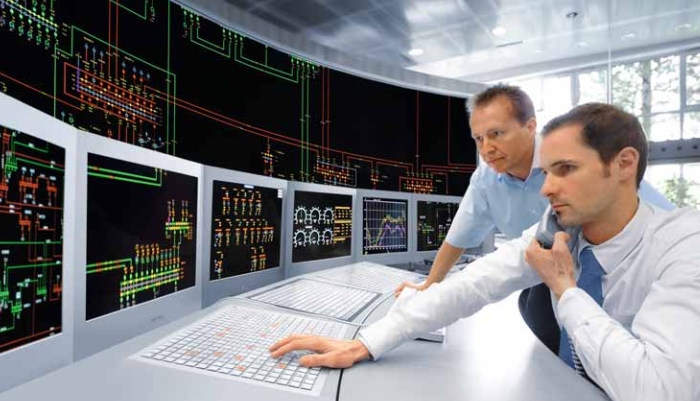
They work with a power system that would have seemed equally futuristic not so long ago. It is also prone to solar turbulence and other unexpected flare-ups.
The technicians work at a monitoring center of the electricity company Amprion — one of the many nerve centers of Germany’s ambitious transition from nuclear to renewable energies.
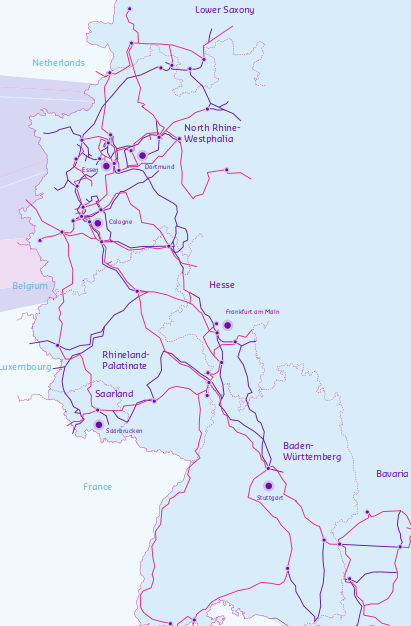
Their job is to watch screens that update every three seconds to monitor about 11,000 kilometers (7,000 miles) of high-voltage power lines that criss-cross much of western Germany and extend into other European countries.
They are watching for sudden peaks and troughs, to avert dangerous power overloads or shortages, from their high-tech safety center at Pulheim near Cologne.
“The situation changes fast, it’s very volatile,” says Christoph Schneiders, the center’s head of planning, pointing to the fickle nature of natural energy.
When clouds cover the sun over the solar plants that have mushroomed across Germany in recent years, he explains, the engineers see an instant drop in output. The sharp falls reverse just as quickly when the sky clears again.
“It goes up, it goes down, it is very difficult to predict,” said Schneiders. And unlike a gas plant, he said, solar power can’t just be switched off when there is an overload.
The hard-to-predict flow of renewable energies compared to fossil or nuclear power is one of the many challenges of the energy transition which Chancellor Angela Merkel rang in in the days after Japan’s 2011 Fukushima nuclear disaster.
It is a grand project that Environment Minister Peter Altmaier once labeled “open-heart surgery on the national economy” of Europe’s export-driven industrial powerhouse.
The goal is to be nuclear-free by 2022 and to combat pollution and climate change by boosting the share of clean and safe renewables to 80 percent by 2050.
Across Germany, solar panels, made popular by state subsidies and falling unit prices, now cover many home roofs and stretches of farmland.
New laws have allowed home owners to sell excess power back into the grid, while other incentives promote home insulation and other efficiency gains.
Germany’s solar power capacity has risen exponentially to about 30 gigawatts now. Another 25 to 30 gigawatts come from wind farms across vast stretches of Germany’s flat, coastal north and offshore parks in the North and Baltic seas.
No comments yet.
1 This Month

Petition to revoke the licensing of the Near Surface Nuclear Disposal Facility (NSDF) at Chalk River. https://www.ourcommons.ca/petitions/en/Petition/Details?Petition=e-7247


of the week – STOP SMALL MODULAR REACTORS IN CANADA
To see nuclear-related stories in greater depth and intensity – go to https://nuclearinformation.wordpress.com
-
Archives
- March 2026 (152)
- February 2026 (268)
- January 2026 (308)
- December 2025 (358)
- November 2025 (359)
- October 2025 (376)
- September 2025 (258)
- August 2025 (319)
- July 2025 (230)
- June 2025 (348)
- May 2025 (261)
- April 2025 (305)
-
Categories
- 1
- 1 NUCLEAR ISSUES
- business and costs
- climate change
- culture and arts
- ENERGY
- environment
- health
- history
- indigenous issues
- Legal
- marketing of nuclear
- media
- opposition to nuclear
- PERSONAL STORIES
- politics
- politics international
- Religion and ethics
- safety
- secrets,lies and civil liberties
- spinbuster
- technology
- Uranium
- wastes
- weapons and war
- Women
- 2 WORLD
- ACTION
- AFRICA
- Atrocities
- AUSTRALIA
- Christina's notes
- Christina's themes
- culture and arts
- Events
- Fuk 2022
- Fuk 2023
- Fukushima 2017
- Fukushima 2018
- fukushima 2019
- Fukushima 2020
- Fukushima 2021
- general
- global warming
- Humour (God we need it)
- Nuclear
- RARE EARTHS
- Reference
- resources – print
- Resources -audiovicual
- Weekly Newsletter
- World
- World Nuclear
- YouTube
-
RSS
Entries RSS
Comments RSS
 nuclear-news
Leave a comment