Japans comfort women -Global comments at the UN – 14 March 2013
…Regarding the issue of “comfort women”, Mr. Okada said that it should not develop into a political and diplomatic issue. He expressed once again Japan’s regret, and said that Japan had set up a reparations fund….
…Japan had not treated honestly the recruitment of comfort women in World War II. China called on Japan to fully implement the recommendations it had accepted and apologize…
…It was deplorable that Japan rejected the recommendation to accept responsibility for Japan’s military sexual slavery system…
….The lack of anti-discrimination legislation on the basis of sexual orientation and gender identity was one of the remaining challenges facing Japan…..

Image source ; http://queens-politics.com/tag/comfort-women/
Consideration of the Outcome of the Universal Periodic Review of Japan
TAKASHI OKADA, Deputy Permanent Representative of Japan to the United Nations Office at Geneva, said that Japan had been making an active contribution to the activities of the Council since its establishment, and stressed that it saw the Universal Periodic Review as a vital mechanism to review the human right situation of all United Nations Member States through dialogue and cooperation. The Constitution of Japan was based on the fundamental principles of the sovereignty of its people and respect for human rights. Japan had developed a democratic political system and implemented a policy which promoted and protected human rights and fundamental freedoms as universal values. Out of the 174 recommendations it had received, Japan had agreed to follow up or partially follow up on 125 of them, including those promoting the protection of the rights of women, children, and persons with disabilities, but was unable to accept 26 of the recommendations. Regarding the remaining 23 recommendations, Japan already had sufficient measures in place to address the issues raised by those. Increasing citizens’ awareness of the results of its Universal Periodic Review was important to Japan from a human rights education perspective. Mr. Okada said that Japan would continue to actively contribute as a member of the Council and would work to improve the human rights situation in the country.
Iran took note of the number of recommendations provided to Japan during its Universal Periodic Review and encouraged Japan to accelerate efforts to eliminate discrimination against children of ethnic minorities, non-Japanese nationality and children with disabilities.
Philippines welcomed the recognition by Japan that the issue of “comfort women” was a grave insult to the honour of a large number of women, many of whom were from the Philippines, and appreciated Japan’s apology. The Philippines awaited further action from Japan to overcome all legal impediments to the full ratification of the Palermo Protocol on trafficking in persons, and hoped that Japan would soon conclude its review of the legal implications of ratifying the Convention for the Protection of the Rights of All Migrant Workers and their Families.
Republic of Korea said that it had raised concerns about the issue of “comfort women” but Japan had not taken sincere measures and had not accepted the recommendations made by the Republic of Korea. Japan should urgently take appropriate measures in that respect.
Republic of Moldova welcomed the efforts of Japan to improve its domestic human rights situation and contribute to the promotion and protection of human rights at the international level. The Republic of Moldova acknowledged Japan’s commitment to address domestic and sexual violence against women and the efforts to combat sexual exploitation of children, child pornography and prostitution and to protect the victims.
Algeria was pleased to note that Japan had accepted Algeria’s recommendations to increase efforts to prevent the sexual exploitation of children and to ensure greater political representation and participation of women in public life.
China expressed regret that Japan rejected some important recommendations and said that until now, Japan had not treated honestly the recruitment of comfort women in World War II. China called on Japan to fully implement the recommendations it had accepted and apologize. China had no objections to the adoption of the outcome of the Universal Periodic Review report of Japan.
Amnesty International welcomed Japan’s acceptance of the recommendation to establish a national human rights institution in accordance with the Paris Principles and regretted that it rejected the recommendation made by more than 20 States regarding the death penalty, including introducing a moratorium on executions with a view to full abolition. It was deplorable that Japan rejected the recommendation to accept responsibility for Japan’s military sexual slavery system.
Save the Children International appreciated the acceptance by Japan of recommendations relating to the ratification of the third Optional Protocol to the Convention on the Rights of the Child and to the adoption of measures to protect the right to health of Fukushima residents. Japan should facilitate and encourage democratic deliberations to implement the act on the protection and support for the children and other victims of the TEPCO disaster.
International Lesbian and Gay Association appreciated that Japan had taken positive steps towards protecting the rights of lesbian, gay, bisexual and transgender persons by changing relevant policies. The lack of anti-discrimination legislation on the basis of sexual orientation and gender identity was one of the remaining challenges facing Japan.
Reporters Without Borders International said that Japan, which could be proud about the freedom of press, had experienced a free fall in the ranking compiled by Reporters Without Borders, due to lack of information available about the accident at Fukushima. It was hoped that Japan would respect the right of its citizens to information.
International Movement Against All Forms of Discrimination and Racism said that many of the recommendations from the first cycle of the Universal Periodic Review had not been implemented and Japan had failed to establish a national human rights institution in accordance with the Paris Principles. The reality on the ground called for anti-discriminatory legislation, and a prohibition of discrimination on any grounds.
Human Rights Now urged Japan to implement the recommendation concerning the protection of the right to life and health of the people affected by the nuclear accident in Fukushima. The response of the Government was not sufficient and Japan should provide sufficient compensation and support for the relocation of people living in contaminated areas.
Japanese Association for the Right to Freedom of Speech said that during the consideration of its Universal Periodic Review report in October 2012, Japan had made a deceptive reply regarding the issue of political tract distribution. This type of detention violated the provisions of the Universal Declaration of Human Rights and the International Covenant on Economic, Social and Cultural Rights.
TAKASHI OKADA, Deputy Permanent Representative of Japan to the United Nations Office at Geneva, said that the Universal Periodic Review was an extremely valuable mechanism. Japan was pleased by the great interest shown in its human rights situation by the delegations and civil society. Regarding the issue of “comfort women”, Mr. Okada said that it should not develop into a political and diplomatic issue. He expressed once again Japan’s regret, and said that Japan had set up a reparations fund. Concerning the death penalty, Japan did not think that it would be appropriate to abolish it. With regard to the Fukushima disaster, the Government had provided financial and medical support to Fukushima residents. Japan would spare no effort in making further improvements in its situation of human rights.
The Council then adopted the outcome of the Universal Periodic Review of Japan.
http://www.ohchr.org/CH/NewsEvents/Pages/DisplayNews.aspx?NewsID=13142&LangID=E
Norway’s Petroleum Safety Authority in danger of going soft on environmental crime
Published on 16 May 2013
The London offices of BP and Shell have been raided by European regulators….
WEBSITE: SOTT.NET
SOURCE CREDITS: Rupert Neate and Terry Macalister of The Guardian
PHOTO CREDIT: © Eric Piermont/AFP/Getty Images
NO COPYRIGHT INFRINGEMENT is EVER INTENDED. I take no credit for the article or the photos at all…
correction: I said LAKE, I meant to say Lord …oops! I apologize for this error.
“..BP said: “BP is one of the companies that is subject to an investigation that was announced by the European commission. We are co-operating fully with the investigation and unable to comment further at this time.”
Statoil, which is 67%-owned by the Norwegian government, said: “The authorities suspect participation by several companies, including Statoil, in anti-competitive agreements and/or concerted practices contrary to Article 53 of the European Economic Area (EEA) [market manipulation].
“The suspected violations are related to the Platts’ Market-On-Close (MOC) price assessment process, used to report prices in particular for crude oil, refined oil products and biofuels, and may have been ongoing since 2002.” ….”
ARTICLE LINK: http://www.sott.net/article/261898-BP…
Norway’s Petroleum Safety Authority in danger of going soft on environmental crime
http://www.bellona.org/articles/articles_2013/PSA_environmental_crime
Bellona is calling for a debate on the role of Norway’s Petroleum Safety Authority (PSA) amid suggestions that only pressure from supervisory bodies compel the government agency to pursue critical legal investigations of environmental crimes.
Several incidents over the past decade that only narrowly avoided becoming serious accidents for Norway’s offshore industry have shown the PSA to be at best overly indulgent of the Norwegian oil industry, and at worst seemingly willfully blind to its missteps.
On an international level, these may seems surprising revelations, given PSA’s well-deserved reputation of one of the best petroleum oversight agencies in the world. But there is still room for improvement, says Bellona.
Bellona advisor Karl Kristensen said that Norway’s Climate and Pollution Agency as well as prosecutors themselves underscored the importance of police investigations and prosecutions of environmental crimes, a topic that was discussed during a Bellona seminar in April.
“Bellona recognized that PSA is undersized in relation to the audit tasks required of it,” said Kristensen. “The increase of funding [to the authority] in recent years has not kept pace with the increase in jobs. Because of this Bellona has requested doubling the PSA budget .
Kristensen noted, however, that such reinforcements would be ineffectual if PSA is reluctant to fulfill its mandate. Kristensen said that “PSA’s lack of willingness to use the strictest measures, as far as Bellona can tell, are unparalleled in Norwegian management practices, which shows an excessively strong and naïve belief in dialogue as the only significant measure.”
Bellona wants PSA to monitor its own obligations in a clearer and more consistent manner. “Our requirements for the use of police reports when justified is thus only a single element of such a change of course,” said Kristensen. “In addition, we want that offshore operations that experience serious and undesired events be stopped until the causes of the events can be determined,” he said.
UK nuclear submarine substantially substandard and seriously stupid! John Large interviewed
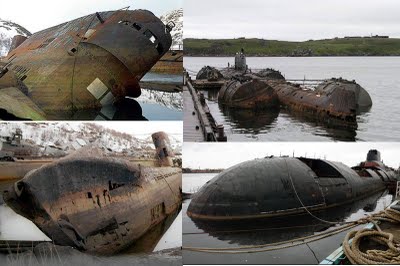
Image source ; http://mojosteve.blogspot.co.uk/2009/08/crazy-ivans-spotted-off-folly-beach.html
From the man at the gates 🙂
US State Department’s Response to Osaka City Mayor Hashimoto: “Outrageous and Offensive”, with Transcript Footnote Showing Disgust to Asahi Reporter’s Question
http://ex-skf.blogspot.co.uk/2013/05/us-state-departments-response-to-osaka.html
A reporter from Asahi Shinbun went to the daily briefing at the State Department on May 16, 2013 and asked questions to the spokesperson Jen Psaki.
What do you think of Mayor Hashimoto’s comments?
What do you think, were those women “comfort women” or “sex slaves”?
(Oh boy.)
From the US Department of State Daily Briefings transcript for May 16, 2013:
QUESTION: Hi, my name is Takashi from Japanese newspaper Asahi. Osaka City Mayor Hashimoto recently made a comment on the so-called “comfort women” issue, arguing that even though it is unacceptable from the moral perspective value, but the comfort women were necessary during the war period. And he also argued that it is not fair that only Japan is criticized by the United States and other countries, because there are other country military that were provided sexual service by prostitute. And do U.S. has any position on his comment or criticism against the United States?
MS. PSAKI: We have seen, of course, those comments. Mayor Hashimoto’s comments were outrageous and offensive. As the United States has stated previously, what happened in that era to these women who were trafficked for sexual purposes is deplorable and clearly a grave human rights violation of enormous proportions. We extend, again, our sincere and deep sympathy to the victims, and we hope that Japan will continue to work with its neighbors to address this and other issues arising from the past and cultivate relationships that allow them to move forward.
QUESTION: Do you describe this issue sex slave or comfort women?
MS. PSAKI: Again, I don’t know that I’m going to define it. You kind of laid out the specific details there, and we have described this issue in the past as comfort women[ii].
What is the footnote ii? Well I am afraid even the Asahi reporter managed to piss off the State Department (emphasis below is mine):
[ii] Rather than focusing on the label placed on these victims, we prefer to address the fact that this was a grave human rights violation of enormous proportions. The United States is also committed to working with our partners and allies around the world to denounce modern-day slavery and trafficking in persons no matter where it occurs.
これらの被害者につけられたラベル[慰安婦(Comfort women)か性の奴隷(Sex slaves)か]にこだわるよりも、私たちは、これが、重大で恐ろしく大規模な人権の蹂躙であったという事実に向き合う[事実を扱う]方を好む。アメリ カ合衆国はまた、世界のパートナーや同盟諸国と共に、世界のどこであろうと現在存在する奴隷制度、人身取引を強く非難する。
I couldn’t believe it until I read several articles by the Japanese media and tweets by some Japanese, but some people in Japan do seem to think if those women were called “comfort women”, somehow they were part of the legitimate business. And they are shocked that foreign media portrays these women as “sex slaves”. Thus the Asahi reporter asked that question.
If you start to believe in your own shit (often called “tatemae” in Japanese, literally “a facade”), you are toast. But many Japanese do not even know that any more. Lost art of tatemae and honne.
1 This Month

of the week – Shut Down Drone Warfare!


Tell the Ukrainian Government to Drop Prosecution of Peace Activist Yurii Sheliazhenko

Petition to revoke the licensing of the Near Surface Nuclear Disposal Facility (NSDF) at Chalk River. https://www.ourcommons.ca/petitions/en/Petition/Details?Petition=e-7247
To see nuclear-related stories in greater depth and intensity – go to https://nuclearinformation.wordpress.com
-
Archives
- April 2026 (103)
- March 2026 (251)
- February 2026 (268)
- January 2026 (308)
- December 2025 (358)
- November 2025 (359)
- October 2025 (376)
- September 2025 (257)
- August 2025 (319)
- July 2025 (230)
- June 2025 (348)
- May 2025 (261)
-
Categories
- 1
- 1 NUCLEAR ISSUES
- business and costs
- climate change
- culture and arts
- ENERGY
- environment
- health
- history
- indigenous issues
- Legal
- marketing of nuclear
- media
- opposition to nuclear
- PERSONAL STORIES
- politics
- politics international
- Religion and ethics
- safety
- secrets,lies and civil liberties
- spinbuster
- technology
- Uranium
- wastes
- weapons and war
- Women
- 2 WORLD
- ACTION
- AFRICA
- Atrocities
- AUSTRALIA
- Christina's notes
- Christina's themes
- culture and arts
- Events
- Fuk 2022
- Fuk 2023
- Fukushima 2017
- Fukushima 2018
- fukushima 2019
- Fukushima 2020
- Fukushima 2021
- general
- global warming
- Humour (God we need it)
- Nuclear
- RARE EARTHS
- Reference
- resources – print
- Resources -audiovicual
- Weekly Newsletter
- World
- World Nuclear
- YouTube
-
RSS
Entries RSS
Comments RSS
 nuclear-news