The mystery of radioactive rain in Brazil; Chris Busby
Saturday, May 4, 2013
Source: drdrwoland (Dr. Chris Busby’s YouTube Channel)
Date: 5/4/2013
by: Dr. Christopher Busby
Video Description
The decay of Radon, Rn-222 which involved gamma rays over the short term is as follows:
Rn-222 half life 3.8days , then Po-218 (3.05mins), Pb-214 (26.8mins), Bi-214 (19.9mins), Po-214 (164uSec), Pb210 (22.3y)
Of these only Ra-222 and Bi-214 give appreciable gamma radiation. The weighted contribution is about 60 Ra-222 to 80 Bi-214. The Brazil rain samples decay with an overall half life of about 37 minutes (16uSv/h to 1uSv/h in 150 min; Four half lives 16,8,4,2,1). If we assume that the radon was generated from radium a few hours before it was detected in the rain, that suggests Bismuth 214 as the origin of the signal. Bi-214 may have a higher concentration in the rain due to fractionation (since it is a solid and Ra222 a gas; it may form some kind of Bismuth hydroxide). The reason it is high in Brazil is there is a lot of Radium in Brazil. Of course, this means that rain can be a radon exposure hazard from external gamma and also drinking fresh rainwater. Not just in Brazil. I have not heard that anyone has realised this or that the official risk agencies have stated it anywhere. Look for diarrhoea and flu like symptoms after heavy rain. Thanks to Samuel dal Pizzol and other radiation measurer’s for discovering this!
Shocking findings on effects of MOX processes on miscarriage and respiratory illness in the UK (Repost)
“…Placing the actual national numbers gleaned from the vaccine/miscarriage study of 2009 against the Watford Hospital, the national figures for pollutant caused miscarriage might be in the tens of thousands, at the very least, if you looked at these figures as representative nationally, this too will effect countries adjacent to the UK…”
29 April 2013
Published by nuclear-news.net
By Arclight2011
In this article I realise that I am touching on a sensitive subject and one that has impacted many. I hope to treat this subject with a respectful degree of gravitas. But I have some points to note.
“In women lead poisoning can cause stillbirth, miscarriage, premature birth and foetal development problems”
In my research of all things nuclear via the World Wide Web, I came across a set of shocking statistics that were unearthed by another independent researcher on You-tube (jamnoise72).
That video shows the figures of miscarriages from Watford Hospital London UK, showed an increase in the cases found. These figures from the hospital came with a year on year (more or less) increase in respiratory admissions to ICU accident and emergency admissions. here is the video for that!
The miscarriage rates were shocking and I wanted to see if there were any other reasons that could have contributed to it.
“Miscarriage statistics aren’t well-publicized. Miscarriage would be much easier if a weight of silence did not hang over the topic. Miscarriage remains an uncomfortable subject in our society. The silence permeating the topic causes more psychological pain for the grieving mother since she is unable to mourn openly and properly.“
But apparently at least 50 percent of all miscarriages are from “unknown causes” and the other common causes/factors have steady proportions. The total amounts are reported in the medical and miscarriage support blogs as being at a steady rate with no particular increase or decrease because they are only a statistical average and not based on the actual numbers!

Image source ; http://www.pediatricsconsultant360.com/content/lead-toxicity-young-boy
Concerning the expensive research that has gone on around this field, into causation, there seems to be no consensus as to what is really causing it. I saw words like “might be” “is possible”, with no definitive statistics for things like alcohol, caffeine, having sex etc. etc..
“And while other countries have seen a fall in stillbirths, the UK’s record is one of the worst, with no improvement in 10 years, ranking us 33rd worst in the world.”
Some studies though were more in depth and actually looking at issues such as changes in their concentrations within coagulation (also known to be caused by ionising radiation in Chernobyl) causing 15 percent of miscarriages and the unknowns causing 50 percent of miscarriages. And This through the early and late stages.. most would be lost in the early stages but I found evidence that late stage pregnancies were on the increase in the UK (it should be safer as the pregnancy progresses).
“This issue is complicated in humans by the high natural spontaneous abortion rate of 15-30%, which makes determining the specific reproductive effects in humans difficult without studying large groups. “
So why don’t they collect the data nationally? Using the expensive computer system they have? Is it because they don’t want the actual numbers, because they have a blind faith in statistics? This is huge problem found in many areas of science and research. For instance, the Japanese study on Post Traumatic Stress Disorder in dogs from the Fukushima Nuclear Accident that was commissioned. At the same time when the Japanese Thyroid Association was doing NO research on the impact of the nuclear disaster on humans.
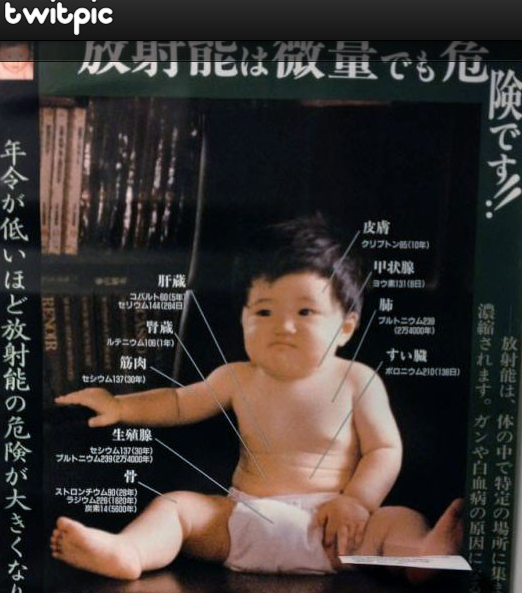
Image source ; 28 doctors in Aomori prefecture made this poster showing radiological/toxic damage.
Meanwhile somewhere in Japan a genetics laboratory staff are still awaiting even a single blood sample from the Fukushima residents so they can test for ionising radiation damage (there is a test for this type of damage but it is not being used!).
“Births, terminations and stillbirths are recorded by law, but the birth of a child before 24 weeks may not be because it is called a miscarriage and there is simply no official audit of miscarriages.”
The Japanese government on year 2 of the disaster are just commissioning a report on the ethics of using genetic research and the time is running out for these tests to be accurate. This shows how science can be manipulated avoiding real numbers for corporate profits. The science community relies instead on the likes of Ricahrd Wakeford (ex BNFL Sellafield) and his handy statistical equations.
So why did I draw your attention to Japan? The UK is complicit in covering up the effects of ionising radiation. The world science community relies on UK scientists to make their biased claims via peer reviewed article (70 percent of which are likely faulty reports in some way according to a recent stunning report) and the vast media presence of the BBC. This criminal use of science media and politics is responsible for the cover up on the effects on the people living in contaminated areas in Japan.
“We postulate that chronic low-level ecological and professional ionizing radiation exposure were causal for haemostasiological imbalance and impaired the cell-cell communication”
Why does the UK and the USA want to increase the amount of allowable contamination into our environment? Is it because our background radiation and more relevantly, our air quality has been polluted with the increased atmospheric emission coming from the new MOX fuel and waste disposal of nuclear materials, nuclear reactor emissions, weapons discharges and uranium/gold mining processes? And this is spreading micro-particles with ionising and toxic effects!
This is a short article of my impression of my findings. I wanted to share these thoughts with you all and ask the questions. Now its up to you to do some research and ask your own questions. Military and governmental research accounts for a large proportion of a universities income.. there is little independent research allowed or funded for. Can we trust our scientists? Do they work for us or for corporate profits? You decide?
The increase in the 2009 to 2010 was likely caused by this;
H1N1 vaccines contributed to 3587 miscarriages and stillbirths in 2009.
By On September 17, 2010
Placing the actual national numbers gleened from the vaccine/miscarriage study of 2009 against the Watford hospital figures the national figures for pollutant caused miscarriage would be in the tens of thousands, at least, if you looked at these figures as representative nationally, this too will effect countries adjacent to the UK.
I have embedded 2 videos showing the statistics with some preliminary thoughts I had on the findings and below is a list of links i used to compile the above article. I will leave a useful link to a book/PDF at the top of the links for women who might need advise on miscarriage issues, though it is a bit dated it was compiled by women who have experienced miscarriage and I thought it informative if dated.
Continued flooding will damage Fukushima reactors’ structures
NBC News: Fears that Fukushima plant could “break apart” during cleanup process http://enenews.com/nbc-news-fears-that-fukushima-plant-could-break-apart-during-cleanup-process

Title: ‘A very fragile situation’: Leaks from Japan’s wrecked nuke plant raise fears
Source: NBC News
Author: Arata Yamamoto and Ian Johnston
Date: May 1, 2013
Like the persistent tapping of a desperate SOS message, the updates keep coming. Day after day, the operators of the wrecked Fukushima Dai-ichi nuclear power plant have been detailing their struggles to contain leaks of radioactive water.
The leaks, power outages and other glitches have raised fears that the plant — devastated by a tsunami in March 2011 — could even start to break apart during a cleanup process expected to take years. […]
“Until you can stop that transfer, you will not contain the radioactivity. That will go on for years and years until they contain it,” [Independent nuclear expert John Large] said. “The structures of containment start breaking down. Engineered structures don’t last long when they are put in adverse conditions.” […]
See also: Fears have also emerged that the Dai-ichi plant could break apart during cleaning, NBC News reports –
NY Daily News
Tomatoes, deformed by Fukushima radiation, on sale in Japan
 Fukushima: Japan sells radiation-mutated tomatoes http://www.agoracosmopolitan.com/news/headline_news/2013/05/04/5858.html# 04 MAY 2013 BY RAYMOND Lori Mochizuki, who edits Fukushima-Diary.com, reports that capitalists in Japan are now selling clearly discernible radiation contaminated and genetically mutated tomatoes. Mr. Mochizuki reports that such mutated plants are being increasingly found all over Japan, as the capitalist try to draw our attention elsewhere.
“I didn’t buy them.” They look like the mutated tomato on this article. The labels of origin read “Kumamoto”, in Kyushu.
Capitalists in Japan have apparently become so bold that they now seek to make money from tomatoes not fit to be eaten by human or animal alike, as their achon confederates in America and elsewhere seek to cover-up their negligent response to the on-going and worsening Fukushima crisis.
See these videos about San Onofre nuclear plant’s jerry-rigged “fix”
 2 VIDEOS San Onofre Nuclear Plant’s Leaky Pipe Apparently ‘Fixed’ With Tape, Plastic Bags http://www.huffingtonpost.com/2013/05/02/san-onofre-leaky-pipe-fixed-tape-plastic-bag_n_3203289.html?utm_hp_ref=green&ir=Green By Meredith Bennett-Smith, 2 May 13, Well, this doesn’t look good. Continue reading
USA’s renewable energy under attack from Koch bros, Heartland Institute

Over the past two years, the Koch brothers and their proxies have worked to undermine Maine’s RPS through a campaign co-sponsored by the Heartland Institute and ALEC.
Koch Brothers, ALEC Attack Maine Renewable Energy Standards http://www.desmogblog.com/2013/05/03/koch-brothers-alec-attack-maine-renewable-energy-standards 3 May 13, Maine’s clean energy legislation has spurred more than $2 billion in local investment and created at least 2,500 jobs in the Pine Tree State. That isn’t stopping some state lawmakers from trying to weaken and kill these laws, as the local political puppets do the will of their fossil fuel masters, the Koch brothers.
A quick reminder: there’s a coordinated national campaign to dismantle renewable portfolio standards (RPS) at the state level. Behind the campaign is the American Legislative Exchange Council (ALEC), who we’ve covered quite a bit before. Behind ALEC is the Heartland Institute and the Koch brothers. Continue reading
Prme Minister Abe signing Turkey up to buy Japanese nuclear technology

it’s a bit dodgy to buy from Mitsubishi Heavy Industries, who built the Fukushima nuclear reactors
 Japan signs Turkey nuclear deal, BBC News 4 May 13, Shinzo Abe signed the deal in Turkey with Prime Minister Recep Tayyip Erdogan The Turkish government has signed a deal with a Japanese-French consortium to build a new nuclear power station.
The $22bn (£14bn) contract is Japan’s first successful bid for an overseas nuclear project since a tsunami wrecked the Fukushima power station.
The deal was signed by visiting Japanese Prime Minister Shinzo Abe.
Turkish Prime Minister Recep Tayyip Erdogan said it would transform relations with Japan into a “strategic partnership”.
“What happened at Fukushima upset all of us. But these things can happen. Life goes on. Successful steps are being taken now with the use of improved technology,” the Turkish prime minister added.
The deal comes as part of renewed efforts to promote Japanese nuclear technologies abroad, despite concerns over safety. One of the Japanese firms included in the consortium is Mitsubishi Heavy Industries, one of the companies behind the Fukushima plant damaged in the 2011 earthquake and tsunami.
Turkey is also prone to earthquakes, and the government cited Japan’s expertise in earthquake protection as one of the factors in signing the deal……http://www.bbc.co.uk/news/business-22398356
VIDEO: Iran’s rights to peaceful use of nuclear energy
VIDEO: West unwilling to recognize Iran’s nuclear rights: Analyst http://www.presstv.ir/detail/2013/05/03/301638/west-ignores-iran-nuclear-energy-right/ A political analyst says the Western governments are not willing to recognize Iran’s right to use nuclear energy for peaceful purposes, Press TV reports.
“They [Western governments] are not willing to admit or recognize the rights of the Iranian people to obtain nuclear energy for civilians … purposes and to produce a clean energy to use in the future…,” political analyst Redwan Rizk said in an interview with Press TV on Friday.
Iran’s chief nuclear negotiator Saeed Jalili agreed on Friday to meet with the European Union foreign policy chief, Catherine Ashton — who represents the P5+1 group of world powers in comprehensive negotiations with Iran — later this month in Turkey’s port city of Istanbul.
Commenting on the planned meeting, the analyst said if the West wants the talks to be fruitful, they have to recognize the rights of the Iranian people and stop “imbalanced judgments towards Iran and towards the Islamic world.”
“So Iran has proposed so many times to fulfill the questions or to answer the questions of the West and the West turned its blind eye most of the time. All they want is to get the Iranians to stop their program and to stop all nuclear reactors on the Iranian land,” he added.Rizk also pointed to the fatwa (religious decree) issued by Leader of the Islamic Revolution Ayatollah Seyyed Ali Khamenei on the prohibition of nuclear weapons saying it is against the Islamic ideology to obtain any nuclear weapon.
Iran and the P5+1 — the US, France, Britain, Russia, and China plus Germany — have held several rounds of talks mainly over Iran’s nuclear energy program. Their latest rounds of talks were held in the Kazakh city of Almaty on February 26-27 and April 5-6.
The United States, Israel, and some of their allies have repeatedly accused Iran of pursuing non-civilian objectives in its nuclear energy program.
Tehran rejects the allegation, arguing that as a committed signatory to the Non-Proliferation Treaty and a member of the International Atomic Energy Agency, it has the right to use nuclear technology for peaceful purposes.
May 9 Live stream panel on Fukushima ocean radiation
 VIDEO: Fukushima ocean radiation panel to be live-streamed http://summitcountyvoice.com/2013/05/03/fukushima-ocean-radiation-panel-to-be-live-streamed/ May 3, 2013 by Bob Berwyn
Experts to discuss concerns about radioactive dispersion; viewers can ask questions via Twitter during May 9 session FRISCO — More than two years have passed since a 9.0 earthquake and a 50-foot tsunami catastrophically damaged the Fukushima Dai-ichi nuclear power plant on Japan’s northeast coast, but questions still linger about the long-term impacts of radioactive pollution in the ocean.
The quake and tsunami killed about 20,000 people, and some coastal Japanese fisheries are still closed due to concern about the radiation. Next week, an international panel of scientists will discuss the accident and potential impacts to the environment and human health in a web-streamed session at the Woods Hole Oceanographic Institution.
The panel will be held on May 9, 2013, from 6:30 to 9:30 p.m. EDT and simulcast on the Web (http://www.whoi.edu/fukushima). Online viewers are encouraged to participate and send questions for the panel discussion via Twitter. The event hashtag is #WHOIfukushima. Questions during the discussion can also be sent via email to cmer@whoi.edu.
The panel will look at natural and human sources of radiation in the ocean, what was released from Fukushima, impacts on marine ecosystems and human health, public policy implications, and how information is communicated to the public.
“The goal is not to alarm or assign blame, but to talk about lessons learned from this tragic event,” said WHOI senior scientist and marine chemist Ken Buesseler, who led the first international, multidisciplinary assessment of the levels and dispersion of radioactive substances in the Pacific Ocean off the Fukushima nuclear power plant in June 2011.
Following the short keynote presentations, Heather Goldstone, host of Living Lab on WCAI, the Cape and Islands NPR station, will moderate a panel discussion from 8 p.m. to 9:30 p.m. EDT.
The program will include presentations by:
- Mitsuo Uematsu, University of Tokyo
“The Fukushima Disaster: An Overview” - Ken Buesseler, Woods Hole Oceanographic Institution
“Radioisotopes in the Ocean” - Jota Kanda, Tokyo University of Marine Science and Technology
“Radioisotopes in Marine Life” - Hiroyuki Matsuda, Yokohama National University
“Seafood Safety and Public Policy” - James Seward, Lawrence Livermore National Laboratory
“Impacts of Radioactivity on Human Health” - Dennis Normile, Science Magazine
“The Role of the Media in Disasters” - Jian Lin, Woods Hole Oceanographic Institution
“Tsunamis and nuclear power in the U.S.”
The program is part of the Woods Hole Oceanographic Institution’s Morss Colloquia series, established thanks to a generous gift by Elisabeth W. and Henry A. Morss, Jr.
Radioactive waste dumping into the world’s oceans
Ocean disposal of radioactive waste http://en.wikipedia.org/wiki/Ocean_disposal_of_radioactive_waste#1946-93 April 2013 (Excellent maps)
From 1946 through 1993, thirteen countries (fourteen, if the USSR and Russia are considered separately) used ocean disposal or ocean dumping as a method to dispose of nuclear/radioactive waste. The waste materials included both liquids and solids housed in various containers, as well as reactor vessels, with and without spent or damaged nuclear fuel.[1] Since 1993, ocean disposal has been banned by international treaties. (London Convention (1972), Basel Convention, MARPOL 73/78)
However, according to the United Nations, some companies have been dumping radioactive waste and other hazardous materials into the coastal waters of Somalia, taking advantage of the fact that the country had no functioning government from the early 1990s onwards. This caused health problems for locals in the coastal region and posed a significant danger to Somalia’s fishing industry and local marine life.[2]
“Ocean floor disposal” (or sub-seabed disposal)—a more deliberate method of delivering radioactive waste to the ocean floor and depositing it into the seabed—was studied by the UK and Sweden, but never implemented.[3]…….
United Nations call to save the world’s oceans
 Ban calls for concerted global action to save world’s oceans from pollution, acidification http://www.un.org/apps/news/story.asp?NewsID=44621&Cr=climate+change&Cr1=#.UYW18aJwpLt 11 April 2013 – Secretary-General Ban Ki-moon today called on world leaders to take stronger action to protect the planet’s seas, warning that pollution, unsustainable exploitation, climate change and acidification threaten the very foundations of all life and the global economy.
“We need practical, timely action at the national, regional and global levels to improve the health of the oceans, and to recover and sustain ocean resources,” he told ‘The High Seas, Our Future! Conference’ in a message read out in Paris by United Nations Educational, Scientific and Cultural Organization (UNESCO) Director-General Irina Bokova.
“It is time to take stronger, more pragmatic and more concerted effort to protect our oceans,” he said, stressing that oceans are heating up and their acidification is adversely affecting on marine life, while rising sea levels threaten to re-draw the global map at the expense of hundreds of millions of people, often the most vulnerable.
He highlighted the critical role oceans play “for the health of our planet, for all life, and for the global economy.”
Mr. Ban said he vividly remembered his meeting last year in New York with the crew of the UN-backed Tara Expedition, which travelled 70,000 miles across the Atlantic, Pacific, Antarctic and Indian oceans investigating the effects of global warming on biodiversity and marine life, particularly focusing on marine plankton.
“The Tara team and other civil society organizations are critical to raising global awareness of the importance of oceans and the challenges they face,” he concluded. “If we work together – the United Nations system, governments and businesses, civil society actors and individuals – we can find sustainable ways to support life and protect our planet and our precious oceans.”
Getting ready for nuclear disasters – radiation-proof vehicles
Japan Launches Radiation-proof Vehicles To Deal With Nuclear Disasters http://www.rttnews.com/2109025/japan-launches-radiation-proof-vehicles-to-deal-with-nuclear-disasters.aspx?type=gn&utm_source=google&utm_campaign=sitemap 5/3/2013 Japan’s National Police Agency has launched radiation-proof vehicles at its headquarters in Tokyo and the nuke accident-hit Fukushima prefecture to better prepare for nuclear-related trouble.
The vehicles have lead on their bodies and windows, air-pressurized, and can monitor atmospheric radiation levels. The 10.5-meter-long vehicle weighing 21 tons costs more than $1.5 million, Japanese media reported on Friday citing the Agency.
It said the vehicles would be mobilized in the event of terror attacks on nuclear facilities or nuclear accidents.
Since the September, 2001 terror strikes on the United States, Japan has been deploying police units at 22 of its nuclear facilities. Police stepped up their alert for possible attacks on nuke facilities after the Fukushima nuclear disaster that contaminated food and water after radiation leak from the tsunami-crippled nuclear power plant of the Tokyo Electrical Power Company.
The Agency said one of the vehicles would be used at the Fukushima plant, while one in Tokyo would be put on standby for use in emergencies across Japan.
In Connecticut they’ll just keep storing more radioactive trash
it would be more sensible to just stop making the stuff
Conn. OK’s more waste storage at nuclear plant, Boston Globe ASSOCIATED PRESS MAY 03, 2013 The key problem facing nuclear plant operators, including Millstone in Connecticut, is the inability in Washington to decide what to do with radioactive waste. NEW BRITAIN, Conn. — State officials authorized the Millstone nuclear plant on Thursday to significantly expand nuclear waste storage capacity over the next 30 years.
Without a national site to take spent nuclear fuel, Millstone Power Station’s owner, Dominion Resources Inc., turned to Connecticut for permission to increase storage at the Waterford site. The nine-member council voted unanimously without discussion to allow Millstone to build concrete pads necessary for an expansion of its waste storage. Millstone is seeking to expand storage from 19 cask storage units now to 135 by 2045. However, Millstone’s application does not include a request to install the 135 casks, the Siting Council said.

Melanie Bachman, staff attorney for the council, said Millstone has authorization to install 49 casks and must seek permission for the remaining 86.
The Black Point Beach Club Association, a homeowners group in Niantic across Niantic Bay from Millstone, asked the Siting Council to reject the nuclear plant’s request. State officials are not accounting for possible problems at Millstone if sea level rises as projected because of climate change, the association said. It also urged the state to wait for guidance from the Nuclear Regulatory Commission.
‘‘All of the association’s members and all residents of Black Point are subject to potential mandatory evacuation orders and martial law and personal harm in the event of a serious accident at Millstone, including the proposed storage facility,’’ the group told the Siting Council.
Dominion is spending $11 million for preparation and other work, Holt said. The plant will move fuel from pools and move them into dry casks, which will be welded shut and moved to a concrete bunker. Fuel will be moved within two years, Holt said. http://www.bostonglobe.com/metro/2013/05/02/conn-oks-expanded-waste-storage-capacity-millstone-nuclear-plant-conn-approves-new-waste-storage-nuclear-plant/NZRUTzzGMvJ0LxVWhkccYM/story.html
The $billion cost of Repairs to the Oconee Nuclear Plant
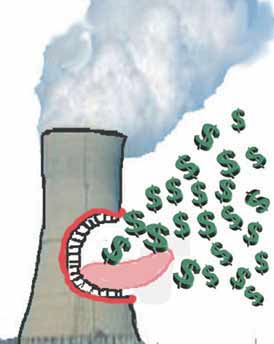 Will Repairs to the Oconee Nuclear Plant Cost Duke Energy a Billion Dollars?, http://www.huffingtonpost.com/philip-radford/will-repairs-to-the-ocone_b_3208859.html Philip Radford, 3 May 13 Duke Energy and government regulators have been hiding a not-so-little secret from the people of the Carolinas. Duke’s Oconee nuclear power plant, three aged nuclear reactors 30 miles from Greenville, SC, isat risk of a meltdown should an upstream dam fail. If that were to happen, a meltdown of all three reactors on the scale of the Fukushima meltdowns and subsequent containment failure are virtual certainties according to U.S. Nuclear Regulatory Commission (NRC) documents obtained by Greenpeace .
We’ve also received a tip that the cost to upgrade the Oconee nuclear plant site to address this triple meltdown threat would cost Duke Energy a billion dollars.
A billion dollars.
So at Duke Energy’s annual shareholder meeting yesterday in Charlotte, NC, I asked Duke CEO Jim Rogers a question about his company’s dangerous nuke plants and the billion dollar cost to protect and upgrade. Tellingly, Jim Rogers did not dispute the billion dollar price tag nor the need to better defend Oconee from flood waters….. It’s worth noting that Mr. Rogers didn’t deny the potential billion dollar price tag of the Oconee repairs. Even for Duke, that’s a serious amount of money.
I wonder if Duke’s shareholders know that the company could end up being on the hook for that kind of a pricey fix? Greenpeace appreciates Mr. Rogers acknowledging the threat to Oconee and the enormous expense of fixing it. If Rogers wants to do the most fiscally prudent thing for Duke’s investors, he should retire the reactors. Duke and its regulators have known about this threat for decades and have utterly failed to address it. While regulation of nuclear power can be very complex, the issue at Oconee is pretty simple to understand. As you can read here, the potential flood height at Duke Energy’s Oconee nuclear plant is well above the height of Oconee’s flood walls leaving important safety equipment vulnerable.
Does this sound familiar? It should. In Japan, the nuclear industry knew that the flood wall at Fukushima was too low and did nothing about it there either.
Other nuclear laden electric corporations face steep costs to upgrade old and dangerous reactors. Dominion recently testified that Fukushima fixes would cost their corporation between $30 and $40 million. But the billion dollar price tag to reduce the risks at Oconee is truly staggering. Rather than wasting a billion dollars on old reactors that will never be safe, Duke Energy should invest in renewable energy and efficiency. Wind turbines and solar panels don’t threaten the Carolinas with the prospect of nuclear meltdowns.
Hundreds of nuclear missiles on high alert
 Nations at nuclear meeting say too many on alert http://news.yahoo.com/nations-nuclear-meeting-too-many-alert-171900328.html
By JOHN HEILPRIN | Associated Press – 8 hrs ago
GENEVA (AP) — More than 100 nations concluding a round of global nuclear talks Friday expressed alarm that many nuclear weapons are kept at a high-alert level and are still being modernized, despite a promise to get rid of them.
The statement was, in effect, a complaint about — and by — some of the most powerful members of the Nuclear Non-Proliferation Treaty, since the U.S. and Russia were included in it. They are known to possess most of the world’s hundreds of launch-ready ballistic missiles that can be ordered to quickly deliver their payload, a nuclear warhead. Continue reading
1 This Month

of the week – Shut Down Drone Warfare!


Tell the Ukrainian Government to Drop Prosecution of Peace Activist Yurii Sheliazhenko

Petition to revoke the licensing of the Near Surface Nuclear Disposal Facility (NSDF) at Chalk River. https://www.ourcommons.ca/petitions/en/Petition/Details?Petition=e-7247
To see nuclear-related stories in greater depth and intensity – go to https://nuclearinformation.wordpress.com
-
Archives
- March 2026 (237)
- February 2026 (268)
- January 2026 (308)
- December 2025 (358)
- November 2025 (359)
- October 2025 (376)
- September 2025 (257)
- August 2025 (319)
- July 2025 (230)
- June 2025 (348)
- May 2025 (261)
- April 2025 (305)
-
Categories
- 1
- 1 NUCLEAR ISSUES
- business and costs
- climate change
- culture and arts
- ENERGY
- environment
- health
- history
- indigenous issues
- Legal
- marketing of nuclear
- media
- opposition to nuclear
- PERSONAL STORIES
- politics
- politics international
- Religion and ethics
- safety
- secrets,lies and civil liberties
- spinbuster
- technology
- Uranium
- wastes
- weapons and war
- Women
- 2 WORLD
- ACTION
- AFRICA
- Atrocities
- AUSTRALIA
- Christina's notes
- Christina's themes
- culture and arts
- Events
- Fuk 2022
- Fuk 2023
- Fukushima 2017
- Fukushima 2018
- fukushima 2019
- Fukushima 2020
- Fukushima 2021
- general
- global warming
- Humour (God we need it)
- Nuclear
- RARE EARTHS
- Reference
- resources – print
- Resources -audiovicual
- Weekly Newsletter
- World
- World Nuclear
- YouTube
-
RSS
Entries RSS
Comments RSS
 nuclear-news