USA’s present danger of nuclear spent fuel pools
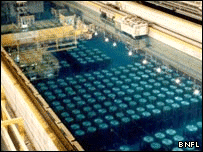 Congress needs to focus on how nuclear waste is stored now By Dave Lochbaum and Robert Cowin, Union of Concerned Scientists – 05/01/13 U.S. nuclear power plants have been generating electricity for more than 50 years, but the nuclear industry and the federal government have yet to figure out what to do with nuclear waste, which remains dangerously radioactive for thousands of years. On April 25, a bipartisan group of senators — Lamar Alexander (R-Tenn.), Dianne Feinstein (D-Calif.), Lisa Murkowski (R-Alaska) and Ron Wyden (D-Ore.) — released draft legislation addressing this intractable problem.
Why is that a problem? Plant owners—who never expected to have to deal with large amounts of radioactive waste on site—are not storing it as safely as they should or could. The blue ribbon commission failed to address this critical issue in its final report, and if the senators stick strictly to the commission’s recommendations, their legislation will do little or nothing to lessen this threat to public safety.
What’s so bad about the cooling pools? They lack diverse emergency cooling and water makeup systems and most are not located within robust containment structures. They also rely on electricity, and are thus vulnerable to events leading to power loss, such as flooding and seismic activity, or to terrorist strikes that cause a loss of water from the pool. Loss of cooling could result in fuel damage and a potentially massive radiological release. Such a scenario was a main concern during the 2011 nuclear disaster in Fukushima, Japan, where the facility’s cooling systems failed due to lack of power.
The high density of fuel in the pools is also a concern. More spent fuel in pools increases the heat load and reduces the response time necessary to address problems. Storing less radioactive material in the pools would mean a smaller radiological release in the event of an accident.
Fortunately there is a more sensible, safer solution: transfer the spent fuel rods to cement and steel casks. Unlike the pools, dry casks are cooled by a “passive” air system that doesn’t require electricity to operate. A case in point is Fukushima: The safety of the spent fuel stored in the facility’s dry casks was never in doubt during the accident.
No comments yet.
1 This Month


10 March A LIVE WEBINAR THE REAL EFFECTS OF NUCLEAR POWER
What the Industry Isn’t Telling Us
1:00 PM Mountain, 2 pm Central, 3 pm Eastern. Live on the Keepers of the Water Facebook page

18 March Webinar @ 1 PM EST: An Assessment of SMR Projects: The Case of Canada
register for the zoom:
https://us02web.zoom.us/webinar/register/WN_o8BIIOUvQ2ONJR1nta65DQ#/registration


of the week – STOP SMALL MODULAR REACTORS IN CANADA
To see nuclear-related stories in greater depth and intensity – go to https://nuclearinformation.wordpress.com
-
Archives
- March 2026 (62)
- February 2026 (268)
- January 2026 (308)
- December 2025 (358)
- November 2025 (359)
- October 2025 (376)
- September 2025 (258)
- August 2025 (319)
- July 2025 (230)
- June 2025 (348)
- May 2025 (261)
- April 2025 (305)
-
Categories
- 1
- 1 NUCLEAR ISSUES
- business and costs
- climate change
- culture and arts
- ENERGY
- environment
- health
- history
- indigenous issues
- Legal
- marketing of nuclear
- media
- opposition to nuclear
- PERSONAL STORIES
- politics
- politics international
- Religion and ethics
- safety
- secrets,lies and civil liberties
- spinbuster
- technology
- Uranium
- wastes
- weapons and war
- Women
- 2 WORLD
- ACTION
- AFRICA
- Atrocities
- AUSTRALIA
- Christina's notes
- Christina's themes
- culture and arts
- Events
- Fuk 2022
- Fuk 2023
- Fukushima 2017
- Fukushima 2018
- fukushima 2019
- Fukushima 2020
- Fukushima 2021
- general
- global warming
- Humour (God we need it)
- Nuclear
- RARE EARTHS
- Reference
- resources – print
- Resources -audiovicual
- Weekly Newsletter
- World
- World Nuclear
- YouTube
-
RSS
Entries RSS
Comments RSS
 nuclear-news
Leave a comment