VIDEO- the struggle by Hanford workers to contain radioactive sludge
 http://www.king5.com/news/investigators/Hanford-worker-pushed-WRPS-to-action-204789701.html Hanford worker’s struggle to ‘do the right thing
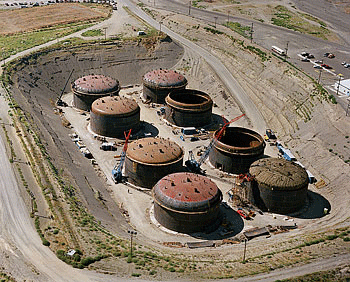 TV: Most hazardous material on planet leaking at U.S. nuclear site — Would contaminate our food chain for hundreds of years to come if it reaches Columbia River (VIDEO) http://enenews.com/tv-hazardous-material-planet-leaking-nuclear-site-contaminate-food-chain-hundreds-years-reaches-columbia-river-video
Source: KING 5
Author: SUSANNAH FRAME
Date: April 25, 2013
Reporter: We’ve heard about other leaking tanks, so why is this one so important? This tank is holding waste that is so toxic that if it were to eat through its outer shell and reach the nearby the Columbia River it would contaminate irrigation water, crops, salmon, our food chain — not for months, but for hundreds of years to come. […]
Underfoot, the most hazardous material on earth is brewing inside a million gallon double shell tank.
Title: Hanford worker’s struggle to ‘do the right thing’Hanford Worker: This tank is holding the nastiest of nastiest stuff at Hanford.
Watch the broadcast here
A plastic bag,tape and broomstick fix for San Onofre nuclear leak
 ‘Plastic Bags, Tape, Broomsticks Fix San Onofre Nuclear Power Plant Leak’ April 30, 2013 http://www.blacklistednews.com/%E2%80%98Plastic_Bags,_Tape,_Broomsticks_Fix_San_Onofre_Nuclear_Power_Plant_Leak%E2%80%99/25680/0/38/38/Y/M.html … April 30, 2013 Source: 10 News ABC
An inside source gave Team 10 a picture snapped inside the San Onofre Nuclear Generating Station (SONGS) showing plastic bags, masking tape and broom sticks used to stem a massive leaky pipe.
San Onofre owner Southern California Edison (SCE), confirms the picture was taken inside Unit Three, but did not say when. The anonymous source said the picture was taken in December 2012.

Unit Three is the same unit that leaked radiation in January 2012. SONGS has been shutdown since then as a precaution.
“[Staff] identified a small leak in the water box and will perform maintenance per our scheduling process,” SCE spokeswoman Maureen Brown wrote in a statement. “In the meantime, plastic is in place to direct the water from the small leak to a drain.”(Team 10 took the picture to the Nuclear Regulatory Commission (NRC) to see what federal regulators had to say about the quick fix. See the commission’s response today on 10News at 5 p.m.)
“If that’s nuclear technology at work and that’s how we’re going to control leaks I think the public should know,” the inside source said.
More than one anonymous source talked about the picture with Team 10. They said the public has a right to know about the plant’s condition, as the NRC decides whether the plant will be allowed to restart.
Unit Two is the generator under consideration for restart – not Unit Three – where the picture was taken. Currently there are no plans to restart Unit Three.
Sources also pointed to what appears to be corrosion on the pipe as a sign of the power plant’s age.
They claim rust is rampant throughout SONGS — including what sources call a fire suppression pipe, which protects both units.
“There’s a pipe that runs along the security fence, from one side of the plant to the other side of the plant — it’s totally blistered,” one inside source told Team 10.
“To take an isolated picture and leap to some kind of conclusion about maintenance is a pretty big leap,” SCE’s Brown said in a phone conversation.
“We are dealing with unknown territory here which has never been explored before,” another inside source said. Two inside sources called restarting SONGS “risky.”
SCE disputes those claims and told Team 10 the plant is safe to restart.
Fukushima nuclear buildings getting flooded with radioactive water
 Radioactive water floods Fukushima buildings http://www.globalpost.com/dispatch/news/regions/asia-pacific/japan/130430/radioactive-water-floods-fukushima-buildings 1 May 13,
Workers have been struggling to contain radioactive wastewater left over from the Fukushima disaster. Radioactive groundwater is pouring into the buildings of the Fukushima Daiichi nuclear power plant at the rate of 75 gallons a minute, the New York Times reported. Worse, the flooding is not new. It’s been a constant headache since the nuclear disaster two years ago, forcing a small army of workers to continuously struggle to contain the endless flow of water.
“The water keeps increasing every minute, no matter whether we eat, sleep or work,” Masayuki Ono, a general manager with the Tokyo Electric Power Company, told the Times. “It feels like we are constantly being chased, but we are doing our best to stay a step in front.”
More from GlobalPost: On Location Video: The dirty work of cleaning up Fukushima
According to the Times, the workers use massive tanks sprawling over 42 acres to hold the water, and even that isn’t enough.
In an interview with the Associated Press, Ono’s description of the tanks was not exactly reassuring: “We admit that the underground tanks are not reliable. But we must keep using some of them that are relatively in good shape while monitoring them closely.”Earlier this month, TEPCO admitted that one of those holding tanks may have leaked up to 120 tons of contaminated water.
Huge jump in Fukushima radiation OUTSIDE of reservoir No1
 [Leakage] Radiation level jumped up over 10 times much as 2 days before OUTSIDE of reservoir No.1 http://fukushima-diary.com/2013/04/leakage-radiation-level-jumped-up-over-10-times-much-as-2-days-before-outside-of-reservoir-no-1/ by Mochizuki April 28th, 2013
It’s on the South West side of the reservoir. The sample is drain hole water.
At 12:05 of 4/26/2013 (JST), they measured 41,000 Bq/Kg of the total β nuclide.
At 12:05 of 4/28/2013, it jumped up to be 1,100,000 Bq/Kg, which is over 10 times much as the previous reading.
Tepco hasn’t verified the reason yet. http://www.tepco.co.jp/nu/fukushima-np/f1/smp/2013/images/chosui_13042706-j.pdf
http://www.tepco.co.jp/nu/fukushima-np/f1/smp/2013/images/chosui_13042601-j.pdf
Doubts about the NRC special team investigating San Onofre nuclear plant
 Unfortunately, many people do not see the NRC and such agencies which have an intimate relationship with the nuclear industry as impartial and reliable. As was the case with Fukushima, it could very well emerge that government agencies have been working with the nuclear companies in order to downplay the dangers of these incidents, but obviously I hope that is not the case here.
but with all of the lies surrounding the Fukushima incident, I find the nuclear industry and their supposed regulators to be highly dubious at best.
NRC dispatches Augmented Inspection Team after California nuclear facility fails test. End the Lie, By Madison Ruppert Editor of End the Lie, 1 May 13, After a safety test at the San Onofre Nuclear Generating Station near San Clemente, California (which we discussed in this episode of End the Lie Radio), resulted in a “significant issue,” the Nuclear Regulatory Commission (NRC) has moved to send out a so-called Augmented Inspection Team (AIT) to determine the cause of the failure. Continue reading
Los Angeles city Council warns on danger of San Onofre nuclear power plant
 Los Angeles to San Onofre: ‘Not So Fast!’ http://www.huffingtonpost.com/harvey-wasserman/los-angeles-to-san-onofre_b_3167482.html 04/29/2013 A unanimous Los Angeles City Council has demandedthe Nuclear Regulatory Commission conduct extended investigations before any restart at the San Onofre atomic power plant.
The move reflects a deep-rooted public opposition to resumed operations at reactors perched in a tsunami zone near earthquake faults that threaten all of southern California. Continue reading
Shortage of water a big threat to nuclear reactors
 Cooling systems for nuclear plants and power plants that burned coal, gas and oil accounted for 41 per cent of fresh water withdrawals and 49 per cent of all water withdrawals.
During the 2003 heat wave in France, which was responsible for more than 10,000 deaths, nuclear plants had to reduce their output, worsening the crisis. The rising temperature of river water meant they could not achieve sufficient cooling and still observe discharge limits
Nuclear and coal-fired power plants with OTC systems are especially vulnerable to droughts and heat waves because they rely on by far the largest volume of water withdrawals.
US energy supplies imperiled by water shortages, The Age May 1, 2013 – John Kemp Water and energy are inextricably linked.Power plants are the largest users of water in the United States, while substantial amounts of energy are needed to supply fresh water to homes, farms and factories and treat waste water prior to safe disposal.
Rising water consumption for hydraulic fracturing and production of biofuels, coupled with severe droughts in Texas in 2011 and across more than 60 per cent of the continental United States in 2012, have propelled that link up the policymakers’ agenda.
The threat to hydroelectric generation is obvious. But in 2007-2009, drought put the water supplies of 24 of the nation’s 104 reactors at nuclear plants at risk. In 2011, more than 3,000 megawatts of thermal generating capacity in Texas also was considered at risk of having to shut down if the drought persisted as reservoir levels plunged.
Texans were asked to conserve water to keep the lights on. The state was only spared blackouts because of high output from wind farms.
On April 25, the Energy and Natural Resources Committee of the US Senate held a hearing to explore the effect of drought on the energy sector and water management, reflecting lawmakers’ fears about the instability created by the tightening links between water and energy supplies. Continue reading
San Onofre nuclear plant at risk of Fukushima style meltdown
Nuclear station insider says San Onofre should stay closed http://rt.com/usa/san-onofre-nuclear-insider-652/ April 30, 2013 A safety engineer from the San Onofre nuclear power plant has warned that “there is something grossly wrong” with the plant and that it faces the prospect of a full or partial meltdown if it is restarted
The safety engineer, who has worked in the nuclear field for 25 years, told ABC 10 that due to broken tubes carrying scalding water, there could easily be a main steam line break, which would cause the nuclear reactor core to overheat and result in a Fukushima-like meltdown. Continue reading
UK government backs down, will not test-fire depleted uranium weapons

“Although this is a big step forward, the campaign must continue until there is a clear guarantee that there will be no more test firing of DU shells in Scotland at any point in the future.”
This is a major victory for our campaign and one that reflects the increasing global opposition to depleted uranium.
CADU campaigners plan to hold a public meeting in Dumfries at the end of May to discuss further plans with local residents. More details will be released on their website
Ministry of Defence back down over test firing of depleted uranium munitions in Scotland, Occupy News Network, 1 May 13
– Parliamentarians and campaigners claim this as a ‘major victory’

 Last week Minister for Defence Equipment, Support and Technology, Philip Dunne, told Katy Clark, MP for North Ayrshire and Arran, that the MoD will not fire depleted uranium (DU) as part of the current Life Extension Programme. This is the first time the MoD have bowed to public and political pressure and not fired depleted uranium as part of the life extension programme (LEP) of CHARM3. Continue reading
Video: Fukushima doctor calls for help for children sick from radiation
Fukushima Doctor: We need outside help, Japanese people not listening — We are now in very bad condition, especially for children — Please help (VIDEO) http://enenews.com/alert-fukushima-pediatrician-we-need-outside-help-japanese-people-not-listening-we-are-now-in-very-bad-condition-especially-for-children-please-give-us-help-video
Japan Doctor: So enraged by response of gov’t — Fukushima children’s rashes, nosebleeds, diarrhea, fatigue blamed on radiation-phobia mothers http://enenews.com/japan-doctor-so-enraged-by-response-of-govt-fukushima-childrens-rashes-nosebleeds-diarrhea-fatigue-blamed-on-radiation-phobia-mothers
Source: THE ASAHI SHIMBUN
Date: April 30, 2013Katsuno Onozawa, a doctor of psychosomatic medicine, who has taken part in children’s health consultations in Fukushima PrefectureWhat shocked me the first time I participated in January of last year was the gap between what the newspapers and TV news were reporting and the reality in Fukushima as attested to by the mothers […]
Wanting to protect their children from radiation, they pleaded with the prefectural and city governments and local doctors, but none would take their side.
They just said things like, “It’s safe. You don’t have to take any special action. There are lots of radiation-phobia mothers, and we can’t deal with them all.”
[…] I was at a loss for words because of these mothers’ situation, and I could not sleep at night because I was so enraged at the government’s heartless response. […]
Yet the children were exhibiting a range of symptoms including sore throats, nosebleeds, diarrhea, fatigue, headaches and rashes. The most dangerous thing is to write off causes of illness as psychosocial factors with statements like, “Your child’s stress comes from not being able to go outdoors” and that a “mother worrying will make her child sick.” […]
See also: Fukushima Doctor: We need outside help, Japanese people not listening — We are now in very bad condition, especially for children — Please help (VIDEO)
Youtube: exposing the pro nuke lies about uranium
 http://www.youtube.com/watch?v=ZotGdcV1Kik&feature=youtu.be Dr. Jim Deutsch Corrects GE’s Uranium Secrets James Deutsch, MD, PhD, FRCP(C) Assistant Professor Faculty of Medicine University of Toronto
 “I think it is important to take apart what the GE spokesperson quoted, which is that uranium is a natural entity and that the problem is not uranium but the general public’s so to speak fear of the unknown.
So there is a problem with that.
It is true that uranium is a naturally occurring element , but we evolved as biological creatures above ground with virtually all of the uranium below the ground safely away from our DNA.
Now we are bringing all of this stuff above ground in different forms
and it goes into the body.
And uranium is an emitter that will release particles with energy that can damage the DNA and various tissues and organs in the body close up.
When the GE people talk about that living next to the reactor is about equivalent to one flight from Toronto to Vancouver
they are talking about gamma radiation which is a high energy radiation that can penetrate tissues and pass right through.
What is happening with uranium and the reactors which produce 200 isotopes that never existed before humankind created them.
What those various isotopes do is they go to specific organs in the body and reside there emitting lower energy particles that will damage the molecules within the cells in the tissues in those organs.
Children are especially susceptible, especially newborns and pregnant mothers.”
A community based approach for renewable energy in Japan
One possible way for Japan to approach the NIMBY problems on renewables, Aldrich said, would be to go bottom up — by trying to find communities that are excited about green energy and renewables, to start from the community side and use that initiative to find the locations for wind turbines and solar energy farms.
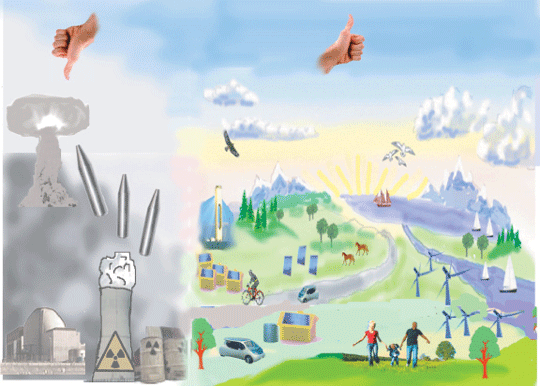
 Siting for renewables needs bottom-up approach http://www.japantimes.co.jp/news/2013/04/30/business/siting-for-renewables-needs-bottom-up-approach/#.UYGdFqJwpLs APR 30, 2013 If post-Fukushima nuclear disaster crisis Japan chooses to fill its energy needs with renewable energy sources, the nation will still face the same NIMBY (not-in-my-backyard) resistance to building large numbers of new facilities in the densely-populated country, an American expert said at a recent energy seminar in Tokyo.
The government is advised to take a bottom-up approach to find communities that are willing to accept wind turbines and solar power generation farms, rather than the top-down process that it used to convince farmers and fishermen into agreeing to the construction of nuclear power plants in their neighborhood over the past five decades, said Daniel P. Aldrich, an associate professor of political science at Purdue University and a Fulbright research fellow at the University of Tokyo. Continue reading
US Energy Information Administration (EIA) shows a way ahead for Renewable Energy
How renewable energy could beat natural gas to the future http://qz.com/79953/how-renewable-energy-could-beat-natural-gas-to-the-future/ By Todd Woody @greenwombat April 30, 2013 We’ve taken the US Energy Information Administration (EIA) to task for its projections of future energy production and consumption that assumes the nation’s fossil fuel addiction will continue until the dinosaur juice runs dry.
Well, today the agency threw caution to the wind and focused on an alternative reality as part of its Annual Energy Outlook, due to be released on May 2. In the latest chapter, EIA examined what the world might look like in 2040 if current renewable energy incentives do not end in 2014 and 2016 as scheduled.
Under that scenario, green energy production grows, accounting for around 23% of total electricity generation in 2040, compared to 16% if business as usual continues. Given the skyrocketing growth in solar and wind generation over the past several years—half of America’s solar capacity was installed just in 2012—that forecast still seems conservative.
It doesn’t take into account, for instance, the likelihood that renewable energy will become cost competitive with fossil fuels, even without subsidies, due to technological breakthroughs and economies of scale. In fact, in some areas of the US with high electricity costs, such as California, that’s already starting to happen.
 But here’s the interesting thing about even the EIA’s conservative forecast: The increase in renewable energy production starts to displace natural gas. (Nuclear power also takes a hit.) The agency estimates that electricity generation from natural gas-fired power plants would be 13% to 16% lower in 2040 compared to its standard forecasts. Not good news for all those investors betting on the shale gas boom. But good news for the planet. Carbon dioxide emissions from energy productions would declined between 1.7% and 2.8% compared to business as usual, according to the EIA. Electricity prices would also drop between 3.9% and 6.3%. (Good diagram)
Clean energy, economy, employment win for Colorado
Another Big Victory for Renewable Energy – This Time in the Rockies http://switchboard.nrdc.org/blogs/nlong/another_big_victory_for_renewa.html Noah Long, 29 April 13, Critical votes in The Colorado legislature late Friday night and yesterday represent yet another victory for renewable energy despite a national drive by the fossil fuel industry to roll back standards supporting increased clean power sources like wind and solar.
The Colorado House voted to increase rural renewable energy to 20 percent, doubling access for 100,000 Colorado customers. A version of the bill had already passed the Senate and is supported by Governor John Hickenlooper. A final vote is still necessary before it gets to the governor’s desk, but after these decisive votes, it should become law.
The move will bring clean energy, jobs and economic opportunity to rural Colorado. The increase could result in as many as 10,000 new wind, solar and renewable jobs.

The win for renewable energy in the heart of the Rockies sends a clear national message. Despite the fossil fuel industry’s attempt to roll back renewable energy standards around the country that require utilities to provide an increasing percentage of their power from renewable resources, voters continue to want more clean energy. Roll back attempts have failed in Kansas and North Carolina (more on NC, here). In Arizona, a lawmaker withdrew his proposal to reduce the renewables requirement on that state’s utilities.
Colorado — which will now get 20 to 30 percent of its energy from clean sources — is on pace to have the second highest renewable energy standard in the country- only behind California.
Media and Advertising Stifle the Truth on Japan’s Nuclear Industry
 Japan’s Media, Mega-Ad Agencies, & Nuclear Industry: A Lethal Combination? BY NATHALIE-KYOKO STUCKY AND JAKE ADELSTEIN , NOVEMBER 17, 2012 ·
Ryu Honma, author of Dentsu and the Nuclear Coverage (電通と原発の報道) spoke at the FCCJ a few weeks ago and his explanation of how Japan’s powerful advertising agencies, “the fifth estate”, stifled unfavorable coverage of nuclear power was eye-opening.
The collusive role between Japan’s major advertising agencies, the media, and Tokyo Electric Power Company (TEPCO)–one of the largest advertisers in Kanto while having a monopoly on electric power—has been blamed for allowing TEPCO to get away with unsafe practices and malfeasance for years. Some have argued that Japan’s major media, bloated on a diet of TEPCO advertising dollars, failed to fulfill their role as monitor and critic of the nuclear industry. A recently published book about Dentsu (電通)Japan’s largest advertising agency and their impact on Japan’s reporting on nuclear power was released this year and stirred up controversy. However, except for one or two magazines, just like the book, TEPCO/The Dark Empire東京電力:帝国の暗黒–the book has been ignored by the major media outlets it criticizes…..
In his book “Dentsu and the Nuclear Coverage,” Ryu Honma offers a clear insight about the great influence Dentsu and Hakuhodo have had on the media coverage of Japan’s nuclear power plant safety issues. Continue reading
1 This Month



Tell the Ukrainian Government to Drop Prosecution of Peace Activist Yurii Sheliazhenko

Petition to revoke the licensing of the Near Surface Nuclear Disposal Facility (NSDF) at Chalk River. https://www.ourcommons.ca/petitions/en/Petition/Details?Petition=e-7247


of the week – STOP SMALL MODULAR REACTORS IN CANADA
To see nuclear-related stories in greater depth and intensity – go to https://nuclearinformation.wordpress.com
-
Archives
- March 2026 (222)
- February 2026 (268)
- January 2026 (308)
- December 2025 (358)
- November 2025 (359)
- October 2025 (376)
- September 2025 (258)
- August 2025 (319)
- July 2025 (230)
- June 2025 (348)
- May 2025 (261)
- April 2025 (305)
-
Categories
- 1
- 1 NUCLEAR ISSUES
- business and costs
- climate change
- culture and arts
- ENERGY
- environment
- health
- history
- indigenous issues
- Legal
- marketing of nuclear
- media
- opposition to nuclear
- PERSONAL STORIES
- politics
- politics international
- Religion and ethics
- safety
- secrets,lies and civil liberties
- spinbuster
- technology
- Uranium
- wastes
- weapons and war
- Women
- 2 WORLD
- ACTION
- AFRICA
- Atrocities
- AUSTRALIA
- Christina's notes
- Christina's themes
- culture and arts
- Events
- Fuk 2022
- Fuk 2023
- Fukushima 2017
- Fukushima 2018
- fukushima 2019
- Fukushima 2020
- Fukushima 2021
- general
- global warming
- Humour (God we need it)
- Nuclear
- RARE EARTHS
- Reference
- resources – print
- Resources -audiovicual
- Weekly Newsletter
- World
- World Nuclear
- YouTube
-
RSS
Entries RSS
Comments RSS
 nuclear-news