Flower exposed to radiation from Fukushima nuclear facility Japan
19 April 2013 posted to
http://phatgenes.tumblr.com/post/48346678294/flower-exposed-to-radiation-from-fukushima-nuclear
Unverified .. but blimey!

Canadian mining company Banda Aceh and others seeks to exploit Aceh’s protected forests
…..”We are very pleased with the recent news from the Indonesian Government. These new developments are good progress and positive news for mineral extraction in the area. This will help us realize the full value of our Miwah gold project in Aceh with a NI 43-101 compliant resource of 3.1 million ounces of gold.” said Edward Rochette, CEO of East Asia Minerals…… (April 16, 2013 Miwah gold project closer to reclassification in Aceh, Indonesia)

The price of gold should be going up! why is it going down? Aceh? Gerald Celente of Trends Journal asking the question at the start of this video! Published 19 April 2013
Source of copy below ; http://endoftheicons.wordpress.com/
PRESS RELEASE
18/04/2013
FOR IMMEDIATE DISTRIBUTION
PLEASE DISTRIBUTE THROUGH RELEVANT NETWORKS
CANADIAN MINING COMPANY ANNOUNCES INVOLVEMENT IN ACEH GOVERNMENT PLAN TO CLEAR OVER 1.2 MILLION HECTARES OF SUMATRA’S PROTECTED FORESTS AND RELATIONSHIP WITH FORMER INDONESIAN MINISTER NAMED AS CORRUPTION SUSPECT
East Asia Minerals admits key role in ‘illegal process’ and claims “good progress” in attempt to ‘reclassify’ over 1 million hectares of ‘protected forests.’ The mining company also claims to have hired Dr. Fadel Muhammad, a former senior Indonesian government official facing corruption charges, “to help them with these efforts.”
Aceh has world-renowned biodiversity, including critically endangered orangutans, rhinos, elephants and tigers. This change would also undermine its incalculable value as a major carbon sink.
BANDA ACEH, Indonesia – A Canadian mining company announced Tuesday that it expects the governor of Sumatra’s Aceh province to allow it and other extractive industries to destroy 1.2 million hectares of valuable and currently protected rainforest.
The company, East Asian Minerals, claims in a press release to be working closely with government officials and to have staff in Aceh lobbying to reclassify large tracts of the province from “protected forest” to “production forest.” The company’s website also states that it has hired a senior government official, former Golkar Deputy Chairman Fadel Muhammad “to help them with these efforts.”
IAEA – Rafael Mariano Grossi, aide to UN nuclear chief unexpectedly resigns and UN Iran team undergoes reshuffle!
“Their departure deprives the agency of the two officials who have spent the most time in the last two years talking with Iranians at senior levels,”
VIENNA — Diplomats say a top aide to the chief of the U.N. nuclear agency has unexpectedly resigned, suggesting tensions among the organization’s top leadership.
By ,
The move comes at a critical time for the International Atomic Energy Agency. It is the outside world’s only window on Iran’s nuclear program, which some nations fear may be turned toward making weapons.

Two diplomats told The Associated Press Friday that Rafael Mariano Grossi, handed in his resignation this week to IAEA chief Yukiya Amano.
Grossi, of Argentina, was touted by some diplomats as a possible successor to Amano, who was re-elected for a second term earlier this year.

Both diplomats demanded anonymity because they are not authorized to discuss confidential IAEA information.
Iran says its nuclear activities are peaceful and denies interest in atomic arms.
U.N. nuclear watchdog team on Iran faces reshuffle
VIENNA — Two senior U.N. nuclear watchdog officials who have been leading talks with Iran will leave this year, potentially robbing it of experience and expertise in dealing with Tehran over its disputed atomic program.
The management reshuffle coincides with apparent deadlock in the agency’s push since early last year to coax Iran into allowing its inspectors to restart a long-stalled investigation into suspected atomic bomb research by the Islamic Republic.
Western diplomats blame Iranian stonewalling for the failure to come to an agreement, a charge Tehran denies, and some say the U.N. agency may soon need to reconsider its tactics. A new round of talks could be held in May.
“I think that we were approaching a potential re-set anyway. It is clear that Iran has been able to stall the process,” a diplomat in Vienna said.
Rafael Grossi, assistant director general of the International Atomic Energy Agency, has been named Argentina’s envoy to the Vienna-based IAEA, a job he is expected to start in the summer, a diplomatic source said on Friday.
The IAEA last month said a senior Finnish nuclear official, Tero Varjoranta, would succeed Herman Nackaerts when he retires in the autumn as chief nuclear inspector in charge of monitoring Iran’s atomic activities and other sensitive issues.
Nackaerts, a Belgian, and Grossi have headed the IAEA’s team of experts who have met nine times with Iranian envoys since early 2012 in an attempt – so far in vain – to secure access to sites, documents and officials in the country.
“Their departure deprives the agency of the two officials who have spent the most time in the last two years talking with Iranians at senior levels,” said Mark Fitzpatrick of the International Institute for Strategic Studies think tank.
Analysts and diplomats stressed, however, that it is IAEA Director General Yukiya Amano, who steered the agency into a tougher approach to Iran, who decides policy. He secured a second four-year term in March, signaling continuity.
“An administrative reshuffle by the agency below Amano will likely have little impact on the Iran talks,” said Mark Hibbs of the Carnegie Endowment think-tank.
The IAEA-Iran talks are separate from, but still closely linked to, broader diplomatic negotiations between Tehran and six world powers aimed at resolving the decade-old dispute peacefully and prevent a new Middle East war.
VIDEO: North Korea now wants talks
 VIDEO Nuclear showdown continues as North Korea issues list of demands
http://www.euronews.com/2013/04/18/nuclear-showdown-continues-as-north-korea-issues-list-of-demands/North Korea has issued a list of conditions in the latest development
in their nuclear showdown. Continue reading
New book “Plutopia” exposes the horror legacy of nuclear weapons making
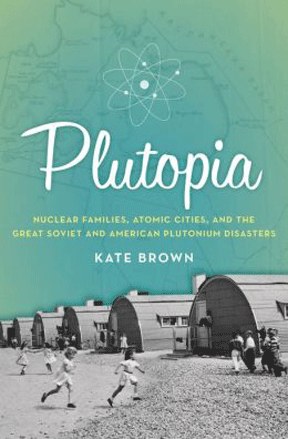 Plutopia: Nuclear Families, Atomic Cities, and the Great Soviet and American Plutonium Disasters Kate Brown http://www.amazon.com/gp/product/0199855765/ref=as_li_ss_tl?ie=UTF8&camp=1789&creative=390957&creativeASIN=0199855765&linkCode=as2&tag=slatmaga-20 While many transnational histories of the nuclear arms race have been written, Kate Brown provides the first definitive account of the great plutonium disasters of the United States and the Soviet Union.
In Plutopia, Brown draws on official records and dozens of interviews to tell the extraordinary stories of Richland, Washington and Ozersk, Russia-the first two cities in the world to produce plutonium. To contain secrets, American and Soviet leaders created plutopias–communities of nuclear families living in highly-subsidized, limited-access atomic cities. Fully employed and medically monitored, the residents of Richland and Ozersk enjoyed all the pleasures of consumer society, while nearby, migrants, prisoners, and soldiers were banned from plutopia–they lived in temporary “staging grounds” and often performed the most dangerous work at the plant.
Brown shows that the plants’ segregation of permanent and temporary workers and of nuclear and non-nuclear zones created a bubble of immunity, where dumps and accidents were glossed over and plant managers freely embezzled and polluted. In four decades, the Hanford plant near Richland and the Maiak plant near Ozersk each issued at least 200 million curies of radioactive isotopes into the surrounding environment–equaling four Chernobyls–laying waste to hundreds of square miles and contaminating rivers, fields, forests, and food supplies.
Because of the decades of secrecy, downwind and downriver neighbors of the plutonium plants had difficulty proving what they suspected, that the rash of illnesses, cancers, and birth defects in their communities were caused by the plants’ radioactive emissions. Plutopia was successful because in its zoned-off isolation it appeared to deliver the promises of the American dream and Soviet communism; in reality, it concealed disasters that remain highly unstable and threatening today.
Japan’s nuclear future – very uncertain
 Japan’s nuclear future Don’t look now A series of mishaps comes at an awkward time for the government the Economist, Apr 20th 2013 | TOKYO In February this year, Shinzo Abe, leader of the then incoming Liberal Democratic Party (LDP), said the new government would restart reactors after they passed a forthcoming set of new safety tests. The country’s “nuclear village”, a cosy bunch from industry and government, cheered. But now the stricken Fukushima Dai-ichi plant is starting to alarm the public once more. Continue reading
Slide Show – history of environmental movement
Slide Show Green Activism Evolution Since The First Earth Day (PHOTOS) http://www.huffingtonpost.com/2013/04/18/green-activism-evolution-photos_n_3103118.html The Huffington Post | By James Gerken 04/18/2013 April 22 marks the 43rd observance of Earth Day in the United States. Organized by Sen. Gaylord Nelson (D-Wis.), the first Earth Day in 1970 saw an estimated 20 million Americans demonstrate in support of the environment. By 2012, over one billion people in 192 countries took part in Earth Day festivities.
Tracing its roots to the 19th century conservation movement, modern environmentalism — and its accompanying protests — has gained support since the first Earth Day, despite modest progress on the policy front. A number of U.S. lawmakers have tried repeatedly to advance bills aimed at protecting the environment and reducing carbon emissions, as the international community warns that global investments in clean energy may be progressing too slowly to limit the effects of climate change.
The second decade of the 21st century -– marked by America’s largest oil spill, thehottest year on record for the continental U.S. and the bitterly divisive Keystone pipeline proposal — has already confirmed the growing relevance of environmental issues in America.
From dramatically unfurled banners across world landmarks to a “toilet protest” and an underwater government cabinet meeting, the demonstrations captured in the images in the slideshow below reflect a spirit unlikely to wane.
Serious worries about safety of Iran’s Bushehr nuclear power plant.
 Another Cause for Alarm in Iran’s Nuclear Program:
  Earthquakes, The Atlantic, Jill Keenan, 18 April 13, The country’s nuclear power plant is built near tectonic plates, and reports show it may not be safe in the event of a major seismic event. On April 16, a massive 7.8-magnitude earthquake hit southeast Iran, sending tremors across the region and causing casualties that are expected to reach into the hundreds. According to an Iranian official , it was the biggest earthquake to hit the country in 40 years. This devastation comes only one week after another earthquake hit the town of Kaki, also in southern Iran, killing at least 37 people and injuring more than 850 others. Shockwaves from both earthquakes were felt as far away as Bahrain, Kuwait, Qatar, the UAE, and western Saudi Arabia. They are only the two most recent in a series of earthquakes that regularly haunt this seismically unstable country.
Most ominously, the epicenter of the April 9 earthquake’s first tremor, which measured a 6.3 on the Richter scale, was centered only 62 miles away from Iran’s Bushehr nuclear power plant. Continue reading
French company EDF quite prepared to pull out of building Britain’s new nukes
” As far as I am concerned, negotiations can also fail,” Proglio told reporters on the sidelines of a debate about France’s energy policy
 EDF SAYS “IN NO HURRY” FOR UK NUCLEAR PROJECTS PARIS
 Reuters April 19, 2013 – EDF chief executive officer Henri Proglio said on Thursday talks are continuing between the French utility and the British government about its nuclear projects in Britain but added that he was “in no hurry” to sign an agreement. Continue reading
Muslumovo, a town radioactively poisoned for 60 years
Soviet radiation biology took a different trajectory from science in the United States. American researchers at that time were working with the highly politicized medical studies of Japanese bomb survivors. They narrowed the list of radiation-related illnesses to leukemia, a few cancers, and thyroid disease. Soviet doctors in formulating chronic radiation syndrome had grasped the effects of radiation on the body more holistically. They determined that radiation illness is not a specific, stand-alone disorder, but that its indications relate to other illnesses. They determined that radioactive isotopes weaken immune systems and damage organ tissue and arteries, causing illnesses of the circulation and digestive tracts and making people susceptible to conventional diseases long before they succumb to radiation-related cancers.
 Strange illnesses in one of the most contaminated towns in the world challenge what we think we know about the dangers of radioactivity. Slate, By Kate Brown, April 18, 2013, ”…… the sad fact is that there are irradiated zones that are fully inhabited, and have been since the first years of the nuclear arms race. Despite a media culture enthralled with nuclear accidents, the cameras generally turn off after the first clouds of radioactive vapors dissipate.
“………..For Soviet leaders, the river dwellers were a unique opportunity in the history of health physics—what scientists call “a natural experiment” that promised to answer an important civil defense question about how to survive a nuclear attack. In 1962, the Cheliabinsk branch of the Soviet Institute of Bio-Physics, called FIB-4, started conducting regular medical exams of the Muslumovo population. FIB-4 doctors invited village children playing on the streets to a clinic room to take blood samples. In Cheliabinsk, they set up a repository of irradiated body parts: hearts, lungs, livers, bones. They started a collection of genetically malformed babies who died soon after birth, each infant preserved in a two-quart glass jar. A Dutch photographer, Robert Knoth, visited the repository and saw hundreds of babies in jars. He photographed one infant with skin like patched, rough burlap. Another boy had eyes on top of his head like a frog. During the examinations, doctors did not inform the villagers of their exposures or of diagnoses of radiation-related illness.
In 1986, soon after the Chernobyl disaster, Glufarida Galimova, working as chief doctor at a pediatric clinic in Muslumovo, her native town, was puzzled by the saturation of illness in her community. The illnesses were rare, strange, complex, and often genetic: hydrocephalic children, children with cerebral palsy, missing kidneys, extra fingers, anemia, fatigue, and weak immune systems. Many kids were orphaned or had invalid parents. Continue reading
Zwentendorf Nuclear Power Plant now a Solar Power Plant
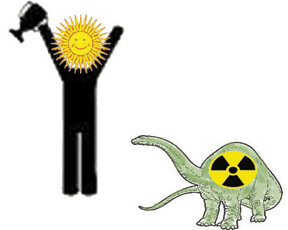 The Zwentendorf Nuclear Power Plant http://en.wikipedia.org/wiki/Zwentendorf_Nuclear_Power_Plant was the first nuclear plant built in Austria, of 6 nuclear plants originally envisaged. The plant atZwentendorf, Austria was finished, but never operated. Start-up of the Zwentendorf plant, as well as construction of the other 5 plants, was prevented by a referendum on 5 November 1978. A narrow majority of 50.47% voted against the start-up.[1][2]
Construction of the plant began in April 1972, as a boiling-water reactor rated at 692 megawatts electric power output. It was built by a joint venture of several Austrian electric power utilities, and was envisioned as the first of several nuclear power plants to be built. The initial cost of the plant was around 14 billions Austrian schillings, about 1 billion Euros today.[3] The ventilation stack chimney of the plant is 110 metres tall. The plant has been partly dismantled. Since 1978 Austria has a law prohibiting fission reactors for electrical power generation.
The plant is now owned by Austrian energy company EVN Group and used as Solar Power Plant and for education purposes.
The Dürnrohr Power Station was built nearby as a replacement thermal power station.
Following the 1978 referendum, no nuclear power plant that was built for the purpose of producing electricity ever went into operation in Austria. However, three small nuclear reactors for scientific purposes have been built and used since the 1960s, with one still being in operation.[4]
Gregory Jaczko appointed to advisory panel on nuclear security
 Reid Appoints Besieged Regulator to Nuclear-Weapons Panel National Journal, By Amy Harder April 18 Late in the evening on Wednesday, one of the busiest and most unnerving times Washington has seen in a long while, Senate Majority Leader Harry Reid quietly appointed a controversial former nuclear-energy regulator to a key but obscure panel.
Reid appointed Gregory Jaczko, the beleaguered former chairman of the Nuclear Regulatory Commission, to a newly created congressional advisory panel that oversees the Energy Department’s National Nuclear Security Administration, which manages the nation’s nuclear-weapons stockpile and nuclear nonproliferation with about $8 billion taxpayer dollars……..
Jaczko also made waves recently in the wake of multiple interviews, including with the trade publication Nuclear Intelligence Weekly and the New York Times, where he called to phase out all nuclear power plants. “What is needed is a phaseout of all nuclear plants in this country,” Jaczko said, according to a March 29 issue of the Nuclear Intelligence Weekly. “They’re not safe.” http://www.nationaljournal.com/energy/reid-appoints-besieged-regulator-to-nuclear-weapons-panel-20130418
Radioactive trash sailing from France to Japan
 Nuclear fuel leaves French port for Japan, first since Fukushima PARIS |
  Michael Rose, Apr 18, 2013 (Reuters) – A shipment of highly radioactive nuclear fuel to Japan left the port of Cherbourg in northern France on Wednesday for the first time since the Fukushima disaster, French energy group Areva said on Thursday.
The shipment of mixed oxide fuel (MOX) is likely to be controversial inJapan, where public opposition to nuclear power and reactor restarts remains strong a month after the second anniversary of the March 11, 2011 catastrophe. France’s state-owned nuclear group, whose activities range from uranium mining and enrichment to reactors and waste recycling, said the shipment will go round the Cape of Good Hope and then through the south-west of the Pacific Ocean.
The group added in a statement it expected the Pacific Heron and Pacific Egret cargoes of British nuclear shipping company PNTL to reach Japanese waters in the second half of June….. The MOX shipment is destined for Kansai Electric Power Co’s Takahama nuclear plant west of Tokyo.
Because MOX fuel contains around 7 percent plutonium, it is perceived as a national security threat, and special precautions are taken during transportation….. http://www.reuters.com/article/2013/04/18/us-areva-mox-japan-idUSBRE93H0EO20130418
Virginia gets an agency to promote nuclear power
 Nuclear authority generates controversy Rapp News By Stephen Nielsen Capital News Service, 18 April 13 RICHMOND – Virginia is creating a new agency to support development of nuclear power – a move that has upset environmentalists and open-government advocates, because the entity won’t have to comply with the state’s Freedom of Information Act and other laws….. In January, Garrett introduced House Bill 1790, which sought to create the Virginia Nuclear Energy Consortium Authority. Sen. Jeffrey McWaters, R-Virginia Beach, sponsored companion legislation – Senate Bill 1138 – in his chamber. Both bills were passed by the General Assembly and signed into law by Gov. Bob McDonnell…..
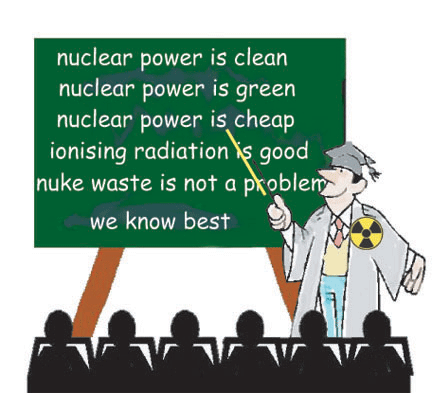
By Jan. 1, the authority will create the Virginia Nuclear Energy Consortium. By law, the consortium will seek to make Virginia “a leader in nuclear energy” Continue reading
Solar power developments in Japan: battery storage
Japan To Implement 60,000 kWh Capacity Battery http://www.energymatters.com.au/index.php?main_page=news_article&article_id=3697 19 April 13 The Japanese government plans to install a massive battery at an electrical substation on the island of Hokkaido.
According to the Japan Times, the country’s Ministry of Economy, Trade and Industry (METI) says the battery will be put in place by the end of the first quarter in 2015 to help develop a stable electricity supply generated by solar and wind power sources. The battery system will have a storage capacity of around 60,000 kWh and will use up a large portion of ¥29.6 billion earmarked for battery projects.
Hokkaido is Japan’s second largest island and the largest and northernmost of Japan’s 47 prefectures. It has become a hive of renewable energy activity due to the availability and low prices of suitable land. According to Bloomberg, the island’s power infrastructure is approaching its limit for handling the amount of clean electricity being generated.
Japan has seen solar uptake skyrocket since the introduction of a feed in tariff scheme, currently paying 38 yen per kilowatt hour (around AUD 38 cents) for rooftop solar power systems under 10kW and slightly more for larger systems.
In other renewables news out of Japan, METI states based on data compiled by the Agency for Natural Resources and Energy (ANRE), the total combined new renewable energy capacity added between April 1, 2012, and January 31, 2013,reached 1,394,000 kW .
Photovoltaic power facilities accounted for 1,329,000 kW, with household solar panel systems making up 1,023,000kW of that amount. METI notes that 37,000kW capacity was added by January 31 – with all of that being added after June 2012.
METI also announced Japan and India have decided to hold the “India-Japan Energy Forum 2013” in September in New Delhi and Greater Noida, which aims to reinforce the two nation’s cooperation in the field of energy.
1 This Month

of the week – Shut Down Drone Warfare!


Tell the Ukrainian Government to Drop Prosecution of Peace Activist Yurii Sheliazhenko

Petition to revoke the licensing of the Near Surface Nuclear Disposal Facility (NSDF) at Chalk River. https://www.ourcommons.ca/petitions/en/Petition/Details?Petition=e-7247
To see nuclear-related stories in greater depth and intensity – go to https://nuclearinformation.wordpress.com
-
Archives
- April 2026 (103)
- March 2026 (251)
- February 2026 (268)
- January 2026 (308)
- December 2025 (358)
- November 2025 (359)
- October 2025 (376)
- September 2025 (257)
- August 2025 (319)
- July 2025 (230)
- June 2025 (348)
- May 2025 (261)
-
Categories
- 1
- 1 NUCLEAR ISSUES
- business and costs
- climate change
- culture and arts
- ENERGY
- environment
- health
- history
- indigenous issues
- Legal
- marketing of nuclear
- media
- opposition to nuclear
- PERSONAL STORIES
- politics
- politics international
- Religion and ethics
- safety
- secrets,lies and civil liberties
- spinbuster
- technology
- Uranium
- wastes
- weapons and war
- Women
- 2 WORLD
- ACTION
- AFRICA
- Atrocities
- AUSTRALIA
- Christina's notes
- Christina's themes
- culture and arts
- Events
- Fuk 2022
- Fuk 2023
- Fukushima 2017
- Fukushima 2018
- fukushima 2019
- Fukushima 2020
- Fukushima 2021
- general
- global warming
- Humour (God we need it)
- Nuclear
- RARE EARTHS
- Reference
- resources – print
- Resources -audiovicual
- Weekly Newsletter
- World
- World Nuclear
- YouTube
-
RSS
Entries RSS
Comments RSS
 nuclear-news