Rosy Fukushima Health Report Faulted by Experts “専門家による楽観的な福島健康被害報告についての過ち”について、阿部首相に寄せた手紙
h/t Mia http://fukushimaappeal.blogspot.jp/2013/04/rosy-fukushima-health-report-faulted-by.html
The February 2013 report by the World Health Organization on the predicted radiation effects of the Fukushima No. 1 nuclear disaster provided some welcome news indeed.
For example, Richard Wakeford of the University of Manchester wrote:

“The additional risk is quite small and will probably be hidden by the noise of other (cancer) risks like people’s lifestyle choices and statistical fluctuations.”
If true, the Japanese government can, for example, now confidently inform mothers living in the irradiated areas of Fukushima Prefecture and beyond that there is no need to worry about their children’s health or futures.
Unfortunately, many international experts take strong exception to these optimistic findings. This disagreement was starkly revealed at a recent symposium held in New York on March 11-12 titled – “The Medical and Ecological Consequences of the Fukushima Nuclear Accident.”
Addressing the symposium, Alexey Yablokov of the Russian Academy of Sciences said:

“Using criteria demanded by the International Atomic Energy Agency (IAEA), the World Health Organization (WHO) and the United Nations Scientific Committee on the Effects of Atomic Radiation (UNSCEAR) resulted in marked underestimates of the number of fatalities and the extent and degree of sickness among those exposed to radioactive fallout from Chernobyl.”
Yablokov continued:
“The Chernobyl catastrophe has already killed several hundred thousand human beings in a population of several hundred million that was unfortunate enough to live in territories affected by the fallout. The number of Chernobyl victims will continue to grow over many future generations.”
Prime Minister, I know many of your advisers claim that the amount of radiation released at Fukushima No. 1 was far less than at Chernobyl. However, a report released by the U.K.-based non-profit Institute of Science in Society in November 2012 said:
“Analysis based on the most inclusive data sets available reveals that radioactive fallout from the Fukushima meltdown is at least as big as Chernobyl and more global in reach.”
That conclusion was reached based on work with state-of-the-art atmospheric dispersion models by an international team led by Andreas Stohl at the Norwegian Institute for Air Research.
Further, nuclear researcher Hiroaki Koide of Kyoto University told the conference:
“The cesium-137 that was released into the atmosphere by Units 1 through 3 was 168 times that of the Hiroshima bomb, according to the Japanese government report to the IAEA, an international organization which promotes nuclear power.
“However, I myself believe this is probably an underestimate, and two or three times that amount, that is, 400 to 500 times the amount of cesium-137 of the Hiroshima atomic bomb, has already been dispersed into the atmosphere. I believe almost the same amount of radioactive material released into the air has probably flowed into the ocean.”
Steven Starr of the University of Missouri pointed out that the WHO is not a reliable source of objective information since it is required to base its research on data submitted to it by member governments. Further, beginning in 1959, all WHO reports on nuclear contamination must first be approved by the IAEA, whose charter requires it to do its utmost to promote the use of nuclear power.
Fukushima Rad News 4/16/13:Plutonium 238 Detected Offshore Of Daiichi; 7.8 Mag Quake Strikes Iran
Published on 16 Apr 2013
M7.8 quake hits Iran-Pakistan border area
A 7.8 magnitude earthquake struck Iran near its border with Pakistan at 10:44 UTC on Tuesday.
The epicenter of the quake is estimated to be about 86 kilometers east-south-east of Khash, a town in Iran’s Sistan and Baluchistan Province.
The US Geological Survey first estimated the focus at a depth of 15.2 kilometers, but later changed it to 82 kilometers.
Details on the damage are not known. Iranian TV says at least 40 people were killed.
The tremor was felt in wide areas, including New Delhi in India, about 1,500 kilometers from the epicenter, and Dubai in the United Arab Emirates, 700 kilometers away.
Iran Quake Shows Recklessness of Nuclear Program
http://www.bloomberg.com/news/2013-04…
TEPCO moves irradiated water to ground tanks
The operator of the crippled Fukushima Daiichi nuclear power plant has begun moving contaminated water from leaking underground storage pools to tanks above ground.
Tokyo Electric Power Company, or TEPCO, plans to move most of the contaminated water to tanks above ground after a series of leaks were found in some of the 7 underground storage pools.
Osaka court rejects demand to halt nuclear reactor
A Japanese court has rejected a suit by local residents demanding 2 nuclear power reactors in central Japan be turned off. The court said the reactors are safe.
The No. 3 and 4 reactors at the Ohi nuclear power plant in Fukui Prefecture are the only 2 online in Japan following the 2011 Fukushima nuclear disaster.
Fukushima I Nuke Plant Pond Leak of April 2013: TEPCO – Waste Water from Pond No.2 to a Steel Tank, Will Take 6 Days
http://ex-skf.blogspot.co.uk/2013/04/fukushima-i-nuke-plant-pond-leak-of_17.html
17 April 2013
EXSKF
OK, so it will be 150 tonnes per day, using temporary pipes and a temporary tank between the Pond No.2 and the final destination which is about 550 meters away.
The Reverse Osmosis apparatus is currently operated intermittently, according to TEPCO (handout for the press in Japanese, 4/16/2013).
From the 58-page handout for the press conference given by the TEPCO president Hirose (4/17/2013):
In-the-ground water storage ponds and where the RO waste water is going. Green line in the map is where the waste water from the Pond 2 is travelling:
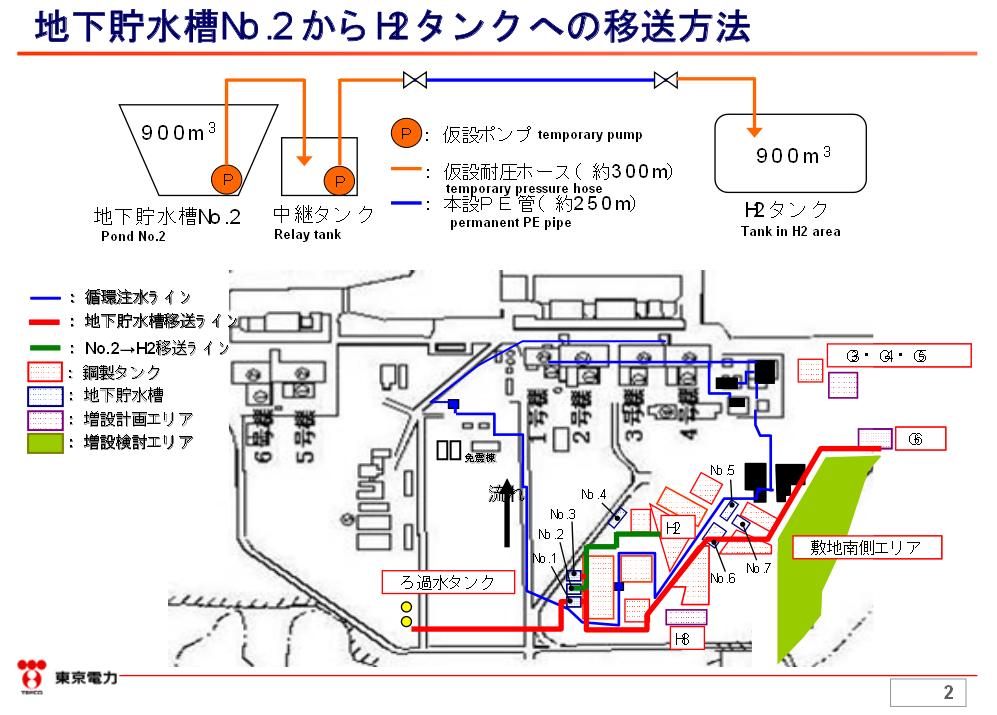
The physical set up to transfer the waste water in the Pond No.2 to a steel tank in H2 area. (I seems to be hallucinating the leak already…):
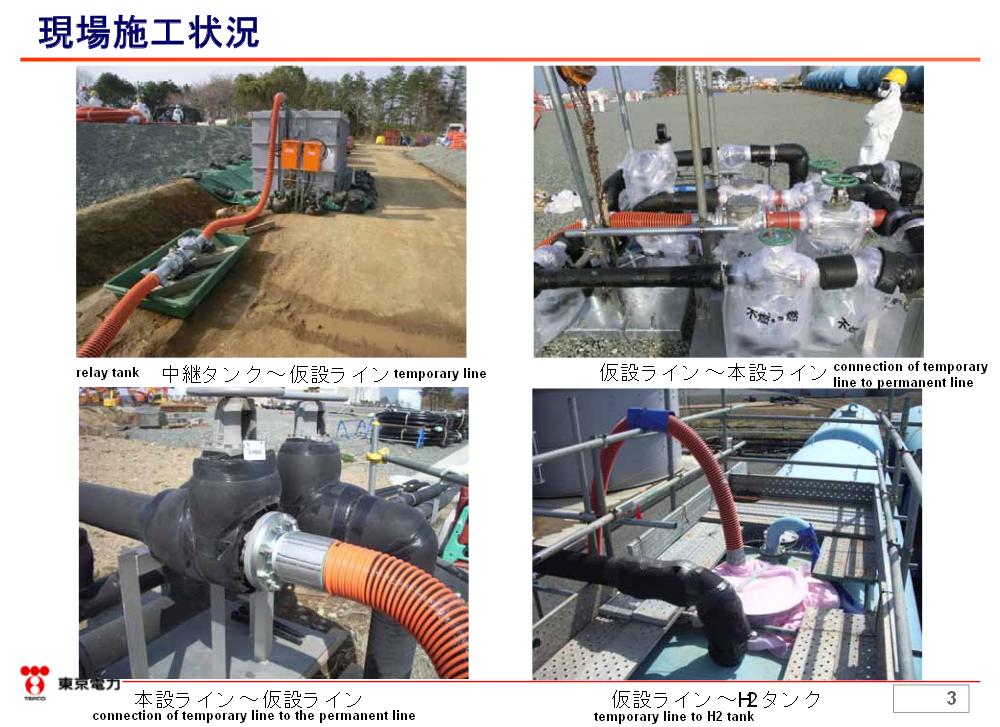
In the handout, I don’t find any reference to any effort to make any of the temporary contraptions since March 11, 2011 into a permanent, stable one.
Here’s page 26, showing photographs of electrical panel for the Reactor 2 Spent Fuel Pool cooling system, which was rigged up after the accident. “Look what we found! A small animal (rat) can get inside!” So what did TEPCO do? Cover the lines with plastic sheets:

From my experience in living in a countryside, rats and mice can easily chew through plastic sheets.
I hear that Mr. Naomi Hirose, TEPCO’s president, is a very smart guy, with MBA from Yale University. He’s from sales and marketing, and not an engineer. He was in charge of TEPCO’s highly successful push for “all-electric” homes, which significantly boosted the electricity consumption in large cities, which in turn was used to justify building more nuclear power plants. Yale MBA Program apparently wrote it up as a case study. I’d love to see it.
I can see that he is indeed an MBA, as he sets up a new “communication” department to better communicate with the press, the government, and citizens as if communication is what’s wrong with TEPCO and Fukushima I Nuclear Power Plant.
Book: Hijackers had airplane in nosedive heading for U.S. nuclear reactor — “A very, very scary situation” -Energy Official
Published: April 16th, 2013 at 12:52 pm ET
By ENENews
Title: The odd side of Oak Ridge history
Source: Knoxville News
Author: Frank Munger
Date: April 16, 2013
On the morning of Nov. 11, 1972, Oak Ridge stood still — or nearly so — while a hijacked Southern Airways jetliner circled above.
“It was a very, very scary situation,” Jim Alexander, a retired public affairs officer at the Department of Energy, recalled in a 2001 interview.
The hijackers threatened to crash the airplane into the Oak Ridge nuclear facilities if their demands, including $10 million in cash, were not met. […]
The threat was real, according to a 1977 book, “The Odyssey of Terror.”
The author, Ed Blair, wrote that the hijackers went berserk after placing a call to the White House and being shunned by John Ehrlichman, an aide to President Nixon, who apparently was unaware of the crisis. Blair reported that the hijackers held a grenade to the pilot’s head and ordered him to dive the plane toward the Oak Ridge reactor. The plane was actually in a nosedive when a report came over the radio that the money demands were being met […]
See also: Japan Gov’t Experts: Airplane crash affecting Fukushima spent fuel pool a key security issue for future
1 This Month

of the week – Shut Down Drone Warfare!


Tell the Ukrainian Government to Drop Prosecution of Peace Activist Yurii Sheliazhenko

Petition to revoke the licensing of the Near Surface Nuclear Disposal Facility (NSDF) at Chalk River. https://www.ourcommons.ca/petitions/en/Petition/Details?Petition=e-7247
To see nuclear-related stories in greater depth and intensity – go to https://nuclearinformation.wordpress.com
-
Archives
- April 2026 (79)
- March 2026 (251)
- February 2026 (268)
- January 2026 (308)
- December 2025 (358)
- November 2025 (359)
- October 2025 (376)
- September 2025 (257)
- August 2025 (319)
- July 2025 (230)
- June 2025 (348)
- May 2025 (261)
-
Categories
- 1
- 1 NUCLEAR ISSUES
- business and costs
- climate change
- culture and arts
- ENERGY
- environment
- health
- history
- indigenous issues
- Legal
- marketing of nuclear
- media
- opposition to nuclear
- PERSONAL STORIES
- politics
- politics international
- Religion and ethics
- safety
- secrets,lies and civil liberties
- spinbuster
- technology
- Uranium
- wastes
- weapons and war
- Women
- 2 WORLD
- ACTION
- AFRICA
- Atrocities
- AUSTRALIA
- Christina's notes
- Christina's themes
- culture and arts
- Events
- Fuk 2022
- Fuk 2023
- Fukushima 2017
- Fukushima 2018
- fukushima 2019
- Fukushima 2020
- Fukushima 2021
- general
- global warming
- Humour (God we need it)
- Nuclear
- RARE EARTHS
- Reference
- resources – print
- Resources -audiovicual
- Weekly Newsletter
- World
- World Nuclear
- YouTube
-
RSS
Entries RSS
Comments RSS
 nuclear-news