Fukushima emmissions update? The new source term obtained in this study is a first guess value
…….The new source term obtained in this study is a first guess value; therefore, these results contain uncertainty. Various types of models that include physical processes and parameters, resolutions, and regions in addition to environmental data are needed to determine the probable source term. Detailed source term estimation obtained using the coupled atmospheric and oceanic dispersion simulation remains a topic for future research…….
…..However, the simulation results for the eastern North Pacific showed a tendency of underestimating observed sea surface concentration of 134Cs. We believed that this tendency resulted from an underestimation of the initial source term. Therefore, the source term of the atmospheric release of radionuclides, hereafter the new source term, was refined to reduce the underestimation of observed sea surface concentration of 134Cs collected from the Pacific Ocean. This refinement of the source term is a first effort to feed oceanic dispersion analysis results back into atmospheric dispersion analysis……
Journal of Nuclear Science and Technology
Volume 50, Issue 3, 2013
Source term estimation of atmospheric release due to the Fukushima Dai-ichi Nuclear Power Plant accident by atmospheric and oceanic dispersion simulations
- DOI:
- 10.1080/00223131.2013.772449
Takuya Kobayashia, Haruyasu Nagaia, Masamichi Chinoa & Hideyuki Kawamuraa
pages 255-264
Publishing models and article dates explained
Received: 29 Nov 2012
Accepted: 18 Dec 2012
Version of record first published: 15 Mar 2013
1. Introduction
2. Methods
2.1. Numerical models for atmospheric dispersion
The calculation period of WSPEEDI-II was from 5 JST (UTC + 9 h) on March 12 to 0 JST on May 1. The computational domain includes the entire North Pacific region (Figure 1) with a horizontal resolution of 80 km. In the vertical resolutions, 23 sigma levels from the surface to 100 hPa and 20 levels from the surface (with a bottom layer of 20 m thickness) to 10 km were set in MM5 and GEARN, respectively. The radioactivity ratio of 134Cs/137Cs was assumed to be 1.0 [16]; therefore, we also treated the release rate of 134Cs to be the same as that of 137Cs in this study. Thus, the source term of 134Cs was given by the initial source term of 137Cs in Terada et al. [12]. The calculated deposition amounts were given to the Lagrangian oceanic particle dispersion model (SEA-GEARN) every 24 h. Further details of WSPEEDI-II and its prediction performance are described in Terada et al. [15].
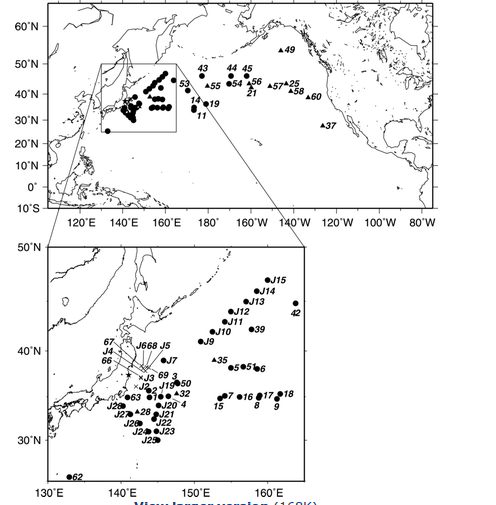
Figure 1 Simulation area and locations of the sampling stations used for verification and refinement of the source term of atmospheric release from the Fukushima Dai-ichi Nuclear Power Plant (FNPP1). Circles (triangles) on the map indicate calculations within (without) a factor of 10 of the measurements in Figure 3. Crosses on the map indicate that 134Cs released directly into the ocean from the FNPP1 may have an influence on the 134Cs concentration in surface water, as indicated by a preliminary modeling study. Numbers with the prefix “J” indicate the sampling points reported by Honda et al. [22], and those without the prefix “J” indicate the sampling points reported by the Meteorological Research Institute [23]
2.2. Numerical models for oceanic dispersion
2.3. Measurement data for the ocean used for the estimation of the new source term
2.4. Validation of the source term by 134Cs simulation
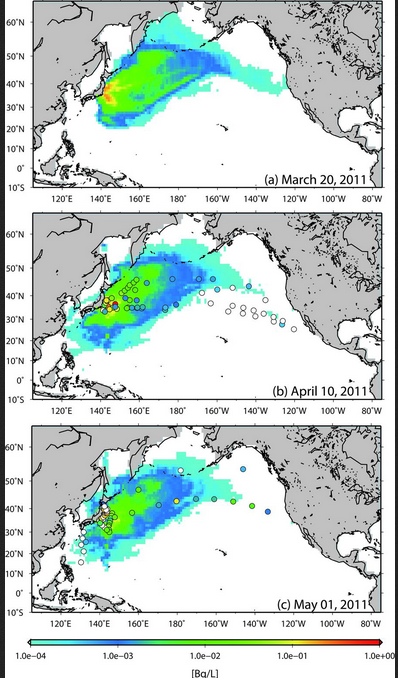
The horizontal distribution of the sea surface concentration of 134Cs used for calculation with the initial source term and for measurements obtained during March 31–May 17 is shown in Figure 2. Because a coarse resolution of the horizontal grid space was used in the calculation, the results of the surface concentration of radionuclides close to the Japanese coast that are reported in Kawamura et al. [4] are not detailed in the present study. An image of the horizontal distribution recorded on March 20 (Figure 2(a)) shows that 134Cs was deposited on the sea surface along Fukushima and Miyagi prefectures and in the offshore area northeast and southeast of the FNPP1. Less than 1 × 10⁻³ Bq L−1 of 134Cs, a substantially low amount, reached the coastal area of California, USA and the Bering Sea. One to two months after the FNPP1 accident (Figure 2 (b) and (c)), approximately 1 × 10⁻³ Bq L−1 of 134Cs was reported near Japan in areas such as the Okhotsk Sea and Japan Sea. Thus, the FNPP1 accident widely dispersed radionuclides across the entire North Pacific region.
Figure 2 Horizontal distribution of sea surface 134Cs obtained by simulation with the initial source term on (a) March 20, (b) April 10, and (c) May 1. Colors of circles in the figures represent observed sea surface concentration of 134Cs at sampling points (b) from March 31 to April 18 and (c) from April 21 to May 17, 2011
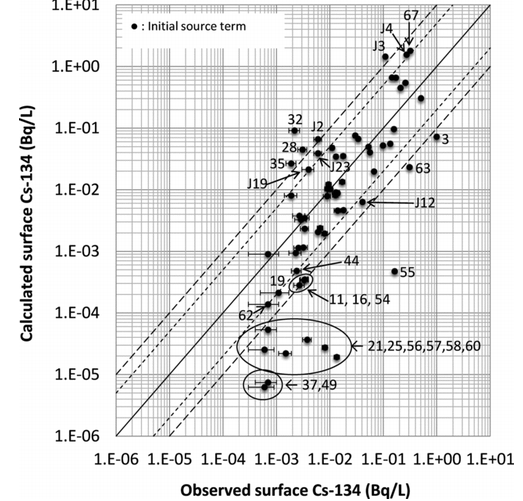
The results of a comparison between the simulation and measurements of the sea surface concentration of 134Cs and statistics on the percentage of calculations of sea surface concentration of 134Cs that are within factors of 2, 5, and 10 of the measurements are plotted in Figure 3 and summarized in Table 1, respectively. The simulation results using the initial source term showed good agreement with observed data (Figure 3) with an FA10 of 75% (Table 1). However, simulation results in some area of the eastern North Pacific (Nos. 21, 25, 37, 49, 55−58, and 60 in Figure 3) showed a tendency of underestimation against observed data. The horizontal distribution of the sea surface concentration of 134Cs in Figure 2 indicates that the simulation results in the eastern North Pacific were also lower than the measurement results. This tendency indicates that the actual abundance of 134Cs in the eastern North Pacific was higher than that obtained by calculation using the initial source term. We attributed this tendency to an underestimation of the release rate in the initial source term for some periods. The initial source term was estimated on the basis of environmental monitoring data on land. However, monitoring data in the ocean were not considered. Therefore, the source term of the atmospheric release of radionuclides, hereafter the new source term, was refined using 134Cs observed in the seawater collected from the North Pacific.
| Release rate used for calculations | FA2 (%) | FA5 (%) | FA10 (%) | Correlation coefficients |
|---|---|---|---|---|
| Initial source term | 35 | 60 | 75 | 0.54 |
| New source term | 37 | 65 | 77 | 0.53
|
Table 1 Statistics of sea surface concentration of 134Cs calculated from data points between March 31 and May 17, 2011. Values of FA2, FA5, and FA10 denote the percentage of calculations within factors of 2, 5, and 10 of the measurements, respectively
2.5. Estimation of the new source term
We set the estimation period as March 12–20 to reflect the large release rate change reported by previous studies [10,12]. The release period was separated into 18 terms, as shown in Figure 4. Numbers with the prefix “a” in the figure indicate a period in which the release rates were determined on the basis of land monitoring data [9,10]. We estimated the new release rate during these periods. No land monitoring data was available; therefore, the hydrogen explosion at Unit 3 was assumed to be the same as the explosions at Unit 1 in the initial source term [12]. For this reason, the Unit 3 event was time-averaged to “term 5” for estimation using measurement data in the ocean.
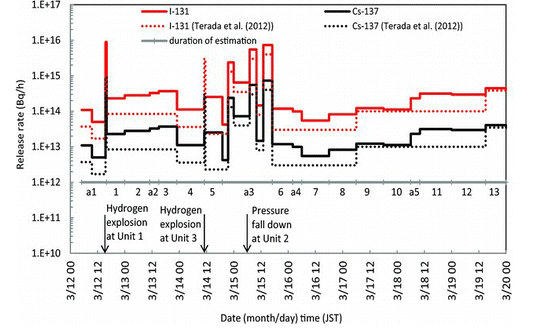
Figure 4 Time variation of estimated new release rates of 131I and 137Cs from March 12 to 20, 2011. Dotted lines show the initial release rates reported by Terada et al. [12]. Divided periods of estimation are represented by gray lines. The date and time of important plant events are also shown in figure. This figure is modified from Figure 4 of Katata et al. [10]
The new release rates at each term were estimated by the following method. First, two model simulations were conducted to calculate the sea surface concentration of 134Cs. These included atmospheric dispersion simulation by GEARN that used the initial release rate, followed by oceanic dispersion simulation by SEA-GEARN that used sources such as direct release from the FNPP1 into the ocean and atmospheric deposition derived from the simulation of GEARN. The correction coefficient for the initial source term, which assumed that these dispersion simulations are correct, was obtained by measuring the calculated sea surface concentration of 134Cs at the sampling point i as follows:

where Ri is the correction coefficient at the sampling point i, Mi is the measured sea surface concentration (Bq L−1) of 134Cs at the sampling point i, and Ci is the calculated sea surface concentration (Bq L−1) of 134Cs at the sampling point i at 12 JST on the same observed date. The range of R i was 0.024 to 706.
Next, to investigate the correction quantity on the basis of the cumulative deposition amount, i.e., to estimate which release period should be corrected, the contribution of deposition must be measured for each release period at each sampling point. In particular, unit release (1 Bq h−1) calculations during each of the 18 terms of the release periods shown in Figure 4 were performed by GEARN. The daily deposition data of each simulation result were used as the input in the calculation of SEA-GEARN. The direct release from the FNPP1 into the ocean was not considered in the calculation of SEA-GEARN. The sea surface concentration Dij (Bq L−1) of 134Cs at the sampling point i at 12 JST on the same observed date were extracted from the calculation results of each term. A large Dij indicates that the term j at the sampling point i has a large contribution to the deposition. The contribution at each term j and sampling point i are obtained by considering the initial source term as follows:

where IRatej is the initial release rate (Bq h−1) at term j, which was estimated by Terada et al. [12]. As a result, the contribution ratio at each term j to the sum of all terms at the sampling point i is written as follows:

The correction coefficient Xj , which considers the weighting of the contribution ratio at each sampling point i, is written as

Finally, in this study, the new release rate NRatej (Bq h−1) at term j is written by multiplying IRatej with the rate Xj :

3. Results
3.1. Estimation results for the new source term
The new release rate of 137Cs was derived from that of 134Cs because the assumed radioactivity ratio of 134Cs/137Cs is 1.0. The radioactivity ratio of 131I/137Cs determined by Terada et al. [12] was also used for estimating the new release rate of 131I. The time variation and values of the new source terms of 131I and 137Cs are shown in Table 2 . These time variations are compared with the initial release rate in Figure 4. For estimating the new release rate, a coarse oceanographic model of 1° horizontal resolution was used; therefore, a sharp change in the release rate could not be expressed.
|

3.2. Cesium-134 simulation with the new source term
|

|

Table 3 summarizes the amounts of 131I and 137Cs that were released into the atmosphere and the ocean and those deposited on the land and ocean surfaces. The deposition amounts of 131I were 7.4 × 10¹⁶ and 9.9 × 10¹⁶ Bq on the land and ocean surfaces, respectively. For 137Cs, the deposition amounts were 5.8 × 10¹⁵ and 7.6 × 10¹⁵ Bq on the land and ocean surfaces, respectively. The results of gross supply to the North Pacific from atmospheric deposition and from direct release from the FNPP1 can be estimated to be 1.1 × 10¹⁷ and 1.1 × 10¹⁶ Bq for 131I and 137Cs, respectively. The new source term of atmospheric and oceanic release offers important information for presuming the remaining radionuclides at the FNPP1.
|
4. Summary
Acknowledgements
References
- 1. Takemura, T, Nakamura, H, Takigawa, M, Kondo, H, Satomura, T, Miyasaka, T and Nakajima, T. 2011. A numerical simulation of global transport of atmospheric particles emitted from the Fukushima Daiichi Nuclear Power Plant. SOLA., 7: 101–104. doi:10.2151/sola.2011-026
- 2. 2011. Report of Japanese government to the IAEA ministerial conference on nuclear safety: The accident at TEPCO’s Fukushima Nuclear Power Stations. http://www.kantei.go.jp/foreign/kan/topics/201106/iaea_houkokusho_e.html
- 3. Tsumune, D, Tsubono, T, Aoyama, M and Hirose, K. 2012. Distribution of oceanic 137Cs from the Fukushima Dai-ichi Nuclear Power Plant simulated numerically by a regional ocean model. J Environ Radioact., 111: 100–108. doi:10.1016/j.jenvrad.2011.10.007 doi:10.1016/j.jenvrad.2011.10.007
- 4. Kawamura, H, Kobayashi, T, Furuno, A, In, T, Ishikawa, Y, Nakayama, T, Shima, S and Awaji, T. 2011. Preliminary numerical experiments on oceanic dispersion of 131I and 137Cs discharged into the ocean because of Fukushima Daiichi nuclear power plant disaster. J Nucl Sci Technol., 48: 1349–1356. doi:10.1080/18811248.2011.9711826
- 5. Bailly du Bois, P, Laguionie, P, Boust, D, Korsakissok, I, Didier, D and Fiévet, B. 2012. Estimation of marine source-term following Fukushima Dai-ichi accident. J Environ Radioact., 114: 2–9. doi:10.1016/j.jenvrad.2011.11.015
- 6. Miyazawa, Y, Masumoto, Y, Varlamov, S M and Miyama, T. 2012. Transport simulation of the radionuclide from the shelf to open ocean around Fukushima. Cont Shelf Res., doi:10.1016/j.csr.2012.09.002. Forthcoming
- 7. Nakano, M and Povinec, P P. 2011. Long-term simulations of the 137Cs dispersion from the Fukushima accident in the world ocean. J Environ Radioact., 111: 109–115. doi:10.1016/j.jenvrad.2011.12.001 doi:10.1016/j.jenvrad.2011.12.001
- 8. Behrens, E, Schwarzkopf, F U, Lubbecke, J F and Boning, C W. 2012. Model simulations on the long-term dispersal of 137Cs released into the Pacific Ocean off Fukushima. Environ Res Lett., 7 stacks.iop.org/ERL/7/034004 doi:10.1088/1748-9326/7/3/034004
- 9. Chino, M, Nakayama, H, Nagai, H, Terada, H, Katata, G and Yamazawa, H. 2011. Preliminary estimation of release amounts of 131I and 137Cs accidentally discharged from the Fukushima Daiichi Nuclear Power Plant into atmosphere. J Nucl Sci Technol., 48: 1129–1134. doi:10.1080/18811248.2011.9711799
- 10. Katata, G, Ota, M, Terada, H, Chino, M and Nagai, H. 2012. Atmospheric discharge and dispersion of radionuclides during the Fukushima Dai-ichi Nuclear Power Plant accident. Part I: source term estimation and local-scale atmospheric dispersion in early phase of the accident. J Environ Radioact., 109: 103–113. doi:10.1016/j.jenvrad.2012.02.006
- 11. Katata, G, Terada, H, Nagai, H and Chino, M. 2012. Numerical reconstruction of high dose rate zones due to the Fukushima Dai-ichi Nuclear Power Plant accident. J Environ Radioact., 111: 2–12. doi:10.1016/j.jenvrad.2011.09.011
- 12. Terada, H, Katata, G, Chino, M and Nagai, H. 2012. Atmospheric discharge and dispersion of radionuclides during the Fukushima Dai-ichi Nuclear Power Plant accident. Part II: verification of the source term and analysis of regional-scale atmospheric dispersion. J Environ Radioact., 112: 141–154. doi:10.1016/j.jenvrad.2012.05.023
- 13. Terada, H, Nagai, H, Furuno, A, Kakefuda, T, Harayama, T and Chno, M. 2008. Development of worldwide version of system for prediction of environmental emergency dose information: WSPEEDI 2nd version. Trans Atomic Energy Soc., 7: 257–267. [in Japanese with English abstract] doi:10.3327/taesj.J07.045
- 14. Grell, G A, Dudhia, J and Stauffer, D R. 1994. A description of the fifth-generation Penn State/NCAR Mesoscale Model (MM5). : 122 NCAR Tech. Note, NCAR/TN-398þSTR
- 15. Terada, H and Chino, M. 2005. Improvement of Worldwide Version of System for Prediction of Environmental Emergency Dose Information (WSPEEDI), (II) Evaluation of numerical models by 137Cs deposition due to the Chernobyl nuclear accident. J Nucl Sci Technol., 42: 651–660. doi:10.1080/18811248.2004.9726433
- 16. 2011. MEXT, http://www.mext.go.jp/english/
- 17. Sugiura, N, Awaji, T, Masuda, S, Mochizuki, T, Toyoda, T, Miyama, T, Igarashi, H and Ishikawa, Y. 2008. Development of a four-dimensional variational coupled data assimilation system for enhanced analysis and prediction of seasonal to interannual climate variations. J Geophys Res., 113 Jul C10017; doi:10.1029/2008JC004741 doi:10.1029/2008JC004741
- 18. Ohfuchi, W, Nakamura, H, Yoshioka, M K, Enomoto, T, Takaya, K, Peng, X, Yamane, S, Nishimura, T, Kurihara, Y and Ninomiya, K. 2004. 10-km mesh meso-scale resolving simulations of the global atmosphere on the Earth Simulator: Preliminary outcomes of AFES (AGCM for the Earth Simulator). J Earth Simul., 1: 8–34.
- 19. Masuda, S, Awaji, T, Sugiura, N, Toyoda, T, Ishikawa, Y and Horiuchi, K. 2006. Interannual variability of temperature inversions in the subarctic North Pacific. Geophys Res Lett., 33: L24610 doi:10.1029/2006GL027865 doi:10.1029/2006GL027865
- 20. Kobayashi, T, Otosaka, S, Togawa, O and Hayashi, K. 2007. Development of a non-conservative radionuclides dispersion model in the ocean and its application to surface Cesium-137 dispersion in the Irish Sea. J Nucl Sci Technol., 44: 238–247. doi:10.1080/18811248.2007.9711278
- 21. Smagorinsky, J. 1963. General circulation experiments with the primitive equations. Mon Wea Rev., 91: 99–164. doi:10.1175/1520-0493(1963)091<0099:GCEWTP>2.3.CO;2
- 22. Honda, M C, Aono, T, Aoyama, M, Hamajima, Y, Kawakami, H, Kitamura, M, Masumoto, Y, Miyazawa, Y, Takigawa, M and Saino, T. 2012. Dispersion of artificial caesium-134 and -137 in the western North Pacific one month after the Fukushima accident. Geochem J., 46: e1–e9. doi:10.1016/j.orggeochem.2012.03.001
- 23. 137Cs and 134Cs activities in the North Pacific Ocean after Fukushima nuclear power plants accident. 2012. [accessed 2012 March 15]. Available from: http://www.mri-jma.go.jp/Topics/hotyouhi/houtyouhi_sea_en.html
No comments yet.
1 This Month

of the week – Shut Down Drone Warfare!


Tell the Ukrainian Government to Drop Prosecution of Peace Activist Yurii Sheliazhenko

Petition to revoke the licensing of the Near Surface Nuclear Disposal Facility (NSDF) at Chalk River. https://www.ourcommons.ca/petitions/en/Petition/Details?Petition=e-7247
To see nuclear-related stories in greater depth and intensity – go to https://nuclearinformation.wordpress.com
-
Archives
- April 2026 (103)
- March 2026 (251)
- February 2026 (268)
- January 2026 (308)
- December 2025 (358)
- November 2025 (359)
- October 2025 (376)
- September 2025 (257)
- August 2025 (319)
- July 2025 (230)
- June 2025 (348)
- May 2025 (261)
-
Categories
- 1
- 1 NUCLEAR ISSUES
- business and costs
- climate change
- culture and arts
- ENERGY
- environment
- health
- history
- indigenous issues
- Legal
- marketing of nuclear
- media
- opposition to nuclear
- PERSONAL STORIES
- politics
- politics international
- Religion and ethics
- safety
- secrets,lies and civil liberties
- spinbuster
- technology
- Uranium
- wastes
- weapons and war
- Women
- 2 WORLD
- ACTION
- AFRICA
- Atrocities
- AUSTRALIA
- Christina's notes
- Christina's themes
- culture and arts
- Events
- Fuk 2022
- Fuk 2023
- Fukushima 2017
- Fukushima 2018
- fukushima 2019
- Fukushima 2020
- Fukushima 2021
- general
- global warming
- Humour (God we need it)
- Nuclear
- RARE EARTHS
- Reference
- resources – print
- Resources -audiovicual
- Weekly Newsletter
- World
- World Nuclear
- YouTube
-
RSS
Entries RSS
Comments RSS
 nuclear-news
Leave a comment