The continuing impact of the New York Fukushima Symposium
The impact of this symposium will go well beyond March 2013 because of the impression made on the participants, and because the lectures, documents and graphic illustrations are available online at Nuclear Free Planet. They will also appear as a film Cinema Forum Fukushima and in book form.
The New York lectures will continue to play an important role in keeping the nuclear danger in front of the public
Two years after Fukushima: a tale of two symposiums Independent Australia 12 April 13, With news today that Fukushima has sprung another radioactive leak, Noel Wauchope reports on two very different nuclear symposiums held last month.
Symposium One: The Medical and Ecological Consequences of the Fukushima Nuclear Accident JUST OVER two years ago, Independent Australia was first to break the news of the real urgency of the Fukushima nuclear accident
Governments, corporations, and mainstream media would have us believe that the Fukushima crisis is resolved — now for nuclear/uranium business as usual. It’s all over, really
But is it?
On March 11th and 12th, on the two year anniversary of the Fukushima nuclear accident, some 400 people gathered at of the New York Academy of Medicine to hear 20 prestigious speakers discuss the meaning of this event for Japan and for the world. Continue reading
Fukushima nuclear plant is NOT stable
 NYTimes: Fukushima plant unstable says official, concern another accident can’t be prevented — “Vulnerable… Very dangerous” http://enenews.com/nytimes-fukushima-plant-unstable-says-official-concern-another-accident-cant-be-prevented-vulnerable-very-dangerous April 11th, 2013
Title: Fukushima Nuclear Plant Is Still Unstable, Japanese Official Says
Source: New York Times
Author: HIROKO TABUCHI
Date: April 10, 2013
[…] a series of recent mishaps — including a blackout set off by a dead rat and the discovery of leaks of thousands of gallons of radioactive water — have underscored just how vulnerable the plant remains.
Increasingly, experts are arguing that [Tepco] cannot be trusted to lead what is expected to be decades of cleanup and the decommissioning of the plant’s reactors without putting the public, and the environment, at risk. […]
“It’s become obvious that Tepco is not at all capable of leading the cleanup. It just doesn’t have the expertise, and because Fukushima Daiichi is never going to generate electricity again, every yen it spends on the decommissioning is thrown away. That creates an incentive to cut corners, which is very dangerous. The government needs to step in, take charge and assemble experts and technology from around the world to handle the decommissioning instead.” -Muneo Morokuzu, a nuclear safety expert at the Tokyo University Graduate School of Public Policy
“The Fukushima Daiichi plant remains in an unstable condition, and there is concern that we cannot prevent another accident.” -Shunichi Tanaka, chairman of Japan’s Nuclear Regulation Authority
See also: Tepco: “Losing faith” in leaking Fukushima tanks — But we don’t have anywhere else to put the radioactive water
Perhaps North Korea can send a “small” nuclear weapon by ballistic missile?
 Pentagon Says Nuclear Missile Is in Grasp for North Korea NYT By THOM SHANKER, DAVID E. SANGER and ERIC SCHMITT April 11, 2013 WASHINGTON — A new assessment of North Korea’s nuclear capability conducted by the Pentagon’s intelligence arm has concluded for the first time, with “moderate confidence,” that the country has learned how to make a nuclear weapon small enough to be delivered by a ballistic missile.
The assessment by the Defense Intelligence Agency, which has been distributed to senior administration officials and members of Congress, cautions that the weapon’s “reliability will be low,” apparently a reference to the North’s difficulty in developing accurate missiles or, perhaps, to the huge technical challenges of designing a warhead that can survive the rigors of flight and detonate on a specific target.
It is unclear whether other American intelligence agencies agree with the assessment by the Defense Intelligence Agency, which has primary responsibility for monitoring the missile capabilities of adversary nations. In the case of Iraq, a decade ago, the agency was among those that argued most vociferously that Saddam Hussein had nuclear weapons…… http://cleantechnica.com/2013/04/11/asia-pacific-renewable-energy-market-to-hit-535-2-gw-by-2020-globaldata-report/#syHiBFsTlrz1xsM2.99
World ignores Fukushima radiation at our peril
 Fukushima is currently releasing up to 93 billion becquerels of radioactive cesium into the ocean each day. How much radiation is that? A quick calculation shows that Chernobyl released around ten thousand times more radioactive cesium each day during the reactor fire. But the Chernobyl fire only lasted 10 days … and the Fukushima release has been ongoing for more than 2 years so far.
Indeed, Fukushima has already spewed much more radioactive cesium and iodine 131 than Chernobyl. The amount of radioactive cesium released by Fukushima was some 20-30 times higher than initially admitted.
Fukushima also pumped out huge amounts of radioactive iodine 129 – which has a half-life of 15.7 million years.
Fukushima has also dumped up to 900 trillion becquerels of radioactive strontium-90 – which is a powerful internal emitter which mimics calcium and collects in our bones – into the ocean..
Radiation Is Not On People’s Radar, Dr. Mark Sircus, Activist Post, 9 April 13, In publishing Atomic Suicide Drs. Walter and Lao Russell united with Dr. Albert Schweitzer’s 1957 appeal to the world to end nuclear tests, and in fact any and all use of radioactive elements. In this prophetic book, the Russells explain clearly that with radioactive elements unleashed into our atmosphere, the human race is heading for catastrophe. Giving detailed scientific evidence, they warn that ‘to fail to consider the nature of radioactive elements and their consequences would be a folly for which humanity would have to pay a terrible price.’ Continue reading
Astronomic costs if France had a nuclear accident: report kept secret
 French Nuclear Disaster Scenario Was So Bad The Government Kept It Secret http://au.businessinsider.com/potential-cost-of-a-nuclear-accident-so-high-its-a-secret-2013-3 WOLF RICHTER15 MARCH 2013 Catastrophic nuclear accidents, like Chernobyl in 1986 or Fukushima No. 1 in 2011, are, we’re incessantly told, very rare, and their probability of occurring infinitesimal.
But when they do occur, they get costly. So costly that the French government, when it came up with cost estimates for an accident in France, kept them secret.
But now the report was leaked to the French magazine, Le Journal de Dimanche. Turns out, the upper end of the cost spectrum of an accident at the nuclear power plant at Dampierre, in the Department of Loiret in north-central France, amounted to over three times the country’s GDP. Continue reading
UK greatly underestimated nuclear decommissioning costs
 Public Accounts Committee – Thirty-Seventh Report HM Treasury: Whole of Government Accounts 2010-11 HM Treasury: Whole of Government Accounts 2010-11 – Public Accounts Committee Contents
http://www.publications.parliament.uk/pa/cm201213/cmselect/cmpubacc/867/86706.htm
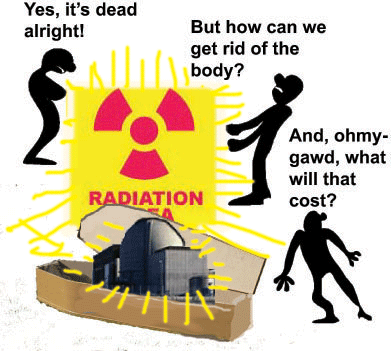
11 April 2013 “…… The C&AG’s report on the 2010-11 WGA shows the Nuclear Decommissioning Authority’s estimated cost of civil nuclear decommissioning increased by around £16 billion to £53 billion between 2007 and 2011. We asked the Treasury how the WGA would be used to influence any decision made in relation to future investments in the nuclear sector. The Treasury acknowledged that not considering these costs when the power stations were built had been a mistake, and considered that the critical issue was to factor in these costs in future, so that the taxpayer would not be burdened with unexpected additional costs of £60 billion.[ http://uk.groups.yahoo.com/group/Claverton/message/10673
VIDEO: More funding for USA’s nuclear weapons!
 VIDEO Obama increases nuclear arms funding: Mark Mason, Press TV 11 April 13, An analyst says a true push for nuclear disarmament is in the international arena, but it won’t come from a US government, which is expanding nuclear terror.
In the background of this US president Obama wants more funds to modernize the country’s nuclear weapons, construct a uranium processing facility in Tennessee, and to sustain existing stockpiles. Obama is requesting 7.9 billion dollars for this purpose, which seems to run counter to the nuclear non-proliferation promotion that Obama led to achieve a Nobel peace prize in 2009. This development also calls into question the existing agreement with Russia that both sides should cut their nuclear arsenal to 1,500 by 2018. The current stockpile is assumed to exceed 5,000.
Press TV has interviewed Mark Mason, professor and political activist from Oakland about this issue. The following is an approximate transcription of the interview.
Press TV: The existing US nuclear weapons can destroy the Earth several times. Why is it that President Obama is proposing for more funding to modernize the country’s existing nuclear weapons, especially at a time of austerity?
Mason: This is in keeping with the previous five years almost of his, I guess you would call it, his administration – it’s hardly even a government anymore.
We have the military industrial complex; there’s money involved – Cash that goes to the Pentagon – the Pentagon is worried about the budget; there are nuclear arms manufacturers- General Electric and others that benefit enormously from really the expansion of nuclear terror around the world……..
we have an international community that’s going to hopefully press forward for nuclear disarmament. It won’t come from the United States government…… http://www.presstv.ir/detail/2013/04/11/297732/obama-derails-nuclear-nonproliferation/
The danger in radioactive iodine
 Radiation Is Not On People’s Radar, Dr. Mark Sircus, Activist Post, 9 April 13, “……….Iodine in the Air The risks associated with iodine-131 contamination in Europe were not “negligible,” after Fukushima exploded in 2011, according to CRIIRAD, a French research body on radioactivity. They advised at that time for pregnant women and infants against “risky behavior,” such as consuming fresh milk or vegetables with large leaves. In response to thousands of inquiries from citizens concerned about fallout from the Fukushima nuclear disaster in Europe, CRIIRAD has compiled an information package on the risks of radioactive iodine-131 contamination in Europe.
CRIIRAD said it had detected radioactive iodine-131 in rainwater in south-eastern France. In parallel testing, the French Institute for Radiological Protection and Nuclear Safety (IRSN), the national public institution monitoring nuclear and radiological risks, found iodine 131 in milk. In normal times, no trace of iodine-131 should be detectable in rainwater or milk. Radiation monitors in Canada, in Ontario, New Brunswick and British Columbia also detected radioactive iodine.
In the United States the 2011 EPA data showed rising levels of Iodine-131, Cesium-134, and Cesium-137 up to 300% of maximum limits. Hawaii milk samples showed radiation 800% above normal for Cesium-134, 633% for Cesium-137, and 600% for Iodine-131. Continue reading
Florida- a change beginning that will end nuclear power development

The House hearing Thursday, and the fact that a similar bill is moving in the Senate, signals a change of face for the legislature. Lawmakers from both parties have accepted millions in campaign contributions from the giant utilities companies as they have rejected calls from consumers and alternative energy groups to modify the nuclear fee.
After years of no action, House committee moves bill to modify nuclear fee law, Mary Ellen Klas, Miami Herald, 11 April 13, A Florida House committee signaled its willingness Thursday to make official what has already happened in practice and passed a bill that will end the future development of nuclear power plants in Florida. Continue reading
NRC report on San Onofre Nuclear Generating Station not good enough
Sen. Boxer Blasts Report on San Onofre Nuclear Generating Station SAN DIEGO (CNS) 11 April 13, – Sen. Barbara Boxer, D-Calif., Wednesday blasted a preliminary finding by Nuclear Regulatory Commission staff that restarting a unit at the idled San Onofre Nuclear Generating Station would not present significant safety hazards.
Officials with Southern California Edison, the plant’s majority owner and operator, have asked for permission to operate the plant’s Unit 2 reactor at 70 percent beginning June 1. The utility wants to run the unit at partial power for five months, then shut it down for an inspection of steam pressure tubes.
Boxer and Rep. Edward Markey, D-Mass, sent a letter to the NRC this week demanding that a comprehensive investigation of the plant be completed before any units be permitted to operate. They also said full public hearings should be held before a decision is made. “The NRC staff proposal, which could pave the way for the restart of the San Onofre nuclear power plant before the investigation of the crippled plant are completed, is dangerous and premature,” Boxer said in response to the commission staff’s preliminary finding. “It makes absolutely no sense to even consider taking any steps to reopen San Onofre until these investigations look at every aspect of reopening the plant, given the failure of the tubes that carry radioactive water.
“In addition, the damaged plant is located in an area at risk of earthquake and tsunami,” she said. “With 8 million people living within 50 miles of this plant, the staff proposal is beyond irresponsible.” …… The NRC has promised to hold a public meeting in Southern California before any final decisions are made on a restart plan. The agency and SCE have repeatedly said they won’t restart the plant until they are sure it is safe. http://www.sandiego6.com/news/local/Sen-Boxer-Blasts-Report-on-San-Onofre-Nuclear-Generating-Station-202441161.html
1 This Month

of the week – Shut Down Drone Warfare!


Tell the Ukrainian Government to Drop Prosecution of Peace Activist Yurii Sheliazhenko

Petition to revoke the licensing of the Near Surface Nuclear Disposal Facility (NSDF) at Chalk River. https://www.ourcommons.ca/petitions/en/Petition/Details?Petition=e-7247
To see nuclear-related stories in greater depth and intensity – go to https://nuclearinformation.wordpress.com
-
Archives
- April 2026 (103)
- March 2026 (251)
- February 2026 (268)
- January 2026 (308)
- December 2025 (358)
- November 2025 (359)
- October 2025 (376)
- September 2025 (257)
- August 2025 (319)
- July 2025 (230)
- June 2025 (348)
- May 2025 (261)
-
Categories
- 1
- 1 NUCLEAR ISSUES
- business and costs
- climate change
- culture and arts
- ENERGY
- environment
- health
- history
- indigenous issues
- Legal
- marketing of nuclear
- media
- opposition to nuclear
- PERSONAL STORIES
- politics
- politics international
- Religion and ethics
- safety
- secrets,lies and civil liberties
- spinbuster
- technology
- Uranium
- wastes
- weapons and war
- Women
- 2 WORLD
- ACTION
- AFRICA
- Atrocities
- AUSTRALIA
- Christina's notes
- Christina's themes
- culture and arts
- Events
- Fuk 2022
- Fuk 2023
- Fukushima 2017
- Fukushima 2018
- fukushima 2019
- Fukushima 2020
- Fukushima 2021
- general
- global warming
- Humour (God we need it)
- Nuclear
- RARE EARTHS
- Reference
- resources – print
- Resources -audiovicual
- Weekly Newsletter
- World
- World Nuclear
- YouTube
-
RSS
Entries RSS
Comments RSS
 nuclear-news