USA and Europe not too worried over North Korea’s nuclear threats
Allies dismiss North Korea’s nuclear war threats Radio Australia, 10 April 2013, By Brendan Trembath, The White House and the European Union dismiss North Korea’s claim war is imminent and call on the rogue state to act sensibly.Both the White House and the European Union have described North Korea’s warnings of “thermo-nuclear war” on the Korean peninsula as “unhelpful rhetoric”.
North Korea has told foreign companies, organisations and tourists in South Korea to consider leaving for their own safety.
Warning that events were “inching closer to thermo-nuclear war”, the North’s official news agency said it did not want foreigners to come to harm if war breaks out.
White House spokesman Jay Carney labelled that statement unhelpful, and said it would only serve to “further isolate North Korea”.
European Union delegates meeting in Brussels have drawn up a response to the North Korean warnings, saying it is wrong to proclaim that war is imminent and Pyongyang should heed international demands regarding its nuclear and ballistic missile programs.
The EU’s note, agreed by the bloc’s 27 member governments on Tuesday, is a response to a warning by North Korea last week that it could not guarantee the safety of diplomats in the country after April 10. An EU diplomat said the note underlined the need for North Korea to act sensibly and rejected “its analysis that full-scale war is imminent”. ….
Japan readies missiles Meanwhile, Japan says it has deployed missile interceptors to the centre of Tokyo and will use them to shoot down any missile heading towards its airspace…..http://www.radioaustralia.net.au/international/2013-04-10/allies-dismiss-north-koreas-nuclear-war-threats/1113858
Fukushima’s radioactive water problem – still unmanageable
 Japan Plant Forced to Move Tainted Water, WSJ, 10 April 13 Disclosure of Plan to Close Massive Storage Pools Over Leaks Is Latest Problem at Nuclear Facility, Rousing Safety Fears TOKYO—The operator of the Fukushima Daiichi nuclear-power plant on Wednesday said it has to move tens of thousands of tons of radioactive water out of leaky underground reservoirs—the latest in a string of problems and missteps that has spurred a rebuke from regulators and amplified fears that the heavily damaged plant isn’t fully under control.
Tokyo Electric Power Co. 9501.TO +9.47% said it would abandon seven massive underground storage pools where it had been keeping 26,600 tons of contaminated water, after finding that three of the pools had likely sprung leaks.
The discovery of those leaks, which Tepco estimates have spilled more than a hundred tons of radioactive water into the ground, came less than a month after a power outage shut a cooling system for used nuclear fuel, and a few days before two underwater barriers separating the most contaminated parts of the plant from the sea were found to have split….. Continue reading
America’s B51 bombers ready for pre-emptive strike – “good for business”
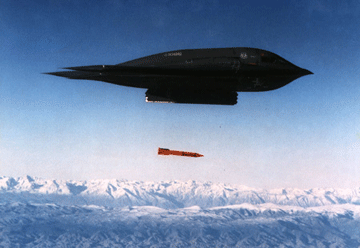 Proponents of ‘first strike’ nuclear war against Iran rob billions from their own citizens, RT.com, Michel Chossudovsky 10 April 13, The Pentagon and NATO’s multibillion-dollar war budgets are financed by massive economic austerity measures, impoverishing people in the US and NATO member-states in order to build advanced nuclear weaponry justified by the ‘Iran threat.’
While the Pentagon’s modernization budget for the pre-emptive nuclear option is a modest ten billion dollars (excluding the outlay by NATO countries). the budget for upgrading the US arsenal of “strategic nuclear offensive forces” is a staggering $352 billion over ten years. (See Russell Rumbaugh and Nathan Cohn,“Resolving Ambiguity: Costing Nuclear Weapons,” Stimson Center Report, June 2012).
These multi-billion military outlays allocated to develop “bigger and better nuclear bombs” are financed by the massive economic austerity measures currently applied in US and NATO countries.
The war economy is largely funded by compressing all categories of civilian government expenditure. In the US, these refurbished state of the art nuclear bombs are largely funded by the dramatic cuts in Medicare, Medicaid and Social Security.
Humanity is at a dangerous crossroads. America is a “Killer State”. The gamut of economic austerity measures impoverish the American people while generously funding the “Killer State” through multi-billion dollar contracts with Lockheed Martin, Northrop Grumman, Raytheon et al.
War preparations to attack Iran are in “an advanced state of readiness”. Hi tech weapons systems including nuclear warheads are fully deployed.
At the height of an Economic Depression, “War is Good for Business”. Continue reading
Earthquake? no worries – Iran will build more nuclear reactors there
 Iran says it will build more nuclear plants in area hit by earthquake : http://www.foxnews.com/world/2013/04/10/iran-to-build-more-nuclear-plants-in-area-hit-by-earthquake/#ixzz2QBoycUDm April 10, 2013
FoxNews A day after an earthquake rattled the area containing Iran’s only nuclear power plant, the country announced that it plans to build more plants in the same place.
Tuesday’s magnitude 6.1 earthquake struck 55 miles southeast of Bushehr, killing at least 37 and injuring more than 900, Iranian officials said.
The Russian power company that helped build the nuclear plant says its operations were unaffected. But the head of Iran’s Atomic Energy Organization told state TV hours after the earthquake that more reactors would be built near Bushehr, Reuters reports.
Iran has repeatedly ignored safety concerns about housing a nuclear facility in the area, which is highly seismic.
Last week, a report by U.S. think tanks the Carnegie Endowment and the Federation of American Scientists said the Bushehr reactor sits at the intersection of three tectonic plates, Reuters reports.
In 2003, an earthquake in Bam, which is about 600 miles east of Bushehr, killed more than 25,000 people.
Anxiety in the neighbourhood, following earthquake near Iran’s nuclear plant
 Earthquake increases worry over nuclear Iran , Gulf News, Gulf officials urge Iran to be transparent amid concerns fuelled by deadly quake near nuclear power plant By Habib Toumi, Bureau Chief April 10, 2013
Manama: Gulf officials and experts have asked Iran to come clean about its nuclear programme amid growing concerns fuelled by Tuesday’s earthquake close to the Bushehr nuclear power station
“It is difficult to reduce the probability of risks related to the Iranian nuclear programme in light of the uncertainty surrounding the issue and the level of Tehran’s compliance with international standards and requirements,” Waheeb Al Nasser, professor of applied physics at the University of Bahrain, said.
“The earthquake that hit Bushehr occurred in a seismically active area and was around 80 kilometres from Bushehr. We are not against Iran’s nuclear activities in peaceful domains, but there are serious concerns about the facilities and their equipment, especially that the Iranian nuclear issue is shrouded in mystery and the international community has been left with many unanswered questions,” he said in Manama…..
In Kuwait City, environment expert Ilham Al Lingawi said that the Iranian nuclear plant “becomes even more dangerous when there is an earthquake.”
“Any earthquake that measures more than 4.5 degrees compounds the risks and disasters associated with the Busheher nuclear plant,” she said, quoted by local Arabic daily Al Rai on Wednesday. “The earthquake on Tuesday could cause fissures in the infrastructure and result in radioactive leaks that would contaminate the water and the air. This is very dangerous for Kuwait and the Gulf states that rely heavily on the desalination of water. This simply means a catastrophe.”….. http://gulfnews.com/news/region/iran/earthquake-increases-worry-over-nuclear-iran-1.1168932
Iran’s nuclear plant – close to recent earthquake
Strong earthquake near Iran nuclear plant kills dozens Radio Australia 10 April 2013, More than 30 people are dead after a magnitude 6.3 earthquake which hit near Iran’s only nuclear power plant. A powerful earthquake has struck close to Iran’s only nuclear power station, killing at least 37 people and injuring 850 as it destroyed homes and devastated two small villages.
The magnitude 6.3 quake totally destroyed one village, a Red Crescent official told the Iranian Students’ News Agency (ISNA), but the nearby Bushehr nuclear plant was undamaged, according to Iranian officials and the Russian company that built it.
Many houses in rural parts of the province are made of mud bricks, which have been known to crumble easily in quake-prone Iran.
The death toll is expected to climb, as the stricken area is home to some 12,000 inhabitants.
Across the Gulf, offices in Qatar and Bahrain were evacuated after the quake. Its epicentre was 89 km south-east of the port of Bushehr, according to the US Geological Survey.
The early afternoon shock was also felt in financial hub Dubai, Kuwait and the United Arab Emirates
The Russian company that built the nuclear power station, 18km south of Bushehr, said the plant was unaffected….. http://www.radioaustralia.net.au/international/2013-04-10/strong-earthquake-near-iran-nuclear-plant-kills-dozens/1113782
Go for renewable energy, scrap subsidies for fossil fuels – Obama
Obama Budget – Spend Big On Renewables, Slash Fossil Fuel Support http://www.energymatters.com.au/index.php?main_page=news_article&article_id=3682 11 April 13, US President Barack Obama has proposed billions more be ploughed into renewable energy and to eliminate $4 billion in fossil fuels subsidies in his 2014 budget proposal.
Among the highlights:
– $615 million to increase the use and reduce the costs of solar power, wind, geothermal, and hydro energy.
– $4 billion in loans to rural electric cooperatives and utilities to support a transition to clean-energy generation.
– $238 million in loan guarantees and grants to assist farmers and rural small businesses in developing renewable energy systems and energy efficiency improvements.
– $100 million to maintain capacity to review and permit new renewable energy projects on Federal lands and waters.
– $23 billion of incentives for renewable energy production and energy efficiency over the next 10 years.
– $153 million in smart grid research and development and other activities plus $80 million to advance clean energy integration into the grid.
– $2.5 billion in tax credits for investments in advanced energy manufacturing projects.
The fossil fuel subsidy gravy train will lose more than just a few carriages.
“As we continue to pursue clean energy technologies that will support future economic growth, we should not devote scarce resources to subsidizing the use of fossil fuels produced by some of the largest, most profitable companies in the world.”
“The Budget proposes to eliminate inefficient fossil fuel subsidies that impede investment in clean energy sources and undermine efforts to address the threat of climate change. The Budget would repeal over $4 billion per year in tax subsidies to oil, gas, and other fossil fuel producers.”
The United States has nearly doubled its energy generation from renewable energy sources since 2008 and President Obama has set a goal of doubling it again by 2020.
Further details of the 2014 budget proposal section, “Clean Energy Economy, Improving Energy Security, and Addressing Climate Change” can be viewed here.
Government Accountability Office find USA nuclear evacuation plans inadequate
Feds sound alarm on nuclear evacuations, NJ.com 11 April 13, By The Associated Press Regulators and congressional investigators clashed today over a new report warning that in the event of an accident at a nuclear plant, panicking residents from outside the official evacuation zone might jam the roads and prevent others from escaping.
The report by the Government Accountability Office, which acts as the investigative arm of Congress, challenges a three-decade-old fundamental of emergency planning around American nuclear power plants: that preparations for evacuation should focus on people who live within 10 miles of the site.
The GAO found that people living beyond the official 10-mile evacuation zone might be so frightened by the prospect of spreading radiation that they would flee of their own accord, clog roads, and delay the escape of others. The investigators said regulators have never properly studied how many people beyond 10 miles would make their own decisions to take flight, prompting what is called a “shadow evacuation.”
As a result, the GAO report says, “evacuation time estimates may not accurately consider the impact of shadow evacuations.”……
The investigation was requested by four U.S. senators: Democrats Barbara Boxer of California, Robert P. Casey Jr. of Pennsylvania and Sheldon Whitehouse of Rhode Island, and independent Bernard Sanders of Vermont. They asked for the report in 2011 in response to an Associated Press investigative series reporting weaknesses in community planning for nuclear accidents, including the likelihood of surprisingly large shadow evacuations…… http://www.nj.com/news/index.ssf/2013/04/feds_sound_alarm_on_nuclear_ev.html
Europe’s role in USA’s pre-emptive B61 nuclear strike program
Proponents of ‘first strike’ nuclear war against Iran rob billions from their own citizens, RT.com, Michel Chossudovsky 10 April 13
“…….Pre-emptive Nuclear Warfare While reports tend to depict the tactical B61 bombs as a relic of the Cold war, the mini nukes are the preferred weapons system for pre-emptive nuclear war. Were an attack directed against Iran to be launched involving the deployment of B61 bunker buster nuclear bombs, these five countries, [Italy, Belgium, Germany and the Netherlands with Turkey and Italy in the forefront, would play a major strategic role. While these “undeclared nuclear states” casually accuse Tehran of developing nuclear weapons, without documentary evidence, they themselves have capabilities of delivering nuclear warheads, which are targeted at Iran. To say that this is a clear case of“double standards” by the IAEA and the “international community” is a understatement.
US and NATO military documents attest to the fact that the B61 is the weapon of choice of pre-emptive nuclear war as opposed to the larger thermo-nuclear bombs of the Cold War era. Moreover, were military action to be launched against Iran, these five countries ]would play a key role in the delivery of B61 bunker buster bombs with nuclear warheads.
The US had originally supplied some 480 B61 thermonuclear bombs to these five “non-nuclear states”, as well as to the United Kingdom, which is categorized as a Nuclear Weapons State (NWS) Moreover, were military action to be launched against Iran, these five countries would play a key role in the delivery of B61 bunker buster bombs with nuclear warheads.
Casually disregarded by the Vienna based UN Nuclear Watchdog (IAEA), the US has actively contributed to the proliferation of nuclear weapons in Western Europe and Turkey. While, some of these bombs were decommissioned as a result of political pressures, particularly in Belgium and Germany, the US –in liaison with NATO– has launched a multi-billion dollar modernisation program of its tactical nuclear weapons arsenal.
According to the National Resources Defense Council (August 2007), the number of B61 nuclear bombs in Europe has been reduced from 480 to 350, following the removal of 130 bombs from the Ramstein airbase in Germany……http://rt.com/op-edge/nuclear-war-iran-nato-629/
Gastro-intestinal cancer – added risk for space travellers
Exposure to Space Radiation Reduces Ability of Intestinal Cells to Destroy Oncoprotein Science Daily Apr. 9, 2013 — Two studies funded by NASA and presented at the AACR Annual Meeting 2013 help explain why space radiation may increase the risk of colorectal cancer in humans.
The researchers, from Georgetown Lombardi Comprehensive Cancer Center, found that cosmic radiation impairs the ability of cells in the intestines of mice to eliminate oncogenic proteins, thus substantially increasing development of colorectal tumors….. “While there is no reliable estimate of colorectal cancer risk from space radiation exposure, we have shown that exposure to cosmic radiation causes markedly increased intestinal tumors in mice,” says Datta, an assistant professor in the department of biochemistry and molecular & cellular biology.
“These findings have implications for the health of astronauts undertaking exploratory missions into outer space and for future space tourists,” he says…..
Both researchers used specialized mutant mice to study the effects of 56Fe radiation, a highly ionizing radiation prevalent in space.”This radiation is considered the greatest challenge for space exploration,” says Datta. “It deposits higher amount of energy in the body than does the gamma-/x-rays causing relatively higher DNA damage. This is believed to increase carcinogenic risk in astronauts, although accurate risk estimates are not yet available.”….http://www.sciencedaily.com/releases/2013/04/130409144837.htm
Radiation on the moon – a barrier to humans
Moon’s radiation damaging for humans, electronics http://zeenews.india.com/news/space/moon-s-radiation-damaging-for-humans-electronics_841092.html April 10, 2013 Washington: The radiation environment near the Moon could be damaging to humans and electronics on future missions, it has been revealed. Continue reading
GDF’s wind energy provides over 50% of the company’s electricity: France
Renewable energy accounts for 50% of GDF Suez production capacity in 2012 http://www.utilityproducts.com/news/2013/04/10/renewable-energy-accounts-for-50-of-gdf-suez-production-capacity-in-2012.html
 Apr 10, 2013 – French utility GDF Suez’s (EPA:GSZ) production capacity from renewable energies stood at 5.1 GW at the end of 2012, or over 50% of the total production capacity of the group in France, the company said.
GDF Suez is the first producer of wind energy in the country and the second major producer of electricity from hydraulic energy, accounting for 25% of France’s capacity.
The group invests in all types of renewable sources, including solar and tidal power, offshore wind energy, biomass and biofuels, such as biomethane.
Savannah River Site – Liquid Waste funding cut, Site Stewardship gets $128M

- By MIKE GELLATLY
- Posted: Thursday, April 11, 2013 12:01 a.m.
Clean up work at the Savannah River Site took a hit in the fiscal year 2014 federal budget, despite record-setting work in 2013. However, other environmental work received substantial funding, with nearly $128 million for Site Stewardship.
Overall, the Department of Energy’s Environmental Management programs, or EM, took a hit of 8.4 percent over previous years.
EM received $1.19 billion in fiscal year 2012, but will only receive $1.1 billion in fiscal year 2014. A reduction of just less than $100 million.
Legacy liquid waste stabilization and disposition, or the emptying of the liquid waste tanks, has been cut by $101 million, or 15.5 percent. An even bigger hit is being taken by the Salt Waste Processing Facility, which is funded $78 million, or 45.9 percent, less in fiscal year 2014.
“At the Savannah River Site, the largest portion of the request supports the Tank Waste Liquid Waste Management Program, which includes the operation of the Defense Waste Processing Facility, as well as operation of the Actinide Removal Process and Modular Caustic Side Extraction units,” the president’s budget states. “These units will be needed through construction of the Salt Waste Processing Facility. This request also supports the operation of the Saltstone Facility and the continued closure activities for Tanks 5 and 6.”
While the budget cuts funding, it took time to laud Environmental Management’s work.
NNSA Nuclear Weapons Budget Ignores Fiscal Realities
NNSA Weapons Activities Funding:
FY 2011 Appropriation: $6.87 billion
FY 2012 Appropriation: $7.21 billion
FY 2013 Request: $7.58 billion
FY 2013 CR: $7.58 billion (excludes sequester reduction)
FY 2014 Request: $7.87 billion

Image source ; http://www.comw.org/wordpress/dsr/obama-requests-nuclear-weapons-spending-surge-mello 2010
Posted on April 11, 2013 by Daryl G. Kimball
By Daryl G. Kimball and Tom Z. Collina
The Barack Obama administration’s fiscal year 2014 budget request proposes spending $7.87 billion for National Nuclear Security Administration (NNSA) Weapons Activities, which would be an increase of $654 million, or nine percent above the 2012 enacted level, and $300 million more than the Continuing Resolution for fiscal year 2013.
And as John Fleck of the Albuquerque Journal notes in a report he posted Wednesday, “The Obama administration’s budget request, being rolled out today, calls for a 23 percent increase in the budget for U.S. nuclear weapons research, manufacturing and maintenance over the next five years,” according to a budget summary document (PDF, page 371) released by the Office of Management and Budget.
So long as the United States has a nuclear arsenal, funding for the core programs to maintain an effective arsenal will be needed, but that can be accomplished in a more cost-effective manner.
Unfortunately, the administration’s proposal for increased NNSA weapons activities spending doesn’t take into account the fiscal headwinds now blowing across the federal budget and it ignores some common-sense cost savings strategies on some of the most costly projects.
Because the administration’s fiscal 2014 budget request is above the levels mandated by the Budget Control Act, the NNSA budget request and future years budget increases are not sustainable or realistic. As a result, it will be up to Congressional budget appropriators to make the tough, practical choices about what is really necessary and what is affordable, or else allow the across-the-board budget cuts mandated by “sequestration” to go forward.
According to the administration’s fiscal year 2014 NNSA budget wish list, the funding would cover cost increases for nuclear weapon life extension programs, such as: upgrades to the W76 and B61 nuclear weapons; initiating new upgrades for the W78 and W88 nuclear weapons; and improving or replacing aging facilities, such as the Uranium Processing Facility; adding funds for tritium production and plutonium manufacturing and experimentation.
The base NNSA weapons activities budget includes programs to sustain the existing stockpile by maintaining the underlying science, surveillance, and other support programs.
Alert to Congress – Nuclear evacuation may bog down escape routes!
Jim Riccio, nuclear policy analyst for the anti-nuclear group Greenpeace, seconded the GAO’s skepticism about current shadow evacuation planning. “Greenpeace has looked at the NRC’s emergency planning for a long time as being ridiculously unrealistic,” he said. “It pretends that Americans are going to follow orders when it comes to emergency evacuation.”

Regulators and congressional investigators clashed Wednesday over a new report warning that in the event of an accident at a nuclear plant, panicking residents from outside the official evacuation zone might jam the roads and prevent others from escaping.
The report by the Government Accountability Office, which acts as the investigative arm of Congress, challenges a three-decade-old fundamental of emergency planning around American nuclear power plants: that preparations for evacuation should focus on people who live within 10 miles of the site.
The GAO found that people living beyond the official 10-mile evacuation zone might be so frightened by the prospect of spreading radiation that they would flee of their own accord, clog roads, and delay the escape of others. The investigators said regulators have never properly studied how many people beyond 10 miles would make their own decisions to take flight, prompting what is called a “shadow evacuation.”
As a result, the GAO report says, “evacuation time estimates may not accurately consider the impact of shadow evacuations.”
However, Neil Sheehan, a spokesman for the federal Nuclear Regulatory Commission, shot back in an email statement: “We disagree with the view that evacuations cannot be safely carried out.”
The investigation was requested by four U.S. senators: Democrats Barbara Boxer of California, Robert P. Casey Jr. of Pennsylvania and Sheldon Whitehouse of Rhode Island, and independent Bernard Sanders of Vermont. They asked for the report in 2011 in response to an Associated Press investigative series reporting weaknesses in community planning for nuclear accidents, including the likelihood of surprisingly large shadow evacuations.
In an interview Wednesday, Casey said the report suggests that “we need to do more to ensure that these residents who live outside of the 10-mile radius have access to and understand evacuation procedures.” He said legislation may be needed but gave no details.
The disaster at the Fukushima Dai-ichi nuclear complex in Japan two years ago has heightened worry about how well U.S. communities can protect themselves from a major release of radiation. When a tsunami cut off power and nuclear fuel melted, more than 150,000 people fled the Fukushima area, many from well beyond 12 miles, according to Japan’s Education Ministry. U.S. officials recommended that Americans in Japan stay 50 miles back.
Under federal rules, however, U.S. communities practice for evacuation or other protective action by residents only within 10 miles of nuclear power plants. States also lay plans to limit consumption of contaminated crops, milk and water within 50 miles.
Environmental and anti-nuclear groups have pressed federal regulators to expand planning to 25 miles for evacuation and 100 miles for contaminated food. They also want community exercises that postulate a simultaneous nuclear accident and natural disaster.
Nuclear sites were originally picked mainly in rural areas to lessen the impact of accidents. However, in its 2011 series, the AP reported population growth of up to 350 percent within 10 miles of nuclear sites between 1980 and 2010. About 120 million Americans — almost 40 percent — live within 50 miles of a nuclear power plant, according to the AP’s analysis of Census data. The series also reported shortcomings in readiness exercises for simulated accidents, including the failure to deploy emergency personnel around the community, reroute traffic, or practice any real evacuations.
1 This Month

of the week – Shut Down Drone Warfare!


Tell the Ukrainian Government to Drop Prosecution of Peace Activist Yurii Sheliazhenko

Petition to revoke the licensing of the Near Surface Nuclear Disposal Facility (NSDF) at Chalk River. https://www.ourcommons.ca/petitions/en/Petition/Details?Petition=e-7247
To see nuclear-related stories in greater depth and intensity – go to https://nuclearinformation.wordpress.com
-
Archives
- April 2026 (103)
- March 2026 (251)
- February 2026 (268)
- January 2026 (308)
- December 2025 (358)
- November 2025 (359)
- October 2025 (376)
- September 2025 (257)
- August 2025 (319)
- July 2025 (230)
- June 2025 (348)
- May 2025 (261)
-
Categories
- 1
- 1 NUCLEAR ISSUES
- business and costs
- climate change
- culture and arts
- ENERGY
- environment
- health
- history
- indigenous issues
- Legal
- marketing of nuclear
- media
- opposition to nuclear
- PERSONAL STORIES
- politics
- politics international
- Religion and ethics
- safety
- secrets,lies and civil liberties
- spinbuster
- technology
- Uranium
- wastes
- weapons and war
- Women
- 2 WORLD
- ACTION
- AFRICA
- Atrocities
- AUSTRALIA
- Christina's notes
- Christina's themes
- culture and arts
- Events
- Fuk 2022
- Fuk 2023
- Fukushima 2017
- Fukushima 2018
- fukushima 2019
- Fukushima 2020
- Fukushima 2021
- general
- global warming
- Humour (God we need it)
- Nuclear
- RARE EARTHS
- Reference
- resources – print
- Resources -audiovicual
- Weekly Newsletter
- World
- World Nuclear
- YouTube
-
RSS
Entries RSS
Comments RSS
 nuclear-news