Mining Corporations seek radioactive rethink of risk assessment! Profit before health?
- by: Annabel Hepworth
- From: The Australian (subscription only)
- April 08, 2013 12:00AM
URANIUM miners have demanded changes to laws so that the “mild” radioactivity that is unique to the sector is no longer a trigger for federal environmental assessments.
The Australian Uranium Association — whose members include BHP Billiton and the operator of the Ranger mine at Jabiluka in the Northern Territory, ERA — says that uranium mining and the milling that makes yellowcake should no longer be defined as a “nuclear action” under the federal law known as the Environment Protection and Biodiversity Conservation Act.

…..Australia is obliged to provide for safe and secure management of radioactive waste under the Joint Convention on the Safety of Spent Fuel Management and on the Safety of Radioactive Waste Management, and report on the implementation of its obligations every three years………….This total does not include uranium mining wastes, which are disposed of at mine sites.
Over half the volume of Australia’s current low level and short-lived intermediate level waste is some ten thousand drums of lightly contaminated soil – a legacy of CSIRO research into processing radioactive ores during the 1950s and 1960s. …….
…….Under the current international guidance, there is not a precise boundary between each of the waste categories, as limits on the acceptable level of activity concentration will differ between individual radionuclides or groups of radionuclides. Waste acceptance criteria for a particular near surface disposal facility will be dependent on the actual design of and planning for the facility………
…….Previously, a contact dose rate of 2 mSv/h was generally used to distinguish between LLW and ILW…….
,,,,,,Waste is often stored indefinitely in facilities that were not designed for long term storage of such material. Such storage, while currently safe, is not ideal. In many cases, storage facilities were not designed for this use and are nearing capacity.,,,,,,
Radioactive waste is a subset of the much broader category of hazardous wastes.
Current global hazardous waste production is approximately 400 million tonnes per annum.
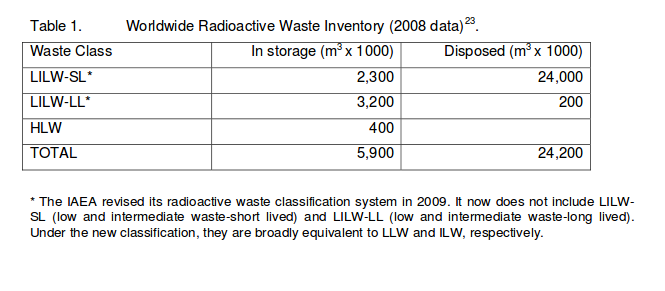
Radioactive waste from nuclear power plants and the fuel cycle support facilities comprises approximately 0.4 million tonnes per annum, or approximately 0.1% of global hazardous waste. Low level and short-lived intermediate level waste is already being disposed of in many countries. Over three quarters of all radioactive waste (on a volume basis) has already been sent for disposal.
Because of the wide variety of nuclear applications, the amounts, types and even physical forms of radioactive wastes vary considerably. They include solid, liquid and gaseous wastes. Some wastes (such as the small radioactive sources found in smoke detectors) carry little or no safety or security risk; however, some other wastes are highly radioactive and must be managed appropriately to address safety and security issues. Internationally, the major source of radioactive waste has been from the development and production of fissile materials for weapons manufacture, especially dating from the cold war period (often referred to as ‘legacy wastes’). The major sources of non-military waste internationally are fission products and contaminated and activated materials from nuclear power generation, including various process wastes arising from parts of the nuclear fuel cycle such as reprocessing, and the decommissioning of nuclear facilities.
ANSTO conducts extensive research in the area of radioactive waste and has developed wasteforms to treat radioactive wastes using a technology called HIP (hot-isostatic pressing) under the ANSTO Synroc brand. The waste is combined with a ceramic material and using the high pressure and temperature of the HIP, it is compressed and sealed into a ceramic wasteform. This process is designed to safely encapsulate the waste for tens of thousands of years. The product is then stored inside shielded containers. …..
Australia has accumulated approximately 4,000 cubic metres (m3) – less than the volume of two Olympic swimming pools – of low level and short-lived intermediate level radioactive waste from over fifty years of research, medical and industrial uses of radioactive materials.
The Commonwealth is responsible for about 3,800 m3 of this waste. The States andTerritories hold the rest (around 200 m3) .This total does not include uranium mining wastes, which are disposed of at mine sites.
Over half the volume of Australia’s current low level and short-lived intermediate level waste is some ten thousand drums of lightly contaminated soil – a legacy of CSIRO research into processing radioactive ores during the 1950s and 1960s.
Australia produces a very small quantity of low level and short-lived intermediate level radioactive waste when compared globally. Each year, Commonwealth agencies produce approximately 35 m3 of such radioactive waste – less than the volume of one shipping container. States and Territories together generate annually another 5 to 10 m3 of this waste.
By comparison, Britain and France each produce annually around 25,000 m3 of low level waste.
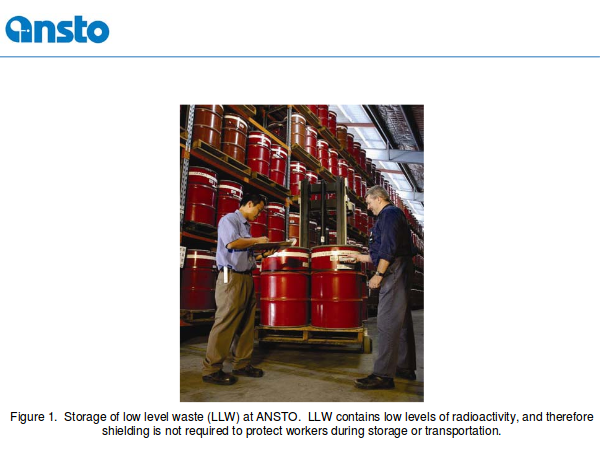
Australia currently holds approximately 535 m3 of long-lived intermediate level radioactive waste (that is, radioactive waste requiring shielding for handling, transport and storage). This 535 m3 is equivalent to the volume occupied by a typical house. This includes waste from the production of radiopharmaceuticals, wastes from mineral sands processing, and used sources from medical, research and industrial equipment. Intermediate level radioactive waste contains radioactive material at a concentration that may require shielding for safe handling and transport.
The Commonwealth is responsible for about 430 m3 of this waste and generates less than 5m3 per year. The States and Territories hold the balance (that is, about 100 m3) and produce about 2 m3 of this waste annually.
Classification of Radioactive Waste
Radioactive waste is defined as ‘radioactive material in gaseous, liquid or solid form for which no further use is foreseen, and which is controlled as radioactive waste by a regulatory body’.
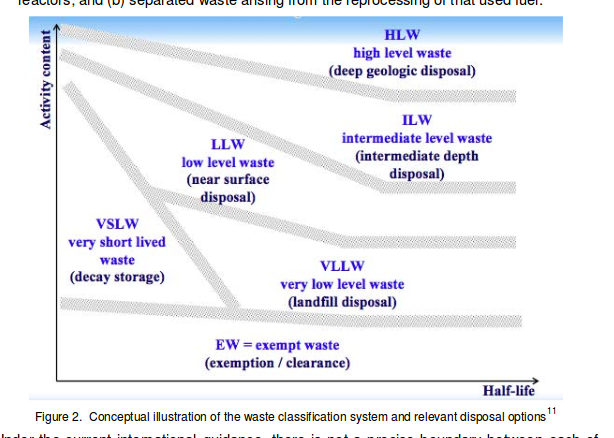
The classification of radioactive waste has been defined in international standards developed by the IAEA. There are three general classes of radioactive waste – low level waste (LLW), intermediate level waste (ILW) and high level waste (HLW). A recent review of the waste classifications added two new classes between LLW and exempt waste.
Under the current international guidance, there is not a precise boundary between each of the waste categories, as limits on the acceptable level of activity concentration will differ between individual radionuclides or groups of radionuclides. Waste acceptance criteria for a particular near surface disposal facility will be dependent on the actual design of and planning for the facility………
Previously, a contact dose rate of 2 mSv/h was generally used to distinguish between LLW and ILW. While this is still an important consideration, long-term safety is the primary basis of the present classification system, and thus short-lived materials are generally classified differently to long-lived materials. ….
Management and Disposal
of LLW (including VLLW)
The isolation period is usually up to 300 years, thus requiring institutional and administrative control for that period. The majority of the world’s LLW has been safely disposed of (Table 1) in near surface disposal facilities which have been operated in numerous countries such as France, the UK and the USA for over 30 years. In Australia, low-level waste is generated in industry, hospitals and nuclear facilities. It typically comprises paper, plastic, gloves, clothing and filters.
Australia does not have a central storage or disposal facility for low-level wastes (except for the Mt Walton Intractable Waste Disposal Facility, in Western Australia, used for the disposal of low level waste produced in that state), and as a result Australia’s low level waste is held at a host of widely dispersed locations across the country. In 2002, an audit of radioactive waste in South Australia found that there were 80 sites where radioactive waste was held.
Management and Disposal of ILW
Intermediate Level Waste (ILW) can be stored in above-ground facilities but requires disposal at a depth between a few tens and hundreds of metres from the surface. This is because some ILW contains long-lived radionuclides in quantities that require a similarly high degree of isolation from the biosphere as high level waste (HLW). Such isolation would be provided by disposal in geologic formations at a depth of several hundred metres.
The Australian situation ILW is generated chiefly from radiopharmaceutical production, the operation of ANSTO’s research reactors and the reprocessing of used fuel from those reactors. In order to limit exposure to radiation, intermediate level waste requires shielding during handling, processing and storage, typically by using concrete, steel or lead.
ANSTO has commenced a project to condition the intermediate level liquid wastes from molybdenum-99 production. The decay product of molybdenum-99, technetium-99m, is used in more than 80% of all diagnostic nuclear medicine procedures worldwide, and molybdenum-99 is the primary radiopharmaceutical produced at ANSTO. Whilst liquid wastes have been accumulated and safely stored at ANSTO (and some have been dried into a solid waste), they are not currently in a form suitable for off-site transport or ultimate disposal. ANSTO therefore plans to implement a process to solidify those wastes. The proposal is to use the “synroc” process to produce a wasteform suitable for long-term storage in an intermediate level radioactive waste store at the proposed National Radioactive Waste Management Facility. Most of Australia’s ILW is currently in storage at ANSTO.
Table 1. It shows that of the approximately 30 million m3 of radioactive waste that has been generated, approximately 24 million m3has been disposed of and approximately 6 million m3 has been placed in storage. This means that approximately 75% of all radioactive waste created since the commencement of the nuclear industry has already been sent for disposal.
Most LLW is typically sent to land-based disposal facilities immediately upon being packaged for long-term management.
Most ILW is currently stored at purpose-built facilities while geological repositories for disposal are being developed. Both Finland and Sweden are well progressed to have geological facilities operational by 2025. In New Mexico, USA a deep geological waste repository has been in operation since 1999. The WIPP (Waste Isolation Pilot Plant) disposes of transuranic waste (essentially long-lived ILW from military operations) at a depth of ~ 650m in a bedded salt deposit. HLW is addressed in a subsequent section, but it is noteworthy that the HLW from military applications totally dominates the inventory of HLW.
The El Cabril radioactive waste disposal facility in Spain provides an example of a modern purpose-built facility. It is designed to offer secure and safe disposal of low level waste produced in Spain. It is a vault-type surface disposal facility. ENRESA (Empresa Nacional de Residuos Radiactivos SA) has operated the facility since 1992; site preparation commenced in 1986. It is located approximately 100 km north-east of Seville (population of 1.5 million people). The capacity of 100,000m3 is much larger than the proposed National Radioactive Waste Management Facility in Australia, because Spain generates approximately 20% of its electricity from eight nuclear reactors. In 2006, it was 38% full. Australia has accumulated less than 5000 m3 of LLW and ILW, i.e. approximately 5% of the capacity of El Cabril.
As noted above, Australia does not have an operating low level waste disposal facility (except for the Mt Walton Intractable Waste Disposal Facility, in Western Australia, used for the disposal of low level waste produced in that state). As a result Australia’s low level and intermediate level waste is held at a host of widely dispersed locations across the country.
Radioactive waste, as explained previously, is radioactive material for which no further use is envisaged. Some countries define used nuclear fuel as waste, whereas others do not. This issue is explored in the following section. Under international law, used nuclear fuel is not defined as waste unless so designated by the responsible country
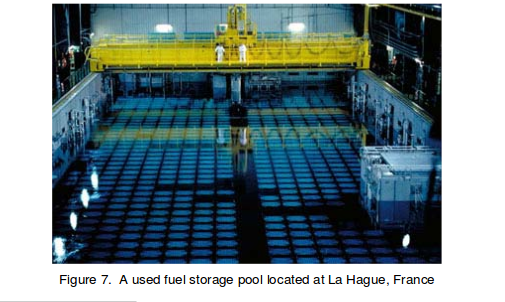
Some countries regard used nuclear fuel as a valuable resource because of the uranium and plutonium that remains in the fuel. This includes France, the UK, Japan and Russia. The uranium and plutonium is recovered by reprocessing and can then be used to fabricate new fuel assemblies.
Reprocessing is the chemical process where plutonium and uranium are separated from the fission products in the used fuel and are then able to be recycled. While reprocessing was originally developed to extract plutonium for use in nuclear weapons, today it is used primarily to treat used fuel from civilian nuclear power reactors. It offers benefits in increased uranium and plutonium utilisation, and a reduction in the volume of high level waste. The liquid waste from the reprocessing of spent fuel must be solidified to be suitable for transportation and disposal. The most frequently used solidification process is vitrification,
i.e. the waste products are melted together with glass material at high temperatures such that they are incorporated into the glass structure. The melted mixture is poured into stainless steel containers, and, after controlled cooling, these are sealed by welding and then decontaminated to remove possible surface contamination.
In the USA, licenses for 60 year dry cask storage have been issued at some nuclear plants.
Despite the view that managed storage is sound for 100 years, dry cask storage is still an interim solution. Unless reprocessed, used nuclear fuel ultimately needs to be disposed in a deep geologic disposal facility. Even if reprocessing is employed, the solidified wastes will still need to be disposed of in such a geologic facility.
Australia does not generate any used fuel that would be classified as HLW. Power reactor fuel generates significantly greater quantities of heat from radioactive decay compared to research reactor fuel. The Commonwealth Radioactive Waste Management Act 2005 defines “high level radioactive material”, as “material which has a thermal energy output of at least 2 kilowatts per cubic metre (as explained in Section 3.1). The radioactive waste generated from the reprocessing of HIFAR and MOATA fuel does not meet this criterion.
Used fuel from ANSTO’s former reactors has been safely shipped overseas for reprocessing or storage since 1963. Since then, ANSTO has planned and managed nine shipments, two to the UK, four to France and three to the USA. ANSTO no longer retains any used fuel from its former HIFAR and Moata reactors. The residual waste material from the reprocessing of the fuel sent to France and one of the shipments to the UK will, under international agreements, return to Australia. No material will be returned to Australia from the other shipments.
The intermediate level waste resulting from reprocessing ANSTO’s used fuel overseas will eventually require geological disposal in Australia. However, the small volumes involved means that Australia can afford to wait and learn from overseas experience in the establishment of such facilities, storing the material in the interim period. The first shipment of reprocessed fuel waste to Australia is due in 2015.
Countries which reprocess their used fuel must still dispose of the high level waste arising
from the reprocessing operation . Many of those countries have also concluded that deep
geological repositories are the best solution to the problem of high level waste disposal.
Switzerland and France are currently assessing the deep geological disposal option for their high level waste, and are in the process of authorising the selection of sites. A French law passed in 2006 on radioactive waste management requires that a deep geological repository for HLW be available by 2025.
The situation in the United States is often cited as an example of the difficulties of arriving at a national consensus about the disposal of used fuel and radioactive waste. The host Australian jurisdictions do not have licensed central facilities for the storage of disused high-activity sources. In fact, holders of such sources are usually required to hold onto such sources indefinitely if return to the supplier is not possible. Again, a centralised national facility that could take such sources for secure storage and/or eventual
disposal would be the ideal situation.
There have been a number of serious accidents overseas as a result of improper care, storage or disposal of radioactive sources. Perhaps the most well known was in Goiania,
Brazil where a radioactive source used for radiotherapy was abandoned when a facility was closed down. Two locals scavenging for scrap took the head of the radiotherapy unit, which contained the radioactive source and in their effort to dismantle it ruptured the capsule. A number of people were exposed to large doses of radiation and four people died
As Australia does not have a central store for disused sources, such sources are stored in a range of locations around Australia. Both Queensland and Western Australia have facilities in place for the management of some classes of radioactive waste; other states have no such facilities, apart from ad hoc arrangements for the management of some “orphaned”radioactive sources.
Tens of millions of shipments of radioactive material are conducted worldwide every year on public roads, railways and ships. In addition to shipments of radioactive waste, there are shipments of radioactive materials for use in medicine, industry, agriculture, research, non-destructive testing and minerals exploration. Only about 5% of shipments are related to the nuclear fuel cycle, i.e. the activities associated with nuclear power generation. This includes uranium mining, uranium enrichment, fuel fabrication, power generation, fuel storage, reprocessing and disposal.
In Australia, individuals and organisations including ANSTO transport radioactive materials every day. Those radioactive materials are used for a large variety of applications, including to diagnose and treat disease, sterilise bandages and other medical goods, and check the integrity of aircraft, roads, bridges and pipelines. On average, ANSTO sends about 1,750 packages of radioisotopes for medical uses per month to hospitals and radiopharmacies around Australia and overseas.
There is also a large number of non-ANSTO movements of radioactive material used for medical and industrial purposes across Australia. Many of these movements involve high activity industrial sources, each of which contains much more activity than an entire truckload of low-level waste.
Wastes are currently held at more than 100 locations around Australia. These locations hold wastes generated by various medical, industrial and research applications, including disused radioactive sources, and are currently required to retain those wastes indefinitely. Waste is often stored indefinitely in facilities that were not designed for long term storage of such material. Such storage, while currently safe, is not ideal. In many cases, storage facilities were not designed for this use and are nearing capacity.
Indefinite storage of radioactive waste in small facilities is inconsistent with international best practice, which involves the provision of central storage or disposal facilities, with the imposition of regulatory requirements to ensure that risks are minimised. Australia is obliged to provide for safe and secure management of radioactive waste under the Joint Convention on the Safety of Spent Fuel Management and on the Safety of Radioactive Waste Management, and report on the implementation of its obligations every three years.
Australia has generated relatively small volumes of low and intermediate level radioactive waste by comparison with other developed countries and with other types of hazardous waste. The absence of a central radioactive waste disposal or long-term storage facility in Australia means that many holders of radioactive waste, including disused industrial and medical sources, are currently forced to store them in conditions that may be unsafe or insecure.
http://www.ret.gov.au/resources/radioactive_waste/waste_mgt_in_aust/Pages/RadioactiveWasteManagementinAustralia.aspx
No comments yet.
1 This Month

Petition to revoke the licensing of the Near Surface Nuclear Disposal Facility (NSDF) at Chalk River. https://www.ourcommons.ca/petitions/en/Petition/Details?Petition=e-7247


of the week – STOP SMALL MODULAR REACTORS IN CANADA
To see nuclear-related stories in greater depth and intensity – go to https://nuclearinformation.wordpress.com
-
Archives
- March 2026 (153)
- February 2026 (268)
- January 2026 (308)
- December 2025 (358)
- November 2025 (359)
- October 2025 (376)
- September 2025 (258)
- August 2025 (319)
- July 2025 (230)
- June 2025 (348)
- May 2025 (261)
- April 2025 (305)
-
Categories
- 1
- 1 NUCLEAR ISSUES
- business and costs
- climate change
- culture and arts
- ENERGY
- environment
- health
- history
- indigenous issues
- Legal
- marketing of nuclear
- media
- opposition to nuclear
- PERSONAL STORIES
- politics
- politics international
- Religion and ethics
- safety
- secrets,lies and civil liberties
- spinbuster
- technology
- Uranium
- wastes
- weapons and war
- Women
- 2 WORLD
- ACTION
- AFRICA
- Atrocities
- AUSTRALIA
- Christina's notes
- Christina's themes
- culture and arts
- Events
- Fuk 2022
- Fuk 2023
- Fukushima 2017
- Fukushima 2018
- fukushima 2019
- Fukushima 2020
- Fukushima 2021
- general
- global warming
- Humour (God we need it)
- Nuclear
- RARE EARTHS
- Reference
- resources – print
- Resources -audiovicual
- Weekly Newsletter
- World
- World Nuclear
- YouTube
-
RSS
Entries RSS
Comments RSS
 nuclear-news
Leave a comment