Mining Corporations seek radioactive rethink of risk assessment! Profit before health?
- by: Annabel Hepworth
- From: The Australian (subscription only)
- April 08, 2013 12:00AM
URANIUM miners have demanded changes to laws so that the “mild” radioactivity that is unique to the sector is no longer a trigger for federal environmental assessments.
The Australian Uranium Association — whose members include BHP Billiton and the operator of the Ranger mine at Jabiluka in the Northern Territory, ERA — says that uranium mining and the milling that makes yellowcake should no longer be defined as a “nuclear action” under the federal law known as the Environment Protection and Biodiversity Conservation Act.

…..Australia is obliged to provide for safe and secure management of radioactive waste under the Joint Convention on the Safety of Spent Fuel Management and on the Safety of Radioactive Waste Management, and report on the implementation of its obligations every three years………….This total does not include uranium mining wastes, which are disposed of at mine sites.
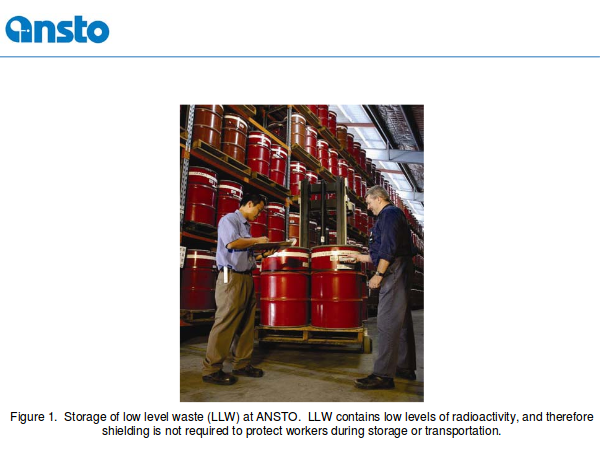
Over half the volume of Australia’s current low level and short-lived intermediate level waste is some ten thousand drums of lightly contaminated soil – a legacy of CSIRO research into processing radioactive ores during the 1950s and 1960s. …….
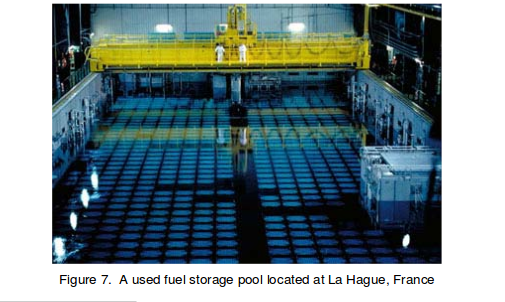
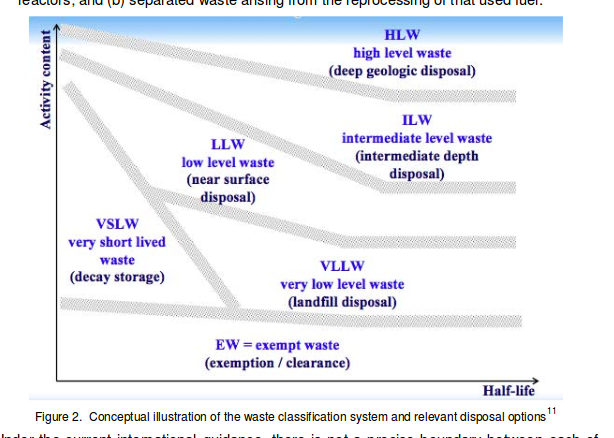
…….Under the current international guidance, there is not a precise boundary between each of the waste categories, as limits on the acceptable level of activity concentration will differ between individual radionuclides or groups of radionuclides. Waste acceptance criteria for a particular near surface disposal facility will be dependent on the actual design of and planning for the facility………
…….Previously, a contact dose rate of 2 mSv/h was generally used to distinguish between LLW and ILW…….
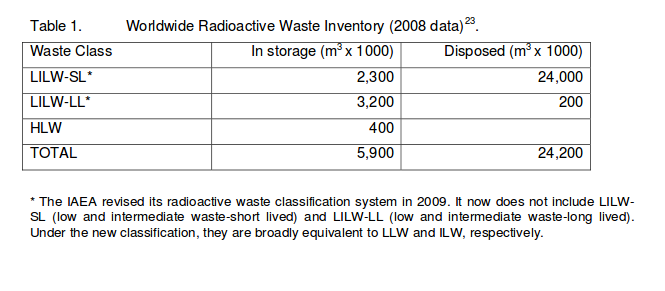
,,,,,,Waste is often stored indefinitely in facilities that were not designed for long term storage of such material. Such storage, while currently safe, is not ideal. In many cases, storage facilities were not designed for this use and are nearing capacity.,,,,,,
Radioactive waste is a subset of the much broader category of hazardous wastes.
Current global hazardous waste production is approximately 400 million tonnes per annum.
Radioactive waste from nuclear power plants and the fuel cycle support facilities comprises approximately 0.4 million tonnes per annum, or approximately 0.1% of global hazardous waste. Low level and short-lived intermediate level waste is already being disposed of in many countries. Over three quarters of all radioactive waste (on a volume basis) has already been sent for disposal.
Because of the wide variety of nuclear applications, the amounts, types and even physical forms of radioactive wastes vary considerably. They include solid, liquid and gaseous wastes. Some wastes (such as the small radioactive sources found in smoke detectors) carry little or no safety or security risk; however, some other wastes are highly radioactive and must be managed appropriately to address safety and security issues. Internationally, the major source of radioactive waste has been from the development and production of fissile materials for weapons manufacture, especially dating from the cold war period (often referred to as ‘legacy wastes’). The major sources of non-military waste internationally are fission products and contaminated and activated materials from nuclear power generation, including various process wastes arising from parts of the nuclear fuel cycle such as reprocessing, and the decommissioning of nuclear facilities.
ANSTO conducts extensive research in the area of radioactive waste and has developed wasteforms to treat radioactive wastes using a technology called HIP (hot-isostatic pressing) under the ANSTO Synroc brand. The waste is combined with a ceramic material and using the high pressure and temperature of the HIP, it is compressed and sealed into a ceramic wasteform. This process is designed to safely encapsulate the waste for tens of thousands of years. The product is then stored inside shielded containers. …..
Australia has accumulated approximately 4,000 cubic metres (m3) – less than the volume of two Olympic swimming pools – of low level and short-lived intermediate level radioactive waste from over fifty years of research, medical and industrial uses of radioactive materials.
Fukushima Rad News 4/6/13: Radioactive Water Seeping Into the Ground?; Strontium Detected In Spill
Published on 6 Apr 2013
TEPCO: Radioactive water may seeped into ground
Tokyo Electric Power Company says a small amount of radioactive water may have seeped out of an underground water storage facility at the Fukushima Daiichi nuclear power plant. The water contained strontium.
The utility spokesperson says that on Friday engineers detected a radioactive substance in the water between the layers of waterproof sheets covering the storage facility. The level of radioactivity is considered by the utility to be low.
RADIATION EFFECTS IN ORGANIC COMPOUNDS
http://nuclearpowertraining.tpub.com/…
http://nuclearpowerradiation.tpub.com…
TEPCO removing radioactive water
Tokyo Electric Power Company has begun transferring radioactive water from a leaking storage tank at its Fukushima Daiichi nuclear plant.
The company says radioactive strontium and other substances were detected on the ground around a storage tank from Wednesday to Friday.
Abe promises to rebuild disaster-hit area
Prime Minister Shinzo Abe says his government will do all it can to help rebuild areas devastated by the earthquake and tsunami that hit northeastern Japan on March 11th, 2011.
Abe visited the stricken areas on Saturday. It was his 5th such visit since taking office in December.
New Fukushima facility shrinks nuclear sludge
The city of Fukushima now has Japan’s first facility capable of reducing the volume of the radioactive sludge from the 2011 nuclear disaster.
The facility was installed by the Environment Ministry in a municipal sewage treatment plant. A ceremony was held in the city on Saturday.
Removal of radioactive water continues
Tokyo Electric Power Company is working to transfer radioactive water from a leaking storage tank at its damaged Fukushima Daiichi nuclear plant.
Radioactive water stored in a large underground tank was found to be leaking between Wednesday and Friday.
The utility estimates that 120 tons have leaked so far.
This is the same amount that leaked from storage tank plumbing in March of last year. The leakage is likely to continue, making it the largest leak since the government announced that the reactors had been brought to a state of cold shutdown in December of 2011.
Workers using 4 pumps started to transfer the water to an adjacent tank on Saturday morning.
To shorten the time for the operation, they later began to transfer the water to another tank south of the one that is leaking. Five pumps are being used to transfer 200 tons per hour. TEPCO says it will take more than 3 days to complete the work.
TEPCO estimates that 710 billion becquerels of radioactive strontium, or about 3 times more than the annual allowable limit at the complex, has leaked.
The utility says the contaminated water has not flowed into the ocean, but the leakage is expected to continue until the transfer is completed.
TEPCO is planning to monitor the state of leakage and its impact on the environment by measuring levels of radioactive materials in the soil around the tank.
Apr. 6, 2013 – Updated 17:38 UTC
100 tones of contaminated water may have already leaked to the ground
Photos
http://fukushima-diary.com/2013/04/10…
http://fukushima-diary.com/2013/04/le…
http://fukushima-diary.com/2013/04/71…
http://www.cbs8.com/story/21840275/se…
Fukushima: Massive Leaks Continuing On a Daily Basis … For Years On End
You may have heard that Tepco — the operator of the stricken Fukushima nuclear power plants — announced a large leak of radioactive water.
You may have heard that the cooling system in the spent fuel pools at Fukushima has failed for a second time in a month.
This is newsworthy stuff … but completely misses the big picture.
Japanese experts say that Fukushima is currently releasing up to 93 billion becquerels of radioactive cesium into the ocean each day.
http://peakoil.com/enviroment/fukushi…
RADIATION EFFECTS IN ORGANIC COMPOUNDS
http://nuclearpowertraining.tpub.com/…
Hanford Waste Plan Under Debate In New Mexico
http://www.opb.org/news/article/npr-h…
VIDEO: Plymouth selectman asks NRC to organize meeting of 104 nuke towns
Read more: VIDEO: Plymouth selectman asks NRC to organize meeting of 104 nuke towns – News – Plymouth, MA – Wicked Local Plymouth http://www.wickedlocal.com/plymouth/n…
“Radiation epidemic” killing So. California sea lions? Gov’t experts now checking animals for contamination from Fukushima Daiichi
Published: April 6th, 2013 at 10:21 am ET
By ENENews

Image source ; http://fox5sandiego.com/2013/04/01/sea-lion-pups-washing-up-on-socal-beaches-at-alarming-rate/#axzz2PmiHzCp7
(Subscription Only) Title: NOAA investigates: natural die-off, radiation?
Source: The Orange County Register
Author: ERIKA I. RITCHIE
Date: April 6, 2013 at 1:46a ET
NOAA investigates: natural die-off, radiation?
A team of experts assembled by the National Oceanic and Atmospheric Agency is looking into radiation from Japan’s nuclear disaster as one of several possible causes of the ongoing sea lion stranding along Southern California beaches. […]
Sea lions keep washing ashore, many in more critical condition than in the weeks before.
[…] All sea lions present similar symptoms, including dehydration and starvation. Some are also showing secondary infections. In Ventura County, mammal centers are finding a high amount of lice. […]
“The radiation epidemic could be a potential cause,” [Sarah Wilkin, NOAA’s California stranding coordinator] said. “We need to look at what’s different in 2013 as compared to 2012, 2011 and 2010. “We will work with lab tests that look at radionuclide signatures. Scientifically, we don’t think radiation is the cause but without testing and data we can’t say for sure. We need to rule it in or out.” […]
“Marine mammals are sentinels of the eco system,” Wilkin said. […]
Watch video from the Orange County register here
Update and clarification on Japanese deep sea waste dumps
Op-Ed by Arclight2011
7 March 2013
One of the overlooked subjects concerns the undersea waste dumps located approximately 200 Km off the Japanese coast. These dumps need monitoring for more than just cesium.
Recent evidence shows us the approximate position of these dumps and I have been collecting the data together to find out if these dumps were affected by the great earthquake of March 2011 that caused 3 meltdowns at Fukushima Daichi.
The first evidence to look at is from Ian Fairlies presentation from the Helen Caldicott Symposium in New York. Below is a diagram of the area most impacted by the initial Large earthquake.
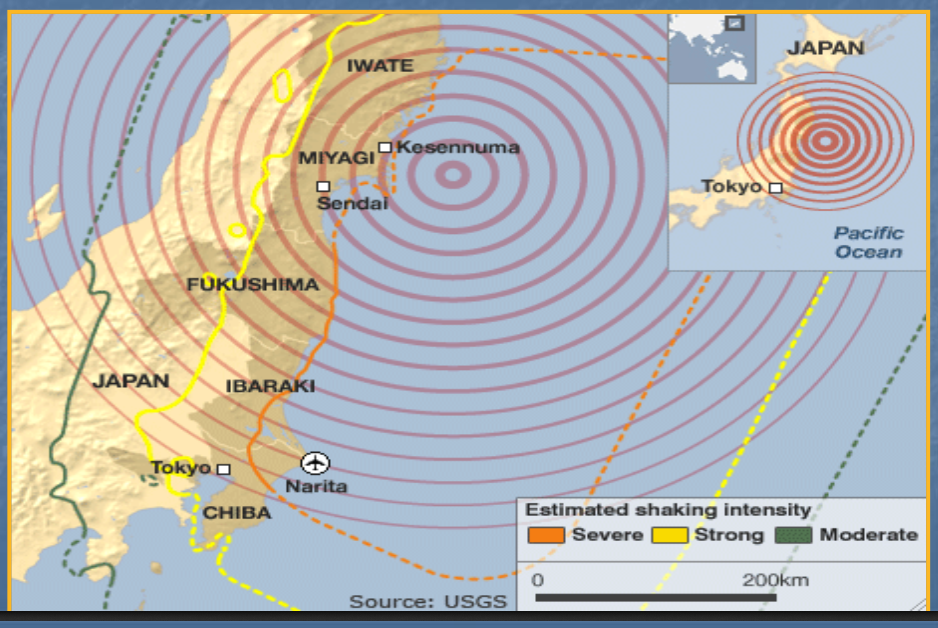
(It might be worth noting that the area of extreme shaking stops at the coast, leaving the nuclear power stations seemingly unaffected. I am only suspicious as Ian Fairlie also used data from Richard Wakeford (a Professor and ex BNFL sellafield) as evidence for the dose measurements. So, the dose measurements found on this PDF are likely an underestimate. There are many reasons to distrust Richard Wakeford to go into here. Please google his name for details in alternate news blogs, LLRC and Green Audit etc. Also, google his name with Chris Busby for interesting information.)
Next is the diagram of the dumps themselves. You will notice that area A3 and A2 seem to be possible targets from the heavy shaking area.

Next is the deposition of Cs 134 and 137 found by the recent released evidence from this report
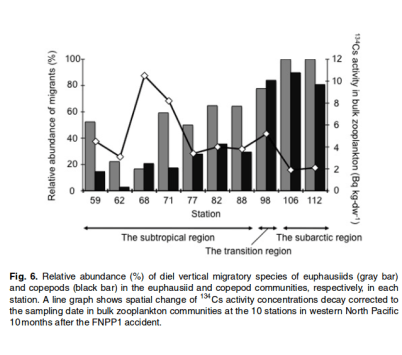
Horizontal distribution of Fukushima-derived radiocesium in
zooplankton in the northwestern Pacific Ocean
Received: 31 December 2012 – Accepted: 27 February 2013 – Published: 2 April 2013

The area near Waste Dump A2 has a proportionally higher levels of cesium 137 Graphic D on Figure 2
The currents took the radioactive effluent North East following the main current shown here;

There was this curious quote from a report.
“…Activity concentrations of radiocesium in zooplankton might be influenced not only environmental radiocesium activity concentration but also other factors that is still unknown….”
and this quote too!
“….……Regardless of how it got there, “there must be some loaded organic material somewhere in the sediment”, Kanda says…….”
And of course there was more than one earthquake and the other dumpsites A3 and A4 may also be effected.
Watch the visualisation video next to the above pictures to match hits on the dumps…..”
2011年の日本の地震 分布図 Japan earthquakes 2011 Visualization map
http://www.youtube.com/watch?v=eKp5cA2sM28
Links to resources
http://www.env.go.jp/en/wpaper/1992/eae210000000000.html#1_1_1_3
http://www.biogeosciences-discuss.net/10/6143/2013/bgd-10-6143-2013.pdf
http://www.totalwebcasting.com/tamdata/Documents/hcf/20130312-1/FairlieFukushimaNYCMarch12.pdf
http://www.nature.com/news/ocean-still-suffering-from-fukushima-fallout-1.11823
“….The oceans may have become ticking time bombs after years of U.S. military dumping have gone almost virtually unregulated, according to government documents. Legislation on the books for this fiscal year requires that the secretary of defense issue a yearly report naming the location and quantity of the dumped military munitions in U.S. waters. The National Defense Authorization Act for Fiscal Year 2007 also mandates sampling and water analysis be done around the disposal sites selected by the secretary. The size of the dump sites as well as the types and quantities of military munitions should also be identified. “The U.S. Army and DoD (Department of Defense) are working deliberately with other federal agencies to verify locations and dates of military sea disposal operations,”……”
“…..”The question always comes up that if there is no release of the munitions, is it worth the risk to pull it up and treat it,” said Siegel. “The answer isn’t clear. We don’t want to risk exposing people to ordnances unless there is a fairly present risk of danger.” The question of whether or not to pull up these sunken canisters continues to baffle and concern environmentalists, politicians, government officials and the general public. “With the initial breach of these canisters, the local impact on the biological communities will be quite high,” said McClain. “Do I think something should be done? Yes. Do I know what should be done about it? No.”…..”
http://abcnews.go.com/blogs/headlines/2007/07/underwater-tick/
And here is a map of undersea dump sites.. The Japanese sites are claimed to be unknown on this interactive map.
http://cns.miis.edu/stories/090806_cw_dumping.htm
……The team will publish all study results, Wilkens says. That’s particularly important because the issue of chemical weapons in the oceans has been kept largely under wraps in many countries, Brewer says. “The topic has pretty much been a black hole.”……. Brewer and Noriko Nakayama of the University of Tokyo wrote in a 2008 article in Environmental Science & Technology. Researchers routinely sample the water column in most of the known dumping areas, “often within a few meters of the seafloor” and “without regard for or knowledge of the disposed materials,” the duo wrote. ……. But no one knows exactly where the weapons are……
….. The records usually don’t contain coordinates. In some cases, historical information only specifies “Atlantic Ocean” or “Pacific Ocean,” according to a 2007 Congressional Research Service report……
http://www.earthmagazine.org/article/danger-deep-chemical-weapons-lie-our-coasts
“….Finally, the Russians were dumping unprocessed nuclear waste into The Sea of Japan. As late as October 1993, the Russians confirmed that one of their ships discharged 900 tons of radioactive water from scrapped nuclear submarines….”
1 This Month

of the week – Shut Down Drone Warfare!


Tell the Ukrainian Government to Drop Prosecution of Peace Activist Yurii Sheliazhenko

Petition to revoke the licensing of the Near Surface Nuclear Disposal Facility (NSDF) at Chalk River. https://www.ourcommons.ca/petitions/en/Petition/Details?Petition=e-7247
To see nuclear-related stories in greater depth and intensity – go to https://nuclearinformation.wordpress.com
-
Archives
- April 2026 (103)
- March 2026 (251)
- February 2026 (268)
- January 2026 (308)
- December 2025 (358)
- November 2025 (359)
- October 2025 (376)
- September 2025 (257)
- August 2025 (319)
- July 2025 (230)
- June 2025 (348)
- May 2025 (261)
-
Categories
- 1
- 1 NUCLEAR ISSUES
- business and costs
- climate change
- culture and arts
- ENERGY
- environment
- health
- history
- indigenous issues
- Legal
- marketing of nuclear
- media
- opposition to nuclear
- PERSONAL STORIES
- politics
- politics international
- Religion and ethics
- safety
- secrets,lies and civil liberties
- spinbuster
- technology
- Uranium
- wastes
- weapons and war
- Women
- 2 WORLD
- ACTION
- AFRICA
- Atrocities
- AUSTRALIA
- Christina's notes
- Christina's themes
- culture and arts
- Events
- Fuk 2022
- Fuk 2023
- Fukushima 2017
- Fukushima 2018
- fukushima 2019
- Fukushima 2020
- Fukushima 2021
- general
- global warming
- Humour (God we need it)
- Nuclear
- RARE EARTHS
- Reference
- resources – print
- Resources -audiovicual
- Weekly Newsletter
- World
- World Nuclear
- YouTube
-
RSS
Entries RSS
Comments RSS
 nuclear-news