Secret nuclear waste – Europe to Murmansk to Mayak
 After unloaded in Murmansk, the containers with nuclear fuel is sent by rail to Mayak, Russia’s reprocessing plant just north of Chelyabinsk in the South Urals.
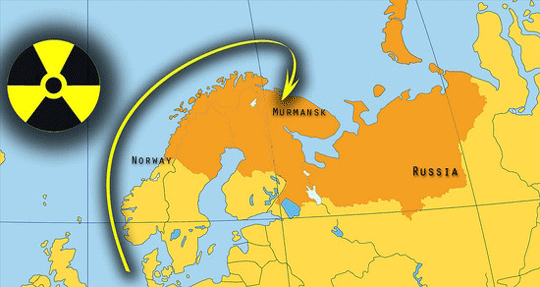
Norwegian Radiation Protection Authorities had no knowledge about the nuclear voyage before being asked by BarentsObserver to give a comment. Then, the vessel “Mikhail Dudin” had sailed along Norway’s long coastline for nearly five days and had already delivered its cargo in Murmansk.
“We have no information about any shipment of nuclear waste outside the coast of Norway last week,” NRPA Director Ole Harbitz said. In Murmansk, information about the nuclear waste arrival was first made public by the non-governmental organization Kola Ecological Center. The group is highly concerned about the radiation safety risk such cargo poses to the city’s 300,000 inhabitants. Maybe for good reasons; similar cargo is expected to arrive again. Continue reading
Internal radiation emitters – cesium and iodine – far more dangerous than external exposure
Risk from internal exposure is 200-600 times greater than risk from external exposure. See this, this, this and this.
cesium-137 and radioactive iodine – the two main radioactive substances being spewed by the leaking Japanese nuclear plants – are not naturally-occurring substances, and can become powerful internal emitters which can cause tremendous damage to the health of people who are unfortunate enough to breathe in even a particle of the substances, or ingest them in food or water.

Fake Science Alert: Fukushima Radiation Can’t Be Compared to Bananas or X-Rays http://www.zerohedge.com/contributed/2013-04-01/fake-science-alert-fukushima-radiation-can%E2%80%99t-be-compared-bananas-or-x-rays George Washington 04/01/2013
“….Mixing Apples (External) and Oranges (Internal) Moreover, radioactive particles which end up inside of our lungs or gastrointestinal track, as opposed to radiation which comes to us from outside of our skin are much more dangerous than general exposures to radiation.
The National Research Council’s Committee to Assess the Scientific Information for the Radiation Exposure Screening and Education Program explains:
Radioactivity generates radiation by emitting particles. Radioactive materials outside the the body are called external emitters, and radioactive materials located within the body are called internal emitters.
Internal emitters are much more dangerous than external emitters. Specifically, one is only exposed to radiation as long as he or she is near the external emitter.
For example, when you get an x-ray, an external emitter is turned on for an instant, and then switched back off.
But internal emitters steadily and continuously emit radiation for as long as the particle remains radioactive, or until the person dies – whichever occurs first. As such, they are much more dangerous. Continue reading
North Korea’s missile movement is not targeting USA
 Defense chief says North’s missile movement not aimed at U.S. mainland By Kim Eun-jung SEOUL, April 4 (Yonhap) — South Korean Defense Minister Kim Kwan-jin said Thursday that North Korea has moved an intermediate-range missile to its east coast for an imminent test firing or military drill, but it does not seem to be aimed at striking the U.S. mainland.
Without specifying the type of missile, Kim said it is believed to be able to reach a “considerable distance,” though it is not able to strike the U.S. mainland.
“The missile does not seem to be aimed at the U.S. mainland,” Kim told lawmakers. “It could be aimed at test firing or military drills.” Although there is slim chance that Pyongyang’s harsh rhetoric could lead to a full-scale war, Kim said the North could launch other forms of provocations, including border clashes and cyber attacks.
“Our military has upgraded several systems and carried out drills under upgraded military readiness status,” Kim said.
According to intelligence analysis by South Korean and U.S. forces, it is believed to be a Musudan missile, which is estimated to have a range of 3,000-4,000 km, putting the U.S. base in Guam within striking….. http://english.yonhapnews.co.kr/national/2013/04/04/96/0301000000AEN20130404009251315F.HTML
VIDEO: North Korea’s nuclear threat on USA
 North Korea ‘ratifies’ nuclear attack on US – video http://www.guardian.co.uk/world/video/2013/apr/04/north-korea-nuclear-us-videoNorth Korean state TV announces that Pyongyang has ‘ratified’ an attack against the United States – though South Korean defence minister Kim Kwan-jin says North Korean missile’s firing range does not extend to the US mainland. Meanwhile, joint US and South Korean military exercises continue. US defence secretary Chuck Hagel says on Wednesday that the North Korea threat is being taken seriously
How the BBC’s John Simpson obscures the truth on depleted uranium
 Depleted Uranium: The BBC’s John Simpson does a hatchet job on Fallujah’s genetically damaged children by William Bowles http://dandelionsalad.wordpress.com/2013/04/04/depleted-uranium-the-bbcs-john-simpson-does-a-hatchet-job-on-fallujahs-genetically-damaged-children-by-william-bowles/
 Under the title ‘Fallujah’s children’s ‘genetic damage’ that old war horse ‘literally’ of the BBC’s foreign propaganda service, John Simpson, manages not to mention the phrase ‘depleted uranium’ when allegedly reporting on the alarming rise in birth defects that include cancer, leukaemia and a horrific rise in child mortality since the US demolished the city of Fallujah in 2004. And it’s not until right at the end of the piece that the US attack on Fallujah is even mentioned, let alone depleted uranium! Continue reading
Tobacco industry hid radiation cancer causer in cigarettes
Nuclear insiders and Big Tobacco No.1 Paul Langley’s Nuclear History Blog http://www.uclahealth.org/body.cfm?id=561&action=detail&ref=1751 5 April 13 University of California Health System, Health and Medicine, Big Tobacco knew radioactive particles in cigarettes posed cancer risk but kept quiet Kim Irwin
Tobacco companies knew that cigarette smoke contained radioactive alpha particles for more than four decades and developed “deep and intimate” knowledge of these particles’ cancer-causing potential, but they deliberately kept their findings from the public, according to a new study by UCLA researchers.
The analysis of dozens of previously unexamined internal tobacco industry documents, made available in 1998 as the result of a legal settlement, reveals that the industry was aware of cigarette radioactivity some five years earlier than previously thought and that tobacco companies, concerned about the potential lung cancer risk, began in-depth investigations into the possible effects of radioactivity on smokers as early as the 1960s.
“The documents show that the industry was well aware of the presence of a radioactive substance in tobacco as early as 1959,” the authors write. “Furthermore, the industry was not only cognizant of the potential ‘cancerous growth’ in the lungs of regular smokers, but also did quantitative radiobiological calculations to estimate the long-term lung radiation absorption dose of ionizing alpha particles emitted from cigarette smoke.” Continue reading
Asbestos killed a town. Uranium towns next?
WA GOVERNMENT TO MOVE LAST RESIDENTS FROM ASBESTOS TOWN ABC Radio National 3 April 2013 By:Catherine Van Extel The West Australian Government is looking to move a group of residents who continue to live in the deadly asbestos mining town of Wittenoom, in the Pilbara region of Western Australia. But while there are moves to finally clean up the toxic site, many continue to face the legacy of their time spent growing up in or visiting the notorious town.
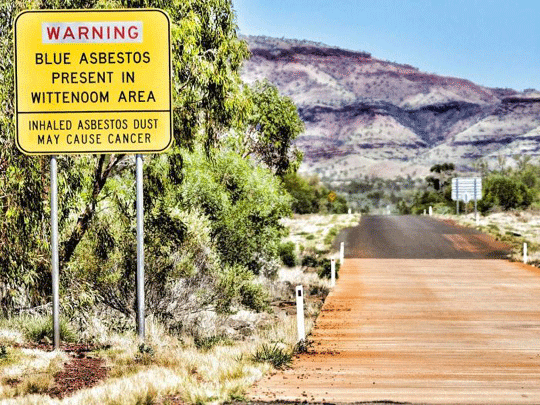
The 1990 Midnight Oil song ‘Blue Sky Mine’ was inspired by Wittenoom and its deadly mining industry. It’s estimated that more than 20,000 people lived at Wittenoom before the mine closed in 1966.
Asbestos-related diseases have killed more than 2000 former workers and family members of Wittenoom, a death toll that continues to rise.
In 2007, the state government withdrew Wittenoom’s town status—disconnecting services like water and electricity—but a small group of residents stayed. Now the government wants them out in order to remediate the contaminated site. Continue reading
Now three Canadian provinces halt uranium mining
Quebec becomes third province to impose uranium moratorium Mining.com Vladimir Basov | April 4, 2013 Quebec became the third Canadian province, after Nova Scotia and British Columbia, to establish a moratorium on uranium development.Environment minister Yves-Francois Blanchet announced last Thursday no permits for exploration or mining will be issued until an independent study on the environmental impact and social acceptance of extracting uranium has been completed…..
Medicine struggles to deal with nuclear radiation -caused illness
 Top Docs’ (Partial) Cure for Nuclear Radiation: Bone-Marrow Drugs http://www.wired.com/dangerroom/2013/04/health-department-nuclear/ BY ROBERT BECKHUSEN 04.04.13
Even if a nuclear bomb exploded far enough away for you to survive the blast, the radiation could still kill you. Now the U.S. government wants to find a cure for one the most vexing causes of radioactive death — starting with your bones.
According to a research solicitation released this week by the Department of Health and Human Services, the department is preparing to spend up to $8 million beginning in 2014 to research ways to treat severe thrombocytopenia — or the loss of cell platelets — caused by excessive radiation poisoning of vital blood-producing organs and tissues like bone marrow and the spleen. Once your organs get blasted with radiation from a catastrophic nuclear detonation, you will likely begin to suffer from internal bleeding and get really sick. Then you’ll die. Continue reading
Radiation releases from fracking for natural gas
among the substances to be tested for are Radium-226, Radium-228, Uranium-238, Uranium-235, Uranium-234, Thorium-232, Radon-220 and Radon-222.
a December 2011 U.S. Geological Survey report that found that millions of barrels of wastewater from unconventional wells in Pennsylvania and conventional wells in New York were 3,609 times more radioactive than the federal limit for drinking water and 300 times more radioactive than a Nuclear Regulatory Commission limit for nuclear plant discharges.
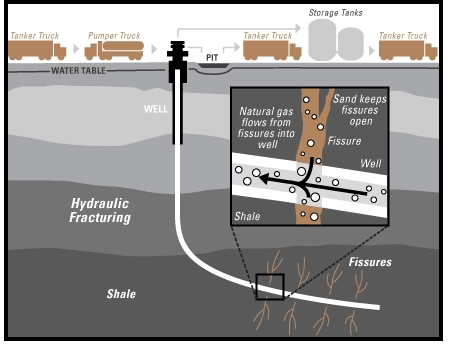
DEP begins fracking radiation tests Times Online, By Rachel Morgan Shalereporter.com 4 April 13 HARRISBURG — The Pennsylvania Department of Environmental Protection this month will begin testing for radioactivity in waste products from natural gas well drilling.
In addition to analyzing wastewater from hydraulic fracturing, known as fracking, the study also will analyze radioactivity in drill cuttings, drilling mud, drilling equipment, treatment solids and sediments at well pads, wastewater treatment and disposal facilities and landfill leachate, among others. The study also will test radiation levels for the equipment involved in the transportation, storage and disposal of drilling wastes. Continue reading
USA Republicans waking up to climate change and renewable energy
 Ending the Debate: Most Republicans Actually Support
  Increased Renewable Energy Use http://www.triplepundit.com/2013/04/breaking-debate-republicans-actually-support-increased-renewable-energy/ By Mike Hower | April 4th, 2013 Apparently, the debate over global warming is not as big as the hard-liners at Fox News and on Capitol Hill would lead us to believe. A recent study released by Yale and George Mason University found that nearly 80 percent of Republicans and Republican-leaning Independents support increasing renewable energy use and more than 60 percent believe the United States should take action to address climate change.
Interestingly, the report also found that only a third of Republican respondents agree with the GOP’s position on climate change, which has changed dramatically since 2008. Continue reading
Cut back UK Trident nuclear programme – says defence expert
UK should consider scaling back nuclear deterrent, says think tank – VIDEO http://www.telegraph.co.uk/news/uknews/defence/9970194/UK-should-consider-scaling-back-nuclear-deterrent-says-think-tank.html
The cost and commitment of replacing Trident with a like-for-like system means the Government should consider what the “most necessary element” of our deterrent is, says Hugh Chalmers from the Royal United Services Institute. The Government ought to consider the range of possible options for the UK’s nuclear deterrent given the country’s financial situation and the committment that renewing the Trident weapons system represents, says a nuclear analyst at the Royal United Services Institute.
“I would recommed that you have to look at all the options available and think very carefully about what is the most necessary element of our deterrent, and which elements of the UK deterrent are no longer required, so we can make cuts where we can, and how we can,” says Hugh Chalmers.
Mr Chalmers also played down the threat posed by North Korea, which has conducted three nuclear tests since 2006 as well as launching a long range rocket in December 2012.
“North Korea doesn’t currently present a direct threat to the UK.
“There’s a suspicion that they might be able to reach the US but they certainly cannot reach the UK, and their ability to mount a nuclear weapon on these missiles is also hotly debated,” he said.
Crescent Dunes Solar Energy Plant solves problem of “intermittent power”
Crescent Dunes Molten Salt Solar Receiver Completed http://www.energymatters.com.au/index.php?main_page=news_article&article_id=3673 5 April 13, SolarReserve has announced one of its flagship projects is reaching final stages of completion in the Nevada desert, with the installation of molten salt receiver panels on the peak of the 540-foot tall tower of the Crescent Dunes Solar Energy Plant. By utilising molten salt storage technology, the Crescent Dunes solar plant, located near Tonopah, Nevada, can operate like a conventional power plant, providing “on demand” and emissions-free electricity for up to 10 hours in adverse conditions.
“The energy storage capability of this technology solves the problem of intermittency typical of other renewable energy sources,” said Kevin Smith, CEO of SolarReserve. Continue reading
MOX nuclear plant – unaffordable?
Budget cuts for MOX plant feared, Augusta Chronicle By Rob Pavey, 4 April 13, The consortium building the mixed oxide fuel plant at Savannah River Site is bracing for possible budget cuts that could stall a project already facing criticism for cost overruns and delays. “It’s reasonable to say there would be a big impact,” said Kelly Trice, the president of Shaw AREVA MOX Services. He said Thursday that it is possible the fiscal 2014 federal budget could include cuts for the program…..
1 This Month

Petition to revoke the licensing of the Near Surface Nuclear Disposal Facility (NSDF) at Chalk River. https://www.ourcommons.ca/petitions/en/Petition/Details?Petition=e-7247


of the week – STOP SMALL MODULAR REACTORS IN CANADA
To see nuclear-related stories in greater depth and intensity – go to https://nuclearinformation.wordpress.com
-
Archives
- March 2026 (153)
- February 2026 (268)
- January 2026 (308)
- December 2025 (358)
- November 2025 (359)
- October 2025 (376)
- September 2025 (258)
- August 2025 (319)
- July 2025 (230)
- June 2025 (348)
- May 2025 (261)
- April 2025 (305)
-
Categories
- 1
- 1 NUCLEAR ISSUES
- business and costs
- climate change
- culture and arts
- ENERGY
- environment
- health
- history
- indigenous issues
- Legal
- marketing of nuclear
- media
- opposition to nuclear
- PERSONAL STORIES
- politics
- politics international
- Religion and ethics
- safety
- secrets,lies and civil liberties
- spinbuster
- technology
- Uranium
- wastes
- weapons and war
- Women
- 2 WORLD
- ACTION
- AFRICA
- Atrocities
- AUSTRALIA
- Christina's notes
- Christina's themes
- culture and arts
- Events
- Fuk 2022
- Fuk 2023
- Fukushima 2017
- Fukushima 2018
- fukushima 2019
- Fukushima 2020
- Fukushima 2021
- general
- global warming
- Humour (God we need it)
- Nuclear
- RARE EARTHS
- Reference
- resources – print
- Resources -audiovicual
- Weekly Newsletter
- World
- World Nuclear
- YouTube
-
RSS
Entries RSS
Comments RSS
 nuclear-news