Study: Nuclear Plant Shutdown Results in 4,319 Fewer Cancer Cases
“….Previous studies on the rates of cancer near eight closed nuclear reactors showed a 25 percent decrease in childhood cancers, while the national rate rose 0.5 percent 10 years after the plants closed. …….”
ABOUT THE AUTHORSJoseph Mangano MPH MBA is an epidemiologist, and Executive Director of the Radiation and Public Health Project. He is the author or co-author of 30 peer-reviewed medicaljournal articles and letters, and author of the booksLow Level Radiation and Immune System Disease: An Atomic Era Legacy(1998);Radioactive Baby Teeth: The Cancer Link(2008); and Mad Science: The Nuclear Power Experiment(2012). Janette Sherman MD is an internist and toxicologist, and adjunct professor at Western Michigan University. She is the author/co-author of many scientific publication s, and is author of the booksChemical Exposure and Disease: Diagnostic and Investigative Techniques(1994) andLife’s Delicate Balance: Causes and Prevention of Breast Cancer(2008).COMPETING INTERESTSThe authors declare that they have no conflict of interest in connection with this publica-tion.
Report source ; http://www.bmijournal.org/index.php/bmi/article/viewFile/115/82
Yahoo posted article…
By Brian Krans
Thu, Mar 28, 2013
Closing a nuclear reactor in California has prevented an estimated 4,319 cases of cancer in the past 20 years, according to a new study released Thursday. Researchers studied the population of the state capitol of Sacramento, an area with more than 1.4 million people living within 25 miles of the Rancho Seco nuclear power plant.
Using 20 years worth of data, researchers found an overall drop in the incidence of all cancers, including six of the 16 most common types. The sharpest drop came within a decade of the plant’s closing in 1989.
“These findings suggest that the closing of Rancho Seco reduced the risk to health for local residents, and provides a basis for conducting analyses on potential long-term health changes,” the study, published in the journal Biomedicine International, states.
Researchers say more work is needed to determine if there’s a cause-and-effect relationship between the reduced incidence of cancer and the closing of the power plant, but they say the data show a statistically significant relationship in several areas.
Women, Children, and Hispanics Affected Most
The most statistically significant reductions were in breast and thyroid cancers in women, two cancers that appeared more frequently in survivors of the nuclear bombs attacks on Hiroshima and Nagasaki during WWII.
Hiroshima updates number of atomic bomb victims for the final time.
The study will most likely be the last one because 68 years have passed since the bombing and it is unlikely that any new documents will be discovered, an official suggested.
Press Trust of India | Tokyo March 28, 2013 Last Updated at 16:35 IST

Image source : http://www.chillinpanda.com/hiroshima-the-nuclear-aftermath/
The number of victims of the 1945 atomic bombing of the Japanese city of Hiroshima has climbed up a notch to 557,478 – 15,000 more than the previously recorded figure, according to a new report.
The total number of the explosion-affected people or “hibakusha” from the Second World War atomic bombing by the US is more than 15,000 people recorded in the previous file, according to research conducted by the city government.
Based on a fresh review of 120,000 documents which was undertaken by computer for the first time, the number of atomic bomb victims has grown by around 15,000 compared with the previous tally 14 years ago, the data showed, Kyodo News agency reported.
Of the latest figure, 384,743 hibakusha were confirmed to have been in the city or nearby towns and villages when the Atomic bomb was dropped in 1945, up by around 12,000 from the previous survey.
The remainder includes people who later entered areas near ground zero and those who lacked sufficient information about their whereabouts.
After eliminating duplications, the death toll from the bombing was lowered to 277,996, from the previously reported 280,959, the report said.
The study will most likely be the last one because 68 years have passed since the bombing and it is unlikely that any new documents will be discovered, an official suggested.
The Hiroshima Study Group on Re-construction of Local Fallout from A-bomb in 1945 Book 2 launched, with recent research results and data !
2013-03-22

HiSoF Book 2 launched, with resent research results and data
Documents Source : http://city.youth-service.com/
Image source ; http://www.chillinpanda.com/hiroshima-the-nuclear-aftermath/
Hiroshima City and HiSoF launched the second volume of “Revisit The Hiroshima A-bomb with a Database -Latest Scientific View on Local Fallout and Black Rain-” on March 22, in Hiroshima (see Publications page).
This book contains recently found data and research results by HiSoF members and its collaborators (see Database page), including:
– the wind data based on the navigation record of the aircraft of bomber and two weather stations data in Japan between July and August 1945;
– results of neutron activation analysis of the soils used under roof tiles in traditional Japanese houses, and ground soil samples in Hiroshima city;
– particle size distribution of the soils used for walls and under roof tiles in traditional Japanese houses and ground soil samples;
– a study that suggests the region west to the hypocenter has a higher risk compared to other areas that cannot be explained by direct exposure only;
– measurements of Cesium-137 and Pu isotopes in under-floor soil samples from houses built 1–4 years after 1945 in Hiroshima;
– a paper which asks a question of whether observed Hiroshima TLD excess dose could be the result of a pattern of local fallout of Hiroshima A-bomb.
Books are available from Hiroshima City
HiSoF Book 1 and Book 2 as well as abridged editions in Japanese are available on request. Those wishing to obtain HiSoF publications, please contact Hiroshima City (see Contact).
http://city.youth-service.com/0400news.html
Links to new Pdfs (recommend) and visit the site to if these interest you!
Revisit The Hiroshima A-bomb with a Database Volume2New!
| Subject | Author(s) | Abstract | Full report | |
| 1.1 | Aerological data in August 1945 at Hiroshima, Japan | Michio Aoyama, Masaru Chiba, Manami Suzuki |
 |
|
| 1.2 | Neutron activation analysis for soils of Hiroshima City and plaster under roof-tiles of Old Hiroshima House | Satoru Endo, Yuta Taguchi, Tetsuji Imanaka, Satoshi Fukutani, Evgeniya Granovskaya, Masaharu Hoshi, Kotaro Shiraishi, Tsuyoshi Kajimoto, Kiyoshi Shizuma |
 |
|
| 1.3 | Soil particle size measurements for the calculation of the spread of dusts blown up by the explosion of the Hiroshima atomic bomb – For radiation dose estimation from neutron activated dusts of soils used in traditional Japanese houses and those of the ground surface – | Aya Sakaguchi, Masaharu Hoshi, Michio Aoyama, Hiroaki Kato, Yuichi Onda |
|
|
Revisit The Hiroshima A-bomb with a Database -Latest Scientific View on Local Fallout and Black Rain-
| Subject | Author(s) | Abstract | Tables/Figures | Full report | |
| 1.1 | Initial process of atomic bomb cloud formation and radioactivity distribution | Tetsuji Imanaka |
|
|
|
| 1.2 | Mapping the Fire Field near the Hypocenter of the Hiroshima A-bomb | Noriyuki Kawano, Megu Ohtaki, Takao Okada |
|
|
|
| 1.3 | Digital mapping of Hiroshima just before and after the atomic Bombing | Toshio Koizumi |
|
*
|
*
|
| 1.4 | Resources of heat, water and carbon fluxs for an induced urban fire in 1945 Hiroshima based on field research of Japanese traditional houses | Yoshihiro Okada and Michio Aoyama |
|
|
|
| 1.5 | Estimation of resource of heat flux based on the structure of Japanese traditional houses at the induced fire by Hiroshima A-bomb | Michio Aoyama, Noriyuki Kawano, Toshio Koizumi, Takao Okada, Yoshihiro Okada, Megu Ohtaki, Takahiro Tanikawa |
|
|
|
| 1.6 | Height Estimation of Hiroshima A-bomb Mushroom Cloud from Photos | Masashi Baba, Fumio Ogawa, Shinsaku Hiura, Naoki Asada |
|
|
|
£31 million injection for new nuclear technology in the UK

26 Mar 2013
The nuclear industry received a boost today as Business Secretary Vince Cable announced major new funding awards that will enhance the supply chain and increase opportunities to commercialise new technologies in the sector.
The funding will support 36 projects across the UK in developing new technologies for the construction, operation and decommissioning of nuclear power plants. This will bring together over 60 experienced organisations including Laing O’Rourke, Sheffield Forgemasters and EDF. They will work alongside innovative small and medium sized enterprises (SMEs) and universities.
The £18 million joint funding between the Technology Strategy Board, the Department of Energy and Climate Change (DECC), the Nuclear Decommissioning Authority (NDA) and the Engineering and Physical Sciences Research Council (EPSRC) is expected to leverage in an additional £13 million making the total value of the projects £31 million.
Business Secretary Vince Cable said:
“There are huge global opportunities that the UK is well placed to take advantage of in the nuclear industry. Our strong research base will help develop exciting new technologies that can be commercialised here and then exported across the globe.
Wind Energy races ahead, as nuclear production falls in USA
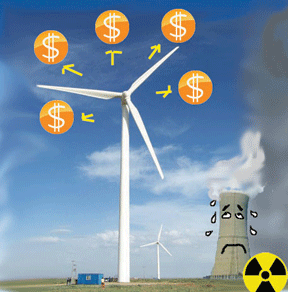 BAD NEWS FOR HOMER SIMPSON HTTP://QZ.COM/68344/US-RENEWABLE-ENERGY-PRODUCTION-NOW-TOPS-NUCLEAR-POWER/ US renewable energy production now tops nuclear power By Todd Woody — March 28, 2013
US president Barack Obama has pursued an energy policy he describes as “all of the above,” a bit of Bill Clinton-style triangulation that seeks to boost production from carbon-intensive oil and gas drilling while promoting clean technologies like solar and wind.
So how’s he doing?
New data released yesterday from the US Energy Information Administration offers a snapshot of the energy landscape in Obama’s first term. Energy production from natural gas grew 16% while coal-fired power fell more than 4%, thanks to a glut of cheap natural gas from the fracking boom. It’s a trend likely to continue as shale gas reserves are tapped and new emissions regulations effectively bar the construction of new coal-fired power plants.
Renewable energy production jumped nearly 24% but remains only 11% of the US’ total energy production. But the trend lines tell the story: Wind energy, for instance, grew 89% while electricity production from nuclear power plants fell 4%.
And this factoid should warm the hearts of anti-nuke activists: The US now gets more energy from renewable sources—wind, solar, hydro, geothermal, and biomass—than it does from nuclear power plants.
While there are new nuclear projects winding their way through the regulatory process, don’t expect a nuke boom. Multibillion-dollar price tags, waste disposal issues and growing water shortages are likely to limit nuclear power’s contribution to the nation’s energy mix in the coming decades.
Mr. Burns just might want to start looking for another job, perhaps as a wind farm magnate.
Up to 1,000 North Wales nuclear workers retraining for alternative industries
….“When considering my future career I needed to think about location and lifestyle. Working in a fast-paced London-based job would not have met my lifestyle results for example.”
Judy says the academic level of the workers in Trawsfynydd and Wylfa would shock most people.
“It’s very unusual for a project to be working with people from the top end of the academic scale,” she said….
….She is worried the are could be “crippled” economically if this does not happen, as a report commissioned by Magnox found £42m would come out of the local economy as a result of 1,200 people at Trawsfynydd and Wylfa not living and working in the area…….
…She admitted “funding is starting to fade” and was unsure whether the project would apply for a second round after 2015…
- by Martin Williams, DPW West
- Mar 27 2013
UP TO 1,000 nuclear energy staff in north west Wales are being retrained and re-educated to work in other industries.
Menter Môn’s £4million Shaping the Future initiative is attempting to get every member of the Trawsfynydd and Wylfa workforces into other jobs in a bid to retain £42m for the region’s economy.
Hitachi’s acquisition of Horizon last year gave the Wylfa B development a shot in the arm and firmed-up its future.
But project director Judy Craske says staff still need to be reeducated and re-skilled so they could be put to use in other industries, such as the automotive, tourism, manufacturing and aerospace sectors.
She says a talent drain would have a knock-on effect for the counties and has been busy enrolling employees at both sites.
At the last count in the new year, 833 of the 1,200 people she targeted have signed up for Shaping the Future – 527 at Wylfa and 306 at Trawsfynydd.
Speaking to Business Post, the former Magnox transition manager revealed last June how she garnered millions of pounds of European Social Fund cash through the Welsh Government, the Nuclear Decommissioning Authority and Gwynedd and Anglesey councils to try and save them from the scrapheap.
“Since last summer the project has been off and now back on again, which has caused uncertainty,” she said.
“There is no panic but there is a wind of change and it is vital they take this on board. They’re going to get an idea in the coming months what the future will look like.
“Most can’t believe the day will come when there is not a job for them. They have to take this opportunity while there’s money in the bank. You never know, Wylfa might break, can keep going as long as it can but eventually there will be no more fuel to burn.”
Judy says, even dismissing the worst-case scenario, the staff should capitalise on Shaping the Future – notably the experience of ambassadors including Centrica nuclear director Greg Evans, and Aerospace Wales chief executive John Whalley – and add more skills to their CV so other positions open up to them. She is worried the are could be “crippled” economically if this does not happen, as a report commissioned by Magnox found £42m would come out of the local economy as a result of 1,200 people at Trawsfynydd and Wylfa not living and working in the area.
Among those to have already benefited is Magnox communications employee Ian Edwards, who secured funding to start an MsC in public relations at the University of Glamorgan.
“I immediately saw the benefits of Shaping the Future in helping me and my colleagues to improve our skills and qualifications for the future,” said Ian.
How wildlife can, and does, damage nuclear reactors
 Wildlife vs U.S. nuclear plants: Flies short-out transformer — Pelican starts emergency generator — Snake causes fire — Bird shuts down reactor… more http://enenews.com/wildlife-incidents-at-u-s-nuclear-plants-flies-short-out-power-transformer-pelican-starts-emergency-generator-snake-causes-fire-fish-block-water-intake-more
March 27th, 2013
Title: Fission Stories #133: Mayflies, and Squirrels, and Rats
 Source: All Things Nuclear (Union of Concerned Scientists)
Author: Dave Lochbaum, director, Nuclear Safety Project
Date: March 26, 2013
[…] one wonders about the havoc that an individual saboteur or a team of bad guys might be able to cause by malicious intent. Could well-trained and heavily armed attackers cause more devastation than a furry little squirrel or a pesky rat? […]
Selected incidents at U.S. nuclear plants:
Pelican started an emergency diesel generator
Bird caused […] shut down […] after it landed in the switchyard containing electrical cables connecting the plant to its offsite electrical power grid
Snake slithering onto an overhead power cable […] caused a short that caught the wooden pole holding the cable on fire
“A large number of small forage fish” blocked the screens at the intake structure
Squirrel caused an electrical short in the main power transformer.
Bunch of jellyfish blocked the screens at the intake station
Mayflies caused a power transformer to short out
Full report here
See also: Tepco: Animal caused extended power outage at Fukushima Daiichi — Nearly a foot long (PHOTO)
VIDEO: Arnie Gundersen at New York Symposium about Fukushima
 Symposium Q&A: Explosion at Fukushima Unit 3 drove nuclear fuel out of storage pool — Scattered up to 2 miles away (VIDEO) http://enenews.com/symposium-qa-explosion-unit-3-drove-nuclear-fuel-pool-scattered-particles-miles-away-video
Author: The Helen Caldicott Foundation
Date Presented: March 11, 2013
Questions & Answers
Arnie Gundersen, Fairewinds Energy Education: Unit 3 started as a hydrogen explosion – I am in the minority, but I think it’s more than a hydrogen explosion.
I actually think it was something called a prompt moderated criticality that was caused by a hydrogen explosion, which then drove the fuel and scattered particles of fuel for as far as two miles from the fuel pool. […]
The important thing though is that it was a detonation. How it was created is less important than the fact that it was a detonation shockwave and no containment can withstand that.
See also: NRC: There’s got to be fission products or pellets in parking lot outside Fukushima plant
Tokyo has the storage capacity for a solar powered city
 A Solar Powered Tokyo? http://www.energymatters.com.au/index.php?main_page=news_article&article_id=3661 28 March 13 Much of Tokyo’s power needs once supplied by nuclear power could be met by rooftop solar along with energy storage systems already in place.
 Nuclear is still a dirty word to many in Japan following the Fukushima crisis, a disaster that will continue to negatively affect a large area for many years to come.
While solar power offers an attractive alternative; the issue remains of continual supply – particularly at night and during heavily overcast days.
A recent study examining the potential for rooftop photovoltaics in Tokyo to replace nuclear capacity reveals some of the answer is already in place – pumped hydroelectric storage. Continue reading
Good Friday protest march to Livermore nuclear weapons labs
Activists begin 30-mile march to end nuclear war San Ramon Express 27 March 13 Annual Good Friday protest to be held at Livermore labs
by Jessica Lipsky About a dozen anti-nuclear weapons activists began a 30-mile march to Livermore Wednesday morning against nuclear weapons and war. A group of protestors left the Mt. Diablo Peace and Justice Center with banners and signs on March 27 and walked 12 miles to Peace Lutheran Church in Danville. The group wants to bring attention to the upgrading of nuclear weapons and encourage conversion of the labs to a more peaceful use.
“We are very much against nuclear weaponry and the upgrading of it, it’s a waste of taxpayer money and we believe we should stop using them,” said the center’s Margli Auclair. “They should use that money for more pressing scientific needs, climate change, solar energy, renewable things that would solve problems rather than contribute.”
Marchers will spend the night at Peace Lutheran and walk 17 miles to the Quality Inn in Livermore using city streets to increase awareness. The group will walk to the entrance of the Livermore Nuclear Weapons Lab at 6:45 a.m. on the morning of Good Friday for an annual mass and rally. …
The event is sponsored bythe Ecumenical Peace Institute, and will consist of a procession to the lab gates, stations of the cross and nonviolent acts of witness. Hanson expects between 75 and 100 attendees at this year’s event. About 25 to 30 will get arrested, he estimated. http://www.sanramonexpress.com/news/show_story.php?id=7187
US nuclear-capable B-2 bombers in exercises with South Korea
US nuclear-capable bombers complete training mission in South Korea The Guardian, 28 March 2013 US military announces B-2 stealth bomber drills amid threats of nuclear strikes from North Korea The US has taken the unprecedented step of publicly announcing that two of its nuclear-capable B-2 bombers have taken part in military exercises with South Korea, dropping dummy munitions on an island range, in what is taken to be a show of force following weeks of North Korean hostility.
The announcement on Thursday is likely to further enrage Pyongyang, which has already issued a flood of ominous statements to highlight its displeasure at the exercises and at UN sanctions over its nuclear test last month. Continue reading
Video: Noam Chomsky on nuclear war and climate change
Noam Chomsky: If Nuclear War Doesn’t Get Us, Climate Change Will
http://www.thenation.com/video/173205/noam-chomsky-if-nuclear-war-doesnt-get-us-climate-change-will#
On The Earth Productions and The Nation March 28, 2013 In the
twenty-first century, humanity will likely burn out in a nuclear
holocaust or fade away amid the gradually mounting effects of climate
change. That was Noam Chomsky’s prediction during a
question-and-answer session in 2009 that still resonates today.
By moving forward with a missile defense policy that upsets the
balance of nuclear deterrence with Russia, “we’re consciously
increasing the threat of nuclear war,” Chomsky said. As for the
effects of climate change, “nobody knows the exact details, but
everybody knows that the longer you wait, the worse it’s going to be.”
—Alec Luhn
Noam Chomsky further eviscerates American foreign policy with his
piece “Why It’s Legal When the US Does It.”
Moratorium on uranium development in Quebec
“It’s a little bit like asbestos — people have come to the conclusion that there are certain minerals that are so dangerous that they’re not worth mining, they’re better to leave underground,” Edwards said. “One is asbestos, and one is uranium
 Quebec imposes moratorium on uranium development, Montreal Gazette, By Kevin Dougherty and Monique Beaudin, March 28, 2013
QUEBEC — No permits for the exploration or mining of uranium in Quebec will  be issued until an independent study on the environmental impact and social acceptance of extracting uranium has been completed, Environment Minister Yves-François Blanchet announced Thursday. Continue reading
UK does not need nuclear power for climate change obligations
 Non-nuclear future
http://www.guardian.co.uk/environment/2013/mar/28/non-nuclear-future
The Guardian, Professor David Elliott Open University 28 March 2013
I was dismayed by the statement by Professor John Beddington, the
government’s chief scientific adviser, that a nuclear energy-free
future for the UK is not something the coalition is thinking seriously
about (Report, 26 March). You quote him as adding: “We really can’t
see a future for the UK energy sector, if we are to meet our climate
change obligations and have resilience in the power sector, without a
significant component of nuclear.”
 The Department of Energy and
Climate Change has provided an extensive online energy modelling
system and invited interested people and organisations to use it. The
British Pugwash Group spent a year doing just that and recently
published the results asa set of 2050 energy Pathways. It included one
I helped with, which showed clearly that it was possible to meet the
UK’s energy needs at reasonable cost with no nuclear power, while
reducing emissions below current 2050 targets. Evidently we were wasting our time.
No deal in site between EDF and UK government, on nuclear subsidy
EDF, U.K. Unlikely to Meet End-March Deadline on Nuclear Subsidy -Sources, Fox Business News, By Geraldine Amiel and Selina Williams March 28, 2013 Dow Jones Newswires French electricity company Electricite de France SA (EDF.FR) and the British government are unlikely to meet a deadline at the end of March to agree on subsidies that would allow the construction of new nuclear power plants in the U.K., people familiar with the matter said.
The people said in recent days that although discussions are still ongoing, they aren’t intensive and neither side appeared to be willing to make any compromises.
“There’s no deal in sight, discussions are ongoing and if EDF doesn’t get the price that it believes is the right price then they won’t do it, they have no choice,” Continue reading
1 This Month

18 March Webinar @ 1 PM EST: An Assessment of SMR Projects: The Case of Canada
register for the zoom:
https://us02web.zoom.us/webinar/register/WN_o8BIIOUvQ2ONJR1nta65DQ#/registration

of the week – STOP SMALL MODULAR REACTORS IN CANADA
To see nuclear-related stories in greater depth and intensity – go to https://nuclearinformation.wordpress.com
-
Archives
- February 2026 (256)
- January 2026 (308)
- December 2025 (358)
- November 2025 (359)
- October 2025 (376)
- September 2025 (258)
- August 2025 (319)
- July 2025 (230)
- June 2025 (348)
- May 2025 (261)
- April 2025 (305)
- March 2025 (319)
-
Categories
- 1
- 1 NUCLEAR ISSUES
- business and costs
- climate change
- culture and arts
- ENERGY
- environment
- health
- history
- indigenous issues
- Legal
- marketing of nuclear
- media
- opposition to nuclear
- PERSONAL STORIES
- politics
- politics international
- Religion and ethics
- safety
- secrets,lies and civil liberties
- spinbuster
- technology
- Uranium
- wastes
- weapons and war
- Women
- 2 WORLD
- ACTION
- AFRICA
- Atrocities
- AUSTRALIA
- Christina's notes
- Christina's themes
- culture and arts
- Events
- Fuk 2022
- Fuk 2023
- Fukushima 2017
- Fukushima 2018
- fukushima 2019
- Fukushima 2020
- Fukushima 2021
- general
- global warming
- Humour (God we need it)
- Nuclear
- RARE EARTHS
- Reference
- resources – print
- Resources -audiovicual
- Weekly Newsletter
- World
- World Nuclear
- YouTube
-
RSS
Entries RSS
Comments RSS
 nuclear-news