The nuclear subway of doom and other doom related articles
Sunday, 24 March 2013
RIA-Novosti Interactive Video: A Day in the Life of a Submarine Crew
https://02varvara.wordpress.com/tag/project-667bdrm-delfin/

The nuclear-powered strategic ballistic missile submarine K117 Bryansk (Project 667BDRM Delfin) is an important part of the Russian nuclear deterrent. Click here for a short video in English. By pushing the blue buttons on the player, you can watch a damage-control drill and an intercontinental ballistic missile launch.
22 March 2013
RIA-Novosti
The world’s biggest submarine
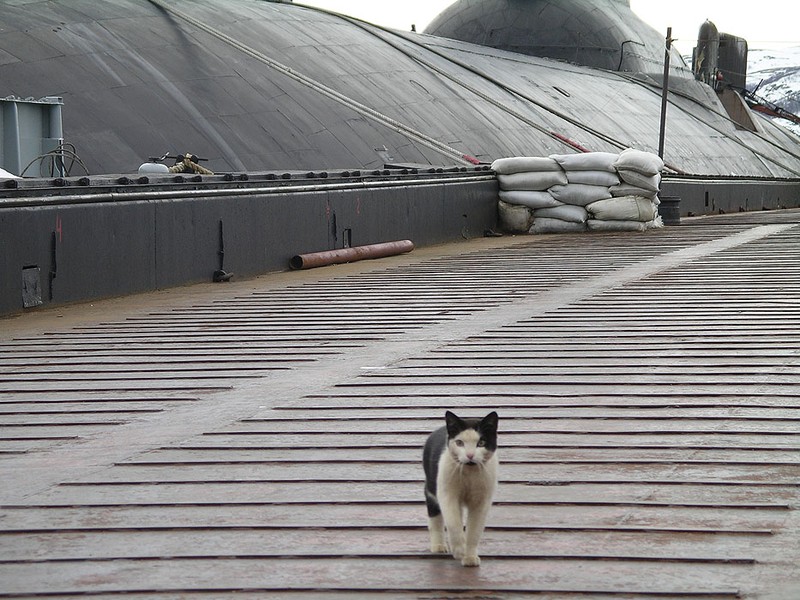
This is submarine “Typhoon” as it was called in NATO documents or “Shark” as it was called in Russia. It is considered to be the biggest submarine in the world, with over than 170 meters (515 feet) long and 23 meter (70 feet) wide. It can carry 20 ballistic nuclear missiles and there were only six of those built. Only 3 left intact, but are staying now out of service with armament control blocks detached according to the agreement between USSR and USA signed by M. Gorbachev. Without those they are way too peaceful.
See more pictures at – English/Russia
That’s No Train! Air Force Eyes Subway for Nuclear Missiles
- By Robert Beckhusen
- 03.14.13

The Air Force wants to upgrade its aging nuclear missiles and the hundreds of underground silos that hold them. One idea it’s exploring: the construction of a sprawling network of underground subway tunnels to shuttle the missiles around like a mobile doomsday train. As one does.
As first reported by Inside Defense, the Air Force Nuclear Weapons Center will award several study contracts next month worth up to $3 million each to research the idea. A broad agency announcement from the Air Force describes the hair-raising concept, intended to keep the weapons secure through 2075, as a system of tunnels where nuclear missiles are shuttled around on rails or some undefined “trackless” system.
The advantage of the world’s deadliest subway: During an atomic holocaust, mobile missiles are harder for an adversary to target than a static silo. Missiles could be positioned at launch holes placed at “regular intervals” along the length of the tunnels.
“The tunnel concept mode operates similar to a subway system but with only a single transporter/launcher and missile dedicated to a given tunnel,” stated the notice. “The tunnel is long enough to improve survivability but leaving enough room to permit adequate ‘rattle space’ in the event of an enemy attack.”
The Air Force hasn’t given specifics on where the tunnels could be built, or how long they’d need to be. But they’ll probably have to be jumbo-sized to “minimize impact from attack during all phases of missions/operations,” the notice stated. The Air Force requires that all research proposals address ways to “minimize likelihood” that unauthorized persons could sneak in, while keeping the system working safely and not sacrificing the doomsday train’s ability to “conduct world-wide operations.”
The project would likely be gigantic, expensive and take decades to build — all things that cut against cut against these relatively lean times at the Pentagon. But the U.S.’ silo-launched nuclear arsenal of 420 Minuteman III ballistic missiles are some of the oldest weapons still in service with the military, and they’re only getting older. (Not to mention the upkeep the military has to perform on the other two legs of the nuclear triad, submarine-launched Trident II missiles and the air-dropped B61 nuclear weapon.)
The Air Force has spent billions upgrading the Minuteman’s guidance systems, rocket motors and power systems to keep them serviceable through 2030. In a March 5 posture statement (.pdf) to the House Armed Services Committee, U.S. Strategic Command chief General Robert Kehler said the Minuteman IIIs are “sustainable through 2030 and potentially beyond with additional modernization investment.” But to sustain the missiles until 2075, the service has to come up with new ideas.
The subway of doom isn’t the Air Force’s only option for revamping its silos. Others include “super-hardened” silos, or ground-based “transporter erector launchers” — really large trucks that can haul nuclear missiles around the country, including on public roads and even off-road. The trucks have their downsides: who knows how well they can cross bridges; people would freak out if they encountered nuclear missiles on their morning commute; and they’re way more expensive than silos.
Last year, nuclear analyst and Danger Room pal Jeffrey Lewis estimated that building a fleet of 500 such mobile launchers would cost about $52 billion. “Apparently, building a 200,000 pound truck with rad-hard electronics and capable of withstanding nuclear blast effects is expensive,” he blogged. Lewis also noted that the mobile nuclear launchers were too expensive during the Cold War when, y’know, full-scale nuclear war was a big threat.
Hans Kristensen, a nuclear analyst at the Federation of American Scientists, thinks the Air Force is stuck with plain old static silos. “The nuclear subway ICBM is, I think, a pie in the sky and more included to have a review process entertain a range of options so it can land on the most sensible,” Kristensen tells Danger Room. “The costs associated with developing and operating such a system would be enormous and completely out of sync with the fiscal realities of this nation. Even a mobile system is probably unrealistic. I think the most likely, and probably only realistic option short of scrapping the land-based leg of the deterrent, is to simply extend the life of the existing Minuteman III ICBM.”
Then again, maybe the Air Force defies logic and builds the death tunnels that it says it wants. Tomorrow’s Armageddon could ride to work on rails.
No comments yet.
1 This Month

Petition to revoke the licensing of the Near Surface Nuclear Disposal Facility (NSDF) at Chalk River. https://www.ourcommons.ca/petitions/en/Petition/Details?Petition=e-7247

18 March Webinar @ 1 PM EST: An Assessment of SMR Projects: The Case of Canada
register for the zoom:
https://us02web.zoom.us/webinar/register/WN_o8BIIOUvQ2ONJR1nta65DQ#/registration


of the week – STOP SMALL MODULAR REACTORS IN CANADA
To see nuclear-related stories in greater depth and intensity – go to https://nuclearinformation.wordpress.com
-
Archives
- March 2026 (152)
- February 2026 (268)
- January 2026 (308)
- December 2025 (358)
- November 2025 (359)
- October 2025 (376)
- September 2025 (258)
- August 2025 (319)
- July 2025 (230)
- June 2025 (348)
- May 2025 (261)
- April 2025 (305)
-
Categories
- 1
- 1 NUCLEAR ISSUES
- business and costs
- climate change
- culture and arts
- ENERGY
- environment
- health
- history
- indigenous issues
- Legal
- marketing of nuclear
- media
- opposition to nuclear
- PERSONAL STORIES
- politics
- politics international
- Religion and ethics
- safety
- secrets,lies and civil liberties
- spinbuster
- technology
- Uranium
- wastes
- weapons and war
- Women
- 2 WORLD
- ACTION
- AFRICA
- Atrocities
- AUSTRALIA
- Christina's notes
- Christina's themes
- culture and arts
- Events
- Fuk 2022
- Fuk 2023
- Fukushima 2017
- Fukushima 2018
- fukushima 2019
- Fukushima 2020
- Fukushima 2021
- general
- global warming
- Humour (God we need it)
- Nuclear
- RARE EARTHS
- Reference
- resources – print
- Resources -audiovicual
- Weekly Newsletter
- World
- World Nuclear
- YouTube
-
RSS
Entries RSS
Comments RSS
 nuclear-news
Leave a comment