Japanese Researchers Say Massive Amount of Fukushima Radiation Released into Ocean
Published on Mar 4, 2013
Researchers are now saying that massive amounts of radiation have been puked in the ocean from Fukushima. 18,000 trillion Bq est.
English Article
http://fukushima-diary.com/2012/04/ma…
Japanese Article
http://www.asahi.com/national/update/…
Fukushima – Strontium 90 is about half the amount of Cesium in the sea water
Sunday, 3 March 2013
Strontium 90 is about half the amount of Cesium in the sea water

Strontium 90 is one of the four major radio nuclides from the nuclear disaster that we need to be aware of. According to Prof. Koide, Kyoto University Reactor Research Institute, the amount of strontium90 that was discharged from Daiichi Nuclear Power Plant was 1/1000 of Cesium 134/137, that doesn’t sound a lot comparing it with Cesium, but it’s considered to be very harmful to the environment: It is 300 times more radioactively toxic. While cesium can be out of body in 100 days, much of strontium 90 stays in bones of the body, and yet we don’t hear much about it. The Food Authority checks Iodine and Cesium but not Strontium 90 because it’s difficult to measure the exact amount. It costs £300 in Japan to measure one item and takes half a month. Therefore if you measure fish, they rot in this time. So there has been a tendency to ignore Strontium 90…….
Bradley Manning Nobel Peace Prize Nomination 2013
Saturday, March 02, 2013

February 1st 2013 the entire parliamentary group of The Movement in the Icelandic Parliament, the Pirates of the EU; representatives from the Swedish Pirate Party, the former Secretary of State in Tunisia for Sport & Youthnominated Private Bradley Manning for the Nobel Peace Prize. Following is the reasoning we sent to the committee explaining why we felt compelled to nominate Private Bradley Manning for this important recognition of an individual effort to have an impact for peace in our world. The lengthy personal statement to the pre-trial hearing February 28th by Bradley Manning in his own words validate that his motives were for the greater good of humankind.
Source:
I was stigmatized as a walking atomic bomb
- WordPress has got some sort of glitch.. the headline link is wrong and if you were looking for the Chernobyl update it is to be found here:
http://www.bellona.org/articles/articles_2013/chernobyl_roof_collapse_report
-
Sometimes they are born alive and live for a few minutes or hours, and you can see the blood moving through their bodies before they die. We give birth to babies with missing limbs, or their organs and spinal cords on the outside of their bodies. We never experienced these types of births before the U.S. testing program. We have complained about these births for decades and we are always told by the U.S. Government that they are not the result of radiation exposure.
- Friday, 01 March 2013 15:47
- The Oslo Times
- Ursula Gelis – No-to-Nuclear-weapons
- http://theoslotimes.com/index.php?option=com_content&view=article&id=9068:i-was-stigmatized-as-a-walking-atomic-bomb&catid=139:op-ed&Itemid=645

- Jelton Anjain (right) and Paul Ahpoy from Fidji. Hiroshima, 6th of August 2012. Photo: Ursula GelisBikini, Rongelap and, and…”I was stigmatized as a walking atomic bomb”. Traveling with Jelton Anjain from Rongelap.
“Test sites are the grounds for unlimited human suffering”. Senator Anjain-Maddison, Republic of the Marshall Islands.In July 1946, two atomic tests–code named “Operation Crossroads”–were conducted at Bikini Atoll in the Pacific, at the Marshall Islands. These tests explored the effects of airborne and underwater nuclear explosions on ships [and] equipment. A fleet of 95 surplus and captured ships were used as targets, including the Saratoga […]. These tests were witnessed by hundreds of reporters, politicians, and international observers, along with 42,000 military and scientific personnel. The two bombs used in Crossroads were identical in design and yield to the bomb used on Nagasaki.
Jelton Anjain and I are crossing the bridge which links the Japanese islands Honshu and Kyushu. We are traveling from Hiroshima to Nagasaki talking about the humanitarian consequences of any nuclear weapons use.
Rongelap was Jelton’s home, one of the Marshall Islands located in the Central Pacific. His island was part of the US nuclear weapons testing program from 1946-58. The Rongelap Atoll is near to the test sites’ ground zero. As the result of being so close to the epicenter where the bombs went off the people of the island became ‘bomb nomads’ and had to leave their sacred land.
Jelton dives back into history when the cobra trade brought German entrepreneurs to Rongelap. Intermarriage among Europeans and islanders was frequent, farming and fishing was the base to sustain families. Women were mainly tied up with housework and children.
Ditches were made by Jelton’s uncle for the Japanese during WWII. Japan “seized the islands in 1914 and later (after 1919) administered them as a League of Nations mandate. Occupied by the United States in World War II, […] the Marshall Islands were made part of the United Nations Trust Territory of the Pacific Islands under jurisdiction of the United States in 1947.”
In 1944 the US had taken Micronesia after two years of fighting bloody battles. A short while later the nuclear age arrived on the beautiful shores. Among the pearls taken was also the island of Tinian where the atom bombs for Japan were loaded.
 Bikini Atoll, Marshall Islands, 1 March 1954
Editorial: Nuclear disaster guidelines must put lessons from Fukushima into practice
“….However, critics have raised questions about whether 500 microsieverts is an appropriate level for ordering evacuations. The NRA should explain the basis for its figure. It should also consider delivering iodine tablets to households outside the five-kilometer zone in advance….”
http://mainichi.jp/english/english/perspectives/news/20130304p2a00m0na005000c.html
The government’s Nuclear Regulation Authority (NRA) has drawn up new guidelines for nuclear disaster countermeasures, providing specific standards for evacuations in the event of another nuclear plant accident. In October last year, the panel decided to expand the priority zone for nuclear disaster prevention measures from a 10-kilometer radius around nuclear power stations to 30 kilometers. Authorities must implement detailed measures that dispense of the safety myth surrounding nuclear power plants.
Disaster prevention measures are the last line of defense in the five-tier layer protecting people from the radioactive substances from nuclear power stations. While guidelines must be strengthened, local governments also have a crucial role to play in protecting local residents from radiation in the event of a serious accident. Twenty-one prefectural governments and 135 municipal governments around Japan’s nuclear plants are drawing up nuclear disaster prevention plans, but their work has been delayed because it took the NRA longer than initially expected to work out its guidelines.
The guidelines are complex and there are numerous challenges to overcome. Local bodies are supposed to work out their nuclear disaster prevention plans by the end of this month, but some have never compiled such plans before. The NRA should help them, even if the process is prolonged.
Unlike the previous guidelines, the new guidelines call for a response before radioactive substances start leaking from damaged nuclear reactors. Residents within five kilometers from a nuclear plant are required to evacuate if a reactor faces serious trouble. Iodine tablets will be delivered in advance to residents in such areas so they can quickly guard their thyroid glands from radiation exposure in the event of a nuclear disaster. We can regard these measures as appropriate.
In areas located more than five kilometers from a nuclear plant, residents will be ordered to evacuate when airborne radiation levels reach 500 microsieverts per hour, and those who have difficulties fleeing their neighborhoods will be instructed to stay indoors. Under the guidelines, local bodies are required to stockpile iodine tablets and deliver them to residents in such areas if necessary.
Brazil to get its first nuclear subs
By Agence France-Presse on Monday, March 4th, 2013
Brazil is set to join the select group of countries that have nuclear-powered submarines, President Dilma Rousseff said Friday.
Rousseff stressed Brazil was committed to peace but also needed its defense deterrent, as she inaugurated a naval shipyard in Rio de Janeiro state where the country’s first nuclear-powered sub is set to be built in partnership with France.
“We can say that with these installations we are entering the select club of countries with nuclear submarines: The United States, Russia, France, Britain and China,” said Rousseff.
Known as the Metallic Structures Construction Unit, the factory in the city of Itaguai near Rio de Janeiro is part of the ambitious ProSub program launched in 2008.
Under the scheme, France will supply Brazil with four conventional submarines and help develop the non-nuclear components of the South American powerhouse’s first nuclear-powered attack submarine.
Brazil already has the uranium enrichment technology required for producing nuclear fuel and wants to use it to power the submarine.
The 7.8 billion reais ($3.95 billion) ProSub program aims to protect the country’s 8,500-kilometer (5,280-mile) coastline and huge deep-water oil reserves.
The defense ministry said the first of the four conventional Scorpene-class subs will be delivered to the Brazilian Navy in 2017, while the nuclear-powered vessel will be commissioned in 2023.
“This alliance (with France) must be carefully watched by all those who are taking part because our mission is to ensure that this technology is transferred to us in line with the contract,” Rousseff said.
The 75-meter-long (246-foot) Scorpene is a diesel-electric attack submarine built by France’s DCNS naval defense firm for a variety of missions, including anti-submarine warfare, special operations and intelligence collection.
France is also vying to win a contract valued at between $4 and $7 billion for 36 multi-purpose combat aircraft to modernize the Brazilian air force.
The Rafale fighter, built by French firm Dassault Aviation, is up against US aviation giant Boeing’s F/A-18 Super Hornet and Swedish manufacturer Saab’s Gripen.
SNEAK PEEK SURVIVING JAPAN: Minimum # tix must be sold by March 4th!
Published on Mar 2, 2013
PLEASE SPREAD THE WORD: LIKE & SHARE (YT will not allow remix)
*Clip used with permission from director/producer Christopher Noland.
Film premiere is planned for the following cities: Los Angeles, New York, Chicago, San Francisco, San Diego, Seattle, Portland, & Laguna Niguel…tickets are available online only by advance purchase until 3.4.13 and if a minimum of 50 seats are not sold, the movie will NOT be shown.
Buy tickets at this link: http://us6.campaign-archive2.com/?u=8…
The screening will benefit the
Save Minami-Soma Project, providing clean water and food to Japanese citizens still living in radioactive waste. A portion of the ticket sales will be donated and generated by your participation. This is an opportunity to raise awareness of the clean-up effort, including worldwide radioactive contamination through open-air burning policies and 200,000+ tons of highly radioactive water dumped into the Pacific Ocean.
Website: http://survivingjapanmovie.com/
Italian Physicist Antonino Zichichi: “Nuclear Technology Is the Safest Technology That Exists, Anti-Nuclear Movement Is Meaningless”
I wonder if Jiji’s reporter dared (or bothered) to ask him about nuclear waste management and disaster cleanup cost. I suppose not. His strange calculation of 1 euro one sandwich doesn’t make any sense to me. And to have him say that the nuclear accidents are caused by lowly workers not scientists.

Sunday, March 3, 2013
EXSKF
and the Fukushima I Nuclear Power Plant accident happened because of human errors.

(Uh… A M.9.0 earthquake and over 30 feet tsunami hitting the nuclear power plant right on the coast, didn’t they have something to do with the accident?)
Italian nuclear physicist Antonino Zichichi was interviewed by Jiji Tsushin in February at CERN in Geneva, Switzerland.
From Jiji Tsushin in the series on the second anniversary of the March 11, 2011 disaster (3/3/2013):
脱原発は「無意味」=安全対策、人為ミス排除を-伊核物理学者【震災2年】
Two years since the disaster: Italian nuclear physicist says anti-nuclear movement is “meaningless”, focus on safety measures and eliminate human errors.
イタリアの素粒子、核物理学の第一人者でボローニャ大名誉教授のアントニノ・ジキキ博士(83)が時事通信のインタビューに応じた。原子力技術は「人類の 最も安全な発明」とした上で、脱原発は「全く無意味」と明言。東京電力福島第1原発事故は人為的ミスで起きたとの認識を示し、知識を持った専門家による安 全対策が不可欠だと述べた。
Dr. Antonino Zichichi (age 83), one of the most prominent particle and nuclear physicists in Italy and professor emeritus at University of Bologna, spoke with Jiji Tsushin. Dr. Zichichi said the nuclear technology was “the safest human invention”, and declared anti-nuclear movement was “totally meaningless”. According to his understanding, the Fukushima I Nuclear Power Plant accident was caused by human errors, and safety measures developed by knowledgeable experts would be indispensable.
Safety inspections for Japan’s nuclear plants will delay any restart
 Japan’s nuclear plants unlikely to restart in 2013 By MarketWatch, 3 Mar 13, TOKYO–None of Japan’s nuclear power plants that have been idled since the nuclear crisis triggered by the March 2011 earthquake and tsunami are likely to restart operations within the year as safety checks under new standards
  are not expected to be completed, a Kyodo news agency survey of utilities showed Sunday.
Kansai Electric Power Co.’s Oi plant in Fukui Prefecture, currently the only operating nuclear plant in the country, is also likely to be suspended in September for routine checks regardless of the new safety standards that are planned to enter into force in July, according to the survey of the 10 power companies that have nuclear plants.
Kyodo reported the financial burden on the utilities is increasing as they enhance preventive measures following the nuclear crisis at the Fukushima Daiichi power plant.
The companies expect the cost of implementing the new standards will total at least 1.1 trillion yen ($11.75 billion), with Kansai Electric saying 285.5 billion yen is needed in the medium to long term.
Kyushu Electric Power Co. said it could restart two of its nuclear reactors in southwestern Japan in July if inspections by the Nuclear Regulation Authority are completed swiftly, but all the other utilities declined to provide specific dates……. Although the authority is now aiming to speed up the process, broader safety measures under the new standards are expected to make it difficult for inspections to be completed by the end of the year. http://www.marketwatch.com/story/japans-nuclear-plants-unlikely-to-restart-in-2013-2013-03-03
Indian farmers determined to stop Mithi Virdi nuclear plant
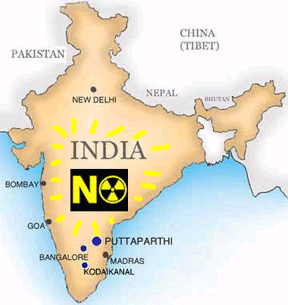
Farmers set for bitter fight over Mithi Virdi nuclear plant Times of India 3 Mar 13, RAJKOT/GANDHINAGAR: Large number of farmers and environmentalists will gather at a mega congregation in Mithi Virdi village of Bhavnagar district on Monday to oppose tooth
and nail the 6,000 MW nuclear power plant proposed at this coastal site. Continue reading
No way to stop Hanford radioactive leaks, says Washington’s Governor
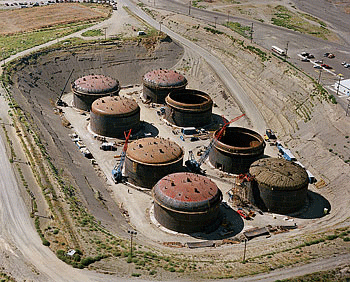 Gov. Jay Inslee says no available technology to plug the radiation leak Examiner.com FEBRUARY 28, 2013 BY: DEBORAH DUPRE Washington state governor Jay Inslee said Wednesday that there is no available technology to plug the radiation leaks at Hanford Nuclear Reservation.
Radioactive waste tanks may be leaking some 1,000 gallons per year at the Hanford Nuclear facility….. Hanford has 177 aging tanks storing millions of gallons of radioactive sludge.
Faulty data analysis meant officials did not properly catch signs of leaking before now, according to Inslee.
The governor expressed concern about the other tanks at the reservation. http://www.examiner.com/article/gov-jay-inslee-says-no-available-technology-to-plug-the-radiation-leak?CID=examiner_alerts_article
Secrecy and lack of oversight in Entergy’s nuclear waste plans for Pilgrim Nuclear Plant
all Pilgrim Coalition is asking.
“Once again, the total lack of transparency and oversight by the NRC
and other regulators responsible for the safe and proper operation of
Pilgrim is alarming,” she said. “All we want is straight answers and
public accountability. It’s not a lot to ask, given what is at stake.”
 NUCLEAR MATTERS: Pilgrim Coalition wants public
  accountability Entergy
seeks zoning permit for dry cask storage project By Frank Mand
Wicked Local Plymouth Mar 03, 2013 PLYMOUTH —
Has Entergy begun construction of a dry cask, spent fuel, storage
system on the grounds of the Pilgrim Nuclear Power Station? And, if
so, why hasn’t the company been more forthcoming about its efforts in
order to assure the public and comply with the town departments which
exercise oversight on projects of this size and scope? Continue reading
Fukushima World Health Organization report greeted with broad skepticism

Image source : http://www2.macleans.ca/2011/03/29/a-radioactive-legacy/
“…In Bellona’s opinion, the WHO report released yesterday falls well short of the realities that are immediately evident from Fukushima’s sister disasters…..”
Charles Digges, 01/03-2013
http://www.bellona.org/articles/articles_2013/who_fukushima_report
As the second anniversary of Japan’s Fukushima nuclear disaster approaches, people in the area worst affected by the catastrophe have a slightly higher risk of developing certain kinds of cancers, the World Health Organization (WHO) said on Thursday.
Many humanitarian groups working in the area have immediately said the WHO is being employed to assist in a whitewash of how dire the health difficulties facing Fukushima residents – as well as workers assisting in the cleanup – actually are, and have refuted the claims of the study, citing at least three thyroid cancer incidents related to the fallout from Fukushima.
A magnitude 9 earthquake and tsunami on March 11, 2011, killed nearly 19,000 people and devastated the Fukushima Daiichi nuclear plant, which spewed radiation, forcing about 160,000 people to flee their homes – the majority of which have not been able to return.
It was the worst nuclear accident since a reactor exploded at the Chernobyl power plant in Ukraine in 1986.
Nils Bøhmer, Bellona’s general manager and nuclear physicist emphasized that the WHO report was only the first in a series of studies that need to be conducted on citizens of Japan’s Fukushima prefecture who were directly impacted by the accident.
He also cited that some 21,000 cleanup workers for Tokyo Electric Power, or TEPCO, have yet to have their own radiation exposure figures submitted to Japanese regulatory officials. These figures are due this month, but TEPCO has blamed its failure to submit the documentation on its current inability to digitize the data.
“These workers have probably received much higher does of radiation that the public that was evacuated,” said Bøhmer. “So it is far too early to reach any conclusions about the actual radiation impacts on humans.”
Bøhmer’s comments point up just one of a number of snafus in the WHO report, which NGOs, aid organizations, other UN bodies, Japanese authorities and a member of the WHO have disputed.
Summary of the WHO’s reporting
“A breakdown of data, based on age, gender and proximity to the plant, does show a higher cancer risk for those located in the most contaminated parts,” Dr Maria Neira, WHO director for public health and environment, said yesterday upon presenting the organizations report entitled, “Health risk assessment from the nuclear accident after the 2011 Great East Japan Earthquake and Tsunami.”
The United Nations agency said for the general population in Japan the predicted health risks of cancer were low. But it was not able to say how many people were exposed in the area where the highest amount of radioactive material was released.
A substantial amount of radiation was released into the environment and a 20-kilometer evacuation zone was set up.
The WHO report says that it has found no data on any cancers among the population in the area, but humanitarian organizations have offered contradictory evidence to those claims, saying at least three cases of thyroid cancer have been linked to the disaster.
Poop protection against ionising radiation!
 Mars Mission to use astronaut feces as radiation shield
http://www.financialexpress.com/news/mars-mission-to-use-astronaut-feces-as-radiation-shield/1082496/2#sthash.4CxWh740.dpuf-
LONDON, MAR 03 2013, Astronauts onboard a privately-funded expedition
to Mars in 2018 will use their own feces to protect themselves against
cosmic radiation. Continue reading
Shock horror: some USA Tea Party Republicans are losing faith in nuclear power
 “Conservatives do not believe in incentivizing failure,” Debbie Dooley, a co-founder of the Atlanta Tea Party, recently told Georgia lawmakers. “
“The price tag keeps going up. The timeframe they are going to build it has been extended year after year after year,” said state Rep. Mike Fasano, a Republican and self-described nuclear power supporter.
“A lot of people are paying for something that they’ll never see any return on their money,” Fasano said.
Some Leaders Souring on Nuclear Power Costs, abc News By RAY HENRY Associated Press ATLANTA March 3, 2013 As the cost of building a new nuclear plant soars, there are signs of buyer’s remorse. The second-guessing from officials in Georgia and Florida is a sign that maybe the nation is not quite ready for a nuclear renaissance. On top of construction costs running much higher than expected, the price of natural gas has plummeted, making it tough for nuclear plants to compete in the energy market. Continue reading
Fukushima nuclear reactors: water pumped in just leaks out
 The melted core cracked the containment vessel, there really is no containment. So as soon as they pump the water in it leaks out again.
Loss of containment of nuclear fuel also exists within the spent fuel pools at Fukushima.
Fukushima Daiichi Reactor 3 Spent Fuel Pool – Fuel racks where refueling  machine mast rests http://www.youtube.com/watch?v=A3A1YA1lt8k&feature=player_embedded
Nuclear Expert: “The Melted Core Cracked The Containment Vessel ” There Really Is No Containment” At Fukushima Reactors http://www.opednews.com/articles/Nuclear-Expert–The-Melte-by-G-Washington-130302-594.html Nuclear Cores and Spent Fuel Pools Have Both Lost Containment Steven Starr – Director of the Clinical Laboratory Science Program at theUniversity of Missouri/Senior Scientist at Physicians for Social Responsibility – said :
The Japanese basically lied about what happened with the reactors for months. They said they were trying to prevent a meltdown, when in fact they knew within the first couple of days Reactors 1, 2, and 3 at Fukushima Daiichi had melted down, and they actually melted through the steel containment vessels.
So there was a worst case scenario that they were trying to hide, they even knew that at that time enormous amounts of radiation were released over Japan and some of it even went over Tokyo […] Continue reading
1 This Month

of the week – Shut Down Drone Warfare!


Tell the Ukrainian Government to Drop Prosecution of Peace Activist Yurii Sheliazhenko

Petition to revoke the licensing of the Near Surface Nuclear Disposal Facility (NSDF) at Chalk River. https://www.ourcommons.ca/petitions/en/Petition/Details?Petition=e-7247
To see nuclear-related stories in greater depth and intensity – go to https://nuclearinformation.wordpress.com
-
Archives
- March 2026 (251)
- February 2026 (268)
- January 2026 (308)
- December 2025 (358)
- November 2025 (359)
- October 2025 (376)
- September 2025 (257)
- August 2025 (319)
- July 2025 (230)
- June 2025 (348)
- May 2025 (261)
- April 2025 (305)
-
Categories
- 1
- 1 NUCLEAR ISSUES
- business and costs
- climate change
- culture and arts
- ENERGY
- environment
- health
- history
- indigenous issues
- Legal
- marketing of nuclear
- media
- opposition to nuclear
- PERSONAL STORIES
- politics
- politics international
- Religion and ethics
- safety
- secrets,lies and civil liberties
- spinbuster
- technology
- Uranium
- wastes
- weapons and war
- Women
- 2 WORLD
- ACTION
- AFRICA
- Atrocities
- AUSTRALIA
- Christina's notes
- Christina's themes
- culture and arts
- Events
- Fuk 2022
- Fuk 2023
- Fukushima 2017
- Fukushima 2018
- fukushima 2019
- Fukushima 2020
- Fukushima 2021
- general
- global warming
- Humour (God we need it)
- Nuclear
- RARE EARTHS
- Reference
- resources – print
- Resources -audiovicual
- Weekly Newsletter
- World
- World Nuclear
- YouTube
-
RSS
Entries RSS
Comments RSS
 nuclear-news