Japan’s Prime Minister keen to restart nuclear reactors, but safety problems remain
skeptics worry that industry supporters in the government will manage to get around the regulations.
According to a report by the newspaper Asahi Shimbun, none of Japan’s 16 undamaged commercial nuclear plants would pass the new standards.
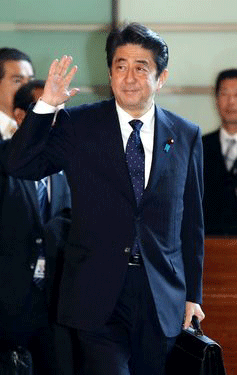 Japan to Begin Restarting Idled Nuclear Plants, Leader Says NYT By MARTIN FACKLER and HIROKO TABUCHI Matthew L. Wald contributed reporting from Washington. February 28, 2013 TOKYO — Japan will begin restarting its idled nuclear plants after new safety guidelines are in place later this year, Prime MinisterShinzo Abe said Thursday, moving to ensure a stable energy supply despite public safety concerns after the Fukushima disaster.
In a speech to Parliament, Mr. Abe pledged to restart nuclear plants that pass the tougher guidelines, which are expected to be adopted by a new independent watchdog agency, the Nuclear Regulation Authority, as early as July. He did not specify when any of the reactors might resume operation, and news reports have suggested that it might take months or even years to make the expensive upgrades needed to meet the new safety standards.
Still, by making the promise in front of the Diet, Mr. Abe indicated in the strongest way yet that he planned to move ahead with a campaign pledge to reverse his predecessor’s hopes that Japan would begin weaning itself off nuclear energy.
The speech came as the World Health Organization published a comprehensive, two-year analysis on the health risks associated with the 2011 disaster suggesting that the chance of getting certain types of cancers had increased slightly among children exposed to the highest doses of radioactivity. But the report said that there would most likely be no observable increase in cancer rates in the wider Japanese population.
The study’s authors warned, however, that their assessment was based on limited scientific knowledge; much of the scientific data on health effects from radiation is based on acute exposures like those that followed the bombing of Hiroshima and Nagasaki and not chronic, low-level exposure. In Japan, some densely populated areas are expected to remain contaminated with relatively low levels of radioactive materials for decades.
The government’s initial reaction to the report — saying it overestimated the risks by failing to fully take into account government evacuations of citizens — suggested that officials did not see it as a help for Mr. Abe’s plans. Antinuclear sentiments in Japan are now strong, and the results could feed fears of any increased risks…..
Leaders from the previous Democratic Party government had vowed to slowly phase out nuclear power by the 2030s in favor of cleaner alternatives like solar and wind power. But Mr. Abe, who took power after his Liberal Democratic Party won national elections in December on a platform of economic revitalization, said the phaseout would keep Japan from the cheap electricity it needs to compete economically.
On Thursday, Mr. Abe said that Japan had learned the need for tougher safety standards, and he said the new standards would be enforced “without compromise.”
Mr. Abe also said Japan would continue seeking energy alternatives to reduce its dependence on nuclear power.
In January, the new nuclear agency released a list of its proposed safety regulations, which include higher walls to protect against tsunamis, additional backup power sources for the cooling systems and construction of specially hardened earthquake-proof command centers. The rules surprised many for their toughness, though skeptics worry that industry supporters in the government will manage to get around the regulations.
According to a report by the newspaper Asahi Shimbun, none of Japan’s 16 undamaged commercial nuclear plants would pass the new standards. The agency has said the new guidelines will be finalized and put in place by July 18.http://www.nytimes.com/2013/03/01/world/asia/japan-to-begin-restarting-idled-nuclear-plants.html?_r=0
No comments yet.
1 This Month

of the week – Shut Down Drone Warfare!


Tell the Ukrainian Government to Drop Prosecution of Peace Activist Yurii Sheliazhenko

Petition to revoke the licensing of the Near Surface Nuclear Disposal Facility (NSDF) at Chalk River. https://www.ourcommons.ca/petitions/en/Petition/Details?Petition=e-7247
To see nuclear-related stories in greater depth and intensity – go to https://nuclearinformation.wordpress.com
-
Archives
- April 2026 (19)
- March 2026 (251)
- February 2026 (268)
- January 2026 (308)
- December 2025 (358)
- November 2025 (359)
- October 2025 (376)
- September 2025 (257)
- August 2025 (319)
- July 2025 (230)
- June 2025 (348)
- May 2025 (261)
-
Categories
- 1
- 1 NUCLEAR ISSUES
- business and costs
- climate change
- culture and arts
- ENERGY
- environment
- health
- history
- indigenous issues
- Legal
- marketing of nuclear
- media
- opposition to nuclear
- PERSONAL STORIES
- politics
- politics international
- Religion and ethics
- safety
- secrets,lies and civil liberties
- spinbuster
- technology
- Uranium
- wastes
- weapons and war
- Women
- 2 WORLD
- ACTION
- AFRICA
- Atrocities
- AUSTRALIA
- Christina's notes
- Christina's themes
- culture and arts
- Events
- Fuk 2022
- Fuk 2023
- Fukushima 2017
- Fukushima 2018
- fukushima 2019
- Fukushima 2020
- Fukushima 2021
- general
- global warming
- Humour (God we need it)
- Nuclear
- RARE EARTHS
- Reference
- resources – print
- Resources -audiovicual
- Weekly Newsletter
- World
- World Nuclear
- YouTube
-
RSS
Entries RSS
Comments RSS
 nuclear-news
Leave a comment