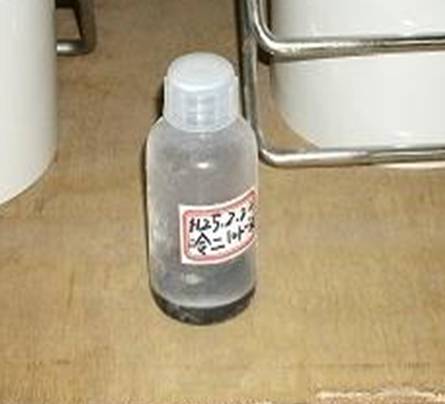
Fukushima I Nuke Plant: Sediment Sample Collected from Flooded Torus Room of Reactor 1
Uh… They put the sediment sample in a plastic bottle?
According to TEPCO, the plastic bottle is emitting 4 millisieverts/hour radiation with the sediment in it.
From TEPCO’s Photos and Videos Library, 2/22/2013:
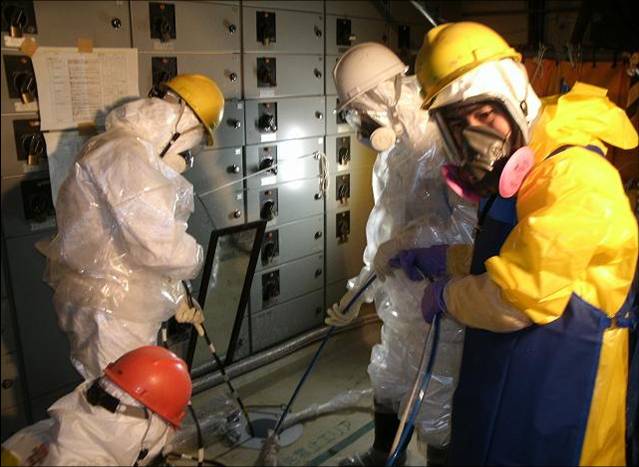
Workers in full gear collecting samples through the hole on the first floor of the Reactor 1 building, where the air radiation dose ranges from 2 to 10 millisieverts/hour. It took 20 workers 2 hours and 35 minutes to complete the task, for which they received 1.46 millisievert (maximum) of radiation exposure.
http://ex-skf.blogspot.co.uk/2013/02/fukushima-i-nuke-plant-sediment-sample.html
From the comments:
A polyethylene bottle is an appropriate container for reducing α, β, and neutron emission. E.g., from “Neutron Interactions with Matter”, P. Rinard:
“Figure 12.8 shows that a cylinder of polyethylene is more effective in preventing the transmission of neutrons than a cylinder of heavy metal. A neutron loses most of its energy by colliding with the light elements in polyethylene and then the mean-free-path length becomes small as the cross sections increase.”
http://www.fas.org/sgp/othergov/doe/lanl/lib-www/la-pubs/00326407.pdf
1 Comment »
Leave a comment
1 This Month

of the week – Shut Down Drone Warfare!


Tell the Ukrainian Government to Drop Prosecution of Peace Activist Yurii Sheliazhenko

Petition to revoke the licensing of the Near Surface Nuclear Disposal Facility (NSDF) at Chalk River. https://www.ourcommons.ca/petitions/en/Petition/Details?Petition=e-7247
To see nuclear-related stories in greater depth and intensity – go to https://nuclearinformation.wordpress.com
-
Archives
- April 2026 (103)
- March 2026 (251)
- February 2026 (268)
- January 2026 (308)
- December 2025 (358)
- November 2025 (359)
- October 2025 (376)
- September 2025 (257)
- August 2025 (319)
- July 2025 (230)
- June 2025 (348)
- May 2025 (261)
-
Categories
- 1
- 1 NUCLEAR ISSUES
- business and costs
- climate change
- culture and arts
- ENERGY
- environment
- health
- history
- indigenous issues
- Legal
- marketing of nuclear
- media
- opposition to nuclear
- PERSONAL STORIES
- politics
- politics international
- Religion and ethics
- safety
- secrets,lies and civil liberties
- spinbuster
- technology
- Uranium
- wastes
- weapons and war
- Women
- 2 WORLD
- ACTION
- AFRICA
- Atrocities
- AUSTRALIA
- Christina's notes
- Christina's themes
- culture and arts
- Events
- Fuk 2022
- Fuk 2023
- Fukushima 2017
- Fukushima 2018
- fukushima 2019
- Fukushima 2020
- Fukushima 2021
- general
- global warming
- Humour (God we need it)
- Nuclear
- RARE EARTHS
- Reference
- resources – print
- Resources -audiovicual
- Weekly Newsletter
- World
- World Nuclear
- YouTube
-
RSS
Entries RSS
Comments RSS
 nuclear-news
That seems like a steaming pile of horse manure!
They use LLDPE because it is cheap and readily available, as is duct tape, baby diapers, etc.
Their clothing appears to have been furnished by Home Depot!
(whispering) TEPCO, nobody in their right minds believes any thing you say, nor has for a long time now.