Radiation situation at Fukushima is unimaginably bad
 No workers were visible around the No. 3 reactor building. An unmanned crane was removing debris on the roof.
It is hazardous to human health to work in the reactor building where
radiation levels range from 20 to 100 millisieverts per hour.
 The amount of radioactive water stored in tanks and other facilities
rose to 230,000 tons this month, up from 10,000 tons in July 2011.
In addition, an estimated 100,000 tons of water have accumulated in
the basements of buildings.
Decommissioning will not be completed for the next 30 to 40 years
High radiation bars decommissioning of Fukushima plant Asahi  Shimbun,
February 21, 2013
By HISASHI HATTORI/ Senior Staff Writer
Preparations for the mammoth task of decommissioning crippled reactors
at the Fukushima No. 1 nuclear power plant are being stymied by
continued high levels of radiation from the triple meltdowns there two
years ago.
Tokyo Electric Power Co., operator of the plant, has had to install
more tanks to store radioactive water, which continues to swell by
several hundreds of tons daily.
Asahi Shimbun reporters entered the No. 4 reactor building on Feb. 20,
accompanied by inspectors from the secretariat of the Nuclear
Regulation Authority, to assess the situation…..
Most of the debris, such as steel frames mangled in the explosion,
have been removed from the roofless top floor of the reactor building,
but radiation levels remain high.
“Here, the reading is 200 microsieverts per hour,” an inspector said.
“But it is 1,000 microsieverts on the north side close to the No. 3
reactor building. Keep your distance.”
A shroud has been placed over the spent fuel storage pool on the top
floor. The water temperature was about 20 degrees. The water, seen
through an opening, was muddy and brown. The fuel inside the pool was
not visible.
Workers were installing a shroud for the No. 4 reactor building on the
south side of the building. It will be equipped with a crane to remove
spent fuel from the storage pool.
The foundation work was already completed, and steel frames were being
assembled.
TEPCO intends to mount a determined effort to remove spent fuel from
the storage pool in November. Two fuel assemblies were removed on a
trial basis in July….
From the top floor of the No. 4 reactor building, the No. 3 reactor
building resembled a bird’s nest made of twisted steel frames.
No workers were visible around the No. 3 reactor building. An unmanned
crane was removing debris on the roof.
It is hazardous to human health to work in the reactor building where
radiation levels range from 20 to 100 millisieverts per hour.
The No. 1 and No. 2 reactors also went in meltdown. Asahi Shimbun
reporters got close to the two reactor buildings by taking routes
where radiation levels are relatively low.
Still, the dosimeter reading was 700 microsieverts per hour east of
the No. 2 reactor turbine building.
The cumulative radiation dose was 0.111 millisievert after the
approximately four-hour tour of the Fukushima No. 1 plant…….
“We have yet to identify all hotspots, where radiation levels are
locally high,” Kosaka said.
Ever-increasing radioactive water has become a key challenge for TEPCO.
Groundwater is flowing into reactor buildings, where it mixes with
water used to cool melted fuel inside the No. 1, No. 2 and No. 3
reactors.
The amount of radioactive water stored in tanks and other facilities
rose to 230,000 tons this month, up from 10,000 tons in July 2011.
In addition, an estimated 100,000 tons of water have accumulated in
the basements of buildings.
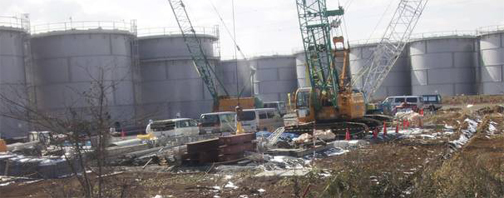
Currently, there are nearly 500 storage tanks on the plant premises,
many as tall as three-story buildings. TEPCO plans to add more by 2015
when it expects to have to store 700,000 tons of radioactive water.
Inside a radioactive water decontamination facility called Sarry,
cylindrical cesium adsorption towers were lined up.
Cesium concentrations in radioactive water have recently fallen, but
an inspector kept reporters from approaching the towers, saying
radiation levels are high……
Preparations for decommissioning have only recently begun.
Decommissioning will not be completed for the next 30 to 40 years
under a plan drawn up by the government and TEPCO.
Trial and error is the only way available because the triple meltdowns
are unprecedented…….
Currently, workers cannot easily approach the three reactor buildings
where the meltdowns occurred due to high radiation levels. They have
been removing debris, such as concrete blocks, on the plant premises.
Work to remove melted fuel from the three reactors is expected to
begin by around 2022. Fuel is believed to be scattered within the
pressure vessels, containment vessels or piping systems, but exact
locations remain unclear.
In addition, TEPCO has yet to identify where radioactive water has
been leaking from the damaged containment vessels. The containment
vessels must be filled with water before melted fuel is removed.
In December, TEPCO sent a remote-controlled robot near the pressure
suppression chamber in the No. 2 reactor building to find out where
water was leaking. But the mission failed when the robot lost its
balance and got stuck.
New technologies must be developed for decommissioning, but
manufacturers and general contractors have shown little enthusiasm.
The companies fear they will not be able to recover their investments
because the technologies would have little practical application other
than for the Fukushima plant…..
http://ajw.asahi.com/article/0311disaster/fukushima/AJ201302210064
1 Comment »
Leave a comment
1 This Month

of the week – Shut Down Drone Warfare!


Tell the Ukrainian Government to Drop Prosecution of Peace Activist Yurii Sheliazhenko

Petition to revoke the licensing of the Near Surface Nuclear Disposal Facility (NSDF) at Chalk River. https://www.ourcommons.ca/petitions/en/Petition/Details?Petition=e-7247
To see nuclear-related stories in greater depth and intensity – go to https://nuclearinformation.wordpress.com
-
Archives
- April 2026 (103)
- March 2026 (251)
- February 2026 (268)
- January 2026 (308)
- December 2025 (358)
- November 2025 (359)
- October 2025 (376)
- September 2025 (257)
- August 2025 (319)
- July 2025 (230)
- June 2025 (348)
- May 2025 (261)
-
Categories
- 1
- 1 NUCLEAR ISSUES
- business and costs
- climate change
- culture and arts
- ENERGY
- environment
- health
- history
- indigenous issues
- Legal
- marketing of nuclear
- media
- opposition to nuclear
- PERSONAL STORIES
- politics
- politics international
- Religion and ethics
- safety
- secrets,lies and civil liberties
- spinbuster
- technology
- Uranium
- wastes
- weapons and war
- Women
- 2 WORLD
- ACTION
- AFRICA
- Atrocities
- AUSTRALIA
- Christina's notes
- Christina's themes
- culture and arts
- Events
- Fuk 2022
- Fuk 2023
- Fukushima 2017
- Fukushima 2018
- fukushima 2019
- Fukushima 2020
- Fukushima 2021
- general
- global warming
- Humour (God we need it)
- Nuclear
- RARE EARTHS
- Reference
- resources – print
- Resources -audiovicual
- Weekly Newsletter
- World
- World Nuclear
- YouTube
-
RSS
Entries RSS
Comments RSS
 nuclear-news
Are the water storage tanks earthquake-tsunami hardened?