Military pressure for USA to increase drones, spying etc, in Africa
US general urges Pentagon to boost its African spying missions by 15-fold, Press Tv, 15 Feb 13, A US general nominated to lead American military’s Africa Command has called for a 15-fold surge in US spying missions in Africa amid reports of Pentagon’s plans to further expand its growing military presence in the continent.Army General David Rodriguez estimated in a written statement submitted to the US Senate Arms Services Committee during his confirmation hearing on Thursday that the American military needs to boost its “intelligence-gathering and spying missions in Africa by nearly 15-fold,” The Washington Post reports Friday. ….”necessary to protect American interests and assist our close allies and partners,” said the four-star general ..

… Rodrigues further emphasized during the hearing that Africa Command requires additional drones, other spying aircraft and more satellite imagery…. The development comes as the American military has intervened over the past two years in internal conflicts in African nations of Somalia, Libya and Mali, as well as central Africa.
This is while the US Air Force is building its fourth assassination and spying drone base in the poor African state of Niger as American Navy warships are expanding their missions along the coastlines of East and West Africa, according to the report….. there is a growing pressure to add even more bases in North and West Africa as the US military is set to build an assassination drone base in the West African country of Niger, which borders Mali, Libya and Nigeria,
France – to phase out nuclear at home, but keen to sell it to India
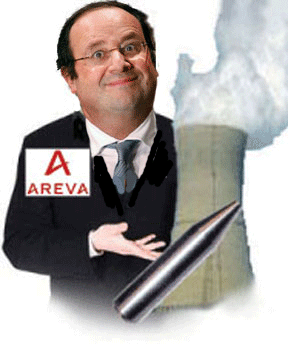 Trust our nuclear technology: French president to India Deccan Herald, Mumbai, Feb 15, 2013, (IANS) French President Francois Hollande Friday urged India “to trust” his country’s nuclear technology and extended France’s support to the Indian nuclear power generation programme……
France is helping India construct two nuclear power reactors at the proposed 9,900 MW Jaitapur Nuclear Power Project in Ratnagiri, 400 km south of Mumbai. The project has been facing stiff resistance from locals, NGOs, anti-nuclear groups and some political parties..… Earlier Friday, Hollande met Maharashtra Governor K. Sankaranarayanan, Industry Minister Narayan Rane, Tourism Minister Chhagan Bhujbal and Protocol Minister Suresh Shetty and stressed the importance of nuclear energy.
Cyber terrorism dangers for USA nuclear weapons laboratory
 NUCLEAR LAB REMAINS VULNERABLE TO CYBERSTRIKES, ENERGY IG SAYS, Nextgov, 15 Feb 13, A leading U.S. nuclear arms site has taken significant steps in recent years to defend against strikes on its computer systems, but key weaknesses remain to be fixed, the Energy Department’s inspector general said this week.
The Los Alamos National Laboratory in New Mexico uses a host of information systems and networks to carry out its duties, which include research and production programs in support of maintaining the nation’s nuclear arsenal, Inspector General Gregory Friedman said in a memorandum attached to a cybersecurity report. Continue reading
In the secrecy of North Korea, it is now immune from attack
 North Korea now immune from attack BY:GREG SHERIDAN, FOREIGN EDITOR The Australian February 16, 2013 “……..The truth is, Western intelligence knows very little about what goes on inside North Korea, especially inside the head of Pyongyang’s bombastic young dictator, Kim Jong-un.
No one watches North Korea more closely than Seoul. But in the 1980s and 90s Seoul was famous for producing faulty intelligence on the North.
I have interviewed the past four South Korean presidents. The only one I found convincing on North Korea was Lee Myung-bak, who leaves office on February 25. He said that on critical North Korea issues: “We don’t have accurate information.”……..
The North Koreans claim their new nuclear device is miniaturised, which implies they could put it on their missiles. This is probably untrue. US intelligence believes Pyongyang is still a few years away from this, but Washington is aware of the limitations of its intelligence….. A decade ago I broke a story about the Pentagon’s contingency plans to strike North Korea militarily to prevent it acquiring nuclear weapons. The arguments against such a strike were always very strong and prudence governed Washington’s decision not to act.
That may have been the right decision. But now North Korea possesses at least several nuclear devices and is immune from attack. …. Kim is capricious, self-indulgent and probably suffers a serious personality disorder, but so far he is making three vastly more powerful nations dance to his tune. In a strategy paradoxically born of weakness, it is the power of the bomb, ruthlessly applied.
USA -Cs137 in my rain? Results in!
antiprotons
Published on Feb 15, 2013
I have concluded that my rain sample has indication of possible Cs137 presence and no indications of Cs134 presence. The levels were too low to accurately quantify but could not exceed 5.55 Bq/liter (and are suspected to be less than 1 Bq/liter if at all).
Sorry folks. Maybe my collection bucket will have better luck next time.
NASA document showing how much more greatly contaminated our soil is than that of my rain sample:
ssfl.msfc.nasa.gov/documents/technical/Natural_Variations_of_Cesium-137.pdf
Unreasonable threats made, about Iran’s uranium enrichment
 Despite Scaremongering Iran’s Uranium Stockpile Not Growing http://news.antiwar.com/2013/02/10/despite-scaremongering-irans-uranium-stockpile-not-growing/ Civilian-Enriched Uranium Fueling Civilian Nuclear Program by Jason Ditz, February 10, 2013
This already happened once, with the “red line” supposed to be reached in October of last year, and Israeli Defense Minister Ehud Barakeventually admitting the use of uranium had pushed it back until this summer. The continued use is pushing it back even more.
The reality of the situation is that these red lines are constantly predicated on Iran inexplicably stopping the use of uranium for civilian purposes, meaning there is always a “red line” looming in the next several months based on having any enrichment capability, an excuse to make threats against Iran without having the line ever actually get crossed.
Serious obstacles to South Africa’s nuclear power plans
South Africa’s new nuclear challenges, Mail and Guardian Africa 15 FEB 2013 LYNLEY DONNELLY South African authorities will have to address two critical issues as the country faces signing for its new nuclear procurement megaplan. Funding and human resources capacity are two of the biggest challenges confronting any country embarking on a nuclear energy programme, according to Yukiya Amano, director general of the International Atomic Energy Agency.
These are two critical issues that South African authorities will have to address as the country faces signing on the dotted line for its new nuclear procurement megaplan for six nuclear power stations by 2030. Funding was a “difficult issue” for the nuclear industry everywhere, said Amano, who was on a brief tour of South Africa last week…… Continue reading
US service personnel affected by Fukushima radiation – but now “on their own”
Fukushima Rescue Mission Lasting Legacy: Radioactive Contamination of Americans, New Jersey News, 31 JANUARY 2013 BY ROGER WITHERSPOON
The Department of Defense has decided to walk away from an unprecedented medical registry of nearly 70,000 American service members, civilian workers, and their families caught in the radioactive clouds blowing from the destroyed nuclear power plants at Fukushima Daiichi in Japan.
The decision to cease updating the registry means there will be no way to determine if patterns of health problems emerge among the members of the Marines, Army, Air Force, Corps of Engineers, and Navy stationed at 63 installations in Japan with their families. In addition, it leaves thousands of sailors and Marines in the USS Ronald Reagan Carrier Strike Group 7 on their own when it comes to determining if any of them are developing problems caused by radiation exposure. Continue reading
More nuclear test plans by North Korea
North Korea tells China of preparations for fresh nuclear test – source By Benjamin Kang Lim BEIJING Feb 15, (Reuters) – North Korea has told its key ally, China, that it is prepared to stage one or even two more nuclear tests this year in an effort to force the United States into diplomatic talks, said a source with direct knowledge of the message.
Further tests could also be accompanied this year by another rocket launch, said the source, who has direct access to the top levels of government in both Beijing and Pyongyang. Continue reading
More nuclear sludge leaking at Hanford Site
“..One million gallons (4,000 cubic meters) of highly radioactive waste from Hanford is currently traveling through the groundwater toward the Columbia River and will reach the river in 12 to 50 years if the cleanup operation is delayed,..”
Sat Feb 16, 2013 3:9AM GMT
Press TV
 Nuclear technicians are working on a storage tank at the Hanford Site. (file photo)
On Friday, Inslee said that between 150 and 300 gallons of waste might be leaking from the 65-year-old tank at the Hanford Site, which is located on the Columbia River in the state of Washington, the Associated Press reported.
“I am alarmed about this on many levels. This raises concerns, not only about the existing leak… but also concerning the integrity of the other single shell tanks of this age,” he added.
The US Energy Department said the leaking tank holds roughly 447,000 gallons of sludge.
For the disposal of its nuclear waste, the United States has constructed 177 underground storage tanks holding nearly 56 million gallons of toxic nuclear sludge.
The US government is currently looking for a site to construct a permanent nuclear waste repository.
Energy Department spokesman Lori Gamache, said the cause of the leakage is still unknown.
“So we have equipment that’s in the tank that monitors the levels. And this week we went in and did some visual inspections and confirmed that the equipment was working correctly. And the equipment was showing there was a level decrease in this tank,” she stated.
Built in 1943 or 1944, the tank is one of 149 with a single shell. The single-walled tank holds spent nuclear fuel from nuclear weapons development and production.
Hanford has the highest level of radioactive waste of any site in the United States. It produced plutonium for the atomic bomb dropped on Nagasaki in 1945.
One million gallons (4,000 cubic meters) of highly radioactive waste from Hanford is currently traveling through the groundwater toward the Columbia River and will reach the river in 12 to 50 years if the cleanup operation is delayed, according to Hanford Quick Facts, which was published by the Washington Department of Ecology.
KA/HGL
http://www.presstv.ir/detail/2013/02/16/289177/more-nuclear-sludge-leaking-at-hanford/
Russian meteorite blast explained: Fireball explosion equal to 20 Hiroshimas
Published: 15 February, 2013, 23:10
Edited: 16 February, 2013, 05:40
RT

A Russian policeman works near an ice hole, said by the Interior Ministry department for Chelyabinsk region to be the point of impact of a meteor seen earlier in the Urals region, at lake Chebarkul some 80 kilometers (50 miles) west of Chelyabinsk February 15, 2013 (Reuters / Chelyabinsk region Interior Ministry)
Russian scientists investigating the meteorite explosion in the Urals explained the nature of the event that caused havoc in the region. NASA meanwhile said that the shockwave from the blast was equivalent to a 300-kiloton explosion.
The object was identified as a solitary 10-ton bolide by the Russian Academy of Sciences (RAN). Bolides, or bright fireballs, are large meteors that explode in the lower atmosphere, and unlike meteorite showers they can be dangerous, scientists explained.
The Chelyabinsk fireball entered the atmosphere moving at a speed of about 20 km/s. The object, which was several meters in diameter, then burst into pieces at a height of 30-50 km above the ground, RAN reported.
Three consecutive explosions shattered the meteorite further. Large fragments moving at a high speed caused a powerful flash and a strong shockwave, with most of its energy released at a height of 5 to 15 km above the earth, with the atmosphere absorbing most of that energy.
NASA has estimated the energy released is equivalent to a 300-kiloton explosion, according to Bill Cooke, head of the Meteoroid Environments Office at NASA’s Marshall Space Flight Center.
The impact and the sound of the blast reached the ground minutes after the explosion, causing havoc and panic in Chelyabinsk. While most of the object burned down during the fall, the remaining parts showered over the region, possibly adding to the damage and injuries.
The actual power of the blast is still being discussed, with some scientists estimating it as low as 0.1 kilotons and others saying it could be more than 300 kilotons, depending on the height the explosion was registered. Conflicting reports also centered on the trajectory of the falling body.
The combustion products won’t stay in the atmosphere for long, and will soon come down with precipitation, Russian scientists said. The meteorite is believed to have caused no significant pollution, but the elements it emitted could only be identified after studying its fragments, they added. So far, RAN and Emergency services have denied the possibility of radioactive pollution.

MET-7 view (Copyright 2013 © EUMETSAT)
Russian space agency Roscosmos earlier admitted they did not track the meteorite that fell near Chelyabinsk, although several other flybys were detected by Roshydromet overnight. “Our ground facilities and, as I understand, those abroad too did not monitor this celestial body,” the agency spokesman said.
Astronomers around the globe didn’t notice the object coming either, and rushed in search of its traces on satellite images after the news spread.
“Objects like that are nearly impossible to see until a day or two before impact,” Timothy Spahr of the Minor Planet Center in Cambridge, Massachusetts told Nature Magazine.
Although the meteor was relatively small to detect, some argued its blast was comparable with the power of a nuclear bomb.
According to Canadian astronomer Margaret Campbell-Brown, the blast could be even more powerful than North Korea’s recent nuclear test. Citing the data from two infrasound stations near the impact site, she estimated the object to be 15 meters in diameter with a mass of around 40 tons.
“That would make it the biggest object recorded to hit the Earth since Tunguska,” Campbell-Brown told Nature Magazine.
Most scientists both in Russia and abroad do not believe the Chelyabinsk bolide had anything to do with the asteroid 2012 DA14, which is expected to fly by just hours later.

Weather sattelite Meteosat 10 has taken an image of the meteriote shortly after entering the atmosphere (Copyright 2013 © EUMETSAT)

Weather sattelite Meteosat 10 has taken an image of the meteriote shortly after entering the atmosphere (Copyright 2013 © EUMETSAT)
http://rt.com/news/scientists-explain-chelyabinsk-bolide-337/
1 This Month

of the week – Shut Down Drone Warfare!


Tell the Ukrainian Government to Drop Prosecution of Peace Activist Yurii Sheliazhenko

Petition to revoke the licensing of the Near Surface Nuclear Disposal Facility (NSDF) at Chalk River. https://www.ourcommons.ca/petitions/en/Petition/Details?Petition=e-7247
To see nuclear-related stories in greater depth and intensity – go to https://nuclearinformation.wordpress.com
-
Archives
- April 2026 (79)
- March 2026 (251)
- February 2026 (268)
- January 2026 (308)
- December 2025 (358)
- November 2025 (359)
- October 2025 (376)
- September 2025 (257)
- August 2025 (319)
- July 2025 (230)
- June 2025 (348)
- May 2025 (261)
-
Categories
- 1
- 1 NUCLEAR ISSUES
- business and costs
- climate change
- culture and arts
- ENERGY
- environment
- health
- history
- indigenous issues
- Legal
- marketing of nuclear
- media
- opposition to nuclear
- PERSONAL STORIES
- politics
- politics international
- Religion and ethics
- safety
- secrets,lies and civil liberties
- spinbuster
- technology
- Uranium
- wastes
- weapons and war
- Women
- 2 WORLD
- ACTION
- AFRICA
- Atrocities
- AUSTRALIA
- Christina's notes
- Christina's themes
- culture and arts
- Events
- Fuk 2022
- Fuk 2023
- Fukushima 2017
- Fukushima 2018
- fukushima 2019
- Fukushima 2020
- Fukushima 2021
- general
- global warming
- Humour (God we need it)
- Nuclear
- RARE EARTHS
- Reference
- resources – print
- Resources -audiovicual
- Weekly Newsletter
- World
- World Nuclear
- YouTube
-
RSS
Entries RSS
Comments RSS
 nuclear-news