They’re untested, they’re just as expensive – small nuclear reactors
Nuclear energy: Flexible fission, Ft.com, By Sylvia Pfeifer 14 Feb 13, At the Baltic Shipyard in St Petersburg squats the hull of the Akademik Lomonosov. It is no ordinary ship. Once it is finished in three years’ time, it will be Russia’s first floating nuclear power plant.Two reactors, similar to those used in Russia’s nuclear-powered ice breakers, will each provide 35 megawatts of power. The floating power plant is one of several planned by the Kremlin to be anchored near towns or industrial sites……
Critics are wary, warning that floating atomic power stations would make an ideal terrorist target and be vulnerable to stormy weather and earthquakes. Others point out that even if smaller reactors had less fuel and were partly buried underground, there would be an increasing number of small facilities dotted across emerging markets, sometimes in places that lack the infrastructure to cope with emergencies….
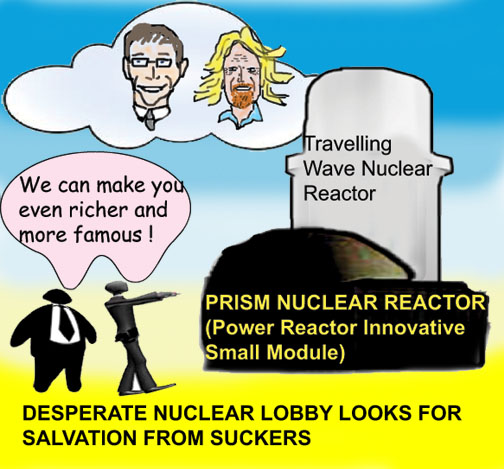
multiple challenges remain.
There are questions over whether the regulatory regime and siting criteria should be relaxed for these reactors? There are also suggestions the plants could be run with fewer staff, helping to cut the costs even further.
Dame Sue Ion, a nuclear fuel expert and fellow at the UK’s Royal Academy of Engineering, says the first small modular reactors will, realistically, be sited on existing nuclear-licensed sites.
“It may be that the physical characteristics make it safer but you would still have to have all the safety arrangements and emergency planning in place,” she adds.
“You still have the same safety, proliferation and accident concerns,” says Doug Parr, chief scientist and policy director at campaign group Greenpeace UK. “You need capacity and supportive infrastructure to respond if there is an emergency.”
Then there is the issue of public acceptance. “To expect the general public to just accept them because they are small is pushing the point. It does not seem obvious to me,” Kevin Hesketh, senior fellow at Britain’s National Nuclear Laboratory, told an industry conference last month…….. “Licensing and public acceptance – both have to be addressed. ..
The biggest challenge facing the model is simply that no one has done it. Nuclear also has a bad record on cost. At the same time, competition from renewables, which are becoming cheaper, is growing.
Dominic Holt, associate director, nuclear advisory, at KPMG, says “none of the positives have been tested yet”. Claims of cost and programme certainty are still unproven. Analysis of a range of available data show that the “levelised cost” – per MW/hour – of SMRs is still similar to that of a large reactor…
No comments yet.
1 This Month



Tell the Ukrainian Government to Drop Prosecution of Peace Activist Yurii Sheliazhenko

Petition to revoke the licensing of the Near Surface Nuclear Disposal Facility (NSDF) at Chalk River. https://www.ourcommons.ca/petitions/en/Petition/Details?Petition=e-7247


of the week – STOP SMALL MODULAR REACTORS IN CANADA
To see nuclear-related stories in greater depth and intensity – go to https://nuclearinformation.wordpress.com
-
Archives
- March 2026 (212)
- February 2026 (268)
- January 2026 (308)
- December 2025 (358)
- November 2025 (359)
- October 2025 (376)
- September 2025 (258)
- August 2025 (319)
- July 2025 (230)
- June 2025 (348)
- May 2025 (261)
- April 2025 (305)
-
Categories
- 1
- 1 NUCLEAR ISSUES
- business and costs
- climate change
- culture and arts
- ENERGY
- environment
- health
- history
- indigenous issues
- Legal
- marketing of nuclear
- media
- opposition to nuclear
- PERSONAL STORIES
- politics
- politics international
- Religion and ethics
- safety
- secrets,lies and civil liberties
- spinbuster
- technology
- Uranium
- wastes
- weapons and war
- Women
- 2 WORLD
- ACTION
- AFRICA
- Atrocities
- AUSTRALIA
- Christina's notes
- Christina's themes
- culture and arts
- Events
- Fuk 2022
- Fuk 2023
- Fukushima 2017
- Fukushima 2018
- fukushima 2019
- Fukushima 2020
- Fukushima 2021
- general
- global warming
- Humour (God we need it)
- Nuclear
- RARE EARTHS
- Reference
- resources – print
- Resources -audiovicual
- Weekly Newsletter
- World
- World Nuclear
- YouTube
-
RSS
Entries RSS
Comments RSS
 nuclear-news
Leave a comment