UK, USA, paralysed, but need permanent deep burial of nuclear wastes
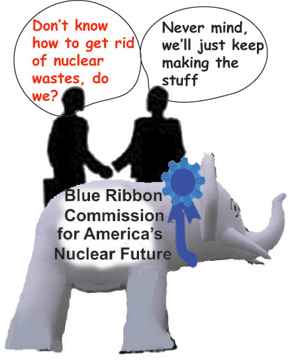 In the United States, efforts to build a repository are in the doldrums
At the Fukushima Daiichi nuclear plant in Japan, spent fuel stored above ground at reactors is likely to have been a major source of contamination following the earthquake and tsunami in 2011. At the last count, the clean-up there is expected to cost trillions of yen, or hundreds of billions of dollars.
In a hole It is in Britain’s best interests to keep looking for a site for a deep nuclear-waste repository. Nature, 05 February 2013 The best way to dispose of nuclear waste is to bury it deep underground. With the right mixture of geology and engineering, researchers think, it should be possible to contain highly radioactive material safely for the many thousands of years that it will take to decay.
Scientists agree on this. The industry thinks the same way, and so do regulators, politicians and most environmental groups. Yet despite the expert endorsement, plans for a deep geological repository in Britain effectively ground to a halt last week, after a local council voted against plans to look for a suitable site…….
why has the process come up empty again? The answer is a lack of political will at almost every level of government. Critics say that the Nuclear Decommissioning Authority, the body responsible for the repository, never did much to try to sell the facility to local residents or to address their concerns about what it might do to property prices or tourism. At a national level, politicians offered only the vaguest promise of ‘economic development’ in exchange for taking the waste. Meanwhile, local politicians advocated an alternative plan: to build more short-term storage at Sellafield, thereby creating jobs in the near-term without making long-term commitments.
“There are moral, financial and environmental reasons to make deep geological disposal work.”
The United Kingdom is not alone in its nuclear torpor. In the United States, efforts to build a repository are in the doldrums following a decision to withdraw from a proposed site at Yucca Mountain in Nevada. A panel has recommended a site-selection exercise similar to the one carried out in the United Kingdom, but there is little reason to believe that it could do any better. The very act of looking at places other than Yucca Mountain will require a change to legislation — unlikely given the nation’s current political paralysis. In the meantime, the bills from neglecting the waste are piling up. The US Nuclear Regulatory Commission faces a costly lawsuit from states and utility companies seeking to have their nuclear waste taken away, as required by federal law. In the United Kingdom, the endless clean-up of Sellafield drags on; it has cost more than £67.5 billion so far, according to a report released this week by a parliamentary committee. At the Fukushima Daiichi nuclear plant in Japan, spent fuel stored above ground at reactors is likely to have been a major source of contamination following the earthquake and tsunami in 2011. At the last count, the clean-up there is expected to cost trillions of yen, or hundreds of billions of dollars.
The bleak situation might encourage some on both sides of the Atlantic to search for a quick fix. Already, there is talk in the United Kingdom of officials trying to bypass Cumbria County Council by going directly to the local communities of Allerdale and Copeland, which supported the survey work. In the United States, some in industry would like to see the plans for a repository at Yucca Mountain revised, despite Nevada’s promise to fight it tooth and nail. Advocates of these solutions may feel that they are in the right, but they are guilty of political myopia: although it might be possible to nudge the projects forward briefly, they would quickly become bogged down again in a mire of legal and civil challenges.
It seems likely that both nations must start again. Scientists can help by reminding politicians that there are moral, financial and environmental reasons to make deep geological disposal work. Given the enormous costs of inaction, it is in everyone’s interest to keep trying. http://www.nature.com/news/in-a-hole-1.12361
No comments yet.
1 This Month

of the week – Shut Down Drone Warfare!


Tell the Ukrainian Government to Drop Prosecution of Peace Activist Yurii Sheliazhenko

Petition to revoke the licensing of the Near Surface Nuclear Disposal Facility (NSDF) at Chalk River. https://www.ourcommons.ca/petitions/en/Petition/Details?Petition=e-7247
To see nuclear-related stories in greater depth and intensity – go to https://nuclearinformation.wordpress.com
-
Archives
- April 2026 (103)
- March 2026 (251)
- February 2026 (268)
- January 2026 (308)
- December 2025 (358)
- November 2025 (359)
- October 2025 (376)
- September 2025 (257)
- August 2025 (319)
- July 2025 (230)
- June 2025 (348)
- May 2025 (261)
-
Categories
- 1
- 1 NUCLEAR ISSUES
- business and costs
- climate change
- culture and arts
- ENERGY
- environment
- health
- history
- indigenous issues
- Legal
- marketing of nuclear
- media
- opposition to nuclear
- PERSONAL STORIES
- politics
- politics international
- Religion and ethics
- safety
- secrets,lies and civil liberties
- spinbuster
- technology
- Uranium
- wastes
- weapons and war
- Women
- 2 WORLD
- ACTION
- AFRICA
- Atrocities
- AUSTRALIA
- Christina's notes
- Christina's themes
- culture and arts
- Events
- Fuk 2022
- Fuk 2023
- Fukushima 2017
- Fukushima 2018
- fukushima 2019
- Fukushima 2020
- Fukushima 2021
- general
- global warming
- Humour (God we need it)
- Nuclear
- RARE EARTHS
- Reference
- resources – print
- Resources -audiovicual
- Weekly Newsletter
- World
- World Nuclear
- YouTube
-
RSS
Entries RSS
Comments RSS
 nuclear-news
Leave a comment