Rare photo of A-bomb split cloud found in Hiroshima -JT
 JAN. 10, 2013 – 01:20PM JST
Japan Today
TOKYO —
A rare photo showing the mushroom cloud from the Hiroshima atomic bombing in two distinct parts, one above the other, has been discovered in the city, a museum curator said Wednesday.
The black-and-white picture is believed to have been taken about half-an-hour after the bombing on Aug 6, 1945, around 10 kilometers east of the hypocentre.
“The existence of this shot was always known in history books, but this is the first time that the actual print has been discovered,” said a curator at the Hiroshima Peace Memorial Museum.
“A shot showing the mushroom cloud split into two like this is very rare.”
The photo was found among articles related to the atomic bombing now owned by Honkawa Elementary School in Hiroshima city, she said.
The best-known pictures of the aftermath of the bombing were taken from the air by the US military.
An American B-29 bomber named Enola Gay dropped the atomic bomb nicknamed “Little Boy”, turning the western Japanese city into a nuclear inferno and killing an estimated 140,000 in the final chapter of World War II.
Three days later another atomic bomb—“Fat Man”—was dropped on the city of Nagasaki, claiming the lives of another 70,000.
What made the atomic scientists tick?
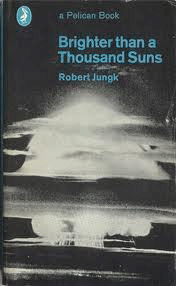 Character before knowledge, Online Opinion, by Noel Wauchope 10 Jan 13, ” Brighter than a Thousand Suns”, A Personal History of the Atomic Scientists, by Robert Jungk, was first published in 1956. “Why are we interested only in what scientists do, and not in what they are? ” This opening question informs Jungk’s entire book. Jungk conversed with many of the scientists of the early days of atomic research, and through until 1954. With the earliest conversations, Jungk was struck by ”the arbitrary and unnatural separation of scientific research from the reality of the individual personality”. To Jungk, it was this division that ”allowed the creation of such monstrosities as the atomic bomb and the hydrogen bomb”.
To this day, many nuclear scientists think of their work as purely mathematical and technical. The human results of nuclear weapons are none of their business. Others, especially after Hiroshima, suffered “their great crisis of conscience”……..
From then on, it was a rush to test the bomb, and then use it, before the Japanese surrendered. Three atomic bombs were built. The first – tested: if the test was a failure – it would be reported as a “girl” – if successful a “boy”.
For the second and third bombs, 67 Scientists petitioned the government to warn the Japanese first – a petition that was prevented by General Groves from reaching the White House. Enrico Fermi commented “Don’t bother me with your conscientious scruples! After all, the thing is superb physics!”
The $2 billion Manhattan Project would be seen as a senseless waste of money, if Japan surrendered. Truman authorised the bombing of Hiroshima and Nagasaki. Oppenheimer explained later that his Interim Committee’s recommendation was “a technical opinion”.
The reactions of the scientists were conflicted……
Robert Jungk’s account of the men, and some women, too, who developed atomic weapons , is set against the background of the big events of the time, with a sympathetic attitude to the pressures and problems that surrounded these people.
From 1951 to 1955 the general attitude of atomic scientists was one of enthusiasm for the hydrogen bomb (1000 times more powerful than the first atomic bomb). Jungk muses on this: “How is one to explain such macabre enthusiasm which had swept away all the earlier scruples and objections to the Super monster?” http://www.onlineopinion.com.au/view.asp?article=14554
South Africa – a voice for nuclear weapons sanity
 Exiting the nuclear club
http://amanpour.blogs.cnn.com/2013/01/09/exiting-the-nuclear-club/ The
world believes that Iran, despite its denials, is trying to join the
handful of nations around the world that possess nuclear weapons.
 Over the past two decades, that list of countries has been growing,
with nations like Pakistan and India publicly acknowledging their
nuclear weapons.
There has been just one exception.
Just as Nelson Mandela was emerging from prison over 20 years ago to
lead South Africa out of the wilderness of racial hatred, his country
was in the midst of another change that could be a model for the rest
of the world.
By 1991, the Rainbow Nation had become the only country to dismantle
and destroy its own nuclear arsenal. That decision, along with the end
of apartheid, helped restore South Africa’s international legitimacy.
It also made the country a leading voice for nuclear sanity.
Today, South Africa’s weapons-grade uranium left over from the
apartheid era is being turned into medical isotopes that can detect
cancer and other diseases.
Swords into plowshares.
Alcoholism among nuclear submarine staff led to murder
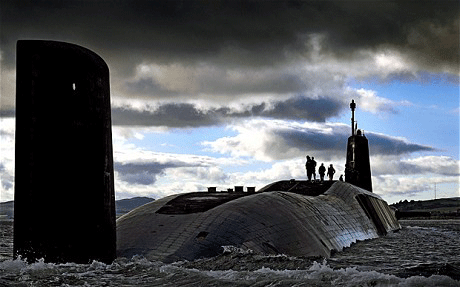 Police alarm at ‘routine’ binge-drinking on nuclear submarine where
murdered shot officer, Telegraph, 9 Jan 13
Police investigating a naval rating who shot dead an officer onboard a
submarine found the 20 pints he consumed beforehand was not unsual and
“significant” numbers of the crew used to get “drunk out of their
minds”. Continue reading
Court puts Nuclear Regulatory Commission on the spot, about public participation
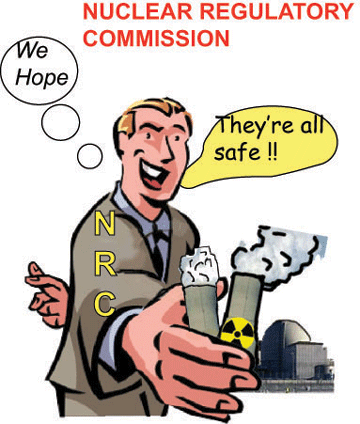 “Now the burden isn’t on the public to show why they need to be part of the exemption process,’’
“The burden is on the N.R.C. to show why they shouldn’t be.
Court Seeks More Public Input on Nuclear Safety, NYT, By MATTHEW L. WALD, 9 Jan 13 A federal appeals court has ruled that the Nuclear Regulatory Commission must either allow more public participation in its decisions about fire safety at the Indian Point 3 nuclear reactor or to show why such input is impractical or inappropriate.
A lawsuit brought by Richard L. Brodsky a former  New York State assemblyman and opponent of Indian Point, involves exemptions granted by the commission from compliance with some fire regulations. Like many reactors around the country, Indian Point installed a fire retardant called Hemyc around critical electric cables in the 1980s to meet a rule that the cables had to be safe from fire for one hour. But the material turned out to be nowhere near as fire-resistant as advertised. Continue reading
NASA explores stratosphere to learn effects of the warming planet Earth
 NASA Chases Climate Change Clues Into The Stratosphere NASA, 9 Jan
13, WASHINGTON — Starting this month, NASA will send a remotely
piloted research aircraft as high as 65,000 feet over the tropical
Pacific Ocean to probe unexplored regions of the upper atmosphere for
answers to how a warming climate is changing Earth. Continue reading
The Western lifestyle is not our only choice, we can change
the visionary realm of the Aborigines represents one of the great experiments in human thought

Studies of the human genome leave no doubt that the genetic endowment of humanity is a single continuum. Race is a fiction. We are all cut from the same genetic cloth, all descendants of a relatively small number of individuals who walked out of Africa some 60,000 years ago and then, on a journey that lasted 40,000 years, some 2,500 generations carried the human spirit to every corner of the habitable world.
It follows, as Boas believed, that all cultures share essentially the same mental acuity, the same raw genius. …..
The Victorian notion of the savage and the civilised, with European industrial society sitting proudly at the apex of a pyramid of advancement that widens at the base to the so-called primitives of the world, has been thoroughly discredited – indeed, scientifically ridiculed for the racial and colonial notion that it was, as relevant to our lives today as the belief of 19th-century clergymen that the Earth was but 6,000 years old….. Continue reading
Wind power to put Uruguay ahead in global renewable enegy stakes
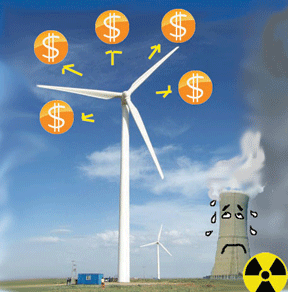 Uruguay set to become world leader in wind power
South American nation plans to produce 90 per cent of its electricity from renewable sources by 2015
BusinessGreen 07 Jan 2013
Uruguay has set its sights on becoming one of the world’s leading wind power producers as part of plans to produce 90 per cent of its electricity from renewable sources by 2015.
Electricity generated from wind is expected to make up 30 per cent of the South American nation’s total mix, with hydropower contributing 45 per cent, and biomass 15 per cent, according to reports from SmartPlanet.
This would put Uruguay ahead of current renewable energy leader Denmark, which gets 26 per cent of its electrical generation from wind.
While Uruguay has a number of hydro power plants, these tend to shut down in dry periods, forcing the country to purchase electricity from Argentina at up to $400per megawatt hour (MWh). The government hopes installing wind farms could provide a more secure source of energy and drop electricity prices to around $64/MWh, well under the current price of $90/MWh…..
France short of money – but can find enough for nuclear weapons
France affirms nuclear arms despite military cuts Miami Herald, BY
JAMEY KEATEN 9 Jan 13,
ASSOCIATED PRESS
OLIVET, France –– France’s president says the country will maintain
its costly nuclear arsenal despite looming military budget cuts,
saying the weapons are essential for national defense.
President Francois Hollande said Wednesday that global security
threats have made nuclear weapons essential for France, which is the
only country in continental Europe to have them…….
http://www.miamiherald.com/2013/01/09/3174407/france-affirms-nuclear-arms-despite.html#storylink=cpy
“Unusual event” – fire emergency at Texas nuclear plant
ABC 13: Fire erupts at U.S. nuclear plant in Texas, emergency declared http://enenews.com/abc-13-fire-erupts-at-u-s-nuclear-power-plant-in-texas-emergency-declared
January 9th, 2013
Title: Fire closes part of nuclear plant; no one injured
Source: Victoria Advocate
Author: Caty Hirst
Date: January 8, 2013
[…] “The good news is no one was injured,” said South Texas Project spokesman Buddy Eller. […]
The fire, in Unit 2 of STP Generating Station near Bay City, was declared an “unusual event,” the lowest level of emergency classification, according to a company news release. […]
The cause of the fire is under investigation […]
See also: Fire strikes South Texas Project nuclear power plant transformer -AP
Clean Energy: Must Act Now| Brainwash Update
Published on Jan 9, 2013
Abby Martin looks at the benefits of renewable and alternative energy sources by highlighting countries that have already taken the initiatives to switch from fossil fuels.
LIKE Breaking the Set @ http://fb.me/BreakingTheSet
FOLLOW Abby Martin @ http://twitter.com/AbbyMartin
The Avian and Wildlife Costs of Fossil Fuels and Nuclear Power

“…Within the uncertainties of the data used, the estimate means that wind farm-related avian fatalities equated to approximately 46,000 birds in the United States in 2009, but nuclear power plants killed about 460,000 and fossil-fueled power plants 24 million…”
Benjamin K. Sovacool
Lee Kuan Yew School of Public Policy – Centre on Asia and Globalisation
June 30, 2012
Journal of Integrative Environmental Sciences vol. 9, no. 4, December 2012, 255-278
Vermont Law School Research Paper No. 04-13
Abstract:
Environmentalists and environmental scientists have criticized wind energy in various forums for its negative impacts on wildlife, especially birds. This article highlights that nuclear power and fossil-fuelled power systems have a host of environmental and wildlife costs as well, particularly for birds. Therefore, as a low-emission, low-pollution energy source, the wider use of wind energy can save wildlife and birds as it displaces these more harmful sources of electricity. The paper provides two examples: one relates to a calculation of avian fatalities across wind electricity, fossil-fueled, and nuclear power systems in the entire United States. It estimates that wind farms are responsible for roughly 0.27 avian fatalities per gigawatt-hour (GWh) of electricity while nuclear power plants involve 0.6 fatalities per GWh and fossil-fueled power stations are responsible for about 9.4 fatalities per GWh. Within the uncertainties of the data used, the estimate means that wind farm-related avian fatalities equated to approximately 46,000 birds in the United States in 2009, but nuclear power plants killed about 460,000 and fossil-fueled power plants 24 million. A second example summarizes the wildlife benefits from a 580-MW wind farm at Altamont Pass in California, a facility that some have criticized for its impact on wildlife. The paper lastly highlights other social and environmental benefits to wind farms compared to other sources of electricity and energy.
Number of Pages in PDF File: 26
http://papers.ssrn.com/sol3/Delivery.cfm/SSRN_ID2198024_code1250463.pdf?abstractid=2198024&mirid=1
Kazakhstan’s nuclear legacy – Euronews video
14/04/2010
At the elderly care home in Semipalatinsk, we met 85 year old Praskovya. Semipalatinsk, or Semey, is a city 150 kilometers from the main Soviet nuclear weapons test site.

Praskovya is a former warehouse manager who used to work in a small town bordering the restricted area in the 1950s. She witnessed one of the nuclear explosions: “We were curious, so we went outside to watch. When the explosion happened, it looked like a large bowl, with black smoke and flames coming from the bowl. Then it rolled into a ball, and a smoke column went up, and at the top, the mushroom appeared. And then the soldiers came and made us leave the street, shouting “it’s not allowed, it’s not allowed”. But we already saw everything interesting. And then everyone got health problems. I’ve had headaches all my life.”
After a wave of popular protests, the Semipalatinsk site was closed in 1991. It had carried out 456 secret nuclear tests.
President of Kazakhstan, Nursultan Nazarbayev, took the decision to close down the facility: “Even senior leaders of Kazakhstan were not allowed to know about the ongoing tests until 1990, until Gorbachev’s glasnost and the opportunity to speak. And as a result of demands from the people, who already knew and understood the complexity and gravity of the issues, I took the only right decision – despite difficulties at the time. The military-industrial complex of the Soviet Union was against it and the Soviet leadership was also against it.”
However, the closure could not reverse the environmental damage to the region, which has more than a million inhabitants, most of which are villagers. Radioactive fallout from nuclear blasts have given Semey and neighboring villages abnormally high rates of cancer and birth defects.
Local oncology centers are screening tens of thousands of patients, trying to detect and treat tumors at early stages. People living in the area are still predisposed to breast and pulmonary cancer.
Tleugaysha Makenova suffers from breast cancer: “I live in a district close to the test zone. Last year I was diagnosed with breast cancer. I had to have an operation and radiation therapy. I didn’t see any explosions myself, but my parents talked about the effects of the blasts on the people. My husband got cancer too – he’s already dead.”
Ed Ou – On Semipalatinisk nuclear victims and other projects
“…So I went to document the city and villages surrounding the test site. I was quickly struck by people’s perseverance and compassion, tirelessly caring for their children born with severe birth defects and handicaps. It was a very underreported issue, but an important cautionary tale that shows what happens when governments and militaries worry more about their political and military might than their own people — something that unfortunately plays out in so many ways to this day…”
How did you get from Canada to being a photojournalist in the Middle East at such a young age?
I was born in Taiwan, and my family moved to Canada long before I can remember. I grew up in Vancouver, a very multicultural city where more or less everyone I knew were immigrants who came from a far-flung corner of the world. In university, I studied languages and international relations, and so my focus in school was the Middle East, as all eyes of the world were on the Muslim world after 9/11. As part of my studies, I ended up in the Middle East as a political science student studying Arabic and Hebrew and trying to academically understand the forces that lead us to conflict. It was a time of intense turmoil in the region, so it didn’t take long to get caught up in the news.
I got into journalism because I found there was a disconnect between academia and the realities of what happened on the ground. In school we would study histories and political systems with such dispassionate analysis that the human toll of politics and conflict became lost in statistics and academic nomenclature. Seeing the troubled outcome of poor political decisions firsthand in the Middle East made me want to report on human stories, and look at how everyday citizens are affected by conflict. I began to shoot images for news wires — the Associated Press and Reuters — covering breaking news and feature stories. While I did not officially train as a photographer, I was lucky to be shooting next to some of the best photographers in the world, many of whom took me under their wing and taught me how to chase news, hone my personal vision and tell stories. I’ve been working in the Middle East, Africa, and Central Asia for the last few years, continuing to shoot news and long-term documentary projects, often working with The New York Times.


Even when you photograph harrowing subject matter, your images are visually very artistic. How do you balance aesthetics and narrative when you’re reporting on a story?
The perfect photo has the ability to take a singular moment and make viewers connect with the people in the frame. We live in a world where we are inundated by imagery, but strong photography balances aesthetics with storytelling value, which gives us information but draws us in to ask more questions. While we may come from different cultures, speak different languages and practice different religions, at end of the day, we are all human. So wherever I make photographs, I try to find moments that show not what makes us different, but universal moments that anybody can relate to, regardless of background. In my storytelling, I try to spend time building intimacy with subjects so the essence of their characters, their hopes, dreams, or flaws and insecurities come out — so they become the ones who are telling their own stories.
The most important thing about journalism is that our photographs serve as evidence that these events we have captured occurred. Whether it is to hold governments and armies to account for their actions, inform the public on injustices and exploitation playing out in our communities, or to create a time capsule of the defining moments in our history for future generations to look back on, they must represent the truth. Of course, “truth” is so subjective, so I spend a lot of time trying to be objective, to photograph people without judgment and without my own personal politics. It is often difficult.
Tell me about the images in Under a Nuclear Cloud. This strikes me as a quietly powerful, hidden story.
I started reading about Central Asia in university, and I realized that I knew very little about the region. The more I dug, the more I was taken aback by the scope of injustices that occurred during the Cold War. In the Semipalatinsk region of northeastern Kazakhstan, hundreds of nuclear weapons were test-detonated by the Soviet military, exposing millions of civilians to nuclear radiation and poisoning the land. Many are still affected to this day, with babies born with a high number of birth defects and conditions linked to radiation.
Talks with IAEA may fail if Iran’s nuclear rights not considered
TEHRAN, Jan. 9 (Xinhua) —
Head of Atomic Energy Organization of Iran (AEOI), Fereidoon Abbasi, said Wednesday that the upcoming talks with the International Atomic Energy Agency (IAEA) may fail if they do not consider Iran’s rights to peaceful nuclear activities and enter the negotiations with “prejudgements.”
Adoption of a cooperative approach by the UN nuclear agency would lead to the settlement of all problems, Abbasi was quoted as saying by semi-official Fars news agency.
“If the representatives of the Agency enter the talks with no prejudgment and aim to clarify the reality and give consideration to our country’s rights, they will certainly reach results in their next meeting with us; but if they want to enter talks with prejudgment, I don’t think that they can attain any result,” said the Iranian official.
In the meantime, Abbasi underlined that Iran will not accept any undertakings outside the framework of the Non-Proliferation Treaty (NPT), adding that Tehran will continue enriching uranium to the levels of 5 percent and 20 percent at its facilities based on the country’s needs, according to the report.
He said Iran has received proposals from the Western and Asian countries for the construction of new nuclear facilities in the Islamic republic, according to Press TV.
The Iranian official stressed that despite the hostile policies of the Western countries toward Iran, their companies are after their own interests.
Both the IAEA and Iran announced progress in December talks towards an agreement the IAEA believes would allow the agency to resume inquiry into the nuclear facilities in Iran.
The IAEA said that it looked forward to finalize the framework in the new round of discussions in Tehran on Jan. 16, and start implementing it soon.
The IAEA urges Iran to open access to the Iranian Parchin military site, saying Tehran might have conducted explosive experiment which is suspected to link to Iran’s nuclear program, and suggests Iran is now removing those evidence.
Iran said it has no interests in developing nuclear weapon, and its nuclear activities is for peaceful purpose, while the Western states suspect Iran is heading for a nuclear bomb.
http://www.shanghaidaily.com/article/article_xinhua.asp?id=118150
1 This Month
22 June – Virtual Event –Climate Change: New Data, New Debate

Monday, June 22, 2026 2:30 p.m. – 3:15 p.m. CT
YouTube. Register here

Protect Sazan Island from the Trump family! https://secure.avaaz.org/campaign/en/protect_sazan_island_from_the_trump_family_loc/?bqFCVab&v=174511&cl=22707147157&_checksum=5e9dde668860e8231c33699735e16a1fbf22ab2cb01da50c999fe8732b9775ef&utm_source=email&utm_medium=blast_email&utm_campaign=174511
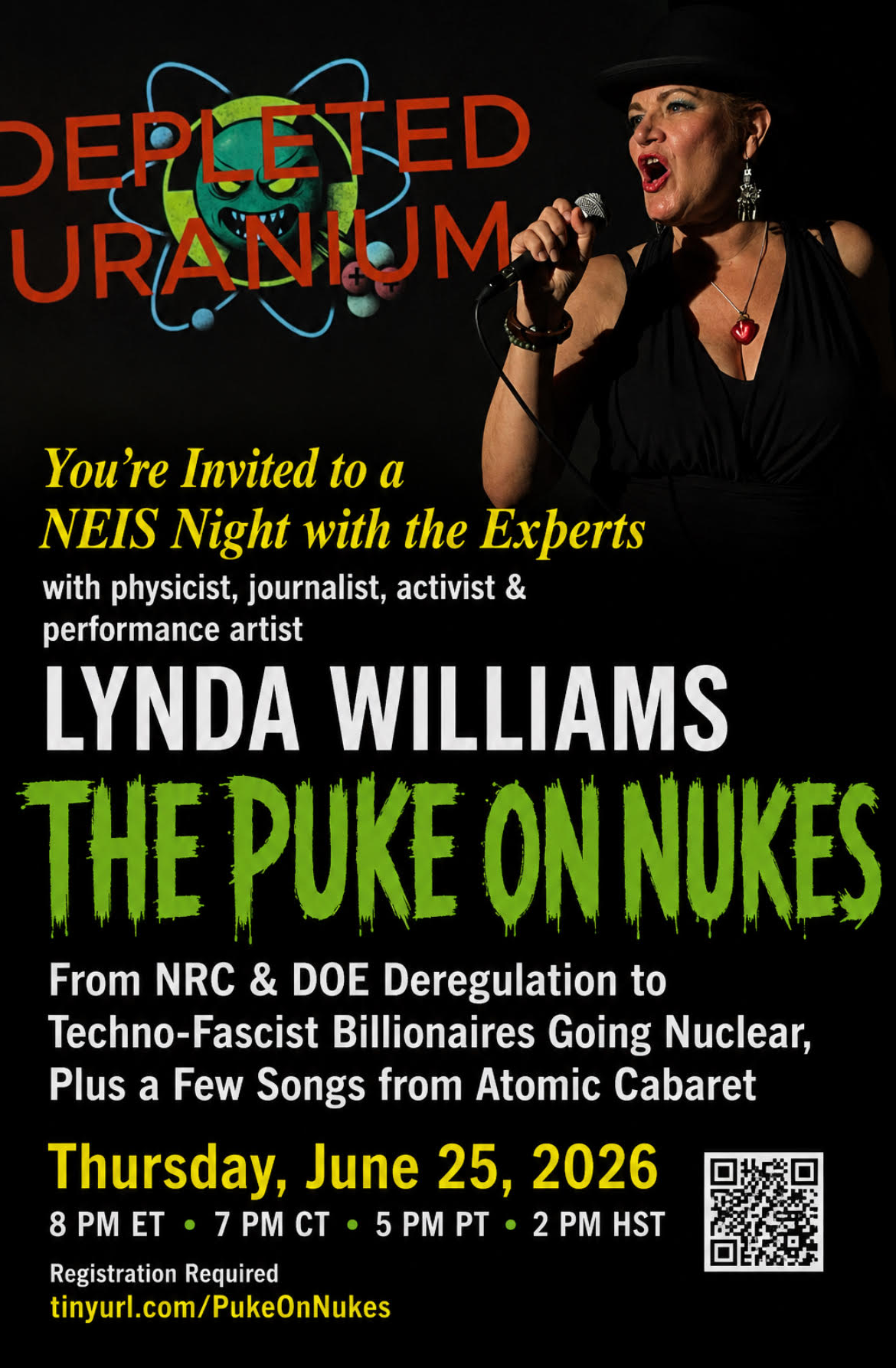
25 June- THE PUKE ON NUKES
Thursday, June 25, 2026
7pm Central Time (8pm ET, 6pm MT, 5pm PT) UTC – 5
From NRC & DOE Deregulation to Techno-Fascist Billionaires Going Nuclear, Plus a Few Songs from Atomic Cabaret REGISTER
26 June – Radiation Trainwreck at the NRC / Join the Protect Better Campaign – https://us02web.zoom.us/meeting/register/4ZlZ5_qLSHGiLSCg8FF6Bg#/registration


Cuba Is Not a Failed State – It Is a Besieged State
PETITION: “Global Appeal to Endorse Palestinian Right of Return of Refugees”
To see nuclear-related stories in greater depth and intensity – go to https://nuclearinformation.wordpress.com
-
Archives
- June 2026 (193)
- May 2026 (306)
- April 2026 (356)
- March 2026 (251)
- February 2026 (268)
- January 2026 (308)
- December 2025 (358)
- November 2025 (359)
- October 2025 (376)
- September 2025 (257)
- August 2025 (319)
- July 2025 (230)
-
Categories
- 1
- 1 NUCLEAR ISSUES
- business and costs
- climate change
- culture and arts
- ENERGY
- environment
- health
- history
- indigenous issues
- Legal
- marketing of nuclear
- media
- opposition to nuclear
- PERSONAL STORIES
- politics
- politics international
- Religion and ethics
- safety
- secrets,lies and civil liberties
- spinbuster
- technology
- Uranium
- wastes
- weapons and war
- Women
- 2 WORLD
- ACTION
- AFRICA
- Atrocities
- AUSTRALIA
- Christina's notes
- Christina's themes
- culture and arts
- Events
- Fuk 2022
- Fuk 2023
- Fukushima 2017
- Fukushima 2018
- fukushima 2019
- Fukushima 2020
- Fukushima 2021
- general
- global warming
- Humour (God we need it)
- Nuclear
- RARE EARTHS
- Reference
- resources – print
- Resources -audiovicual
- Weekly Newsletter
- World
- World Nuclear
- YouTube
-
RSS
Entries RSS
Comments RSS
 nuclear-news