USA’s nuclear waste dumpsters need high level guarding
 America’s Nuclear Dumpsters After Yucca Mountain, the Nuclear Regulatory Commission is stocking up on guns and ammo. Slate, By Geoffrey Brumfiel| , Jan. 30, 2013, While the rest of America spent January debating new gun control laws, one government agency announced its plans to expand the use of high-capacity magazines, assault weapons, and even fully automatic machine guns. The Nuclear Regulatory Commission, which oversees the nation’s nuclear plants, is seeking the firepower not for securing the plants themselves, but to defend their nuclear waste.
Since America’s commercial reactors started opening in the 1960s and ’70s, nuclear waste has been piling up. At first, it was stored in spent fuel pools—swimming pools you’d never, ever want to swim in. That was fine for a time, but by the 1980s, the pools started to get crowded. So the utilities began putting old fuel rods in something they call dry cask storage, and I’ll call nuclear dumpsters.
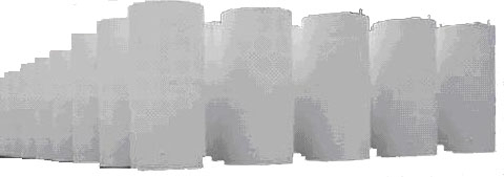
They’re big, they’re white, and they’re literally kept out back like the rest of the trash.
This system of nuclear disposal might seem a bit shortsighted. Plutonium-239 has a half-life of 24,100 years; the full life of a machine-gun-toting security guard is 80 or 90, tops. There’s got to be a better solution. And here’s the crazy part: There is. The scientists have proposed it. The environmentalists and the power companies agree on it. So why isn’t America doing it?
The Department of Energy started considering a number of sites, including one in Washington, one in Texas, and one in Nevada. They were taking their sweet time doing scientific studies, so in 1987, Congress decided to choose for them. Jim Wright, the speaker of the House, was from Texas. Tom Foley, the majority leader, was from Washington State. That left Nevada. Under an amendment to the original act, Yucca Mountain, 90 miles northwest of Las Vegas, was enshrined in law as America’s nuclear landfill…….
he [Obama] assigned a bipartisan, blue-ribbon panel to look at the nuclear waste problem. Their conclusion was that deep geologic disposal was still the best option, but this time around, the feds should try to find a state and local government that actually want to host a giant nuclear waste dump. Getting local communities to buy into a nuclear waste repository isn’t easy. Just this week, the Cumbria County Council in the United Kingdom voted down plans for a repository. But the strategy has worked in places like Sweden and Finland, and compared with the American solution of trying to force a dump on a politically weak state, it’s a lot more sensible. Frishman, who’s spent decades fighting Yucca Mountain, thinks it’s the way to go. So does the Nuclear Energy Institute, the Washington lobby for the nuclear industry. And so does the Union of Concerned Scientists, an environmental organization. You get the idea.
There’s only one problem: The 1987 law specifically names Yucca Mountain as the U.S. site for the nation’s first nuclear waste dump. Legally, there is no other option. The Department of Energy can’t even ask for a show of hands of other places that might want to take a nuke dump in exchange for jobs and benefits. Meanwhile, the NRC is being sued by two states and several utilities for letting the government withdraw its license for the Yucca site. (The plaintiffs are stuck with nuclear waste they want to ship away.) Since there is no technical reason not to consider Yucca Mountain, the lawsuit claims that the withdrawal breaks the law.
And thus we come back to those big, white nuclear dumpsters out behind the power plants. They aren’t pretty, but until the politicians can work it out, they’re the only option. Researchers think that they can last for decades. That’s less than a single percent of the time it will take for most of the nuclear waste to decay, but it’s still good news. At the rate Congress is going, we’ll need all the time we can get. http://www.slate.com/articles/health_and_science/nuclear_power/2013/01/nuclear_waste_storage_why_did_yucca_mountain_fail_and_what_next.html
No comments yet.
1 This Month

of the week – Shut Down Drone Warfare!


Tell the Ukrainian Government to Drop Prosecution of Peace Activist Yurii Sheliazhenko

Petition to revoke the licensing of the Near Surface Nuclear Disposal Facility (NSDF) at Chalk River. https://www.ourcommons.ca/petitions/en/Petition/Details?Petition=e-7247
To see nuclear-related stories in greater depth and intensity – go to https://nuclearinformation.wordpress.com
-
Archives
- April 2026 (57)
- March 2026 (251)
- February 2026 (268)
- January 2026 (308)
- December 2025 (358)
- November 2025 (359)
- October 2025 (376)
- September 2025 (257)
- August 2025 (319)
- July 2025 (230)
- June 2025 (348)
- May 2025 (261)
-
Categories
- 1
- 1 NUCLEAR ISSUES
- business and costs
- climate change
- culture and arts
- ENERGY
- environment
- health
- history
- indigenous issues
- Legal
- marketing of nuclear
- media
- opposition to nuclear
- PERSONAL STORIES
- politics
- politics international
- Religion and ethics
- safety
- secrets,lies and civil liberties
- spinbuster
- technology
- Uranium
- wastes
- weapons and war
- Women
- 2 WORLD
- ACTION
- AFRICA
- Atrocities
- AUSTRALIA
- Christina's notes
- Christina's themes
- culture and arts
- Events
- Fuk 2022
- Fuk 2023
- Fukushima 2017
- Fukushima 2018
- fukushima 2019
- Fukushima 2020
- Fukushima 2021
- general
- global warming
- Humour (God we need it)
- Nuclear
- RARE EARTHS
- Reference
- resources – print
- Resources -audiovicual
- Weekly Newsletter
- World
- World Nuclear
- YouTube
-
RSS
Entries RSS
Comments RSS
 nuclear-news
Leave a comment