Police arrest animal rescuers inside Fukushima evacuation zone — “They cannot be contacted and are being charged with crimes”
“…Some 80,000 people have been forced to flee the evacuation zone, and in many cases they have left behind pets, which are now dying of thirst or starvation. About 5800 licensed dogs are believed to be in the evacuation zone, plus thousands of unregistered animals and cats, along with beef and dairy cattle, pigs and a handful of exotic animals, such as the ostrich.
The Japanese government has been slammed for failing to allow owners back to their homes within the evacuation zone frequently enough to care for their pets. The government has also failed to implement a program to kill doomed livestock humanely….”

Published: January 29th, 2013 at 12:10 am ET
By ENENews
Source: The Hachiko Coalition Page
Date: Jan 28, 2013
h/t Anonymous tip
BREAKING NEWS: Two of the Hoshi Family Have Been Arrested as of Yesterday and detained by the Futaba Fukushima Police. Of course it is none other than animal activists Hoshi Hiroshi and Leo Hoshi. They cannot be contacted and are being charged with crimes. The Hoshi Hiroshi Family has been rescuing animals each weekend inside the zone and surroundings for almost 2 years as a private volunteer rescue group. This is atrocious and we will be showing our support. Stay tuned as we learn more. Please share with your friends in English, Japanese and other languages.
More on the Hachiko Coalition here
Activist Hiroshi Hoshi defies fallout to pluck animals from Fukushima dead zone
- BY:RICK WALLACE, TOKYO CORRESPONDENT
- From:The Australian
- June 27, 2011 12:00AM
A SELF-DESCRIBED “animal rescue guerilla” has made a daring raid to the centre of Japan’s nuclear crisis to pluck to safety two dogs seen wandering around the stricken Fukushima Daiichi nuclear plant.
In recent months, Hiroshi Hoshi has made a series of trips to the radioactive dead zone around the plant to rescue distressed and abandoned pets while dodging roadblocks and police patrols.
He has come across countless animal corpses, dogs that had become cannibals and even an ostrich strolling the streets of a village within the 20km perimeter around the plant.
But perhaps the most amazing was the discovery via a camera trained permanently on the Fukushima Daiichi plant of the pair of Japanese Shiba dogs prowling around the highly radioactive plant more than three months after the beginning of the tsunami and nuclear crisis.
In the footage, the two biscuit-coloured dogs stand out clearly against the grey backdrop of wrecked reactor buildings and tangled metal, and they were spotted by supporters of Mr Hoshi, who were monitoring the internet feed of the camera.
On June 5, he and several sympathisers donned protective suits and skirted police roadblocks in their car and drove right into the plant to where the camera is based. Before long, they had found the dogs, whisked them into their car and got them back to safety.
“For the past three months they have had such a tough time,” Mr Hoshi says. “When we got them, they weren’t even able to urinate or eat any kind of hard food. So we called up an emergency medical centre in Yokohama and they checked and treated them and then we took them to our home.”
Japan- Kamikaze Currency Killers and an MI5 attack on internet activists explained!!
Max Kaiser and Stacy Herbert
We discuss Japan where the latest source of monetary inspiration is Korekiyo Takahasi, described by Ben Bernanke as the man who “brilliantly rescued” his country from the Great Depression of the 1930′s, while neglecting to mention that Takahasi was then assassinated by the army, who were angered by cuts to their wages. They also discuss the biggest Aso in Japan, finance minister Taro Aso, suggesting old people just ‘hurry up and die’ in order to save money for government. In the second half of the show, Max Keiser talks to former MI5 agent turned whistleblower, Annie Machon, about the global crackdown on the internet and the activists who live there.
Danish U-turn clears way for uranium mining in Greenland and dodgy dealings on the stock market?
“…Despite having passed a law against social dumping in Denmark two months ago, the Danish government is backing the Greenlandic law.
Two weeks ago, Prime Minister Kleist said he had rejected requests from the European Union to block access to its deposits of rare earths, strategically important metals in which China has a near monopoly….”
“…In December, Greenland passed a bill setting the framework for foreign mining and exploration companies to start exploiting Greenland’s natural resources. It included plans to open up the country to foreign labour, including workers from China.
The legislation defines the size of large-scale projects and regulates the minimum salary of foreign workers. It has been criticised for allowing companies to employ cheap foreign workers, at the expense of local employment…..”

Image source http://www.ggg.gl/rare-earth-elements/rare-earth-elements-at-kvanefjeld/
Published 29 January 2013
EUractive
A majority in the Danish parliament signalled their readiness to allow extraction and exports of uranium from Greenland, marking a historical shift in Danish foreign policy after 30 years of opposition to nuclear power.
A majority in the Danish parliament is prepared for the first time to repeal Denmark’s so-called zero-tolerance policy on the radioactive metal, according to media reports.
The world’s fifth largest uranium deposit, Kvanefjeld, is situated in the south of Greenland and if the Danish self-ruled territory makes a formal request to exploit it, Denmark could become one of the biggest exporters of the radioactive metal.
Uranium is created as a byproduct when extracting many valuable and strategically important metals used in for example mobile phones. Uranium is also used for nuclear power and atomic bombs.
Because of the security political significance, Greenland will have to ask Denmark for permission before the zero-tolerance policy can be repealed.
“We have to approach this positively. We would be caught in a very weird Danish role if we block Greenland’s wish,” foreign policy spokesperson Rasmus Helveg Petersen from the Social Liberals, one of the parties constituting the Danish government, told the newspaper Politiken.
New report to be published
Greenland, a former Danish colony, was granted home rule in 1979. Thirty years later, Greenland assumed self-determination with responsibility for judicial affairs, police, and natural resources, but the Danish government is still in charge of foreign affairs, financial policy and security.
In spring, a report by the Greenlandic Directory for Raw Materials on uranium’s effect on the environment and public health will be published. If the report doesn’t point to major issues, there is likely to be a majority in Greenland’s parliament for extracting uranium.
“We support uranium mines as long as these are handled in a proper way and in collaboration with Denmark,” said Greenland’s Deputy Prime Minister Jens Frederiksen, a member of the Democratic Party.
“If everybody else can sell uranium, then we might as well. There’s a lot of money in it,” he said.

[More on a failing uranium industrycan be found here https://nuclear-news.net/2013/01/29/petition-to-save-nuclear-news-net-and-antinuclearnews-net/ ]
Meanwhile, Greenland’s Prime Minister Kuupik Kleist said his party Inuit Ataqatigiit (IA) wants a public debate in Greenland on uranium first.
“Until there is a good reason for repealing the zero-tolerance policy, we will keep our zero-tolerance policy,” Kleist said.
U-turn on uranium
Uranium is a toxic and radioactive metal and uranium exposure can affect a person’s kidney, brain, liver and heart. Many studies have also found workers working with uranium in mines to have a higher risk of developing lung cancer.
The main use of uranium in the civilian sector is to fuel nuclear power plants and its large-scale exploitation could potentially change Denmark’s position on the international stage.
“This is a huge turning point in the kingdom’s foreign policy,” said uranium expert Cindy Vestergaard from the Danish Institute for International Studies.
Fukushima I Nuke Plant: Pipes That Should Not Be There Are Blocking the Way in Reactor 2 Torus Room
“…I have to ask again if someone did go to the main building to retrieve the documents. However, the most recent work [drilling a hole through the floor of Reactor 2] revealed unexpected pipes right there in the middle of where they were not supposed to be. So I wonder….”
http://ex-skf.blogspot.co.uk/2013/01/fukushima-i-nuke-plant-pipes-that.html
EXSKF
TUESDAY, JANUARY 29, 2013

From the handout, this was what TEPCO had planned:

How did this happen? TEPCO chose the location because there wasn’t supposed to be anything, according to the original drawings. However, as repairs and renovations were done over the years, the original drawings from the time the reactor was built became obsolete.
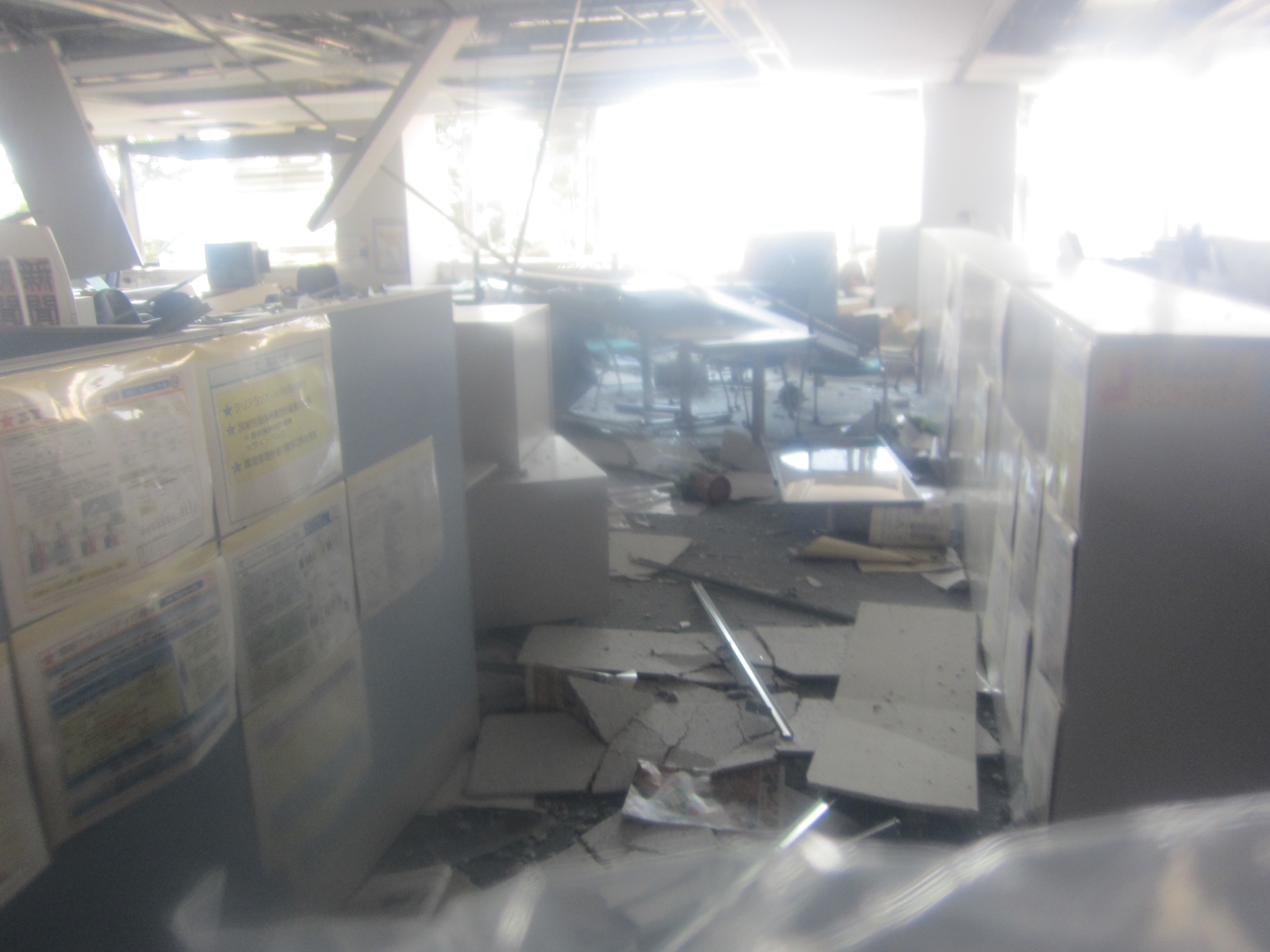
Don’t they have the drawings of those repairs and renovations? Yes they do.But those drawings were stored in one of the buildings that was devastated by the March 11, 2011 earthquake and declared too dangerous to enter. There is no information as to whether anyone has gone back in to retrieve any document or data from the main building. Probably not, because, as we know well by now, TEPCO carefully abides by the rules and regulations from the authorities:
(Photo of the 2nd floor of the main building, Fukushima I Nuke Plant)
Independent journalist Ryuichi Kino tweeted:
福島第一の現況の把握が難しいことは、以前からわかっていた。原子炉の基本的な構造は設計当初のままだが、配管や細かい設備などは後から追加、修正をうけて、元の状況とは大きく変わっている。だからこれまでも、構造物に手を着ける作業は慎重に進められた。
It has been known that it is difficult to completely grasp the condition of Fukushima I Nuke Plant. The basic structures of reactors have been the same since the plans were drawn up, but pipes and other small facilities were added and modified later, making the current condition vastly different from the original condition. Therefore, any work that has to do with the structures have been carried out very carefully.
1 This Month

of the week – Shut Down Drone Warfare!


Tell the Ukrainian Government to Drop Prosecution of Peace Activist Yurii Sheliazhenko

Petition to revoke the licensing of the Near Surface Nuclear Disposal Facility (NSDF) at Chalk River. https://www.ourcommons.ca/petitions/en/Petition/Details?Petition=e-7247
To see nuclear-related stories in greater depth and intensity – go to https://nuclearinformation.wordpress.com
-
Archives
- April 2026 (68)
- March 2026 (251)
- February 2026 (268)
- January 2026 (308)
- December 2025 (358)
- November 2025 (359)
- October 2025 (376)
- September 2025 (257)
- August 2025 (319)
- July 2025 (230)
- June 2025 (348)
- May 2025 (261)
-
Categories
- 1
- 1 NUCLEAR ISSUES
- business and costs
- climate change
- culture and arts
- ENERGY
- environment
- health
- history
- indigenous issues
- Legal
- marketing of nuclear
- media
- opposition to nuclear
- PERSONAL STORIES
- politics
- politics international
- Religion and ethics
- safety
- secrets,lies and civil liberties
- spinbuster
- technology
- Uranium
- wastes
- weapons and war
- Women
- 2 WORLD
- ACTION
- AFRICA
- Atrocities
- AUSTRALIA
- Christina's notes
- Christina's themes
- culture and arts
- Events
- Fuk 2022
- Fuk 2023
- Fukushima 2017
- Fukushima 2018
- fukushima 2019
- Fukushima 2020
- Fukushima 2021
- general
- global warming
- Humour (God we need it)
- Nuclear
- RARE EARTHS
- Reference
- resources – print
- Resources -audiovicual
- Weekly Newsletter
- World
- World Nuclear
- YouTube
-
RSS
Entries RSS
Comments RSS
 nuclear-news