Dangers of nuclear spent fuel cooling ponds, and of dry cask storage
 Seventy Years of Nuclear Fission, Thousands of Centuries of Nuclear Waste ,25 January 2013 By Gregg Levine, Truthout “…….Everyone Out of the Pool
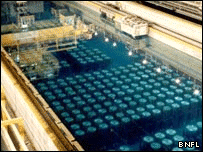
As disasters as far afield as the 2011 Tohoku earthquake and last October’s Hurricane Sandy have demonstrated, the storage of spent nuclear fuel in pools requires steady supplies of power and cool water. Any problem that prevents the active circulation of liquid through the spent fuel pools – be it a loss of electricity, the failure of a back-up pump, the clogging of a valve or a leak in the system – means the temperature in the pools will start to rise. If the cooling circuit is out long enough, the water in the pools will start to boil. If the water level dips (due to boiling or a leak) enough to expose hot fuel rods to the air, the metal cladding on the rods will start to burn, in turn heating the fuel even more, resulting in plumes of smoke carrying radioactive isotopes into the atmosphere.
And because these spent fuel pools are so full – containing as much as five times more fuel than they were originally designed to hold, and at densities that come close to those in reactor cores – they both heat stagnant water more quickly and reach volatile temperatures faster when exposed to air.
After spent uranium has been in a pool for at least five years (considerably longer than most fuel is productive as an energy source inside the reactor), fuel rods are deemed cool enough to be moved to dry casks. Dry casks are sealed steel cylinders filled with spent fuel and inert gas, which are themselves encased in another layer of steel and concrete. These massive fuel “coffins” are then placed outside and spaced on concrete pads so that air can circulate and continue to disperse heat.
While the long-term safety of dry casks is still in question, the fact that they require no active cooling system gives them an advantage, in the eyes of many experts, over pool storage. As if to highlight that difference, spent fuel pools at Fukushima Daiichi have posed some of the greatest challenges since the March 2011 earthquake and tsunami, whereas, to date, no quake or flood-related problems have been reported with any of Japan’s dry casks. The disparity was so obvious that the NRC’s own staff review actually added a proposal to the post-Fukushima taskforce report, recommending that US plants take more fuel out of spent fuel pools and move it to dry casks. (A year and a half later, however, there is still no regulation – or even a draft – requiring such a move.)
But current dry cask storage poses its own set of problems. Moving fuel rods from pools to casks is slow and costly – about $1.5 million per cask, or roughly $7 billion to move all of the nation’s spent fuel (a process, it is estimated, that would take no less than five to ten years). That is expensive enough to have many nuclear plant operators lobbying overtime to avoid doing it.
Further, though not as seemingly vulnerable as fuel pools, dry casks are not impervious to natural disaster. In 2011, a moderate earthquake centered about 20 miles from the North Anna, Virginia, nuclear plant caused most of its vertical dry casks – each weighing 115 tons – to shift, some by more than four inches. The facility’s horizontal casks didn’t move, but some showed what was termed “cosmetic damage.”
Dry casks at Michigan’s Palisades plant sit on a pad atop a sand dune just 100 yards from Lake Michigan. An earthquake there could plunge the casks into the water. And the casks at Palisades are so poorly designed and maintained, submersion could result in water contacting the fuel, contaminating the lake and possibly triggering a nuclear chain reaction.
And though each cask contains far less fissile material than one spent fuel pool, casks are still considered possible targets for terrorism. A TOW anti-tank missile would breach even the best dry cask [PDF], and with 25 percent of the nation’s spent fuel now stored in hundreds of casks across the country, all above ground, it provides a rich target environment….
No comments yet.
1 This Month

of the week – Shut Down Drone Warfare!


Tell the Ukrainian Government to Drop Prosecution of Peace Activist Yurii Sheliazhenko

Petition to revoke the licensing of the Near Surface Nuclear Disposal Facility (NSDF) at Chalk River. https://www.ourcommons.ca/petitions/en/Petition/Details?Petition=e-7247
To see nuclear-related stories in greater depth and intensity – go to https://nuclearinformation.wordpress.com
-
Archives
- April 2026 (19)
- March 2026 (251)
- February 2026 (268)
- January 2026 (308)
- December 2025 (358)
- November 2025 (359)
- October 2025 (376)
- September 2025 (257)
- August 2025 (319)
- July 2025 (230)
- June 2025 (348)
- May 2025 (261)
-
Categories
- 1
- 1 NUCLEAR ISSUES
- business and costs
- climate change
- culture and arts
- ENERGY
- environment
- health
- history
- indigenous issues
- Legal
- marketing of nuclear
- media
- opposition to nuclear
- PERSONAL STORIES
- politics
- politics international
- Religion and ethics
- safety
- secrets,lies and civil liberties
- spinbuster
- technology
- Uranium
- wastes
- weapons and war
- Women
- 2 WORLD
- ACTION
- AFRICA
- Atrocities
- AUSTRALIA
- Christina's notes
- Christina's themes
- culture and arts
- Events
- Fuk 2022
- Fuk 2023
- Fukushima 2017
- Fukushima 2018
- fukushima 2019
- Fukushima 2020
- Fukushima 2021
- general
- global warming
- Humour (God we need it)
- Nuclear
- RARE EARTHS
- Reference
- resources – print
- Resources -audiovicual
- Weekly Newsletter
- World
- World Nuclear
- YouTube
-
RSS
Entries RSS
Comments RSS
 nuclear-news
Leave a comment