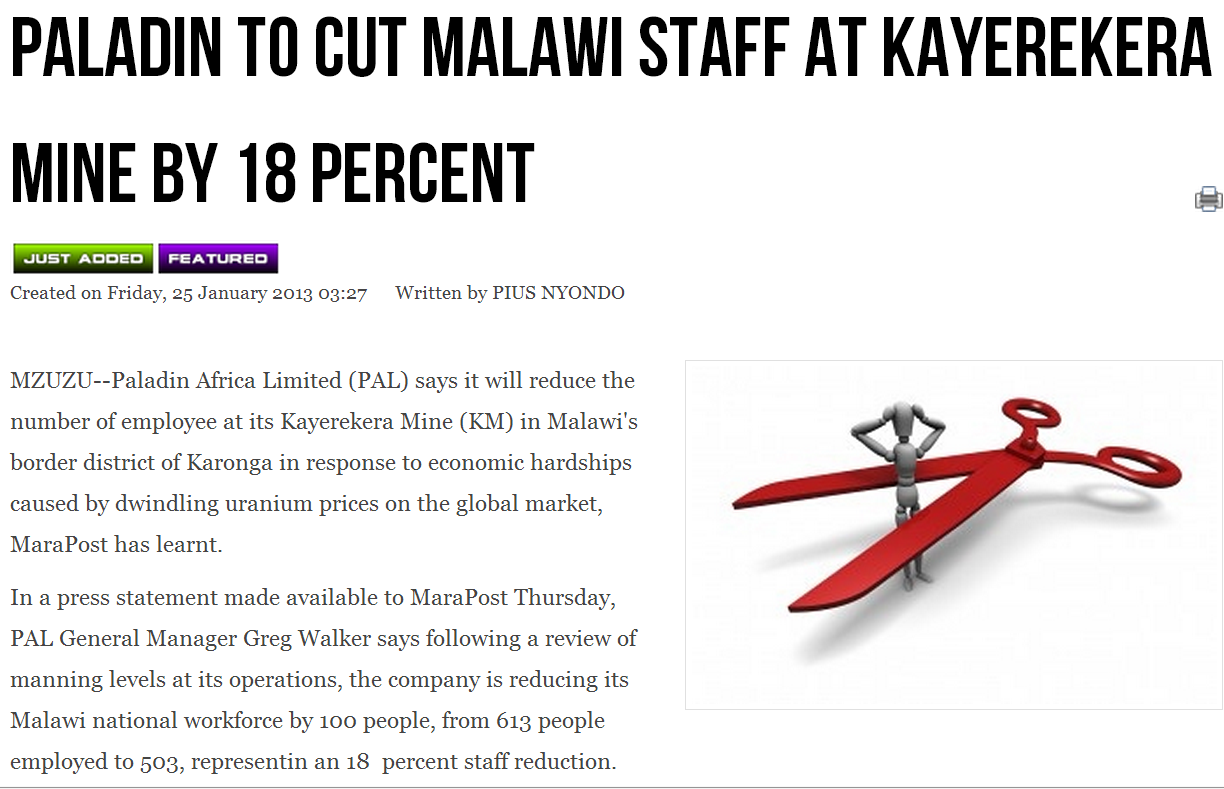
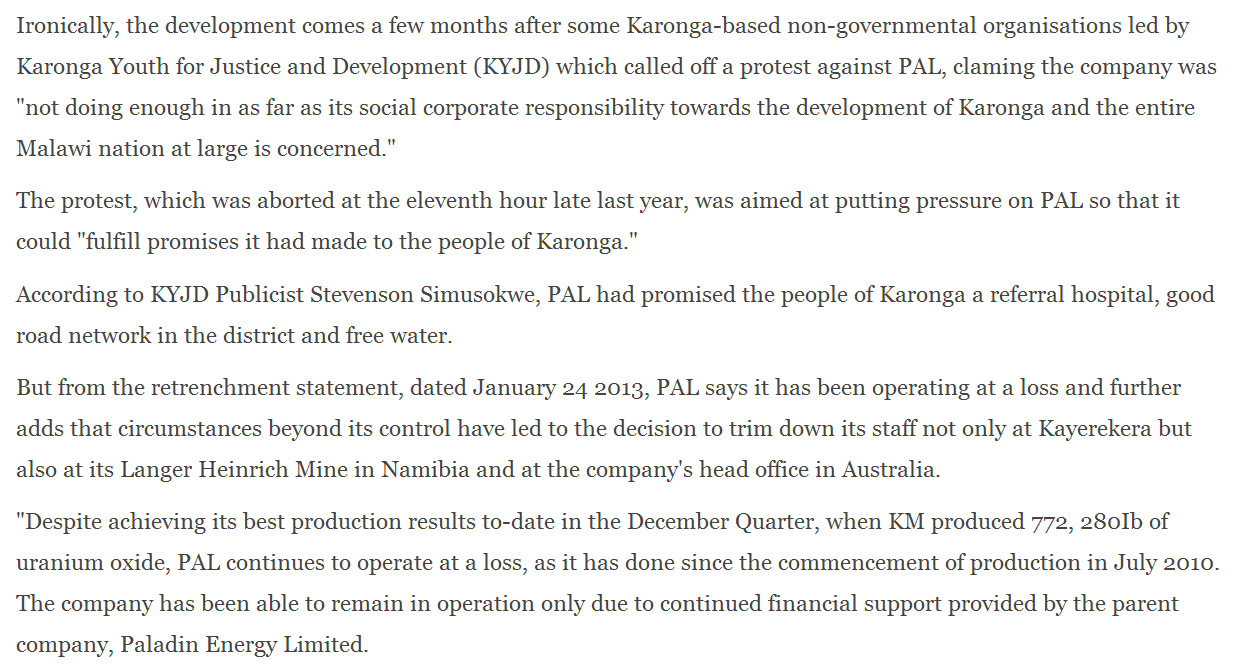
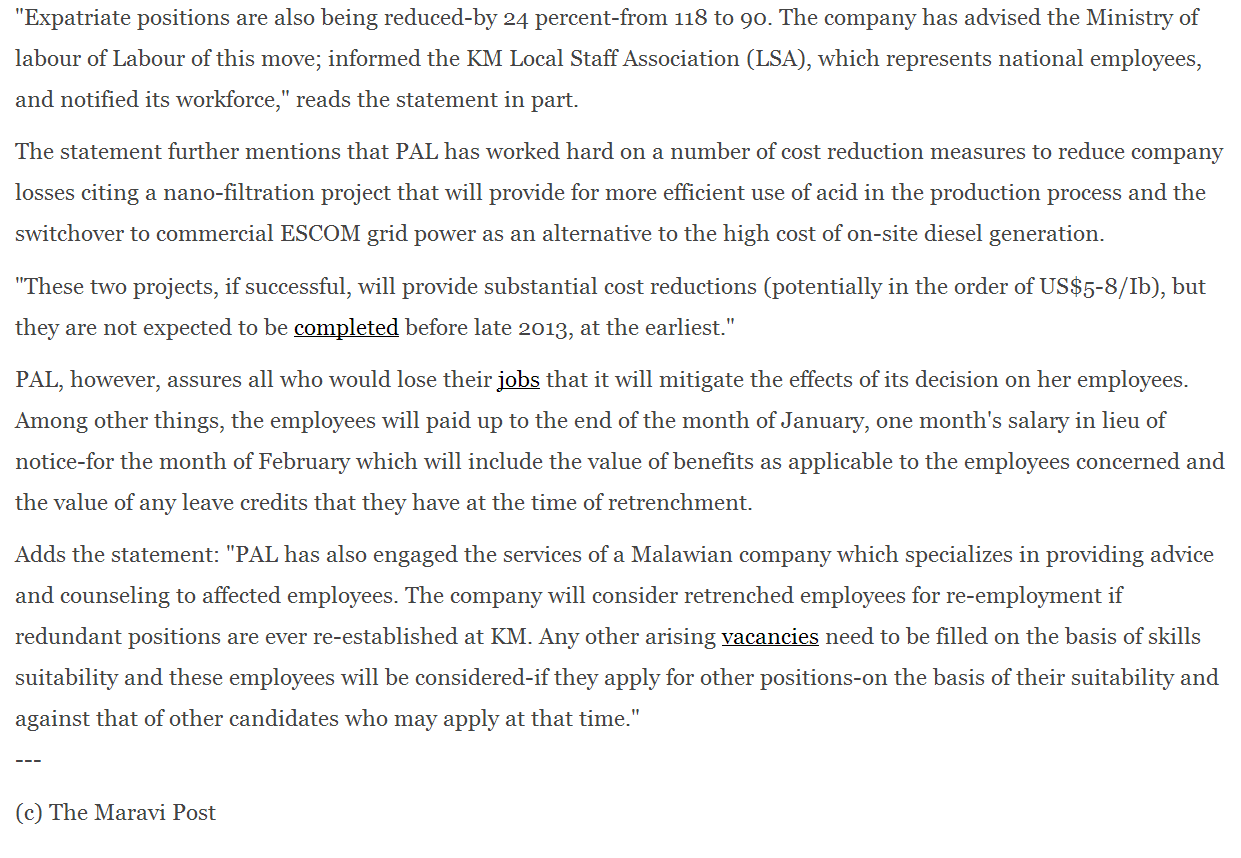
Paladin to cut Malawi Staff at Kayerekera mine.. Running out of money to fulfill promises.
“…not doing enough in as far as social corporate responsibility towards the development of Karonga and the entire Malawi nation at large is concerned…”
Paladin Africa Ltd required to “..fulfill promises it had made to the people of Karonga…”
“..The company has been able to remain in operation only due to the support by the parent company Paladin Energy Ltd..”
Nuclear re-licensing to go ahead, even though no new Waste Confidence Rule yet?
The court disapproved of the NRC’s continued relicensing of nuclear facilities based on the assumption of a long-term geologic repository that in reality did not exist – and the NRC said it was suspending licensing pending a new rule – but now regulators say they don’t anticipate the denial or even the delay of any reactor license application while they await the new waste confidence decision [PDF, pp. 49-50].
In fact, the NRC has continued the review process on pending applications, even though there is now no working Nuclear Waste Confidence Decision (NWCD) – something deemed essential by the courts – against which to evaluate new licenses.
The NRC is looking for a way to permit the continued operation of the US nuclear fleet – and so, the continued manufacture of nuclear waste – without an answer to the bigger, pressing question

 Seventy Years of Nuclear Fission, Thousands of Centuries of Nuclear Waste ,25 January 2013 By Gregg Levine, Truthout Lack of Permanent Spent Fuel Storage Looms Large
“……….When a US Court of Appeals ruled in June that the Nuclear Regulatory Commission (NRC) acted improperly when it failed to consider all the risks of storing spent radioactive fuel onsite at the nation’s nuclear power facilities, it made specific reference to the lack of any real answers to the generations-old question of waste storage:
[The Nuclear Regulatory Commission] apparently has no long-term plan other than hoping for a geologic repository…. If the government continues to fail in its quest to establish one, then SNF (spent nuclear fuel) will seemingly be stored on site at nuclear plants on a permanent basis. The Commission can and must assess the potential environmental effects of such a failure.
The court concluded the current situation – in which spent fuel is stored across the country in what were supposed to be temporary configurations-”poses a dangerous long-term health and environmental risk.”
The decision also harshly criticized regulators for evaluating plant relicensing with the assumption that spent nuclear fuel would be moved to a central long-term waste repository.
A Mountain of Risks Continue reading
Hydraulic Fracking is a source of radiation pollution, too
“We’ve known for a long time that there is radiation coming back in the wastewater”
Among the radioactive material often found in drilling wastes is radium 226, which can cause cancer, anemia and cataracts, according to the federal Agency for Toxic Substances and Disease Registry
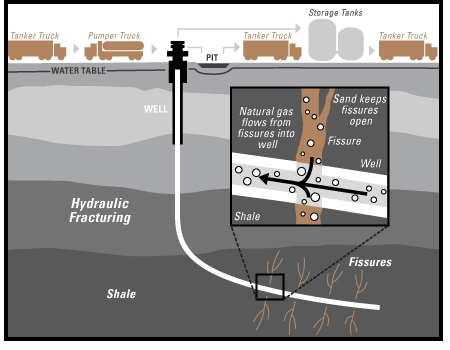
DEP backtracks on radiation issue Times online,January 25, 2013 By Rachel Morgan HARRISBURG — For months, the state Department of Environmental Protection denied that radiation in wastewater from natural gas drilling was an issue. On Thursday night, the state announced plans to study the effects of radiation in natural gas drilling wastewater.
After continued questioning by Shale Reporter regarding radioactivity in wastewater, Gov. Tom Corbett’s announcement of a 12-month DEP study of radioactive wastewater was a surprise. The DEP had consistently denied radiation was even an issue……. In the governor’s unexpected announcement Thursday evening, DEP officials said they will begin sampling and analyzing fracking flowback for radioactivity, testing everything from fracking wastewater, drill cuttings, treatment solids and sediments at well pads and wastewater treatment and disposal facilities.
They also plan to analyze radioactivity in pipes, well casings, storage tanks, treatment systems and trucks. http://www.timesonline.com/news/local_news/dep-backtracks-on-radiation-issue/article_9e5853a5-325b-5f9a-83ed-24aea5811db0.html
An Increase in Radiation Monitoring for Fracking, NYT, Jan 25 13 By JON HURDLE Pennsylvania will step up its monitoring of naturally occurring radiation levels in water, rock cuttings and drilling wastes associated with oil and gas development in a yearlong study that will be peer-reviewed, the state’s environmental agency reports.
The study will also assess radiation levels in the pipes, well casings, storage tanks, treatment systems and trucks used by the natural gas industry, which has drilled thousands of wells in the gas-rich Marcellus Shale over the last five years….
Hydraulic fracturing, which involves injecting chemicals and water under enormous pressure into underground shale formations to extract gas or oil, got under way in Pennsylvania in 2008.
In New York, state officials are currently weighing whether to allow the drilling process to begin. The state’s health commissioner is conducting a review of whether the state’s Department of Environmental Conservation has adequately addressed potential impacts on public health. Continue reading
Nuclear plant operators, not taxpayers, should pay for safety upgrades, says EU Parliament
 “Nuclear operators should bear €25 billion cost of making Europe’s reactors safer“http://www.europarl.europa.eu/news/en/headlines/content/20130121STO05427/html/Nuclear-operators-should-bear-%E2%82%AC25-billion-cost-of-making-EU-reactors-safer 25-01-2013 Nuclear operators,
  not taxpayers, should cover the costs of necessary safety upgrades as well as pay for everything they are liable for in the event of a nuclear accident, according to a resolution approved by the EP’s energy committee on 24 January. Improving Europe’s nuclear power plants so that they can withstand a natural disaster is estimated to cost up to €25 billion.
Threat to the public
Nuclear energy accidents, whether caused by human error or an earthquake, pose a severe risk to public health. The consequences from the explosion in the Chernobyl plant in 1986, the world’s worst nuclear disaster, are still being felt today as discussed in the EuroparlTV video above.
The aftermath of Fukushima
After the Fukushima accident in Japan in March 2011, 145 reactors in 15 EU member states were tested to assess whether nuclear power plants here could withstand a natural disasters. The checks showed that nearly all nuclear power plants need safety improvements. Continue reading
Safety concerns may shut world’s largest nuclear plant, Kashiwarazaki-Kariwa
The Kashiwarazaki-Kariwa plant may be susceptible the same type of
cataclysmic event which led to Fukushima Daiichi nuclear disaster, as
the plant itself is situated in an active fault zone.
Japan may shutter world’s largest nuclear plant over earthquake
threat, RT.com 26 January, 2013, The world’s largest nuclear power
plant may be forced to shut down under stricter rules proposed by
Japan’s new nuclear watchdog. The measures are intended to safeguard
against future natural disasters following the 2011 tsunami.

The Kashiwazaki-Kariwa nuclear power plant in the heart of Japan is
now facing permanent closure following a move by the country’s Nuclear
Regulation Authority (NRA) to expand the definition of an active fault
– a crack in the earth’s crust. The operators of the plant, Tokyo
Electric Power are the same company which powered the stricken
Fukishima plant. Continue reading
Contamination of seafoods, following nuclear and oil spill disasters
Frankenfish Surface in Japan and the Gulf of Mexico Years following some of the world’s worst environmental disasters, marine life remains contaminated, Energy Digital 25 Jan 13, Two years after the catastrophic Fukushima nuclear plant meltdown in Japan, fish with 2,500 times the legal limit for radiation in seafood are turning up near the plant.
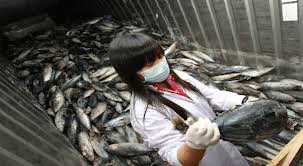 Since the incident, fishing around Fukushima has been banned, along with beef, milk, mushrooms and vegetables produced in surrounding areas. The sale of certain kinds of seafood and produce have resumed, while scientists continue to monitor the spread and impact of radiation from the disaster.
Marine chemist Ken Buesseler, leading the research from the US-based Woods Hole Institution, has warned that Fukushima fish “may be inedible for a decade,” according to the Guardian. They found “elevated levels” of radiation in the marine environment, and cited that 40 percent of the fish caught near the nuclear plant were contaminated with radioactive caesium above government safety limits.
Related Story: Radioactive Japanese Tuna Found off California Coast
Meanwhile, in the US, the debate continues over the safety of seafood from the Gulf of Mexico nearly three years after BP’s offshore rig exploded, dumping some 4.9 million barrels of oil into the ocean. Not to mention the two million gallons of dispersants used to clean up the spill that were up to 52-times more toxic than the oil itself. Read More in Energy Digital’s December/January Issue http://www.energydigital.com/oil_gas/frankenfish-surface-in-japan-and-the-gulf-of-mexico
Japan’s only two operating nuclear reactors to be shut for maintenance in 2013
 Japan faces nuclear shutdown for 2nd time since Fukushima — Expert: They’re trying to protect their nation from diseases, death http://enenews.com/reuters-japan-faces-nuclear-shutdown-for-2nd-time-since-fukushima-expert-trying-to-protect-their-nation-from-diseases-and-death-audio

January 24th, 2013
Title: Japan faces nuclear shutdown for second time since Fukushima
Source: Reuters
Author: Aaron Sheldrick
Date: Jan 24, 2013
Japan may face a total nuclear shutdown in the summer for the second time since the March 2011 Fukushima disaster as the country’s two operating reactors close for maintenance and tough new safety checks keep the rest of the fleet offline. […]
The only two of Japan’s 50 nuclear plants operating are both at Kansai Electric Power’s Ohi plant in western Japan, and must be for shut for maintenance [in mid-September 2013] 13 months after resuming commercial operations, according to Japanese law. […]
Title: Japan Contemplates Complete Nuclear Shutdown
Source: Voice of Russia American Edition
Date: Jan 24, 2013
Full broadcast here
Uranium mining: In situ leaching not the same as fracking
A spokesperson for Uranium Energy disputes the similarities to fracking that is made in the article.
“By contrast, ‘in-situ recovery’ is the process of injected-solution mining that reverses the natural process of deposited uranium in sandstones. On-site groundwater fortified with oxygen is introduced into the ground through a pattern of injection wells. The solution dissolves uranium from the sandstone host rock, and the uranium-bearing solution is brought back to surface through vacuum-suction production wells, where the uranium is concentrated on resin beads for trucking to a nearby processing plant where it is concentrated further and dried into yellowcake.”

Opponents of in situ uranium extraction start throwing around the F word MINING.com Editor | January 25, 2013 A US company is extracting underground uranium reserves in Texas using in situ methods, but opponents are comparing it to another process that is drawing high-profile protests.
Forbes reports that Texas-based Uranium Energy Corp (UEC) uses the in situ method for extracting underground uranium by pumping oxygenated water into porous rock layers via deep-drilled wells.
Forbes notes the process is raising concerns among some in Texas who compare the process to hydraulic fracturing, which has some celebrity opponents.”By design it’s much worse than fracking,” says Houston attorney Jim Blackburn, who is interviewed by Forbes.
“This is intentional contamination of a water aquifer liberating not only uranium but other elements that were bound up with the sand. We know this process will contaminate groundwater; that’s the whole point of it.” Continue reading
New Nuclear Waste Confidence Decision” (NWCD) designed to let nuclear power continue?
the fact that their best scenario now projects a repository to be ready by about 2050 is a story in itself.
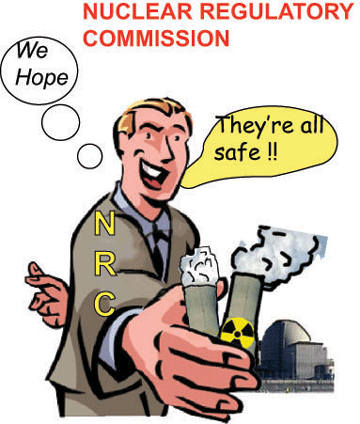 Seventy Years of Nuclear Fission, Thousands of Centuries of Nuclear Waste ,25 January 2013 By Gregg Levine, Truthout “…….Confidence Game
Two months after the Appeals Court found fault with the NRC’s imaginary waste mitigation scenario, the agency announced it would suspend the issuing of new reactor operating licenses, license renewals and construction licenses until the agency could craft a new plan for dealing with the nation’s growing spent nuclear fuel crisis. In drafting its new nuclear “Waste Confidence Decision” (NWCD) – the methodology used to assess the hazards of nuclear waste storage – the Commission said it would evaluate all possible options for resolving the issue.
At first, the NRC said this could include both generic and site-specific actions (remember, the court criticized the NRC’s generic appraisals of pool safety), but as the prescribed process now progresses, it appears any new rule will be designed to give the agency, and so, the industry, as much wiggle room as possible. Continue reading
Explosion at Iran’s Fordo uranium enrichment site. Is this report true?
 So far, I have not been able to find corroborating information on this. Please check out the comments below this item – some good points to alert us to the possibility that this is a hoax. And note the video below the blogs – reminder of the effect of the radio program “War of the Worlds” – which panicked people many decades ago. – C.M.
Report: Explosion Destroys Key Iran Nuclear Site http://www.tabletmag.com/scroll/122646/report-explosion-destroys-key-iran-nuclear-site A source is reporting much of the underground Fordo site has been hit By Adam Chandler|January 25, 2013 A few major sites that linked to WND story have removed it. I take that as a pretty good indication that this story cannot be confirmed.
According to World News Daily, a massive explosion is said to have destroyed most of Iran’s nuclear facility at Fordo.
An explosion deep within Iran’s Fordow nuclear facility has destroyed much of the installation and trapped about 240 personnel deep underground, according to a former intelligence officer of the Islamic regime.
The previously secret nuclear site has become a center for Iran’s nuclear activity because of the 2,700 centrifuges enriching uranium to the 20-percent level. A further enrichment to weapons grade would take only weeks, experts say.
The explosion is said to have taken place on Monday. The nuclear site is a high profile target given that it’s completely underground and recently reached nuclear capacity. Just earlier today, it was reported that the Iran could quadruple enrichment at the Fordo site.
While I am extremely skeptical of this report’s veracity until I hear more, this is potentially a massive development. More to come.
Indecision is a bore. Will San Onofre nuclear plant ever run again?
 Decision on sickly San Onofre nuclear power plant delayed http://www.scpr.org/blogs/news/2013/01/25/12206/decision-on-sickly-san-onofre-nuclear-power-plant/
AP | January 25th, 2013 It’s going to take a little longer to learn if California’s troubled San Onofre nuclear power plant will start again.
Federal regulators Friday pushed back their timetable to make a decision on Southern California Edison’s proposal to restart the Unit 2 reactor and run it at reduced power.
Nuclear Regulatory Commission officials said earlier that a ruling could come in March.
But the NRC has delayed that decision until at least late April or May.
The plant between San Diego and Los Angeles hasn’t produced electricity since a tiny radiation leak in January last year led to the discovery of excessive wear on hundreds of steam generator tubes that carry radioactive water.
Edison predicts running at low power will stop tube damage.
Environmentalists say the plant cannot run safely.
Running nuclear power plant – 45 times more costly than coal, and gas is even cheaper
while fuel costs [for nuclear power] are low, maintenance costs for enhanced
safeguards are rising.
UBS UBSN.VX -0.98% analyst Julien Dumoulin-Smith estimates fixed costs
per kilowatt of capacity at a nuclear plant are perhaps five times
those for a comparably sized coal plant.
Smaller nuclear plants, with less output over which to spread fixed
costs, suffer most.
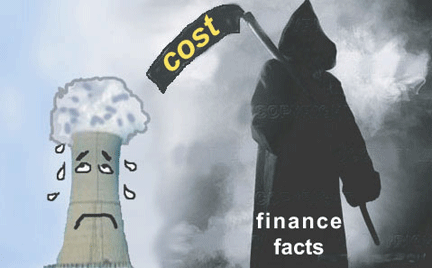
Gas Suffocates Nuclear Power
http://online.wsj.com/article/SB10001424127887323854904578263952157252768.html
Natural gas is poison for coal. But its toxicity also extends to
nuclear power. 25 Jan 13, Low gas prices have made it cheaper to run
gas-fired power plants more often and, because these plants often set
the wholesale electricity price, reduced power prices overall. Add on
tightening emissions standards, and coal plants have suffered, with
many expected to close.
But nuclear power stations haven’t escaped. Cheap electricity due to
weak gas prices hurts their profits, too. Continue reading
Dangers of nuclear spent fuel cooling ponds, and of dry cask storage
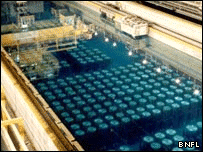 Seventy Years of Nuclear Fission, Thousands of Centuries of Nuclear Waste ,25 January 2013 By Gregg Levine, Truthout “…….Everyone Out of the Pool
As disasters as far afield as the 2011 Tohoku earthquake and last October’s Hurricane Sandy have demonstrated, the storage of spent nuclear fuel in pools requires steady supplies of power and cool water. Any problem that prevents the active circulation of liquid through the spent fuel pools – be it a loss of electricity, the failure of a back-up pump, the clogging of a valve or a leak in the system – means the temperature in the pools will start to rise. If the cooling circuit is out long enough, the water in the pools will start to boil. If the water level dips (due to boiling or a leak) enough to expose hot fuel rods to the air, the metal cladding on the rods will start to burn, in turn heating the fuel even more, resulting in plumes of smoke carrying radioactive isotopes into the atmosphere.
And because these spent fuel pools are so full – containing as much as five times more fuel than they were originally designed to hold, and at densities that come close to those in reactor cores – they both heat stagnant water more quickly and reach volatile temperatures faster when exposed to air. Continue reading
10 big reasons to reject nuclear energy
 Reject Nuclear Power Here’s Why, Dissident Voice, by Jim McCluskey / January 25th, 2013 Citizens do not want nuclear power.1 They know it is both far too dangerous and far too expensive. Politicians want nuclear power because they know it puts Power in their hands. This is exactly paralleled by politicians embracing nuclear weapons. They think it gives them power and this is what they want above all else. Citizens do not want nuclear weapons because they know they are insanely dangerous and what they want is to live without the threat of sudden and complete annihilation hanging over them and their children at all times. As we will see there is a close relationship between the weapons and the power in every sense of the word.
Politicians have different agendas to the people on these issues. The remedy is for us to wise up, get organised and then instruct them to do what we want — or join the job market.
The main objections to nuclear power are outlined below under the following headings:
- Nuclear power stations are prohibitively dangerous
- Nuclear power stations are prohibitively expensive
- Nuclear power stations use the same technology as that required to manufacture nuclear weapons
- The resulting nuclear waste will be dangerous for thousands of years
- Plant and waste deposit storage are vulnerable to terrorist attack
- Nuclear power stations epitomise the centralisation of power
- Poor countries are made dependent on rich ones
- These plants draw funds away from the development of sustainable energy
- The uranium fuel will become increasingly scarce
- The support of nuclear power by government results from special pleading lobbying by the industry
These aspects are briefly expanded upon below.
Nuclear power stations are prohibitively dangerous…..
The support of nuclear power by government results from special pleading lobbying by the industry
The adoption of nuclear power is favoured by the government but in a referendum would be rejected by citizens as being too dangerous and too expensive. A major reason that government favours this form seems to be due to vast amounts of money and effort being put into lobbying by the power companies. Their profits are huge so they have the funds for lobbying whereas the NGOs and citizens at large who are against nuclear power and have overwhelming arguments do not make the same impact because they lack the funds for effective lobbying.
This is one tendency which we are trying to help counter by this article! http://dissidentvoice.org/2013/01/reject-nuclear-power/
Over 5 months, radiation in Fukushima soil nearly doubled
TV: Radiation levels nearly doubled in Fukushima soil sample over 5-month period (VIDEO) http://enenews.com/watch-radiation-levels-doubled-fukushima-soil-sample-5-month-period-video
Title: ReUpload. Full Version Upload was Rejected !!! 音声入りが上がりません
Source: guardianofmiyagi
Date: Jan 24, 2013
Riverside soil samples from same location in Aizu, Fukushima (~100 kilometers west of Fukushima Daiichi)
December 2011: 8,790 becquerels per kilogram of cesium 134 & 137
April 2012: 17,000 becquerels per kilogram of cesium 134 & 137
Watch the video here
1 This Month

of the week – Shut Down Drone Warfare!


Tell the Ukrainian Government to Drop Prosecution of Peace Activist Yurii Sheliazhenko

Petition to revoke the licensing of the Near Surface Nuclear Disposal Facility (NSDF) at Chalk River. https://www.ourcommons.ca/petitions/en/Petition/Details?Petition=e-7247
To see nuclear-related stories in greater depth and intensity – go to https://nuclearinformation.wordpress.com
-
Archives
- March 2026 (237)
- February 2026 (268)
- January 2026 (308)
- December 2025 (358)
- November 2025 (359)
- October 2025 (376)
- September 2025 (257)
- August 2025 (319)
- July 2025 (230)
- June 2025 (348)
- May 2025 (261)
- April 2025 (305)
-
Categories
- 1
- 1 NUCLEAR ISSUES
- business and costs
- climate change
- culture and arts
- ENERGY
- environment
- health
- history
- indigenous issues
- Legal
- marketing of nuclear
- media
- opposition to nuclear
- PERSONAL STORIES
- politics
- politics international
- Religion and ethics
- safety
- secrets,lies and civil liberties
- spinbuster
- technology
- Uranium
- wastes
- weapons and war
- Women
- 2 WORLD
- ACTION
- AFRICA
- Atrocities
- AUSTRALIA
- Christina's notes
- Christina's themes
- culture and arts
- Events
- Fuk 2022
- Fuk 2023
- Fukushima 2017
- Fukushima 2018
- fukushima 2019
- Fukushima 2020
- Fukushima 2021
- general
- global warming
- Humour (God we need it)
- Nuclear
- RARE EARTHS
- Reference
- resources – print
- Resources -audiovicual
- Weekly Newsletter
- World
- World Nuclear
- YouTube
-
RSS
Entries RSS
Comments RSS
 nuclear-news